




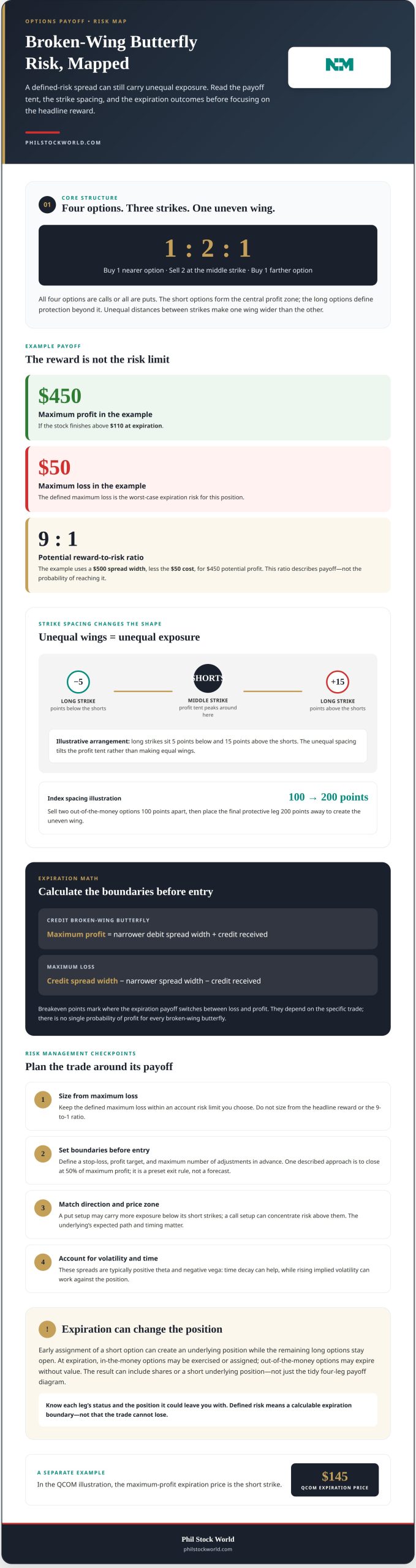
A broken-wing butterfly keeps the familiar 1:2:1 position ratio, but its strike widths are unequal. That imbalance shapes the trade’s risk: in one example, the maximum loss is $50, while maximum profit is $450 if the stock finishes above $110 at expiration. Effective broken wing butterfly spread risk management starts with knowing where those outcomes occur, not just admiring the profit potential.
That trade-off deserves a closer look. A defined-risk spread can still have very different exposure on either side of its profit zone, and the call and put versions express different directional views.
This guide explains the structure, the assumptions behind each setup, and how to calculate maximum profit, maximum loss, and breakeven points. You’ll also see how call and put configurations shift the risk, so you can assess the payoff shape against a market view and timeframe.
Key Takeaways
- Read the 1:2:1 structure and unequal strike widths to see how a broken wing changes a standard butterfly’s payoff shape.
- Match the call or put setup to your directional view and the price zone you expect the underlying to approach.
- Map maximum profit, maximum loss, and breakeven before entry; the wider wing determines where risk can build.
- Use the payoff profile to set clear profit and risk-management boundaries before market movement puts the trade under pressure.
What is a Broken Wing Butterfly Strategy?
A broken-wing butterfly combines four options at three strike prices in a 1:2:1 ratio. Its unequal strike spacing changes the payoff shape, so the potential loss differs across the two sides.
Spread Structure and Position Ratio
The standard structure buys one option at a nearer strike, sells two at the middle strike, and buys one at a farther strike. All four options are calls or all are puts, and both spreads share the middle strike.
That 1:2:1 balance matters because the two short options create the central profit zone, while the long options define protection beyond it. For example, a put version may combine a long put spread with a short put spread. The ratio stays fixed even as the distance between strikes changes.
Strike Spacing and Risk Definition
A broken wing uses unequal gaps between its three strikes; one protective leg sits farther from the short strike than the other. In an index illustration, selling two out-of-the-money options 100 points apart and moving the final protective leg 200 points away instead creates the uneven wing.
Unequal spacing changes the expiration payoff, so one side can carry a larger potential loss than the other. The long option on the wider wing limits the spread’s loss at expiration, while the opening credit or debit affects the result. Defined risk means the payoff has a calculable boundary, not that the trade cannot lose.
Assignment and Expiration Effects
Early assignment of a short option can create an underlying position before the other options are closed or exercised. The remaining long options don’t automatically disappear, so the original four-leg payoff may temporarily become an options position plus shares.
At expiration, in-the-money options may be exercised or assigned, while out-of-the-money options may expire without value. The result can include shares or a short underlying position, rather than the neat spread shown in a payoff diagram. Before expiration, understand the status of each leg and the position it could leave you with.
Broken-wing butterfly structure and directional assumptions
Unequal strike spacing does more than reshape the payoff. It also tilts the strategy toward a particular price path, making the underlying’s expected direction and timing central to the setup.
Directional Bias from Strike Spacing
Asymmetric spacing creates directional bias by placing the protective long options at different distances from the short strike. The narrower side reaches its boundary sooner, while the wider side leaves a broader area of exposure.
The long strikes sit 5 points below and 15 points above the shorts, respectively. That arrangement shapes the profit tent around the short strike, rather than creating equal wings around it.
For traders, the practical question is whether the expected move can carry the underlying toward that tent by expiration. A forecast for a rise toward $105 differs from a broad bullish outlook with no target. Strike selection turns that distinction into a payoff profile.
Risk Asymmetry and Directional Outlook
Asymmetric risk means potential loss and reward differ across the two sides of the position. A put setup may have more exposure below its short strikes, while a call setup can concentrate risk above them. Defined risk describes a bounded loss at expiration, not equal risk on both sides.
The structure also shapes the profit tent, whose highest point generally sits around the short strikes. The position benefits as the underlying approaches that zone, but a sharp move beyond it can erode the expected reward, even if the initial directional outlook was right.
Volatility matters too. Broken-wing butterflies are typically positive theta and negative vega, so time decay can help while rising implied volatility can work against the position. The setup is often considered when implied volatility is high and the trader expects price to move toward the shorts, with volatility easing. Market charts and analysis can help frame that outlook alongside the chosen expiration.
Maximum profit, maximum loss, and breakeven calculations
Start with the opening credit or debit, then map the expiration payoff at each strike. For a credit broken-wing butterfly, maximum profit equals the narrower debit spread’s width plus the credit received. Maximum loss equals the credit spread’s width minus the narrower spread’s width, minus that credit. Effective broken wing butterfly spread risk management starts with these calculations, not the headline reward.
One example has a $50 maximum loss and a $450 maximum profit if the stock finishes above $110 at expiration. Its reward-to-risk ratio is 9-to-1: the profit calculation uses a $500 spread width, then subtracts the $50 cost. That ratio describes potential payoff, not the probability of reaching it.
There’s no single probability of profit for every broken-wing butterfly. It depends on the selected strikes, entry price, expiration, and assumptions about the underlying’s price distribution. Breakeven points show where the expiration payoff switches between loss and profit, making them essential to broken wing butterfly spread risk management.
For a bullish setup, identify the maximum-profit strike, often the short strike where the payoff tent peaks. In the QCOM example, that expiration price is $145. These outcomes illustrate how quickly the payoff can shift around the tent.
Set position size by the trade’s maximum loss, not its headline maximum profit. Keep that loss within a risk limit chosen for the account, and define a stop-loss, profit target, and maximum number of adjustments before entry. One described approach targets closing at 50% of maximum profit; treat it as a preset exit rule, not a forecast.
Common mistakes include sizing from the 9-to-1 ratio, overlooking the wider wing, or adjusting without a preset limit. The worst-case expiration risk is the position’s defined maximum loss. A sharp move beyond the profit tent can still turn an attractive options payoff into a losing trade.
Call and put broken-wing butterfly setups
Calls and puts create the same four-option pattern but place its directional bias on opposite sides of the market. Compare the expected price path with the wider wing before choosing a setup; that asymmetry shapes the trade’s risk through expiration.
Call setup for an upward price view
A call broken-wing butterfly can use one long call below the short strike, two short calls at that strike, and one long call farther above. For a stock at $100, an example buys the $95 call, sells two $100 calls, and buys the $110 call. The upper wing is wider, so this isn’t a symmetrical butterfly.
Its payoff centers on the $100 short strike, while the distant $110 call shapes exposure if the underlying rises beyond the profit zone. A call version has no downside risk when entered for a net credit, but this example’s stated entry is a cost, not a credit. Don’t apply the credit setup’s risk description to every call spread.
Put setup for a downward price view
A put version can suit a bearish outlook, with its profit tent near the short puts. In the QCOM example, the position pairs a $150-$145 long put spread with a $145-$143 short put spread.
If QCOM finishes above $150, the example position is worthless at expiration. That contrast shows why the entry premium, short strike, and protective wing all matter. A put broken-wing butterfly entered for a net credit has no upside risk; a debit entry changes the payoff calculation.
Before trading either version, compare its expiration payoff across the short strike and both wings. For more options-market ideas and analysis, explore Phil Stock World Premium Membership.
Phil Stock World
Phil Stock World’s educational resources, market commentary, and analysis help traders study how options structures behave as market conditions shift. Review these materials when comparing a broken-wing setup’s strikes, payoff shape, and directional assumptions. A Virtual Portfolio Review can add context as you consider how an options position fits alongside other holdings, and Educational Webinars offer another way to build familiarity with trading concepts.
Use these resources to deepen your understanding of the trade’s mechanics, not as a substitute for knowing its defined risk and expiration outcomes. Explore Phil Stock World’s educational resources and market analysis to continue learning about options strategies.
Make Your Next Trade a Deliberate One
A payoff diagram is only the starting point. Before placing a trade, turn your market view into a clear plan: what price movement supports the position, what would challenge that view, and what you’ll do if conditions change. That discipline makes broken wing butterfly spread risk management a repeatable process, rather than a last-minute reaction to a shifting market.
Keep the next step practical. Review how different price paths affect the position, then decide whether its risk profile fits your trading approach. Phil Stock World’s educational resources can support your continued study of options.
For a conversation about your options-related questions, contact Phil Stock World. Keep learning, stay deliberate, and let your plan lead the trade.
Frequently Asked Questions
The Greeks: How Do Time Decay and Volatility Affect the Trade?
A broken-wing butterfly is typically positive theta and negative vega, so time decay can support the position while rising implied volatility can reduce its value. The effect depends on where the underlying trades relative to the short strikes and how much time remains. A flat stock price, for example, doesn’t guarantee a flat spread value if implied volatility changes.
What Is a Broken Wing Butterfly Spread and How Does It Work?
A broken-wing butterfly is an options position built around a central short strike, with unequal distances to the protective long strikes. The short options create sensitivity near the center, while the long options shape the payoff farther away. Traders use calls or puts to express different directional views. Before entry, read the payoff across all strikes, not just the price target.
How Do You Calculate Maximum Profit, Maximum Loss, and Breakeven Prices?
Calculate the position’s expiration value across its strikes, then include the opening credit or debit. The highest resulting value is maximum profit; the lowest is maximum loss. Breakeven prices are where the expiration payoff equals the entry cost or credit. As a practical check, test prices below, between, and above the strikes, then identify where the net result changes sign.
How Do You Choose Strikes and Expiration for a Broken Wing Butterfly Spread?
Choose strikes around a price area the underlying could approach within the trade’s timeframe, then compare the payoff on both wings. One put-entry approach uses a 50-60 delta first long put, 30-40 delta short puts, and a 15-25 delta lower long put. These are entry preferences, not universal settings. Expiration should match the period behind the directional view.
How Does a Broken Wing Butterfly Compare With a Standard Butterfly Spread?
A standard butterfly has equally spaced strikes, creating symmetrical wings around the center strike. A broken-wing version changes one wing’s width, shifting the expiration payoff and creating unequal exposure on either side. This makes the broken-wing structure more tailored to a directional view, while the standard shape centers attention on a more balanced price zone.
How Does Implied Volatility Affect Broken Wing Butterfly Risk and Pricing?
Implied volatility affects the options’ premiums, so a change can alter the spread’s value before expiration even without a large move in the underlying. A broken-wing butterfly is typically negative vega, meaning rising implied volatility tends to pressure its value. Compare volatility conditions at entry with the spread’s net premium and planned exit, not price direction alone.