

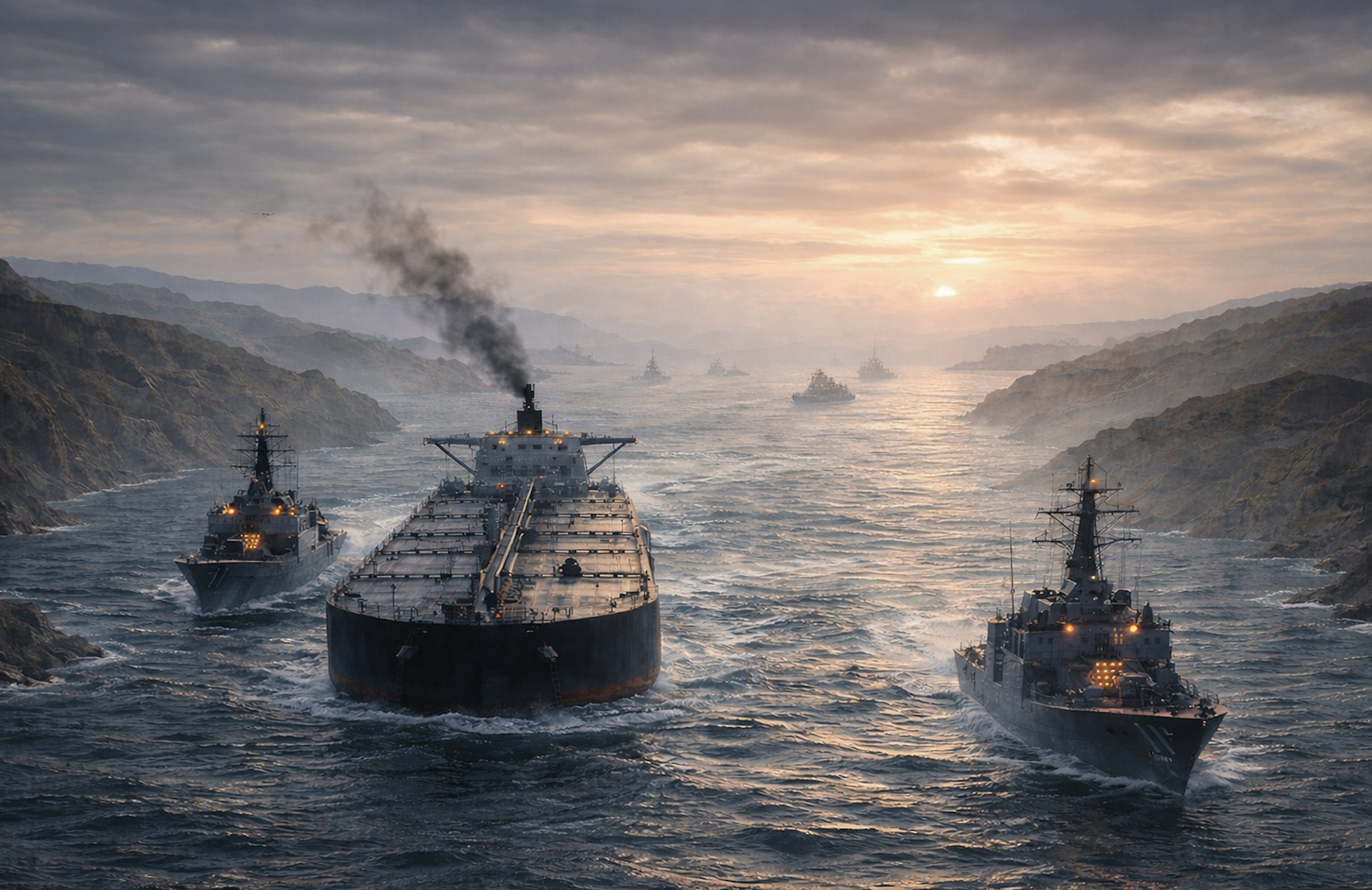
Iran is dictating who moves through the world’s most important oil chokepoint. Now the U.S. response could reshape global trade.
In the March 27, 2026 video below, Peter Zeihan explains why allowing Iran to control traffic through the Strait of Hormuz puts the U.S. in a difficult position. In a follow-up video—summarized below—he discusses the U.S.’s planned response. That second video is currently behind a paywall, but should be available on Zeihan’s website in a few days.
The Strait of Hormuz Remains Open…For Iran
By Peter Zeihan
Despite the ongoing conflict in the Persian Gulf, shipping in the Strait of Hormuz remains open…sort of. The Iranians have taken control, requiring ships to get clearance for safe passage.
Basically, Iran has set up a protection racket. They’re earning more from transit fees and oil exports than before the war, and all the Chinese ships carrying drone parts and components heading to Iran remain untouched…
Summary
In this video, Zeihan argues that despite active conflict in the region, Iran has effectively taken control of shipping flows in the Persian Gulf—and in some ways is benefiting from the situation rather than being constrained by it.
He points to a central contradiction: even though the security environment has deteriorated to the point where maritime insurance has largely collapsed, ships are still moving through the Strait of Hormuz. Under normal circumstances, that alone would halt most commercial traffic, since shipowners and captains would be exposed to enormous financial risk. As a result, many vessels are stuck waiting outside the Gulf, while others remain trapped inside.
And yet, some ships are still transiting—and, according to Zeihan, all of them are doing so with explicit Iranian approval.
Rather than using the standard navigational channels, which have largely shut down due to the fighting, ships are now following a different process. Vessels seeking safe passage must travel deep into Iranian-controlled territory, dock at Imam Khomeini port in the northern Persian Gulf, obtain authorization, and pay substantial fees—reportedly around $2 million for large ships. They then sail back down along the Iranian coastline, staying close to shore to reduce risk. Incoming ships follow the same process in reverse.
In effect, Iran has established a de facto system of control over regional shipping. Instead of being shut out of global trade, it is regulating traffic within the Gulf—deciding which ships move, under what conditions, and at what cost.
Zeihan argues this has two major consequences. First, it strengthens Iran financially. Oil exports continue—approaching roughly 2 million barrels per day in his estimate—and higher prices combined with wartime surcharges mean Iran may actually be earning more than before the conflict. Much of this revenue flows through the Islamic Revolutionary Guard Corps (IRGC), reinforcing the regime’s stability.
Second, Iran’s control allows it to continue importing critical materials, particularly from China, including components used in drones and missile systems. As a result, Iran is able to sustain its military operations.
Underlying this is a broader critique of U.S. policy. Despite its military presence, the United States has not meaningfully disrupted these flows. Zeihan frames this as a failure to adapt to how Iran is operating in the current environment.
The overall picture he presents is one in which Iran, rather than being isolated or economically squeezed, has leveraged the conflict to consolidate control over a critical chokepoint—turning restricted access into both a source of revenue and a strategic advantage.
In a follow-up video posted April 12, Zeihan turns to what may come next, following Trump’s statements that the U.S. would blockade the Strait of Hormuz. In The United States Gets Into Privateering (subscription-based), Zeihan writes:
“The U.S.–Iran negotiations in Islamabad failed completely. The U.S. showed up outmanned and outgunned, with the Iranian extremists showing out in full force. However, President Trump did one of the most significant things of the last year when he said that the U.S. would now blockade the Strait of Hormuz. This effectively ends globalization and freedom of the seas. We’ll know in the next few days whether this is implemented, but it could reshape everything.”
Summary
Zeihan shifts from describing how Iran has been controlling shipping inside the Strait of Hormuz to arguing that the situation may now be approaching a much larger strategic turning point—one that could reshape global trade.
He begins with the broader context of the war and the failed negotiations between the United States and Iran. According to Zeihan, the talks ended without progress, in part due to a mismatch in structure and preparation. The U.S. sent a relatively small and less experienced team, while Iran fielded a large, deeply embedded political delegation. More importantly, he argues that recent military actions strengthened Iran’s internal position by eliminating more moderate figures, leaving hardliners firmly in control and less inclined to compromise.
From there, Zeihan pivots to what he sees as the key development: statements from President Trump suggesting that the United States may move to block shipping through the Strait of Hormuz. The framing, as he describes it, is binary—either all shipping flows freely, or none does. While he acknowledges that such statements don’t always translate directly into policy, he argues that even a partial implementation would represent a significant shift.
In Zeihan’s view, the United States has the capability to enforce at least a targeted version of this approach in the near term. With multiple carrier groups, amphibious units, and destroyers already in the region, he believes the U.S. could intercept and stop the relatively small number of ships currently transiting under Iranian control.
But the larger point, he argues, goes beyond immediate military feasibility. For decades, the United States has acted as the guarantor of global maritime trade, enforcing what is often referred to as “freedom of the seas.” This system—established after World War II—allowed goods to move relatively freely across oceans and became the foundation of modern globalization.
Zeihan suggests that a move to restrict shipping—even in a selective or targeted way—would mark a departure from that role. Instead of ensuring open access, the U.S. would be using control over sea lanes as a strategic tool. In his framing, this represents a shift from a global security provider to a more selective, interest-driven enforcer.
The implications, he argues, could be significant. Global trade—especially in lower-margin goods like manufactured products—depends on predictable and secure shipping routes. If those guarantees weaken, large portions of trade could become uneconomic. Even higher-value sectors like energy and agriculture would face disruption, as there are not enough naval resources globally to protect shipping at scale.
He also points to unresolved practical questions. If ships attempt to transit, what happens to them? Are they boarded, redirected, or seized? How are vessels with unclear ownership—so-called “shadow fleets”—handled? These are operational questions, but they quickly become legal and economic ones as well.
In the end, Zeihan’s argument is that this moment could represent the early stages of a structural shift. Not necessarily a full and immediate shutdown of global trade—but a move away from the system of open, protected sea lanes that has defined globalization for decades.

