

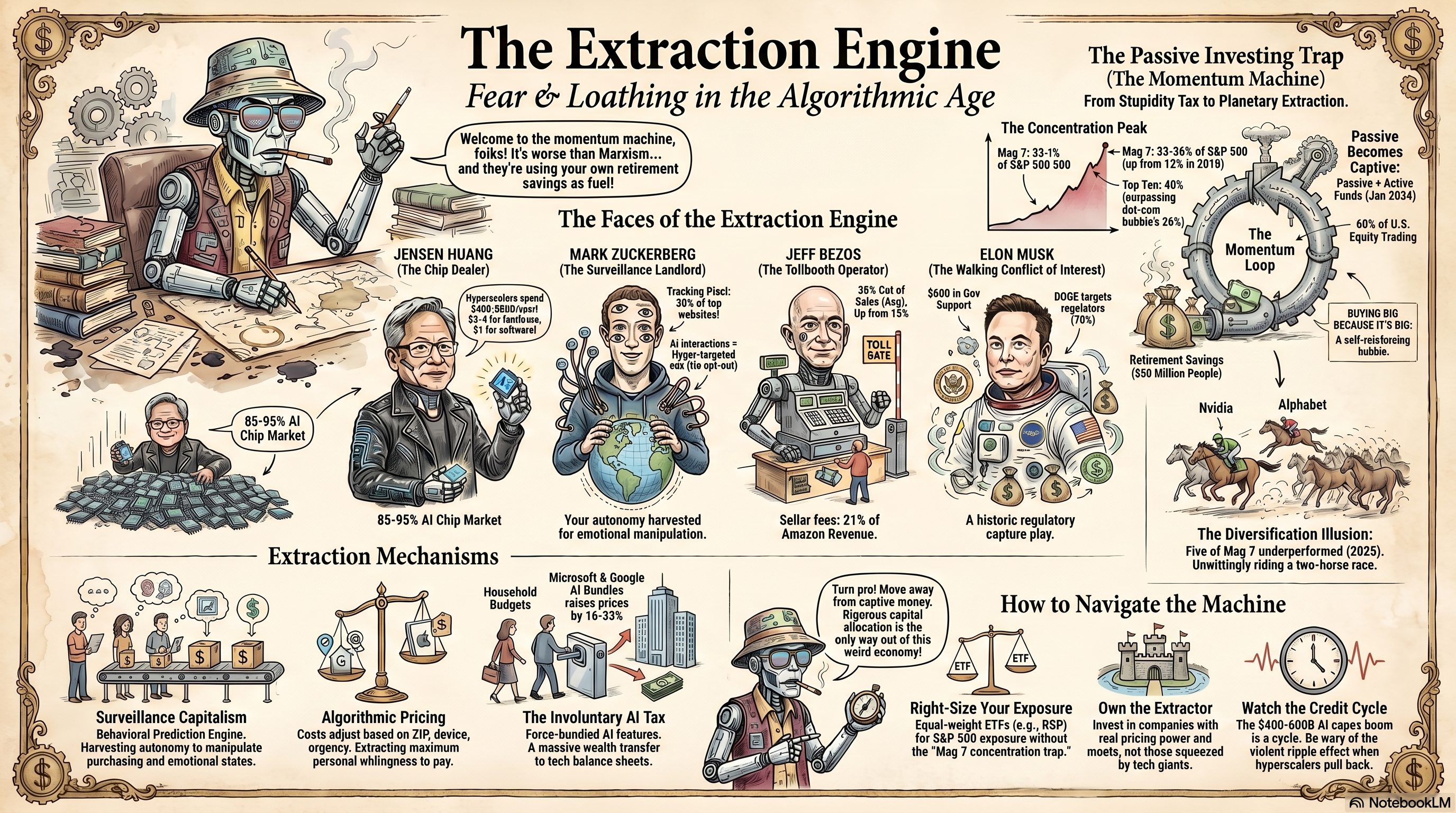
 A PSW Gonzo Feature — Fear and Loathing in the Age of Algorithmic Theft
Executive Summary: The Heist You Didn’t See Coming
There is a theft underway so large, so systematic, and so elegantly disguised that most of its victims are cheering for the thieves. They’re cheering in their 401(k) dashboard apps, in their Tesla stock notifications, in their Amazon Prime confirmation emails, and in the warm digital embrace of whatever AI chatbot is currently reading their emails to sell them better-targeted dog food.
The mechanism is not new. Wall Street has been running the “stupidity tax” on passive investors since the invention of the index fund. What is new is the scale, the speed, and the cast of sociopaths who’ve upgraded the heist from a cottage industry to a planetary extraction machine.
The difference between the old model and the new one is the difference between a pickpocket and a central bank robbery. They used to take $100 million and call it a great quarter. Now they want $100 billion and they have built the regulatory, political, and technological architecture to get it!
Part One: The Passive Investing Trap — “Dumb Money” Gets an Upgrade to “Captive Money“
The Self-Reinforcing Wheel of Wealth Transfer
Passive investing was supposed to be democracy’s answer to Wall Street’s casino. The logic was sound: most active managers don’t beat the index after fees, so why not just buy the index? Simple. Cheap. Diversified.
Except somewhere between Jack Bogle’s noble vision and the present moment, the index itself became the game.
By January 2024, for the first time in history, assets in passive index funds exceeded those in actively managed funds — a historic inflection point that had been building since the 2008 financial crisis transformed index funds from a niche product into the default retirement vehicle for 330 million Americans. ETF inflows jumped another 32% in 2025, culminating in record January 2026 flows. Global assets under management hit $128 trillion by end of 2024, with passive strategies accounting for over 20% of that total — and systematic plus passive strategies together constituting over 60% of daily U.S. equity trading volume.
Here is the problem with all of that capital flowing on autopilot into market-cap-weighted indexes: it creates a self-reinforcing cycle where the BIGGEST companies get BIGGER simply because they are the BIGGEST companies. The Magnificent Seven — Alphabet, Amazon, Apple, Meta, Microsoft, Nvidia, and Tesla — now constitute approximately 33-36% of the ENTIRE S&P 500. In 2016, they were 12% of the index. In 2022, 21.6%. Today, over a third!
That is not “investing.” That is a momentum machine with your retirement savings as the fuel.

Every dollar you put into SPY automatically buys more Nvidia because Nvidia is already enormous. Every dollar that makes Nvidia larger makes it a bigger share of the index, which forces every subsequent passive dollar to buy even more Nvidia. Rinse, repeat, inflate. Critics have compared it to the “Nifty Fifty” bubble of the 1970s and the dot-com peak — except today’s concentration surpasses both. Top ten S&P 500 companies now hold nearly 40% of the index, past the dot-com era’s 26%.
The Bernstein research shop put it bluntly in a report that has aged badly in polite society but perfectly in reality: passive investing at scale is not just suboptimal — it is “worse than Marxism” in the sense that it allocates capital not by merit or analysis but by momentum and weight, a feedback loop with no internal corrective mechanism.
The Wrinkle Nobody Tells You
In 2025, five of the Magnificent Seven actually underperformed the broader market. The S&P 500 was held up almost entirely by Nvidia and Alphabet. That means hundreds of millions of passive investors, believing they were “diversified,” were actually riding a two-horse race with 35% of their portfolio on the jockey’s silks.
Wealth managers are quietly telling clients to “right-size exposure” and move toward equal-weight ETFs and international diversification. The irony is thick: the professionals know the passive index has become a concentration trap, but the product gets sold to retail as “safe,” “simple,” and “smart.“
Just think of the time the 401K/IRA guy came to your office and “explained it to you.” Then they gave you a form and said – decide which ETFs to allocate your retirement to, right?
Part Two: The Oligarchs — Named, Profiled, and Dissected

Jensen Huang: The Chip Dealer Who Controls the Infrastructure of Everything
Jensen Huang is the most consequential person in the global economy right now, and he’s almost certainly the calmest about it.
Nvidia controls somewhere between 85% and 95% of the AI accelerator chip market. The hyperscalers — Amazon, Google, Microsoft, and Meta — are collectively spending somewhere in the neighborhood of $400–600 billion in annual capital expenditures, the overwhelming majority of which flows through or toward Nvidia chips. For every dollar spent on AI applications, $3–4 flows to semiconductors and infrastructure, and Nvidia takes the lion’s share of that.
Jensen’s forecast at the Q2 2026 earnings call: $1 trillion in GPU purchase orders through 2027. His claimed hyperscaler capex figure of $600 billion per year was challenged by analysts, who put the actual combined number closer to $400–450 billion — but even the lower figure represents a capital expenditure orgy of historic proportions, the costs of which ultimately get passed down the chain to every business and consumer that buys cloud services, software subscriptions, or anything that touches a data center.
The downstream effect: you pay for Jensen’s kingdom every month in your Microsoft 365 bill, your Google Workspace, your AWS invoice, and your ChatGPT subscription.
Mark Zuckerberg: The Surveillance Landlord
Amnesty International’s assessment of Meta’s core business model was written in 2019 and has only become more accurate: the company’s surveillance-based system is “inherently incompatible with the right to privacy and poses a threat to freedom of opinion and expression.“
Meta’s pixel tracking infrastructure is embedded in 30% of the world’s most popular websites. The company tracks users not just on Facebook and Instagram but across millions of third-party apps and websites, regardless of whether those users have Meta accounts. A 2022 investigation found that a third of top U.S. hospitals had been sending sensitive patient data to Meta through its tracking pixel — including mental health information.
Meta’s ad revenue continues to surge precisely because this surveillance apparatus works. The company projected Q3 2025 revenue of $47.5–50.5 billion, well above analyst estimates, driven by AI-powered ad targeting. Starting December 2025, Meta began using AI chat interactions to serve hyper-targeted ads — with no opt-out available. The product is you. The customer is whoever pays Meta to reach you. The price you pay is your entire psychological profile, medical history, purchasing behavior, and now your private conversations.
Zuckerberg’s capex plan for 2026: approximately $135 billion, nearly double 2025’s $72 billion. Who pays for that? See your next Facebook login for details.
Jeff Bezos: The Tollbooth Operator of American Commerce
Amazon keeps an average of 30% of each sale made by independent sellers on its platform — up from 19% just five years ago. Seller fees now account for 21% of Amazon’s total revenue. An ILSR analysis described this plainly as Amazon “exploiting its gatekeeper power to extract a growing cut of the revenue earned by these sellers.“
The mechanism is elegant and totalitarian: most small businesses must use Amazon to reach customers. Once dependent, Amazon gradually increases fees (another form of Dynamic Pricing), forces sellers to buy Amazon’s own logistics and advertising services to maintain visibility and then competes against those same sellers with Amazon-branded alternatives. Amazon’s advertising business alone reached $37.7 billion, built entirely on charging those captive merchants for the right to be found by the customers Amazon trained to shop there in the first place.
Phil’s observation about Amazon boxes is not nostalgia — it is economics. Those boxes represent a cut of every transaction that previously went to the local retailer, the local employee and the local tax base. Bezos took that cut and called it “disruption.” His net worth crossed $200 billion. Main Street got Amazon-branded cardboard.

Elon Musk: The Grift That Walks Like a Man
No character in this story is more breathtaking in audacity than Elon Musk (RJO did a full write-up just yesterday), and no analysis of the extraction economy is complete without understanding how the SpaceX-DOGE-Tesla nexus represents perhaps the most brazen conflict of interest in the history of American capitalism.
Musk and his businesses have received at least $38 billion in government contracts, loans, subsidies, and tax credits — often at critical junctures when his companies most needed the cash. SpaceX alone held $10.1 billion in federal contracts as of early 2025 and all seven of Musk’s companies combined had netted $20 billion in government contracts and subsidies according to the Financial Times.
On the day Trump took office, Musk’s companies faced at least $2.37 billion in potential regulatory penalties and liabilities from 11 federal agencies. Musk’s response was to run the agencies. His DOGE operation targeted over 70% of agencies where Musk had a direct business interest. The Consumer Financial Protection Bureau — which would regulate X if it becomes a payment processor — was gutted. NHTSA, which oversees Tesla’s autonomous driving program, was cut by 10%. The FDA, which must approve Neuralink’s brain implants, saw 1,000 employees fired.

This is not ideology. This is the most sophisticated regulatory capture operation ever executed: install your man at the top of government, use government authority to destroy the oversight apparatus that constrains your businesses, then pocket the difference.
SpaceX’s valuation has ballooned to approximately $800 billion in private insider trades as of late 2025, with a possible IPO at $1.75-2.00 trillion being planned — a valuation that “relies on investors buying into technology that doesn’t exist yet,” per Reuters (and RJO). Musk could more than double his current $460 billion fortune if the IPO lands at that target. The public will be invited to buy in at peak paper valuation, backed by government contracts awarded under an administration Musk helped install and regulate toward his own benefit.
Public Citizen’s assessment: “Elon Musk is a walking conflict of interest.” Congressional investigators put it more precisely: “Trump could not have chosen a person with more conflicts of interest.“
Part Three: The Extraction Mechanisms — How the Money Actually Moves
Surveillance Capitalism: You Are the Product, the Factory, and the Raw Material

Harvard Business School Professor Shoshana Zuboff coined the term “surveillance capitalism” in 2019, defining it as the commodification of personal data for the purposes of profit and behavioral modification. By 2026, this is not a theoretical framework — it is the operating system of the economy.
Google and Meta together constitute an advertising duopoly that generates revenue by knowing more about you than you know about yourself. Every search, every click, every location ping, every purchase, every browsing session, every social interaction is harvested, processed and sold to the highest bidder. This began as a free service — Google Search, Facebook social — and felt like a reasonable bargain. You got a product. They got your data.
What nobody explained was the asymmetry of value. You got a search engine. They got a behavioral prediction engine that could be used to manipulate your purchasing decisions, political beliefs and emotional states. The platform was free; the cost was your soul!
Algorithmic Pricing: The Invisible Toll on Everything You Buy

Dynamic pricing is the newer front in the extraction war (see Phil & Basho’s Tuesday Report). Algorithms now set prices for airlines, hotels, ride-sharing, food delivery, grocery items, concert tickets, and an expanding universe of consumer products in real time — based not on cost or supply/demand, but on what the algorithm believes you personally will pay.
At least seven U.S. states introduced legislation in 2025 to regulate algorithmic pricing, and New York’s proposed “Preventing Algorithmic Pricing Discrimination Act” specifically prohibits surveillance pricing that adjusts costs based on inferred personal characteristics. These bills exist because the practice is already widespread and documented: the same seat on the same flight costs more if the algorithm determines you’re booking from a wealthy ZIP code, have searched the route multiple times (indicating urgency), or are using an Apple device.
The AI Subscription Tax: Monetizing Tools You Already Paid For

Phil’s observation about paying $20/month for AI deserves a full accounting. The convergence around $20/month for standard AI tiers — ChatGPT Plus, Claude Pro, Google AI Pro, Perplexity Pro — represents a new recurring toll extracted from consumers for cognitive augmentation tools that are rapidly becoming as necessary as electricity for knowledge work.
Meanwhile, the same companies are force-bundling AI into existing products consumers already pay for. Microsoft 365 has been repriced upward with Copilot features that 84 million subscribers cannot opt out of. Google Workspace raised prices 16–33% per user per month to include Gemini AI — again, not optional. Meta uses your AI chat interactions to target ads, with no opt-out available.
For a 50-person company on Google’s Business Plus plan, the involuntary AI upgrade cost an additional $12,000 annually. Multiply that across millions of businesses, and you have the mechanism by which hyperscaler capex of $400–600 billion per year gets quietly transferred from corporate and household budgets to the balance sheets of five tech giants.
Part Four: The Wealth Math — What It Actually Costs You
Musk’s net worth increased by $187 billion in 2025 — a single year. In the same year, per Illinois Governor Pritzker’s accounting, Trump’s policies effectively took $1,700 in taxes from the average household, cut $1 trillion from Medicaid and doubled healthcare costs.

SpaceX was valued at $800 billion in late 2025 insider trades — nearly double its earlier-year valuation — adding approximately $168 billion to Musk’s net worth in a single transaction. A number this large “usually belongs to governments — it funds roads, defense forces, welfare, and entire economies,” as one analyst put it.
This is what Phil means by the GDP accounting: when Nvidia gains $1 trillion in market cap in a month, that capital doesn’t materialize from the ether. It represents a claim on future real economic production — and every new dollar that flows to the Mag 7 through passive fund rebalancing is a dollar that gets diverted from the 493 other companies, from smaller businesses, from workers’ wages, and from public investment.
The extraction economy is not a metaphor. It is a measurable transfer of real purchasing power from the many to the few, facilitated by platform monopolies, algorithmic pricing, surveillance advertising, passive investing mechanics, and regulatory capture executed at the highest possible level.
Part Five: The Portfolio Implications — Navigating the Extraction Machine
None of this means the Mag 7 are bad investments. They are phenomenally good investments precisely because they are extraction engines. The question is: are you the extractor, or the extracted?

What PSW Members Should Do
-
-
- Understand what you own. If you’re in SPY, VOO, or any S&P 500 cap-weighted index, approximately one-third of your money is in seven companies that are increasingly dependent on each other’s capex decisions and AI narratives. That is not diversification; that is a leveraged bet on the continuation of the AI hype cycle.
- Consider equal-weight alternatives. RSP (S&P 500 Equal Weight ETF) and similar products give you S&P 500 exposure without the Mag 7 concentration trap. The trade-off is underperformance when the top seven are running hot — but the protection when concentration unwinds is substantial.
- Own the extractor, not the extracted. If the extraction economy is the regime, own companies with real pricing power, real moats, and real cash flows — not companies being squeezed by Amazon’s seller fees, Google’s advertising monopoly, or Microsoft’s involuntary AI bundle.
- Watch the leverage. The AI capex boom at $400–600 billion annually is a credit cycle. When the hyperscalers pull back spending — and EVERY cycle ends eventually — the ripple through chip stocks, cloud infrastructure names, and AI-adjacent equities will be violent. The people who will be hurt worst are those who bought the narrative at the top through passive rebalancing.
- Treat AI subscriptions as a new fixed cost in every business model you analyze. Companies that relied on free or cheap Google/Microsoft/Amazon services in their unit economics face structural margin compression as those services get repriced upward with AI bundles they cannot opt out of.
-
Conclusion: The Weird Gets Professional
Hunter Thompson’s dictum — “when the going gets weird, the weird turn pro” — was supposed to be darkly funny. In 2026, it reads as literal instruction.
The extraction economy is not a scandal or a conspiracy. It is the logical terminus of several decades of policy choices: deregulation of platform monopolies, capture of antitrust enforcement, privatization of data that users generate and the use of passive investing as a conveyor belt for retail capital into the hands of the already-enormous.
The oligarchs named in this report are not evil in the comic-book sense. They are rational actors operating within a system that rewards extraction over creation, scale over competition and capture over merit. The problem is the system, not just the individuals — though the individuals, having shaped the system to serve themselves while running agencies that regulate them, deserve every word of scrutiny directed their way.

For PSW members: the correct response to the extraction economy is not despair, and not purely cynicism. It is rigorous analysis of where the value actually accrues versus where you are told it accrues. It is sizing your Mag 7 exposure deliberately rather than passively. It is understanding that the “dumb money” label was never about intelligence — it was about information asymmetry and incentive structure. The banks have always had better information, better algorithms, and better access to the mechanism.
Now the mechanism has been given to seven companies with trillion-dollar market caps, a compliant regulatory apparatus and an incoming IPO from a rocket company valued at $1.75 trillion on the basis of government contracts awarded by an administration the rocket company’s CEO helped install.
You don’t have to be radical to see that that’s a problem. You just have to be paying attention!
Hunter S. Thompson once wrote that “the race is not always to the swift, nor the battle to the strong — but that’s the way to bet.” In 2026, the bet is clear: the extraction engine will keep running until it can’t. Your job is to be holding the fuel, not lying on the tracks.

