
When the Trump Family Business Shapes U.S. Policy: The Syria Sanctions Story
Based on Syrian Billionaires Needed a Favor in Washington. They Invoked the Trump Name.
Summary
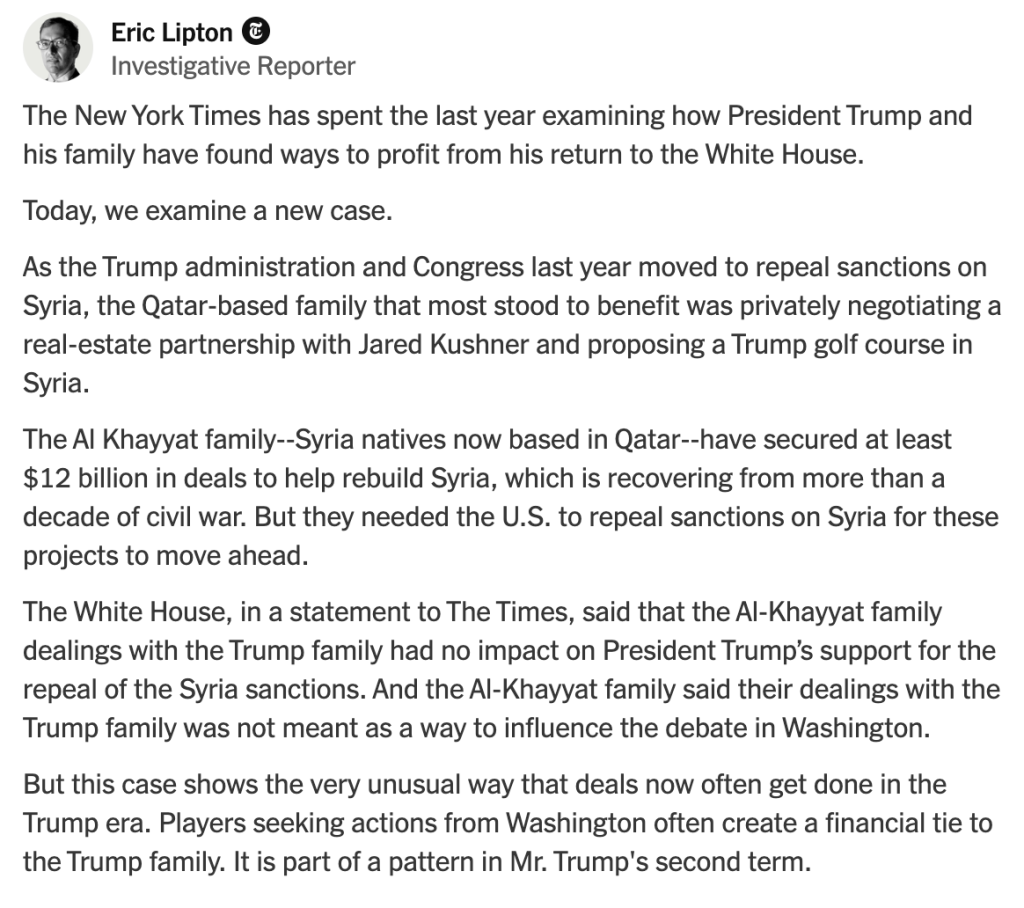
Eric Lipton’s New York Times investigation [shared: Syrian Billionaires Needed a Favor in Washington. They Invoked the Trump Name], details how a group of Syrian investors seeking to rebuild the country secured billions in contracts while simultaneously pursuing business ties with the Trump family, including a proposed Trump-branded resort. As these relationships developed, the U.S. moved to permanently lift sanctions on Syria—an outcome critical to unlocking foreign investment. While the White House denies any connection between the business dealings and policy decisions, the episode reveals a deeper problem: a system in which financial relationships tied to the president’s orbit overlap with geopolitical decision-making, blurring the line between public policy and private gain.
A Pattern in Plain Sight
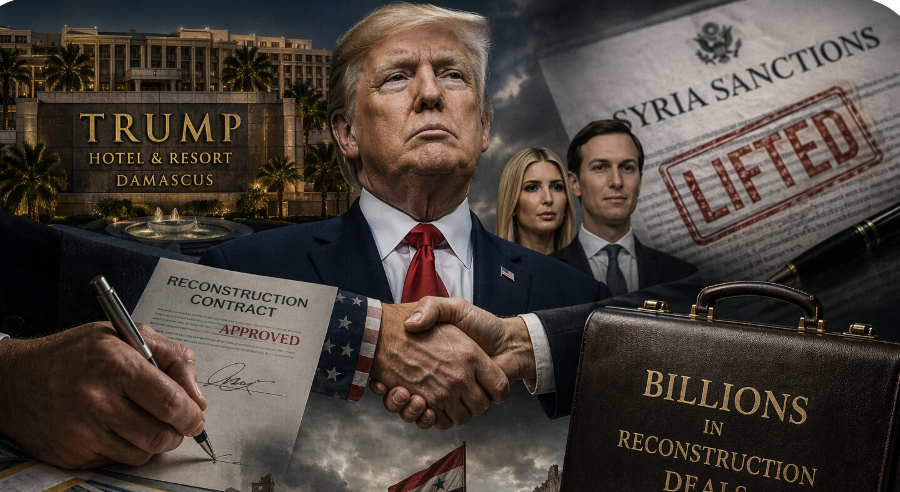
The story itself is simple. A wealthy Syrian-origin family positioned itself to profit from rebuilding a war-torn country. To make that possible, they needed U.S. sanctions lifted. At the same time, they were building relationships with the family of the president—exploring a Trump-branded resort in Syria and a separate joint development deal abroad with Jared Kushner and Ivanka Trump.
Then the United States permanently repealed those sanctions.
No one claims there was a signed agreement trading policy for profit. That’s not how modern corruption tends to work. What matters is the alignment: the same actors who stood to gain financially were operating inside the political orbit most capable of delivering the outcome they needed—and the outcome arrived.
How Influence Works Now
The reporting points to something structural, not incidental.
Access to President Trump is cultivated through relationships, and the Trump name itself functions as a kind of political currency—something that can focus attention, open doors, and shape decisions.
At one point, a lawmaker suggested branding a Syrian development as a “Trump National Golf Course” as a way to get the president’s attention. That detail captures the underlying logic of the system. Proximity to the president’s business identity is treated as leverage.
This is a shift away from a system where policy is expected to be decided on its merits, toward one where influence flows through personal and financial alignment.
Why This Case Matters
To understand why this matters, it helps to be explicit about what actually happened.
A group of well-connected Syrian investors secured billions in reconstruction deals that could only move forward if U.S. sanctions were lifted. At the same time, they were lobbying members of Congress, building relationships in Washington, and exploring business partnerships tied to the Trump family—including a proposed Trump-branded resort in Syria. Over the course of 2025, the Trump administration first eased sanctions temporarily and then, with congressional support, permanently repealed them in December.
That sequence—lobbying, relationship-building, business alignment, and ultimately policy change—is the mechanism.
Sanctions were the central barrier to rebuilding Syria. Without them being lifted, international banks, investors, and corporations could not safely commit capital. Once removed, the door to large-scale investment opened immediately.
The policy decision to lift sanctions effectively determined who would participate in one of the largest reconstruction efforts in the world.
At the same time, removing sanctions eliminated a key source of leverage. Before repeal, the United States retained the ability to pressure Syria’s new government. After repeal, that leverage became far more difficult to reestablish. Some lawmakers have already expressed concern that the country’s internal violence and instability have not meaningfully improved.
The Broader Context
This episode doesn’t stand alone. It fits into a broader pattern in which political power and financial interests increasingly move together.
As described here, analysts have emphasized that Syria’s reconstruction could require hundreds of billions of dollars, making it one of the most significant post-war investment opportunities globally.
https://www.reuters.com/world/middle-east/syria-reconstruction-sanctions-2025
In another example, Jared Kushner raised a multibillion-dollar investment fund backed by Middle Eastern sovereign wealth funds, including Saudi Arabia.
https://www.nytimes.com/2022/04/10/us/jared-kushner-saudi-investment-fund.html
At the same time, reporting has continued to track how Trump-linked business interests remain active internationally, often in regions directly affected by U.S. policy decisions.
https://www.wsj.com/articles/trump-business-foreign-deals-2024
These are not isolated facts. Taken together, they describe a system in which political authority and private financial opportunity are increasingly intertwined in ways that would once have raised serious legal and constitutional concerns. The Constitution’s Emoluments Clause, for example, was designed to prevent U.S. officials from benefiting from financial relationships with foreign governments—precisely to avoid this kind of overlap between public power and private gain.
What’s Changed—and Why It Matters
In a traditional system, even the appearance of a conflict between public office and private gain is treated as a serious risk. Here, that boundary has eroded.
Investors behave as if alignment with the president’s business interests improves their chances of achieving policy goals. They invest accordingly. They build relationships accordingly. And over time, those expectations begin to shape real-world outcomes.
That is how corruption evolves—not always through explicit deals, but through systems where influence becomes predictable and repeatable.
What This Leaves Behind
On paper, lifting sanctions enables reconstruction, investment, and economic recovery. On the ground, the reality is more complicated. Large-scale projects are moving forward, but so are reports of instability, sectarian violence, and uncertainty for local populations whose land and livelihoods may be displaced.
The Syria sanctions story isn’t just about one country or one set of deals. It’s about how power is exercised.
When financial relationships, political access, and policy outcomes align this consistently, the question is no longer whether any single line was crossed. The pattern is clear: the system has been reshaped to reward those with proximity to power—and those willing to align financially with it.
That shift carries real consequences, not just for foreign policy, but for how decisions are made and who they ultimately serve.

