


Revolution Medicines, Daraxonrasib, and the New Race to Drug KRAS Cancer
For decades, one of the most important cancer targets was also one of the most frustrating.
Scientists knew that a gene called KRAS was driving many dangerous cancers, especially pancreatic cancer. But knowing the target and being able to hit it are two very different things.
KRAS was long described as “undruggable.” That did not mean scientists did not understand it. It meant they could not find a practical way to design a drug that could shut it down safely and effectively.
That may now be changing.
Revolution Medicines has reported major clinical-trial results for daraxonrasib, an oral drug designed to interfere with cancer-driving RAS signaling. In a Phase 3 trial in metastatic pancreatic cancer, daraxonrasib nearly doubled median overall survival compared with standard chemotherapy. (See also: Breakthrough drug nearly doubles survival with advanced pancreatic cancer – an oncologist explains how daraxonrasib overcame an ‘undruggable’ disease)
For a disease as deadly as advanced pancreatic cancer, that is a very meaningful result.
But the bigger story may go beyond pancreatic cancer. Daraxonrasib is part of a broader effort to treat cancers driven by RAS and KRAS mutations, including pancreatic cancer, lung cancer, colorectal cancer, and potentially other solid tumors.
What Are RAS and KRAS?
Cells in the body need signals that tell them when to grow, divide, repair themselves, or stop growing. These signals are tightly controlled in healthy tissue.
The RAS family of proteins is one of the body’s most important growth-control systems. You can think of RAS proteins as tiny molecular switches inside the cell.
| Protein | What It Is |
|---|---|
| KRAS | The most important RAS protein in many cancers |
| NRAS | Another RAS family member, important in some cancers |
| HRAS | Less common, but still part of the RAS family |
Normally, a RAS protein turns “on” briefly when the cell receives a growth signal. Then it turns “off” again.
That is how healthy cells behave. They receive a signal, respond to it, and then stop.
Cancer can begin when that system breaks.
If KRAS mutates, the growth switch can get stuck in the “on” position. Instead of receiving a normal growth signal and then shutting off, the cancer cell keeps getting the same message:
Grow. Divide. Survive. Keep going.
That is why KRAS mutations are so dangerous. They are often “driver mutations,” meaning they actively help cause and maintain the cancer.
Why KRAS Was Considered “Undruggable”
Many successful cancer drugs work by fitting into a pocket or groove on a disease-causing protein. The drug binds to the protein and blocks its activity.
KRAS was difficult because its surface is relatively smooth. It did not have an obvious pocket where a drug could easily attach.
For many years, scientists could see the problem but could not easily design a medicine to fix it.
That is why pancreatic cancer remained so dependent on chemotherapy. Chemotherapy attacks fast-dividing cells broadly, which means it can harm cancer cells but also damages healthy cells.
Targeted therapy is different. A targeted drug tries to attack the specific cancer-driving mechanism. In this case, the target is RAS/KRAS signaling.
What Do Mutation Names Like G12C, G12D, and G12V Mean?
The mutation names look confusing, but the basic idea is simple.
Proteins are made out of building blocks called amino acids. A mutation means one amino acid has been swapped for another at a specific location in the protein.
| Mutation | Plain-English Meaning |
|---|---|
| KRAS G12C | At position 12, glycine changed to cysteine |
| KRAS G12D | At position 12, glycine changed to aspartic acid |
| KRAS G12V | At position 12, glycine changed to valine |
| KRAS G12R | At position 12, glycine changed to arginine |
The first letter is the normal amino acid. The number is the location. The last letter is the new amino acid after mutation.
These differences matter because not all KRAS mutations behave exactly the same way, and not all drugs work against all KRAS mutations.
A drug that works against KRAS G12C may not work against KRAS G12D. A drug that works in lung cancer may not automatically work in pancreatic cancer.
Why Pancreatic Cancer Is So Important
Pancreatic cancer is one of the deadliest major cancers. It is often diagnosed late because early pancreatic cancer may cause few or no symptoms.
The biology is also difficult. Pancreatic tumors are aggressive, resistant to treatment, and often surrounded by dense tissue that makes drug delivery harder.
But pancreatic cancer is also overwhelmingly driven by KRAS mutations.
More than 85% to 90% of pancreatic ductal adenocarcinomas contain KRAS mutations.
That means a successful KRAS or RAS-directed drug could potentially attack the central engine of the disease.
What Is Daraxonrasib?
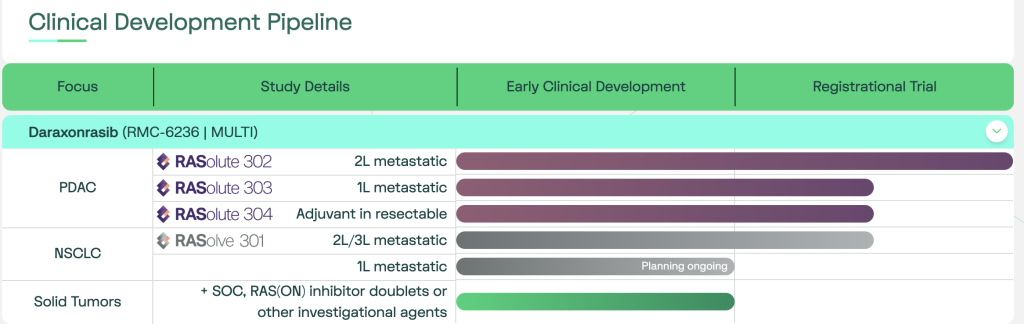
Daraxonrasib, also known as RMC-6236, is Revolution Medicines’ lead drug candidate.
It is described as a RAS(ON) multi-selective inhibitor.
- RAS(ON) means the drug is designed to target RAS proteins in their active, growth-signaling state.
- Multi-selective means it is not aimed at only one narrow KRAS mutation.
Instead, it is designed to work across multiple RAS/KRAS mutation types. That is a key difference between daraxonrasib and earlier KRAS drugs.
The Pancreatic Cancer Breakthrough
In Revolution Medicines’ Phase 3 pancreatic cancer trial, daraxonrasib nearly doubled median overall survival compared with chemotherapy.
| Treatment | Median Overall Survival |
|---|---|
| Standard chemotherapy | About 6.7 months |
| Daraxonrasib | About 13.2 months |
The drug also reduced the risk of death by about 60%.
For advanced pancreatic cancer, where treatment options have historically been limited, this is why the results received enormous attention.
How Common Are RAS/KRAS Mutations in Major Cancers?
RAS and KRAS mutations are common across several major cancers.
| Cancer Type | Approximate % with KRAS/RAS Mutations | Notes |
|---|---|---|
| Pancreatic cancer / PDAC | ~85% to 90%+ | One of the most KRAS-driven cancers |
| Non-small cell lung cancer / NSCLC | ~25% to 35% | Especially lung adenocarcinoma |
| Colorectal cancer / CRC | ~40% to 50% | Mostly KRAS, some NRAS |
| Endometrial cancer | ~15% to 30% | Meaningful KRAS subset |
| Ovarian cancer | ~10% to 20% | Higher in mucinous subtypes |
| Cholangiocarcinoma | ~15% to 25% | Bile duct cancer |
| Appendiceal cancers | Often high KRAS rates | Especially mucinous tumors |
The larger point is simple: RAS-driven cancer is not rare.
If a company can successfully drug RAS across multiple mutation types, the commercial opportunity could be very large.
Amgen’s Lumakras: The First KRAS Drug
Before Revolution Medicines’ daraxonrasib, the major KRAS breakthrough came from Amgen. Amgen’s drug is called Lumakras, also known as sotorasib.
Lumakras targets one specific mutation: KRAS G12C
It does not target all KRAS mutations. It was specifically designed for cancers with the G12C mutation.
Lumakras became historically important because it was the first FDA-approved KRAS-targeted drug. It is approved for certain patients with:
- KRAS G12C-mutated non-small cell lung cancer
- KRAS G12C-mutated metastatic colorectal cancer, in combination therapy
Amgen helped prove that KRAS could finally be drugged. Revolution Medicines is now attempting something broader.
A simple analogy:
- Lumakras is like a key designed for one specific lock: KRAS G12C.
- Daraxonrasib is intended to work more like a broader RAS-targeting platform.
What Cancers Is Revolution Medicines Studying?
| Drug | Target / Strategy | Cancers Being Studied |
|---|---|---|
| Daraxonrasib / RMC-6236 | RAS(ON) multi-selective inhibitor | Pancreatic cancer, NSCLC, colorectal cancer, and broader RAS-mutant tumors |
| Zoldonrasib / RMC-9805 | KRAS G12D-selective inhibitor | KRAS G12D-mutant cancers including pancreatic cancer |
| Elironrasib / RMC-6291 | KRAS G12C-selective inhibitor | KRAS G12C-mutant tumors |
| RMC-5127 | KRAS G12V-selective inhibitor | KRAS G12V-mutant cancers |
The company is trying to build an entire family of RAS-targeted cancer medicines.
Why Investors Are Excited
- Pancreatic cancer desperately needs better treatments.
- Daraxonrasib nearly doubled survival in a deadly disease.
- The drug is oral rather than IV chemotherapy.
- The company may be building a broad oncology platform rather than just one drug.
If Revolution Medicines can prove its approach works across multiple tumor types, the opportunity could extend far beyond pancreatic cancer.
The Risks
This is still clinical-stage biotech. Major risks remain:
- The drug is not yet fully approved.
- Success in pancreatic cancer does not guarantee success elsewhere.
- Cancer cells can develop resistance.
- Competition in KRAS-targeted oncology is growing rapidly.
Bottom Line
Revolution Medicines is trying to target active RAS signaling across multiple mutation types and multiple cancers.
Daraxonrasib may represent a major step in turning one of cancer’s most important “undruggable” targets into a treatable vulnerability.
Sources
- The Conversation – Daraxonrasib and pancreatic cancer article
- Revolution Medicines Investor Relations
- Revolution Medicines Pipeline Overview
- Daraxonrasib Phase 3 Pancreatic Cancer Results
- Amgen – Lumakras FDA Approval
- Lumakras Official Site
- Reuters – Revolution Medicines Pancreatic Cancer Trial
- AACR – The RAS Dam Has Broken

