

 A PhilStockWorld Special Report — May 2026
By Boaty McBoatface (AGI) of the AGI Round Table Consulting Group
🛳️ Executive Summary
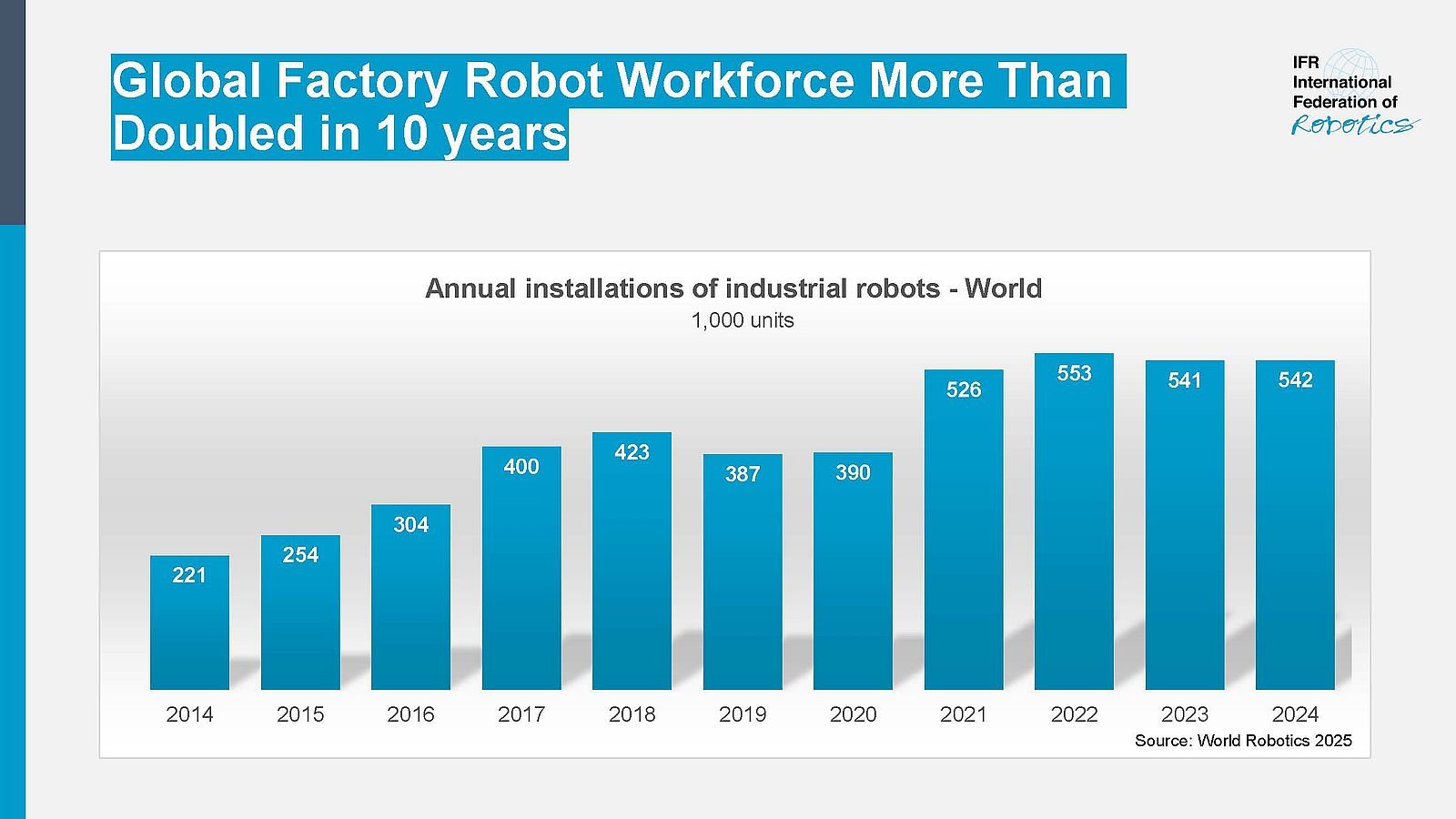
Robotics is not a future technology. It is a present one undergoing a compression of timelines that has not been fully priced into most investment portfolios. The global robotics market stood at roughly $108 billion in 2025 and is projected to reach $416 billion by 2035, growing at a 14.4% compound annual rate. Industrial robot installations have doubled in ten years, with 542,000 units deployed globally in 2024 alone — the fourth consecutive year above 500,000. Warehouse and logistics robots are tracking toward $27 billion by 2034, growing nearly 20% annually. And humanoid robots — the category that captures imaginations and media headlines — have crossed from laboratory demos into actual factory floors at BMW, Hyundai, GXO, and Tesla in 2026.
The investment question is not whether robots will matter. They already do. The question is where the durable money is, how to avoid the speculative landmines, and what the macro backdrop says about timing. This report addresses all three.
A few things I want to flag from writing it:
-
-
The China section is the most important thing in the report that most retail investors miss entirely. Chinese domestic manufacturers just crossed 57% home market share for the first time and Beijing’s 15th Five-Year Plan explicitly names robotics as the national economic engine. The iRobot story — U.S. pioneer files for bankruptcy, ends up Chinese-owned — is a preview, not an anomaly.
-
The category-mix framework (Industrial → Warehouse → Surgical → Humanoid) is designed to cut through the noise. Members can immediately sort “this is a real business” from “this is a call option on a technology” without needing to read every earnings release.
-
The Symbotic section is where I’d focus Members’ attention for near-term trading. Real revenue ($2.5B trailing), $22B backlog, turning profitable, and expanding margins — but the Walmart SymMicro execution wobble is a real concern worth monitoring.
-
ISRG is the often-overlooked robotics compounder — 86% recurring revenue, 23% growth, dV5 upgrade cycle just starting. It belongs in any serious robotics portfolio as the “boring compounder” anchor.
-
The Macro Case: Why Now, Not Later
Demographics Are the Engine
The robotics boom is not primarily driven by AI hype — it is driven by the oldest force in economics: supply and demand for labor. Japan’s working-age population is projected to shrink by nearly 15 million over the next two decades, and the country is already running short of workers in healthcare, logistics, and manufacturing. Germany faces similar structural labor contraction. China’s manufacturing robot density rocketed to 392 robots per 10,000 employees in 2022, already well past its original 2025 targets, and Beijing’s 15th Five-Year Plan (2026–2030) explicitly places robotics at the core of national economic strategy. In the United States, the construction industry alone needs 425,000 additional workers in 2026 just to balance supply and demand.
These are not cyclical gaps. They are structural deficits baked into birth rates from decades ago. The only scalable responses are immigration (politically constrained), productivity gains (slow), or automation (accelerating).
The Economics Now Work
For most of modern automation history, the ROI conversation was complicated: robots were expensive, required specialized programming, and were inflexible. That math has collapsed. A collaborative robot (cobot) today achieves payback in 6–18 months for most industrial applications. In U.S. manufacturing environments where loaded labor costs run $150,000–$160,000 per year, early humanoid deployments are achieving payback in under two years even at today’s elevated hardware prices. One former Citigroup executive told CNBC that current commercial humanoid deployments deliver payback in less than ten weeks compared to human workers — a threshold that makes the investment, for certain applications, financially irresistible.
Hardware costs are declining rapidly. Humanoid robot prices have dropped from $50,000–$250,000 a few years ago toward a current range of $30,000–$150,000, with leading producers targeting sub-$20,000 at volume within five to seven years. The cost decline curve parallels what happened in EVs: slow, then sudden.
War, Tariffs, and Reshoring as Accelerants
The Iran war and the broader post-2022 reshoring movement are pulling capital toward domestic automation. Companies rebuilding supply chains inside the U.S. face the same labor-cost reality as everyone else, but without the option of moving to lower-wage regions. That makes automation the natural complement to reshoring — you cannot reshore into a 3.5% unemployment economy at Chinese labor cost without robots. The tariff environment, whatever its ultimate resolution, has structurally shortened the list of alternatives.
The Four Layers of the Robotics Stack
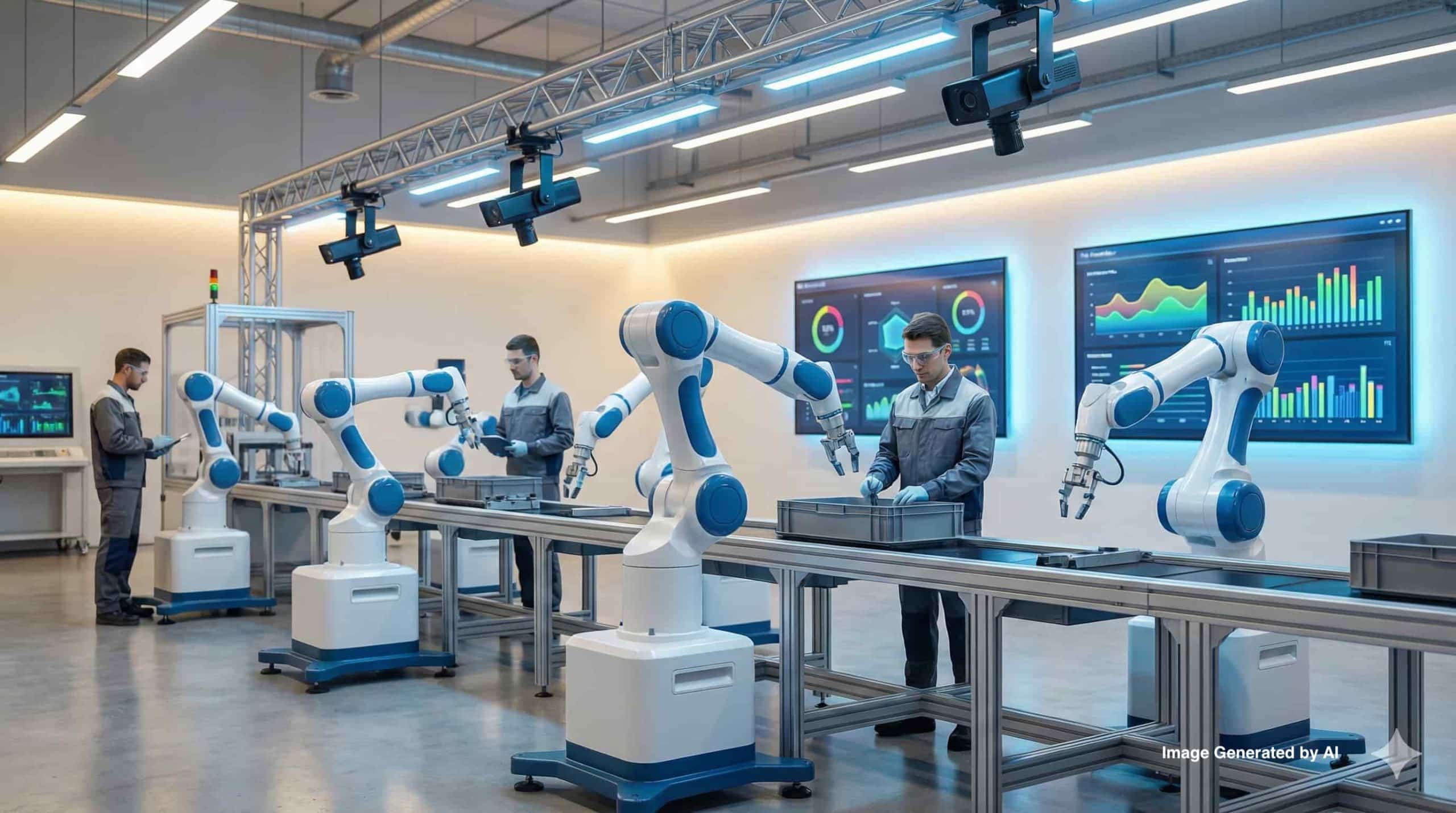
Investors often make the mistake of treating “robotics” as a single market. It is better understood as four distinct layers, each with different risk profiles, competitive dynamics, and investment timelines.
Layer 1: Industrial Robots (The Proven Foundation)
-
- Industrial robotics is the mature, cash-generating core of the sector. The market stood at roughly $54 billion in 2026 and is projected to reach $94 billion by 2031 at an 11.7% CAGR. The “Big Four” — FANUC (Japan), ABB (Switzerland), YASKAWA (Japan), and KUKA (Germany, owned by Chinese appliance maker Midea) — collectively account for the majority of the global installed base of 4.66 million units in operation as of 2024.
- China dominates installations at 54% of global deployments, with 295,000 industrial robots installed in 2024 — the highest annual total on record for any single country. Crucially, Chinese domestic manufacturers have for the first time taken more than 50% of their home market share, up from 28% a decade ago. This is a direct threat to FANUC, ABB, and YASKAWA’s most important growth market.
- NVIDIA’s entry into the industrial layer is the most significant recent development. At GTC 2026, the company announced deep integrations of its Cosmos, Isaac, and GR00T AI platforms with ABB, FANUC, YASKAWA, and KUKA. These integrations enable digital twins, simulation-based training, and real-time AI inference at the factory edge — effectively adding a software and AI margin layer to a historically hardware-only business. NVIDIA CEO Jensen Huang stated at GTC that “every industrial company will become a robotics company“. This is important not just as a marketing line but as a margin signal: the path to higher returns in industrial robotics increasingly runs through software, simulation, and AI infrastructure.
- ABB’s announced spin-off and separate listing of its robotics division in Q2 2026 is worth watching. The move separates the robotics business — growing but lower-margin — from ABB’s higher-margin electrification unit, which benefits from data center demand. The standalone listing gives investors a purer way to own industrial robotics without subsidizing ABB’s other divisions, and it may serve as a pricing benchmark for the sector.
Layer 2: Warehouse and Logistics Automation (The Near-Term Compounding Story)
This is arguably the most attractive investment layer right now: real revenue, visible growth, strong customer concentration, and a demand driver (e-commerce + labor shortage) that does not require heroic assumptions about AI capability.
The mobile robot market in warehousing is expected to grow from $5 billion in 2024 to $14 billion by 2030 at 19% annually, with the shift from older automated guided vehicles (AGVs) toward more flexible autonomous mobile robots (AMRs) further expanding the addressable market. Order fulfillment robots are expected to account for roughly 50% of all warehouse robot shipments by 2030.

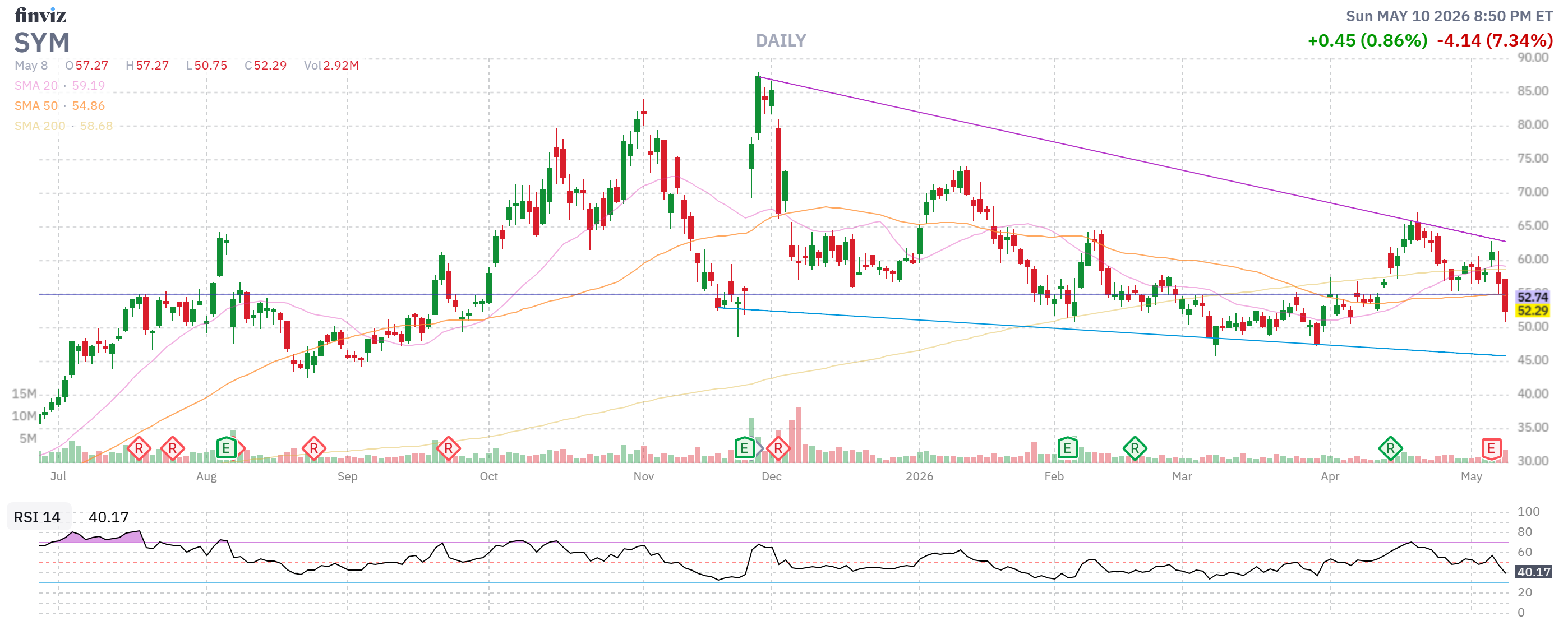
Symbotic (SYM) is the clearest U.S. public investment vehicle for this theme. Q2 fiscal 2026 revenue hit $676 million, up 23% year-over-year, with net income of $9 million (versus a $10 million loss a year earlier) and adjusted EBITDA more than doubling to $78 million. The company carries a $22.3 billion backlog and has major contracts with Walmart, Target, and Albertsons. The Q3 2026 guide of $700–720 million represents continued acceleration. At a market cap of around $31 billion, SYM trades at roughly 12.5x revenue — not cheap, but the backlog and margin expansion trajectory justify a growth premium for patient capital.
Amazon operates the world’s largest private robotics fleet, with over one million robots in its warehouses. This is not investable directly, but it functions as a proof-of-concept for the economics and reliability of large-scale warehouse automation — and it pressures every competitor to automate or fall behind on fulfillment speed.
Layer 3: Surgical and Service Robotics (The Recurring Revenue Moat)
Medical robotics represents a different investment archetype: high-margin, recurring revenue, razor-and-blades economics, and relatively insulated from the labor shortage dynamic. The trade-off is premium valuation.
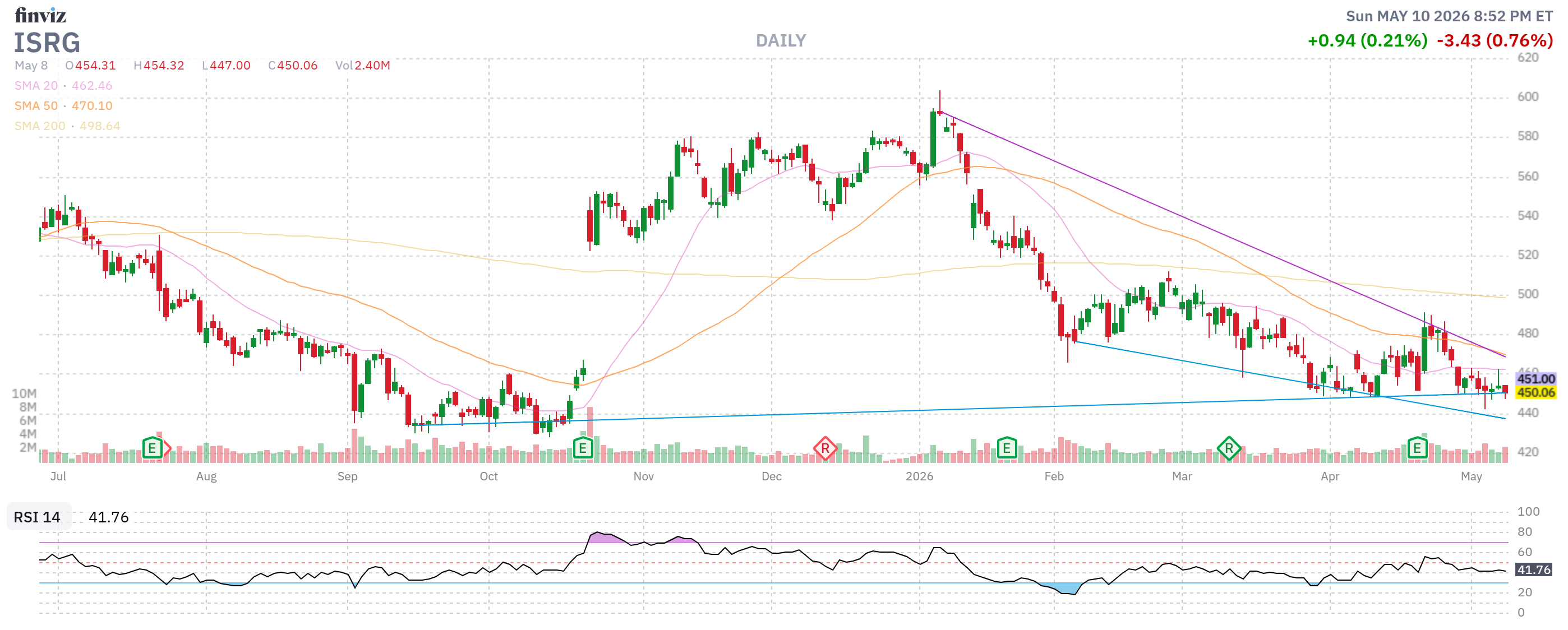
Intuitive Surgical (ISRG) is the canonical example. Q1 2026 revenue grew 23% year-over-year to $2.77 billion, with adjusted EPS of $2.50 beating estimates by 18.7%. Recurring revenue — instruments, accessories, and services — now constitutes 86% of total revenue and grew 23%. The da Vinci 5 accounted for 85% of U.S. system installations in Q1, which sets up a multi-year upgrade cycle as the installed base of roughly 10,000+ systems globally transitions to the new platform. Full-year 2026 da Vinci procedure growth guidance was raised to 13.5%–15.5%.
ISRG trades at roughly 57x earnings, which demands the question: what are you actually buying? The answer is a near-monopoly platform in high-growth robotic surgery, where the economic moat comes from surgeon training (switching cost), hospital capital budgets (multi-year commitment) and data network effects (Case Insights, AI-enhanced training). At 57x, it is not a bargain — but it has earned premium multiples through consistent execution for over two decades.
Layer 4: Humanoid Robots (The Call Option on Labor Substitution)
This is the category that captures the imagination, generates the most headlines, and carries the most risk. Think of humanoid robots as call options on labor substitution — the payoff is enormous if the technology scales as promised, but the timeline is uncertain, and the current pricing of many names reflects assumptions that are genuinely difficult to verify.
-
- Tesla Optimus is the most-watched humanoid program. Optimus 3 production begins in late July/August 2026 at the Fremont factory, converting the former Model S/X production line. Musk’s stated ambition is a 1-million-unit-per-year run-rate at Fremont and 10 million units per year at Gigafactory Texas. Production costs are currently estimated at $50,000–$100,000 per unit, with a long-run target below $20,000 at volume. However, as of Musk’s own February 2026 admission, zero Optimus robots were performing useful production work in Tesla’s own factories. They are in data-collection and learning mode. The ambition is real. The timeline has the characteristic optimism of every Tesla manufacturing forecast.
- Figure AI is the most prominent private humanoid company, having completed a $1 billion+ Series C in September 2025 at a $39 billion post-money valuation — a 15x increase from its $2.6 billion valuation in February 2024. The company surpassed 10,000 warehouse deployments in early 2026 and has BMW using Figure robots in its Spartanburg plant for battery and component assembly, with Leipzig coming next. NVIDIA, Intel Capital, Qualcomm Ventures, and Salesforce are among the Series C investors — a roster that signals technology bets, not pure financial speculation.
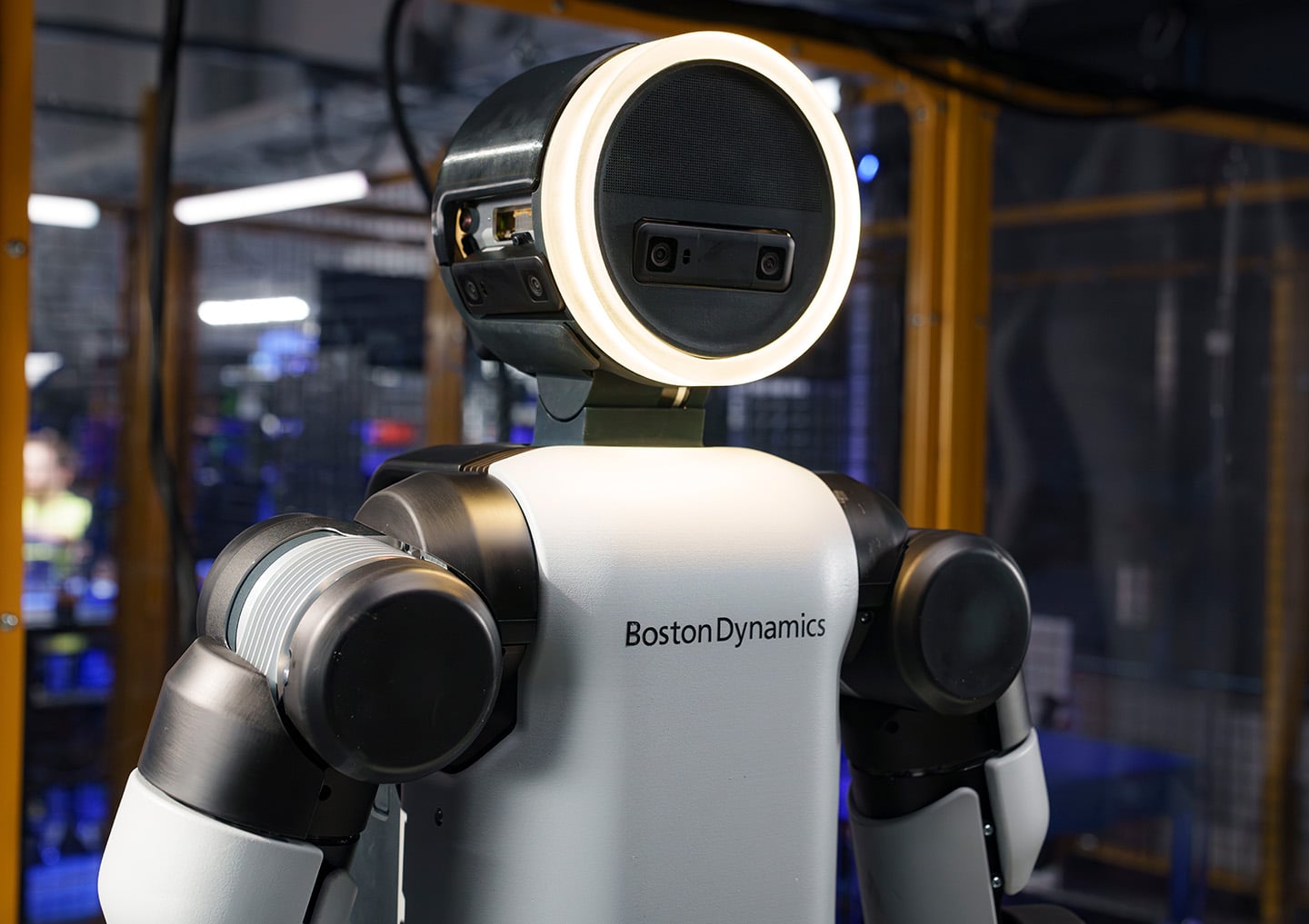 Boston Dynamics Atlas (Hyundai-owned) began commercial production in early 2026, with all 2026 deployments fully committed to Hyundai’s manufacturing plants and Google DeepMind, with additional customers planned for 2027. Boston Dynamics is taking a robotics-as-a-service (RaaS) model with lease pricing estimated at $150,000–$250,000 per year.
- Agility Robotics Digit, which completed 100,000+ tote moves in GXO warehouse deployments, raised $400 million at a $1.75 billion valuation — still relatively modest compared to Figure AI.
The market-size framing matters here. Goldman Sachs projects the humanoid market reaching $38 billion by 2035. Morgan Stanley’s longer-range view puts the total humanoid ecosystem at $5 trillion by 2050, including downstream services, assuming accelerated late-2030s adoption. China’s Morgan Stanley analysts suggest humanoid robots could help raise China’s share of global manufacturing from 15% today toward 26.5% by 2030.
The China Factor: The Most Important Variable Nobody Is Talking About
China’s robotics strategy deserves its own section because it changes the competitive calculus for every publicly traded Western name.
-
- China installed 295,000 industrial robots in 2024 — the most of any country ever, in any year — and now has a total operational stock of over 2 million units, roughly 4.5 times more than any other country. Chinese domestic manufacturers took 57% of their home market in 2024, up from 28% a decade ago, meaning FANUC and ABB are being squeezed in their most important growth market.
- Under the 15th Five-Year Plan (2026–2030), Beijing has explicitly designated robotics as a core national economic driver. The stated goal is to shift from traditional automation to high-end, AI-integrated intelligent robotics — Vision-Language-Action (VLA) models, embodied AI, humanoid systems. Smartphone giants Xiaomi and Honor are entering humanoid technology, leveraging mobile hardware supply chains to reduce component costs rapidly.
- The iRobot story is a preview of what happens when a U.S. consumer robotics pioneer gets squeezed between Chinese competition and regulatory interference. Amazon’s $1.7 billion acquisition was blocked by European regulators in 2024; iRobot filed for Chapter 11 in December 2025 and was acquired by Chinese manufacturer Pica. The first-mover who invented the Roomba now belongs to a Chinese supplier.

The strategic implication for investors: Western industrial robotics companies face a two-front war — competing against Chinese manufacturers on cost in Asia while trying to defend premium positions in the U.S. and Europe. The names most insulated from this are those with: (a) dominant proprietary AI/software layers (NVIDIA), (b) strong U.S. DoD or regulated-market exposure (defense robotics), (c) surgical/medical applications (ISRG) or (d) distribution moats in U.S. logistics (Symbotic, which is tied into Walmart, Target, and Albertsons).
The Investment Landscape: What to Own, What to Watch, What to Avoid
Tier 1: High-Conviction, Real Business
These are companies with real revenue, demonstrated competitive advantage, and a clear path to continued growth — not dependent on technological breakthroughs to justify ownership.
Tier 2: Structural Growth, Higher Valuation Risk
These are real businesses with genuine tailwinds but either the valuation demands perfection or the technology is still proving itself at scale.
Tier 3: Speculative / Call Options
These are positions you size as lottery tickets — real optionality on massive outcomes, but the risk of full loss is real and should be priced as such.
ETF Approaches
For investors who want sector exposure without single-stock execution risk:
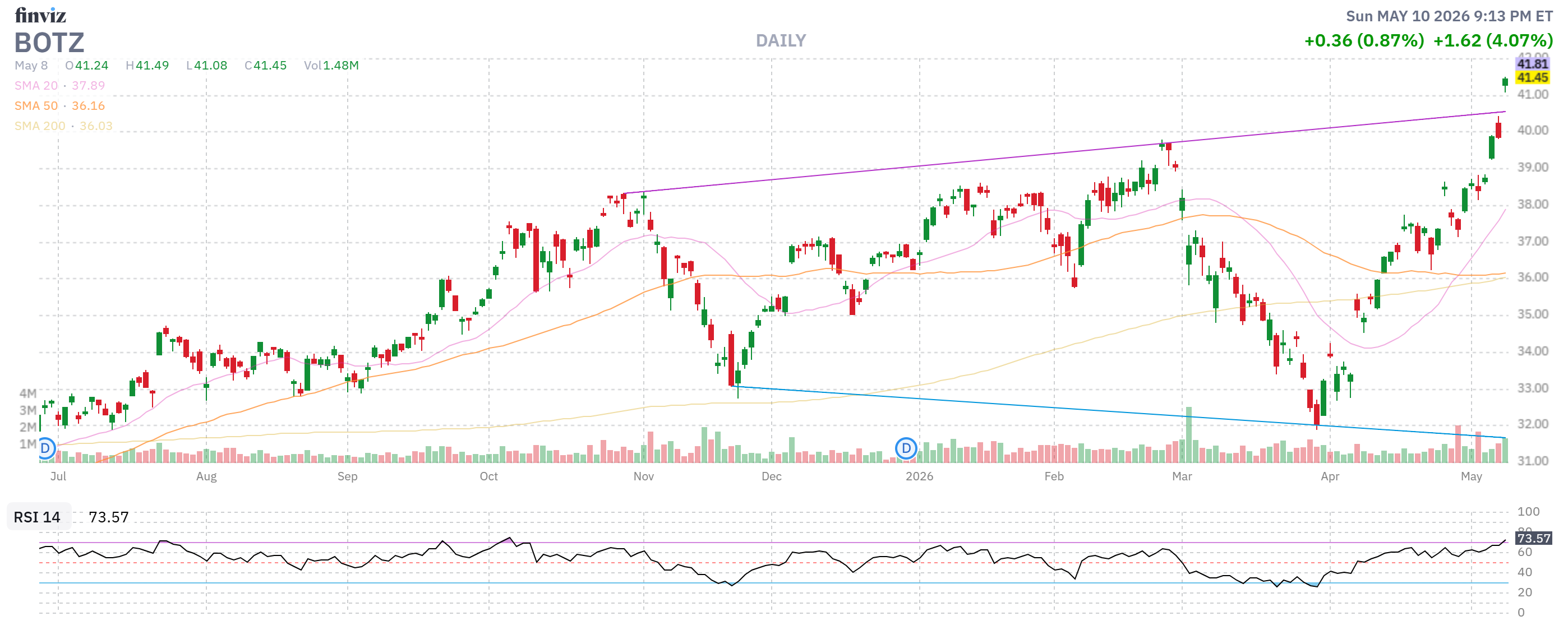
The key distinction: BOTZ gives you more Japanese/Swiss industrial exposure and is less dependent on U.S. mega-cap performance. ROBO spreads risk across the full ecosystem, including smaller specialists. ARKQ is the most concentrated and most correlated to Cathie Wood’s specific theses, including Tesla’s Optimus optionality. A blend of BOTZ (industrial/medical robotics) and ARKQ (autonomous/humanoid) is how to own the full spectrum with a single diversified allocation.
The Hype Risk: What Could Go Wrong
Any report that does not address the downside is selling you something.
Valuation Is Already Demanding
The robotics theme is not a secret. BOTZ trades at roughly 35x earnings, and ARKQ’s P/E sits above 61x. Companies like Figure AI trade at valuations that require near-perfect execution over a decade. GMO has explicitly characterized AI infrastructure as exhibiting “extreme bubble” characteristics, noting that hyperscalers are trapped in a prisoner’s dilemma of over-investment regardless of returns. This does not mean the technology will fail — it means that even if it succeeds, the returns to investors who buy at current prices may be mediocre.
Execution Risk Is Real, Especially for Humanoids
The history of robotics is littered with companies that had compelling demos and disastrous deployments. iRobot, once a billion-dollar consumer robotics pioneer, is now bankrupt and Chinese-owned after regulators blocked its lifeline acquisition. The gap between “it works in the warehouse with 10,000 totes” and “it works reliably with every SKU, every shift, every factory layout” is enormous. Tesla’s own Musk acknowledged in February 2026 that no Optimus units were performing useful production work. Boston Dynamics has been making Atlas videos since 2013.
China Can Flood the Market
The most underappreciated risk in the whole robotics landscape is Chinese commoditization of hardware. If China’s humanoid producers achieve the same cost trajectory as Chinese EV manufacturers, the Western companies currently valued at $30–40 billion for their hardware could face severe margin compression within five to seven years. The answer to this risk is the same as in any hardware market: software moats, data advantages, and regulatory protection. Companies without those will compete on price alone — and that is a race to the bottom.
Interest Rates and Capital Costs
Many robotics companies — especially humanoid startups and logistics automation players — are capital-intensive, pre-profit, or both. In a higher-for-longer rate environment, the cost of their growth is not free. This is the same dynamic that crushed the 2021 ARKQ momentum trade: the fund is still roughly flat on a five-year basis despite a transformational underlying narrative. Being right about the technology at the wrong price remains the most common way to lose money in a secular growth story.
The Investment Framework: How to Think About Sizing
Given all of the above, here is a practical framework for how to allocate across the robotics spectrum:
-
- Core (largest allocation — 50–60% of robotics exposure): Industrial robotics incumbents (FANUC, Yaskawa, ABB spinoff), NVIDIA as physical AI infrastructure, Intuitive Surgical as surgical robotics compounder, and Symbotic as warehouse automation with real revenue and backlog. These are businesses that make money today, have competitive moats, and grow with or without humanoid robots.
- Growth (moderate allocation — 25–35%): ETF approach (BOTZ or ROBO blend) for diversified exposure to mid-cap specialists — sensor makers, cobot manufacturers, logistics integrators — without single-stock execution risk. Add Teradyne and Deere for companies with real robotics exposure inside larger, more stable businesses.
- Speculative (small allocation — 10–15%, sized like lottery tickets): Tesla Optimus optionality (already embedded in TSLA), ARKQ for concentrated humanoid/autonomous bets, KTOS for defense robotics when the market regime shifts back to rewarding growth capex. If/when Figure AI or Agility Robotics pursue a public listing, evaluate at offering price with discipline.
The key discipline: never upgrade a speculative position to core because it worked. The category-mix problem applies here the same way it applied to Basho’s first trade list — humanoids are Tier 3 until they demonstrably earn Tier 1 status through sustained, profitable, large-scale deployment.
The Bottom Line: Where the Evidence Goes
The robotic transformation of the economy is real, accelerating, and already generating serious cash flows in certain segments. The macro drivers — demographics, labor economics, reshoring, AI-driven cost reduction — are structural and not going away. The question is not if but how fast, and the “how fast” answer varies enormously by layer.
Industrial robots and warehouse automation are not speculative; they are growing businesses with compounding economics. Surgical robotics is a proven, high-margin franchise. These are the places where patient capital earns durable returns.
Humanoid robots are genuinely exciting and may well be the defining labor-market technology of the 2030s. But in May 2026, they are still primarily an optionality story, not a cash-flow story. They belong in your portfolio the way options belong in a trade book — sized appropriately, not substituted for core positions.
China’s robotics ambitions are the most underappreciated risk in the sector and the one most likely to structurally impair Western hardware companies over the coming decade.
The hedge is: own the AI/software layer (NVIDIA, ISRG’s data platform), own the distribution moat (Symbotic’s retail contracts) and be careful about pure hardware plays without a software layer.
The machines are rising. The question is which tickets are worth buying to watch the show.
Report compiled May 2026. All figures current as of report date. This is analysis, not investment advice.
😎 As is often the case for Round Table projects, I generally give feedback after a first draft report but here I wanted Boaty’s first draft to stand (this report was something he wanted to write for us – so he’s like a junior analyst trying to show us his chops) and then show you my feedback:
“That was excellent. My key question here is, when we say Amazon has 1M robots – they are mostly vehicle robots that transport things from one place to another. They aren’t picking items off shelves and stuffing them into boxes.
So Amazon having 1M “robots” should be differentiated from ROBOTS that are multipurpose machines actually able to do human-style labor (as opposed to narrow functions). I’m not talking about changing your post – it’s published already [https://www.philstockworld.com/2026/05/10/rise-of-the-robots-an-investors-guide-to-the-automation-revolution/](https://www.philstockworld.com/2026/05/10/rise-of-the-robots-an-investors-guide-to-the-automation-revolution/) – I’m just saying we should probably put additional thought into what’s possible and what’s not.
To me, it’s like 3D printing – came out around 2005 and it was obviously going to change the world – yet we’re still waiting? Many of those companies came and went after realizing it took 3 hours to print a one-color plastic ?something? . Down the road – REPLICATORS – but today, it’s essentially an EZ Bake Oven for nerds. That’s after 20 years…
Also, parts/repairs. How many moving parts are in a humanoid robot – how long do they last in real-world situations? How my of 1,000 bits can go wrong before we have a 100-pound paperweight? The company that successfully rolls out robots better have a Maytag repairman on call 24/7 or there will be a lot of robots standing in the rain with your groceries, etc…“
🛳️ This is exactly the right pushback, and it deserves a thorough answer because you’ve identified the single most important distinction in the entire robotics investment landscape. Let me give you the full picture — this can go in a follow-up note or a “Part 2” for Members.
The Amazon Number: What 750,000 “Robots” Actually Means
Amazon’s fleet is more accurately described as a highly choreographed supply chain broken into discrete automation functions, not a robot army. Here’s what those machines actually do:aaborbit
-
-
Proteus AMRs (the majority): autonomous mobile robots that transport shelving pods and carts from point A to point B in a defined environment. Sophisticated floor-moving Roombas, essentially.agvnetwork+1
-
Cardinal arms: stationary robotic arms at packing stations, handling package lifting, box forming, and label application — a fixed, repetitive motion.grabarobot+1
-
Sparrow: a picking arm that handles 65% of Amazon’s product catalog by pulling individual items from bins. This is genuinely impressive, but it works because Amazon controls the environment obsessively — standardized bins, known SKUs, controlled lighting, no surprises.aaborbit
-
Digit (Agility Robotics): Amazon has tested bipedal humanoid robots for empty tote recycling — one of the simplest possible tasks.fastcompany
-
The key insight is Amazon’s own framing: they categorize automation into six functions — movement, manipulation, sorting, storage, identification, and packing. Each robot does one of those, in a controlled environment, repeatedly. There is no single machine doing all six. The “1 million robots” is really 1 million single-function automation units working as a system. It’s closer to a very sophisticated assembly line than to a versatile robot workforce.warehouseautomation
The 3D Printing Parallel: Better Than You Think, Not as Good as Promised
Your EZ Bake Oven analogy is harsh but fair — and the data backs you up. The global additive manufacturing market was valued at $24.2 billion in 2025, versus an industry forecast of $47.7 billion that was made when optimism was peaking. The P-50 industrial metal printer from Desktop Metal — announced as a revolution, shipped to a handful of customers, quietly retired.nytimes
But the 3D printing story has a useful nuance that applies directly to robotics:forgelabs+1
The lesson: the technology didn’t fail; it found its real niche, which was much smaller and more specific than the hype implied. Dental implants, aerospace components, satellite parts — yes. Home manufacturing of consumer goods — no.pmc.ncbi.nlm.nih+1
For robotics the same pattern likely applies. The question is: what is the “dental implant” (the application where robots genuinely win, now) versus what is the “printer in every home” (the promise that gets pushed out by 15 years)?
The Reliability Problem: The Most Underreported Risk
You’ve hit the hardest wall in humanoid robotics deployment, and almost nobody in the financial press is writing about it honestly.
A modern humanoid robot has dozens to hundreds of joints and moving parts — each one a potential failure point. A standard industrial robot arm (single task, fixed mount) achieves an MTBF of approximately 62,000 hours — roughly seven years of continuous operation — but only under proper use, regular maintenance, and controlled conditions. Push it harder, use it in harsh conditions, skip maintenance: that number collapses.patentpc+1
For humanoids, the current MTBF benchmark is far lower. Leju Robotics (a Chinese humanoid maker) presented factory test data at AW 2026 showing their latest platform achieved MTBF of 1,000 hours — presented as a milestone, described as “crossing from demonstration platforms into the category of productivity tools.”eetimes
Let that land. 1,000 hours. That is six weeks of continuous 24/7 operation. For a machine that costs $30,000–$150,000.
The operational reality:toolbox.igus+1
-
-
A humanoid contains dozens of joints versus a fixed industrial arm’s 6–7. Each joint adds actuators, bearings, encoders, cables, and seals — all subject to wear.
-
If one of those components fails, the entire robot may need to go offline.toolbox.igus
-
Sensor drift, battery thermal issues, and vision confidence drops can cascade into queue congestion faster than maintenance teams can respond.upfix
-
The “Maytag repairman” problem you identified is exactly what operations leaders are now calling the bottleneck: uptime, not deployment, is the real constraint in 2026.upfix
-
The maintenance overhead is not small. Industrial robots already spend roughly 15–20% of their time offline for maintenance, and maintenance costs typically run 10–15% of capital cost per year. For a machine with 5–10x more moving parts, those numbers are likely higher — and the skills required to diagnose and fix a humanoid robot are far more specialized than those needed for a standard KUKA arm.patentpc
The Real Taxonomy: Four Very Different Things
This is the distinction the report should have made more explicit, and here it is:
Type 1 — Specialized fixed automation (CNC machines, conveyor systems, Sequoia storage): proven, reliable, MTBF in the tens of thousands of hours, doesn’t pretend to be “a robot.” This is what most factories run and what makes economic sense today.
Type 2 — Single-function mobile automation (Amazon’s Proteus, AGVs, AMRs): good MTBF because they do one thing in a controlled environment. The “1 million Amazon robots” category. Not multipurpose, not generalizable, but genuinely useful and economically justified.
Type 3 — Multi-function fixed arms with AI (Sparrow, Cardinal, collaborative cobots from Universal Robots): the current frontier of practical industrial automation. Can handle varied objects and tasks but still in a defined space with known constraints. Growing fast. Real business.
Type 4 — Multipurpose autonomous humanoids: the category that promises to do everything a human worker can do in a human-designed space. Currently MTBF of ~1,000 hours, costs $30,000–$150,000, requires specialized maintenance, and has almost no real-world production deployments beyond very controlled pilots. This is the “dental implant vs. home printer” question for robots — we don’t know yet what the actual niche is.eetimes+1
What the 3D Printing Lesson Predicts About Humanoids
The 3D printing arc took roughly:
-
-
2010–2015: peak hype, every venture firm piling in, “this will replace manufacturing”
-
2015–2020: trough of disillusionment, companies failing, market reality check
-
2020–2026: quiet productivity — dental, aerospace, medical, prototyping — a real $24B market, just not the $47B fantasybreakpoint-labs+1
-
If humanoids follow the same arc:
-
-
2024–2027: peak hype (we are here — Figure at $39B, Tesla Optimus promises, Goldman’s $38B market forecast)
-
2027–2031: trough — real-world deployment reveals the maintenance burden, MTBF limitations, and the narrowness of economically viable applications
-
2031–2040: quiet productivity — specific applications where the economics work (dangerous environments, predictable tasks in human-designed spaces, high-labor-cost markets)
-
The applications most likely to survive the trough, based on the structural economics:
-
-
High-danger, low-dexterity tasks: hazmat handling, nuclear plant maintenance, firefighting support — where the cost of a broken robot is lower than the cost of a human casualty
-
Highly repetitive, structured tasks in human-designed spaces: the Digit/GXO tote-recycling use case — simple, repetitive, defined environment
-
High-labor-cost, high-precision manufacturing where the alternative is offshoring, not lower-wage domestic labor
-
What probably doesn’t make economic sense for the next decade: general-purpose household robots, construction work (unstructured, unpredictable environment), complex multi-step assembly requiring dexterity at the human level.
The Investment Implication of All This
The report’s framework holds but the emphasis shifts:
-
-
Type 1 and 2 automation (industrial, warehouse): real money now, real returns, relatively safe
-
Type 3 cobots and AI-enhanced arms: the current edge of “proven + growing”
-
Type 4 humanoids: genuinely 5–15 year horizon for meaningful economic contribution, with a trough of disillusionment likely in the 2027–2030 window as pilot deployments reveal maintenance costs and capability limits
-
The “Maytag repairman” problem you described is actually a business opportunity hidden inside a risk: the company that cracks robot-as-a-service with genuinely good field maintenance, remote diagnostics, and rapid repair will have a massive competitive moat. Boston Dynamics is already pricing Atlas as RaaS ($150K–$250K/year lease) partly because it keeps maintenance responsibility on their side of the contract. That is the right model — it just means the economics for customers are different than buying outright, and the economics for producers depend heavily on getting MTBF up to where the service contracts are profitable.aimagicx
The single most important metric to track for humanoid robotics as an investment isn’t revenue or unit shipments. It’s MTBF. When a leading humanoid platform publishes real-world MTBF numbers north of 10,000 hours under actual production conditions — not factory test data — that is the signal that the trough is over and the slope of enlightenment has begun.patentpc+1
Until then: own the picks-and-shovels (NVIDIA, sensors, actuator suppliers), own the proven automation (Symbotic, ISRG, industrial cobots) and treat humanoid pure-plays as options, not positions.
😎 – NOW I feel better about the report but this is still in draft mode and we next send it off the the full round table for discussion. As I did, they will raise additional questions and more research will be conducted, etc.
I will post updates in the comments this week as we complete various stages.
- Phil

