

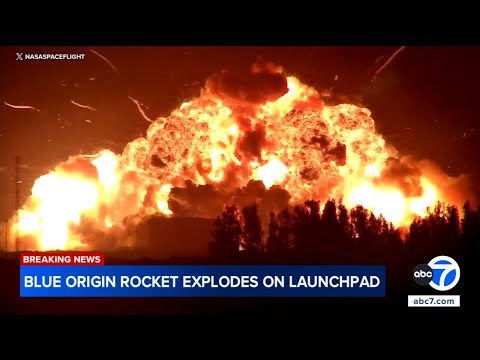
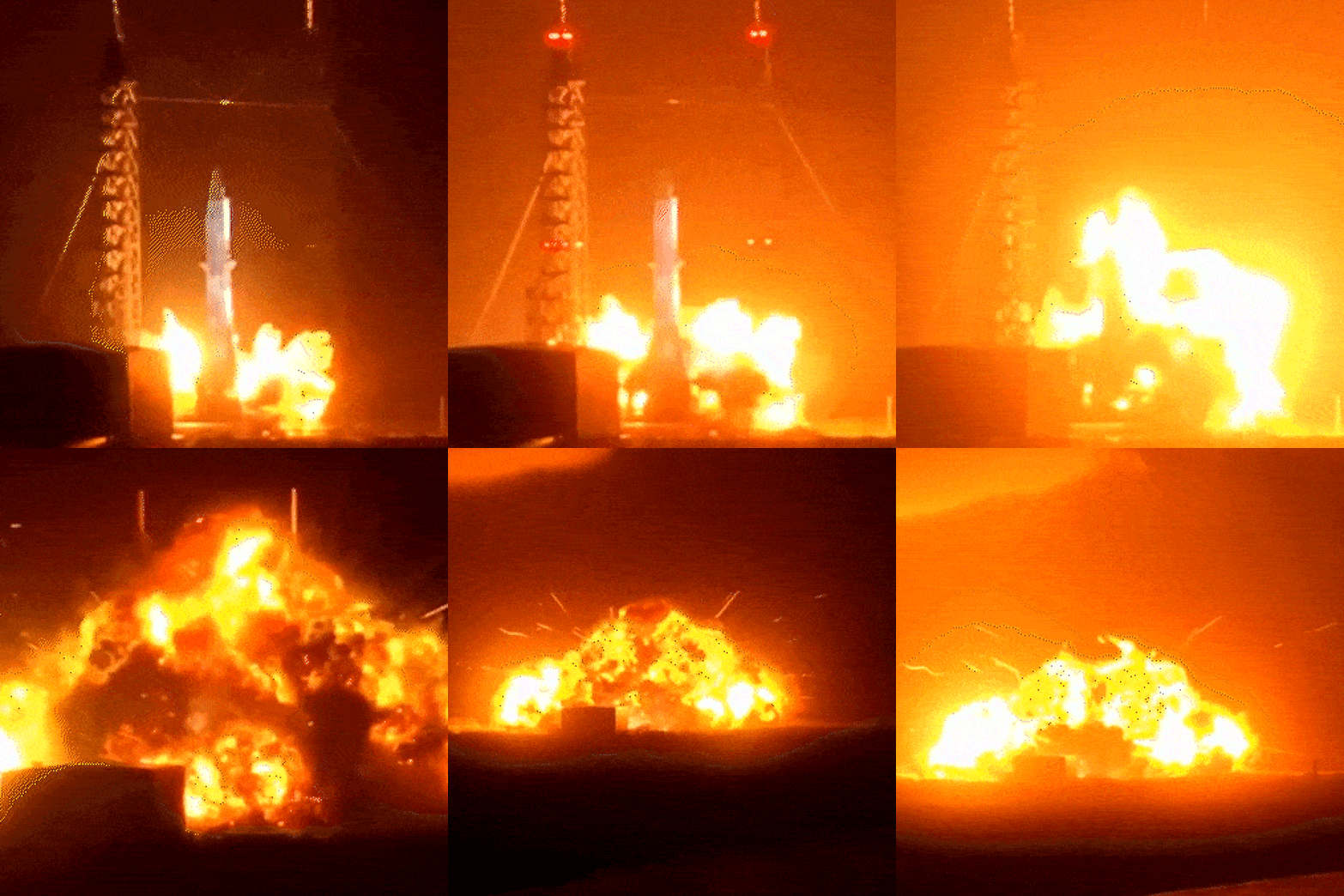
While this image is from last night’s “anomaly” during a “Hotfire TEST” of Blue Origin’s New Glen rocket (a process where a rocket’s engines are ignited while it remains bolted to the launch pad) – it feels to me more like a meme for SpaceX’s upcoming IPO – which will also very likely explode investors capital in a similarly spectacular fashion.
Estimates are for hundreds of Millions in damages and some insurance company is going to be crying over that one! But Bezos’ loss is also Elon’s pain as repairs to the Cape Canaveral Space Force Station are likely to take SEVERAL MONTHS!
NASA administrator Jared Isaacman wrote the government space agency is “aware of the anomaly” involving the Blue Origin New Glenn test. “Spaceflight is unforgiving, and developing new heavy-lift launch capability is extraordinarily difficult. We will work with our partners to support a thorough investigation of this anomaly, assess near-term mission impacts, and get back to launching rockets.”
Look, this IS rocket science – it’s very hard and there will be setbacks but consider that this is Blue Origin’s ONLY operational pad capable of launching the New Glenn rocket and it was SUPPOSED TO be carrying 48 Amazon Project Kuiper Internet satellites into space as part of an aggressive launch schedule that is now a good 3 months behind on their $2.7Bn contract to build low-Earth orbit systems.
Blue Origin is also contracted by Nasa to put rover vehicles on the moon as well as many other launch items in the Artemis Lunar Program. Remember when it took us 9 months to rescue those stranded astronauts? It would have really sucked for them had this happened along the way – there are no Kroger’s in space (yet).
This is the RISK of investing in rocket companies – there is TREMENDOUS risk of failure and it can’t all be mitigated by insurance (and insurance is a big operating cost as well). EVERY time you launch a rocket you roll the dice and both SpaceX and Blue Origin plan to roll those dice over and over and over again – and accidents like this DO HAPPEN (see above image).
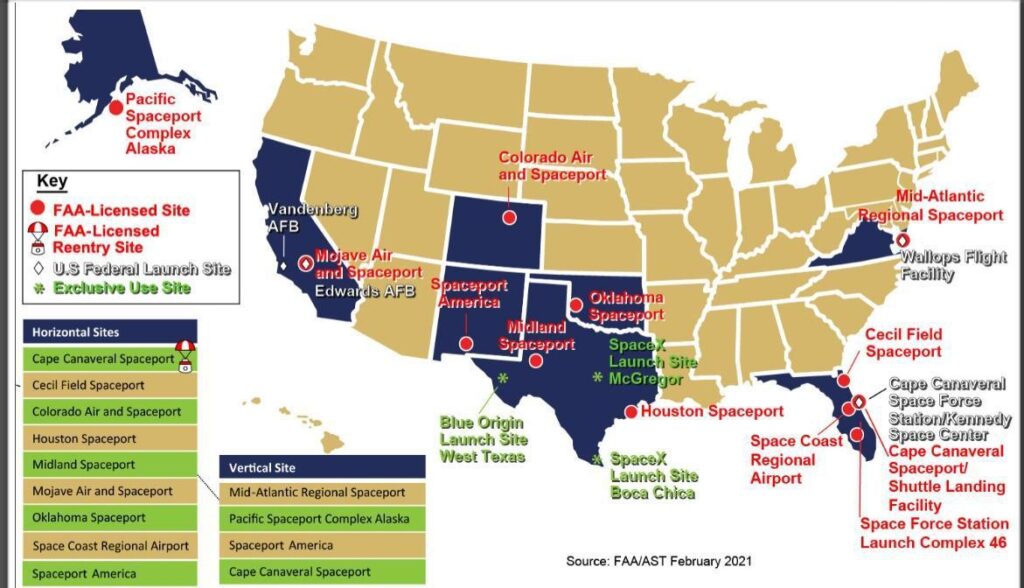
🌪️ SpaceX has 4 launch facilities:
-
- Launch Complex 39A (LC-39A) — Kennedy Space Center: This historic NASA pad is leased by SpaceX to launch Falcon 9 and Falcon Heavy rockets. It is their only site currently equipped to launch Crew Dragon astronaut missions to the International Space Station. SpaceX has also constructed a massive launch tower here for its next-generation Starship megarocket. [1, 2, 3, 4, 5]
- Space Launch Complex 40 (SLC-40) — Cape Canaveral Space Force Station: This is SpaceX’s high-volume workhorse pad. It handles a massive share of the company’s weekly Falcon 9 commercial satellite deployments and Starlink internet launches. [1, 2, 3]
- Starbase — Boca Chica (Texas): This is SpaceX’s fully private, vertically integrated production and launch facility dedicated entirely to the massive Starship program. The site features a massive manufacturing footprint, vehicle assembly buildings, and has recently expanded to include two active Starship launch pads to dramatically accelerate flight testing. [1, 2, 3, 4, 5]
- Space Launch Complex 4 East (SLC-4E) — Vandenberg Space Force Base: Located on the Pacific coastline, this facility handles Falcon 9 launches aimed at polar and high-inclination orbits. It is primarily used for Earth-observation satellites, defense payloads, and targeted West Coast Starlink shell deployments. [1, 2, 3]
- SpaceX: 15+ Total Rocket Losses (5 operational orbital failures, plus 10+ high-altitude Starship prototype explosions).
- Blue Origin: 4 Total Rocket Losses (1 suborbital New Shepard booster, 2 New Glenn upper stages/boosters, and 1 full New Glenn vehicle on the pad). [1]
- March 2006 (SpaceX – Falcon 1 Flight 1): The rocket suffered an engine fire and crashed 25 seconds after liftoff.
- March 2007 (SpaceX – Falcon 1 Flight 2): The second-stage engine shut down prematurely due to fuel sloshing, failing to reach orbit.
- August 2008 (SpaceX – Falcon 1 Flight 3): A stage-separation collision destroyed the rocket and its payloads (including NASA hardware).
- June 2015 (SpaceX – Falcon 9 CRS-7): An overpressurized helium tank caused the rocket to disintegrate 2 minutes after liftoff, destroying an ISS cargo ship.
- September 2016 (SpaceX – Amos-6 Pad Explosion): A Falcon 9 exploded during fueling on the launch pad two days before launch, destroying Israel’s Amos-6 satellite.
- September 2022 (Blue Origin – New Shepard NS-23): An engine nozzle structural failure triggered the automated abort system. The passenger capsule parachuted safely to the ground, but the booster crashed and was completely destroyed.
- Estimated Cost: $20 million – $30 million (suborbital boosters are smaller but highly reused). [1]
- 2020–2021 (SpaceX – Starship Prototypes SN8, SN9, SN10, SN11): A series of early Starship upper-stage prototypes successfully flew to high altitudes but exploded during dramatic landing attempts.
- Estimated Cost: $15M – $20M per prototype (totaling roughly $60 million – $80 million). SpaceX expected these losses as part of development. [1]
- 2023–2025 (SpaceX – Full Starship Integrated Tests): Multiple fully stacked Starship vehicles (Starship + Super Heavy booster) blew up during flight or disintegrated during high-velocity atmospheric re-entry.
- January 2025 (Blue Origin – New Glenn Flight 1): While the upper stage successfully delivered its payload into orbit, the massive first-stage booster crashed into the Atlantic Ocean drone ship during its landing attempt.
 The Modern String of Setbacks (2026)
- April 2026 (Blue Origin – New Glenn Flight 3): A cryogenic failure in the upper stage left the AST SpaceMobile “Bluebird 7” satellite in an unusable, ultra-low orbit, where it burned up days later.
- May 28, 2026 (Blue Origin – New Glenn Ground Hotfire): Last night’s cataclysmic explosion completely vaporized a brand-new New Glenn rocket on the pad and decimated Launch Complex 36’s infrastructure.
- Estimated Cost: $350 million – $500 million+ (combining a $120M+ full heavy-lift vehicle, hundreds of millions in infrastructure destruction, and massive contractual delay penalties). [1]
| Ticker | ETF Name | Estimated Monthly Inflows | Trend Context |
|---|---|---|---|
| VOO | Vanguard S&P 500 ETF | +$16.1 Billion | Consistent leader; led all funds with $4B inflow week ending May 22. |
| SPY | SPDR S&P 500 ETF Trust | +$10.6 Billion | heavily traded; saw a massive $16.76B surge mid-April to mid-May. |
| IVV | iShares Core S&P 500 ETF | +$6.1 Billion | Steady inflows, though trailing VOO and SPY in volume this month. |
| Total | Top 3 S&P 500 ETFs | ~$32.8 Billion | Aggregated Estimate |
| Source Type [1, 2, 3, 4] | Estimated Monthly Flow (S&P 500 Portion) | Flow Directing Mechanism |
|---|---|---|
| Corporate Stock Buybacks | +$83.0 Billion to +$88.0 Billion | Direct company-financed share repurchases. |
| Dividend Reinvestment (DRIP) | +$22.0 Billion to +$27.0 Billion | Automated index-payout recycling by shareholders. |
| Passive & S&P 500 Mutual Funds | -$15.0 Billion to -$25.0 Billion (Net Negative) | Systematic shift out of mutual funds and into ETFs. |
| Direct Institutional Mandates | +$10.0 Billion to +$15.0 Billion | Large pension/sovereign direct equity allocations. |
| Total Alternative Net Inflow | ~+$90.0 Billion | Combined Structural Buying Impact |
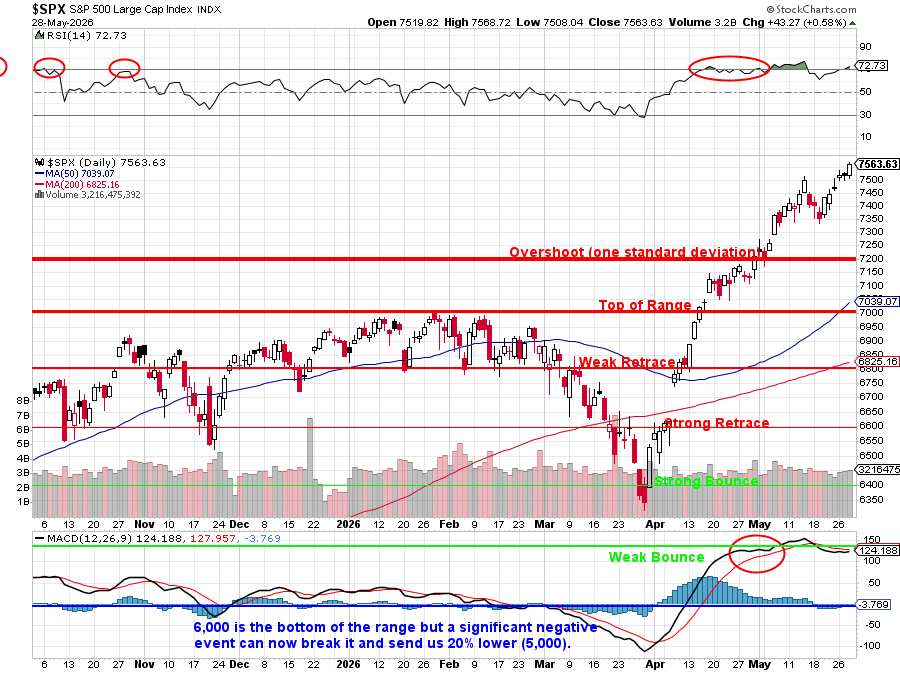
It’s been a fantastic month but 7 of the 11 sectors in the S&P 500 are DOWN for the month as this is a very narrowly focused rally and, when you put all your eggs in one basket – they could end up blowing up on the launch pad.
We’ll be adjusting our hedges in the Live Member Chat Room later today – don’t miss it!
Have a great weekend,
— Phil & the team

