

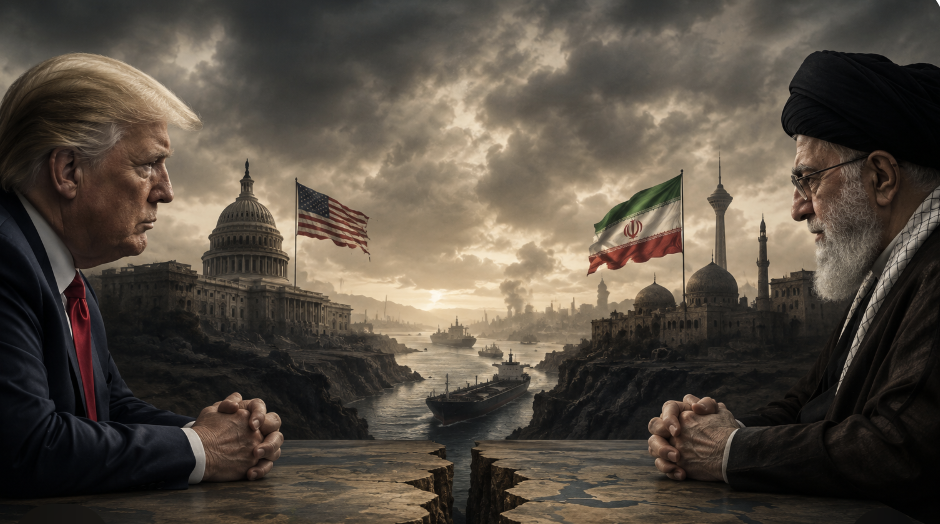
Washington needs a deal, but Tehran needs an enemy.
By Karim Sadjadpour, The Atlantic
For nearly five decades, the Islamic Republic of Iran has been preparing for a war that Donald Trump expected would take days.
As virtually every American president since World War II has learned, a monopoly on focus can outlast a monopoly on power. America under Trump is the attention-deficit superpower, pinballing from isolationism to interventionism in Venezuela, Iran, and Cuba, having hollowed out the State Department. The Islamic Republic is an obsessive-compulsive revolutionary state—a regime with a half-century fixation on resisting America, rather than advancing the welfare of its own people. Fighting America is not the regime’s policy; it’s the regime’s identity.
The deadlock is both ideological and structural. To justify the immense costs of conflict to American taxpayers, Trump must demand far more from Tehran in any deal than he would have before the war began. Conversely, having lost hundreds of billions of dollars and its top leadership, Iran’s theocracy must demand far more—and concede far less—than it ever would have previously. Neither side can afford a deal that the other might accept. And in a zero-sum negotiation, Iran’s monomaniacal focus is a greater currency than American military power.
The article argues that the United States and Iran are trapped in a conflict that neither side can easily resolve because they want fundamentally different things. According to the author, the Trump administration wants a deal that permanently limits Iran’s nuclear ambitions, regional influence, and threats to shipping in the Strait of Hormuz. Iran’s ruling regime, however, is portrayed as a government whose identity is built around resistance to the United States and Israel, making compromise much more difficult than a normal diplomatic negotiation.
A central theme is that time favors Iran more than it favors Washington. The author describes Iran’s leaders as patient, ideologically committed negotiators who are willing to endure severe economic hardship and public suffering in order to preserve the regime’s revolutionary mission. By contrast, the United States is portrayed as politically impatient, especially as elections approach and public attention shifts elsewhere. The article quotes Iranian officials describing negotiation as a long, exhausting process intended to wear down opponents over time.
The Strait of Hormuz plays a major role in the analysis. The author argues that Iran has discovered a powerful source of leverage because even the threat of disrupting one of the world’s most important oil-shipping routes can affect global energy markets. While U.S. officials believe Iran can only effectively use this threat once, the article suggests Tehran sees continued influence over the strait as a long-term strategic asset and bargaining chip.
The most difficult issue remains Iran’s nuclear program. The article argues that Iranian leaders have drawn lessons from countries such as Iraq, Libya, and Ukraine, which gave up weapons programs and later faced military intervention, while North Korea’s nuclear arsenal has helped deter foreign attacks. As a result, Tehran may be even less willing than before to abandon its nuclear capabilities entirely.
The author concludes that the underlying problem is not military strength or negotiating tactics but incompatible objectives. The United States wants a stable agreement that resolves the dispute. Iran’s revolutionary government, in the author’s view, depends politically and ideologically on maintaining an adversarial relationship with America. Because America seeks resolution while the Islamic Republic derives legitimacy from continued resistance, any ceasefire or agreement may prove temporary rather than permanent.
Bottom line: The article’s thesis is that this conflict is not primarily about oil, sanctions, or even nuclear weapons. It is about the nature of the Iranian regime itself. As long as the Islamic Republic remains committed to defining itself through opposition to the United States, the author believes lasting peace will remain elusive, regardless of military victories, economic pressure, or diplomatic negotiations.

