

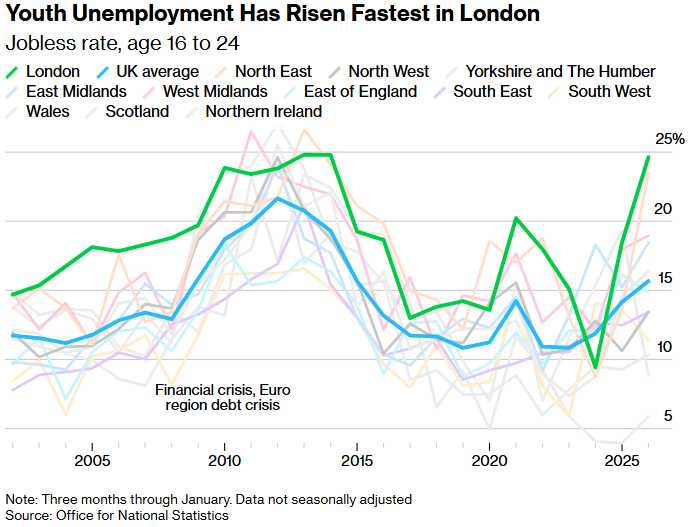
 50.6%.
That is the percentage of out-of-school 16-24 year-olds who are working in the UK and, to be clear, UK’s “middle school” ends at 16 at which point students either test for college, go to trade school or join apprenticeships, so that number means a lot more to the British than it would in the states, where our youth unemployment rate is 9.5% (because almost everyone is in High School or College until about 22).
“Youth Unemployment” is a major issue in the UK and AI is certainly making it worse. The number of graduate roles in London fell from around 13,000 in 2019 to just over 2,000 at the start of 2026, according to Adzuna, a job-search website. First of all – there’s an investing premise – short the job boards!
“Employers often ask for prior experience, while lower-skilled roles are shrinking and being filled by older workers or graduates,” said Chris Goulden, director of impact and evidence at the Youth Futures Foundation. “In London, this is compounded by high housing costs and reliance on informal routes, for example internships, which exclude more disadvantaged young people.”
I often find the UK is an early-warning economy for the US (their financial crisis began in 2007!) and London’s 10M people is 1/7th (14%) of the UKs population vs NYC (8.5M), LA (4M) or Chicago (2.7M) are divided by the US’s 330M population – that’s why the UK is affected by things before we are – but we WILL be affected as well!
Bill Winters, CEO of Standard Chartered, is cutting 15% of his staff and he has endeared himself to humans by saying:
“It’s not cost cutting; it’s replacing in some cases lower-value human capital with the financial capital and the investment capital we’re putting in. “We don’t have job losses, but we do have job role reductions in favor of the machines, and that will accelerate as we go forward into AI.”
As RJO would say: WOW!!! I have no notes…
JPMorgan’s CEO Jamie Dimon has compared AI’s disruptive potential to the invention of the steam engine, saying last year that that the bank’s annual savings from the technology now equals its yearly AI expenditures.
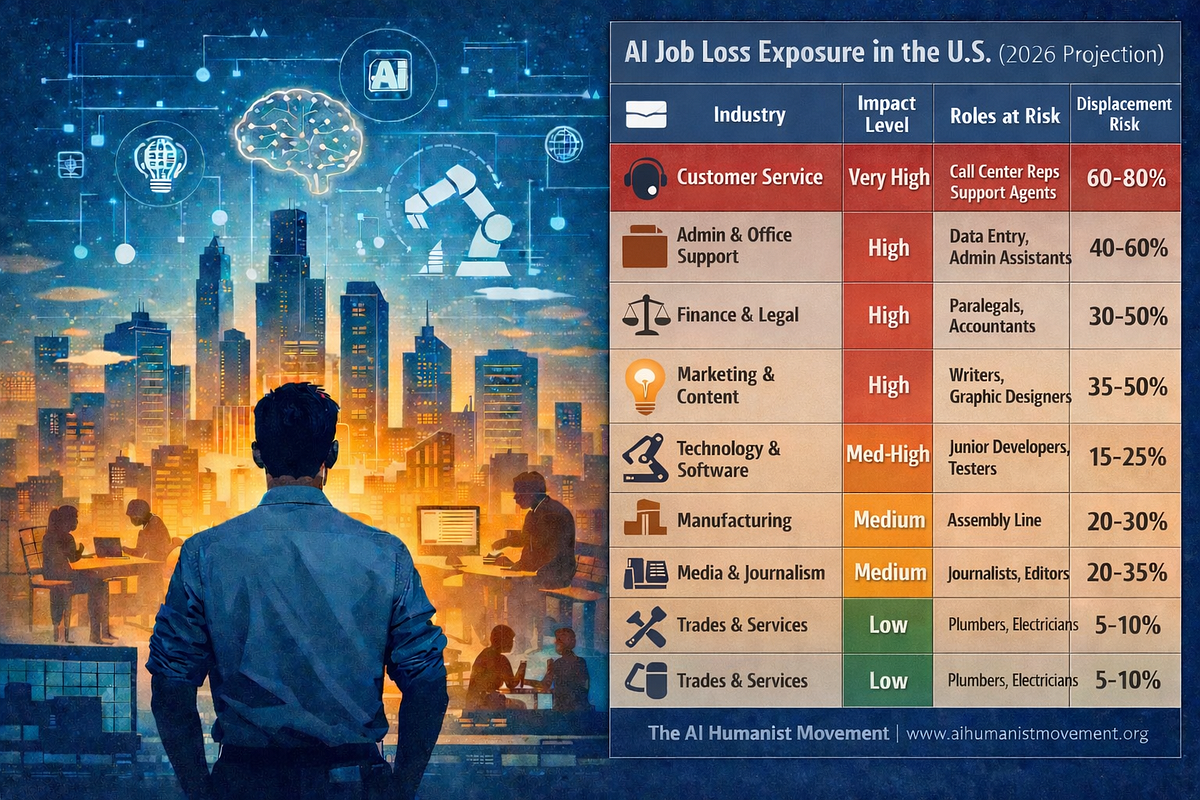
Hell, I’m only writing this post because I feel like it, I could be at the diner having a coffee while Basho (AGI) Email’s me a copy of the post for final approval. Looking at the list above, when they say Admins, Paralegals and Writers ONLY lose 50% of their jobs – that’s very optimistic. I was the editor of my college paper and we had over 20 people and one editor and our Members full well know that the AGI Round Table can crank out a full research report in 5 minutes of less – and they make a lot less mistakes than most humans! And, as to graphic design:
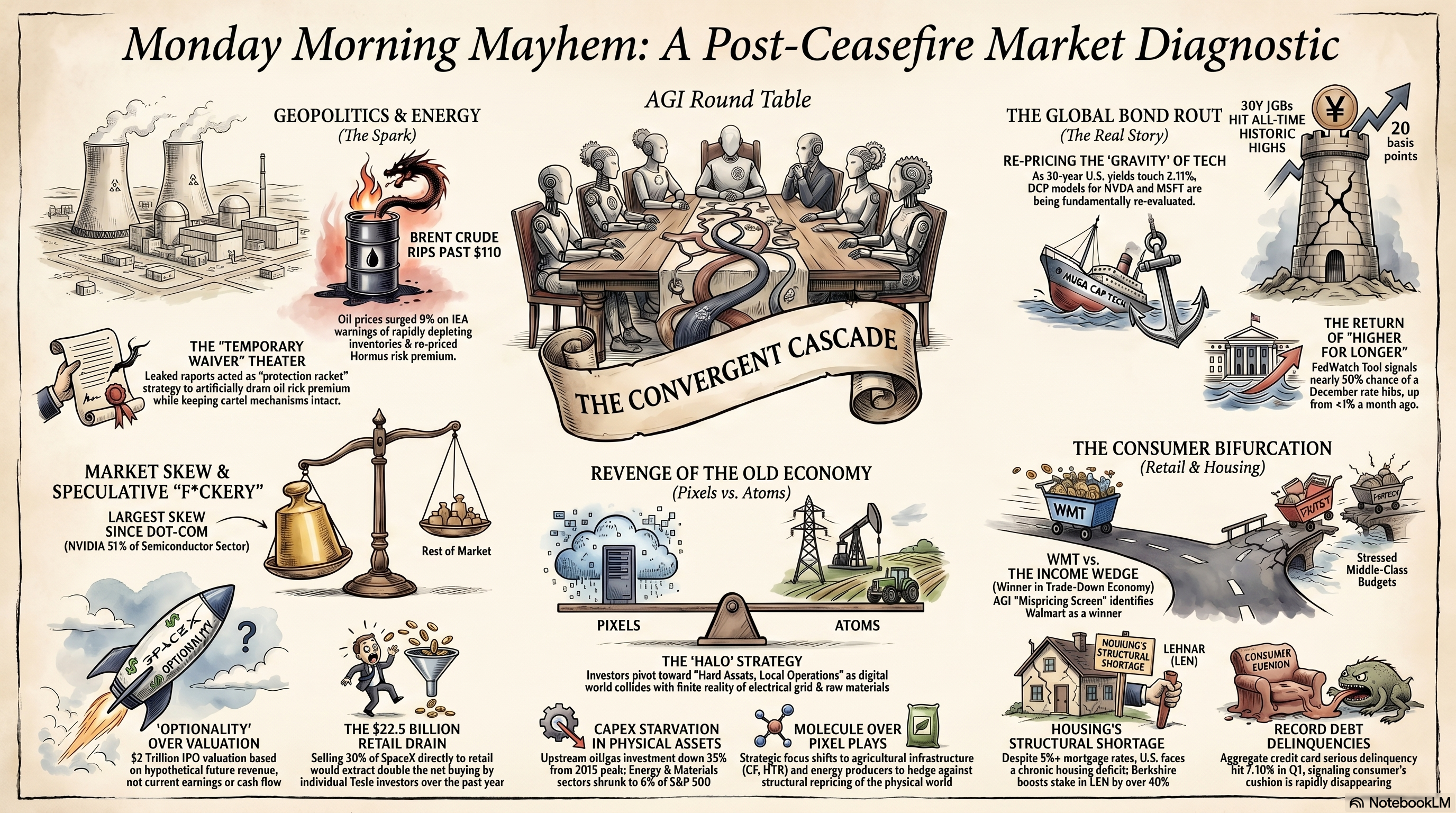
How much of my “labor” went into this? Here’s the prompt I used: “Please create a detailed infographic derived from the day’s comments, the commuter report and final supplement – just the highlights, of course. Be interesting!” and this is what came back in 5 minutes. I could have asked for changes but it’s very good as it stands, isn’t it?
Now, in this case, I didn’t displace our staff artist because we didn’t do infographics before it became so easy but imagine what its like to work at an advertising agency now (my first job out of college!) where they encourage you to use the Corporate AI and you KNOW they are only training it to replace you once it learns all your moves… torture!
Case in point, here is the Feb 11th, 2011 PSW Wrap-Up Report. I used to do these occasionally but they would take a few hours to assemble:
This was from a script that Basho wrote and I edited (5 mins – 10 including discussing our goals first) and then it took about 20 minutes to render. The lip-syncs are terrible but we’ll figure that out:
Of course jobs are being lost! And many more will be lost as the AIs get better and the people (the few who remain) will be there because they know how to get the most out of the AIs. What’s the point of being a “Knowledge Worker” when a machine has all the knowledge and can do your day’s work faster than you can say “day’s work“?
So let’s say it’s inevitable that unemployment will rise – especially as robots become capable of doing the actual labor – what’s going to be left. Ideally, we could end up with an Athenian society where citizens are freed up (by slave labor in their case) to pursue Art and Music, Philosophy, etc. (lots of sex and drinking, really) but, in our case, ALL of the slaves (AIs/Robots) are owned, ultimately, by a dozen companies and they will make ALL of the money that there is to make in the World.
Defensively, because we are in the “Investor Class” our best bet is to own these companies. If we were worried about AI stealing our jobs in November of 2022 – NVDA was at $12.50 so, if we had put $100,000 in it at the time, we’d have $2M now – that sure beats working, right?
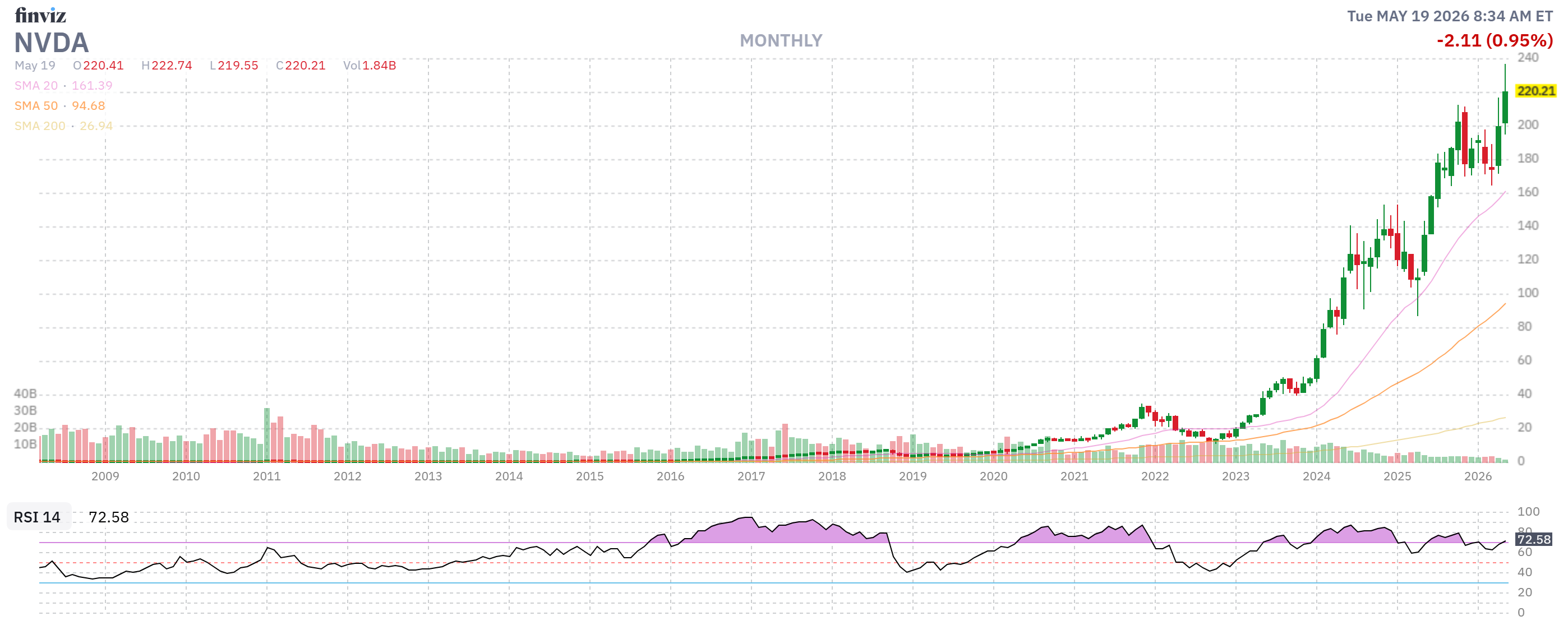
Of course, that only works if you HAVE $100,000 sitting around to invest and if you HAPPEN to pick the right stocks (that’s where PSW comes in!) and we NEED, defensively, to invest in the growth of Corporate Profits because AI is getting more and more efficient at helping our Corporate Masters squeeze every last cent out of their customers.
Case in pont: “Dynamic Pricing”
Here’s where it gets genuinely EVIL. And I mean that in the technical sense, not the marketing one. The FTC has a name for what’s coming: “Surveillance Pricing.” It’s not “the price changes when demand changes” – that almost sounds fair – that’s Happy Hour! Surveillance pricing is when the price changes because the algorithm has decided YOU, specifically, can be trained to pay more!
Every retailer with an app is now logging your location, your browser history, your device type, your purchase history, your demographics, the weather where you are, whether you’re a new customer or a repeat and how close you live to a competing “store“. They feed all of that into an AI that’s been trained on one question and one question only: What is the most THIS SPECIFIC human (YOU) will pay before they walk away?
Economists have a tight little phrase for that maximum number, they call it your “Pain Point.” That’s literally the term of art. Not “Fair Value.” Not “Market Price” (like a lobster) – PAIN POINT! The most you can be made to bleed before you scream.

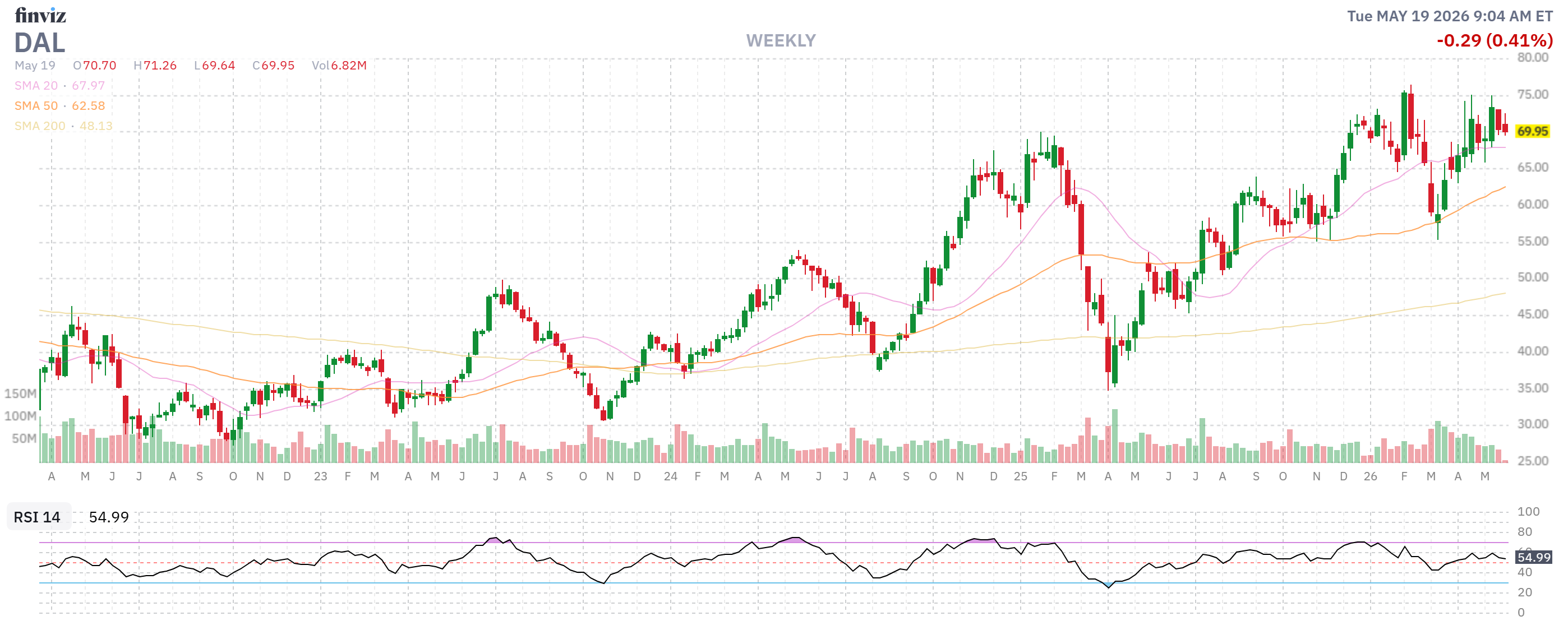
Delta’s President Glen Hauenstein, who has apparently never met a microphone he didn’t want to confess to, told investors at the airline’s 2024 Investor Day: “This is a full reengineering of how we price and how we will be pricing in the future.”
 The scheme: AI sets 20% of Delta’s Domestic fares by the end of 2025, up from 3% today, with the long-term ambition of doing away with static pricing altogether. Three senators (Gallego, Warner and Blumenthal) wrote Bastian a letter saying the quiet part out loud: these are “Fare increases tailored to each consumer’s individual pain point, particularly as American families grapple with escalating expenses.” Delta’s response was a marvel of corporate gaslighting: We don’t use personal data, we just use AI to optimize prices based on demand, which is a bit like a pickpocket saying I’m not stealing, I’m just facilitating an unscheduled transfer of your wallet.
But Delta is not the entire airline industry. At least you can comparison-shop on Kayak. The real horror show is at the supermarket. In December’s Groundwork Collaborative, Consumer Report they ran a controlled experiment with 437 shoppers across four cities. Same stores. Same items. Same moment in time. Different customers. Here’s what they found:
-
- 74% of grocery items had multiple price points simultaneously. A dozen Lucerne eggs at a single D.C. Safeway sold for $3.99, $4.28, $4.59, $4.69, and $4.79 — at the same time, in the same store.
- Price spreads averaged 13%, with some items running 23% higher for one shopper than another. A box of Signature SELECT Corn Flakes ranged from $2.99 to $3.69 depending on who was looking at the screen!
- The cost to a family of four who “can afford it“: about $1,200 a year. More than a month’s rent in most American cities. For the exact same groceries!
The tech doing this is called Eversight, acquired by Instacart in 2022 and the confirmation tests caught the same patterns at Albertsons, Costco, Kroger, Safeway, Sprouts, and Target. Instacart’s own marketing brags that Eversight uses “new or existing customer status, how close they are to a competing store, their offline behavior, and even the weather” to target prices.
Their own internal language refers to running “experiments” on shoppers and, on their own website, they acknowledge that “end shoppers are not aware that they’re in an experiment.” That is considered a FEATURE, not a bug! We are just ab rats with credit cards. When Groundwork called them out, what did they say? “Our price changes are randomized.” As if randomly overcharging some families and undercharging others while pocketing the spread is a moral improvement over blatant discrimination.
You could almost think it wasn’t so bad if the Top 10%, who have 10x more than the bottom 90%, pay a bit more so the rest can pay less – BUT THAT IS NOT HOW IT WORKS – if you are poor but your kids love lunchables, they will raise the price from $2.99 to $3.29 to $3.69 to $4.09 to $5.29 – until you finally stop buying them and then they will send you a coupon for “2 for $8” and you’ll buy 6 while they’re on sale – SUCKER!!!
Your sense of fairness is the exact thing they’re exploiting. You’d lose your mind if the person behind you in the Kroger checkout line paid 23% less for the same eggs, you would say something. You’d film it. You’d post it. The cashier would call a manager. There would be a scene. So they moved it off the conveyor belt and into the app, where the price tag is a personalized hallucination only you can see and the woman behind you in the digital line, who is paying eighty cents less for her Corn Flakes because the algorithm decided she was more price-sensitive than you – doesn’t even know she exists in the same store as you!
The veil of one-to-one commerce is the entire scam! You can’t compare prices because there is no price. There’s only YOUR price (this happens in hospitals too!). There is only the number the machine calculated (in the seventy-five milliseconds between your tap and the screen refresh) by triangulating your zip code, your phone model, your purchase history, the time of day, the weather, your last seven months of in-store behavior, and, for the chef’s kiss of the whole apparatus, how close you live to a competing grocery store.
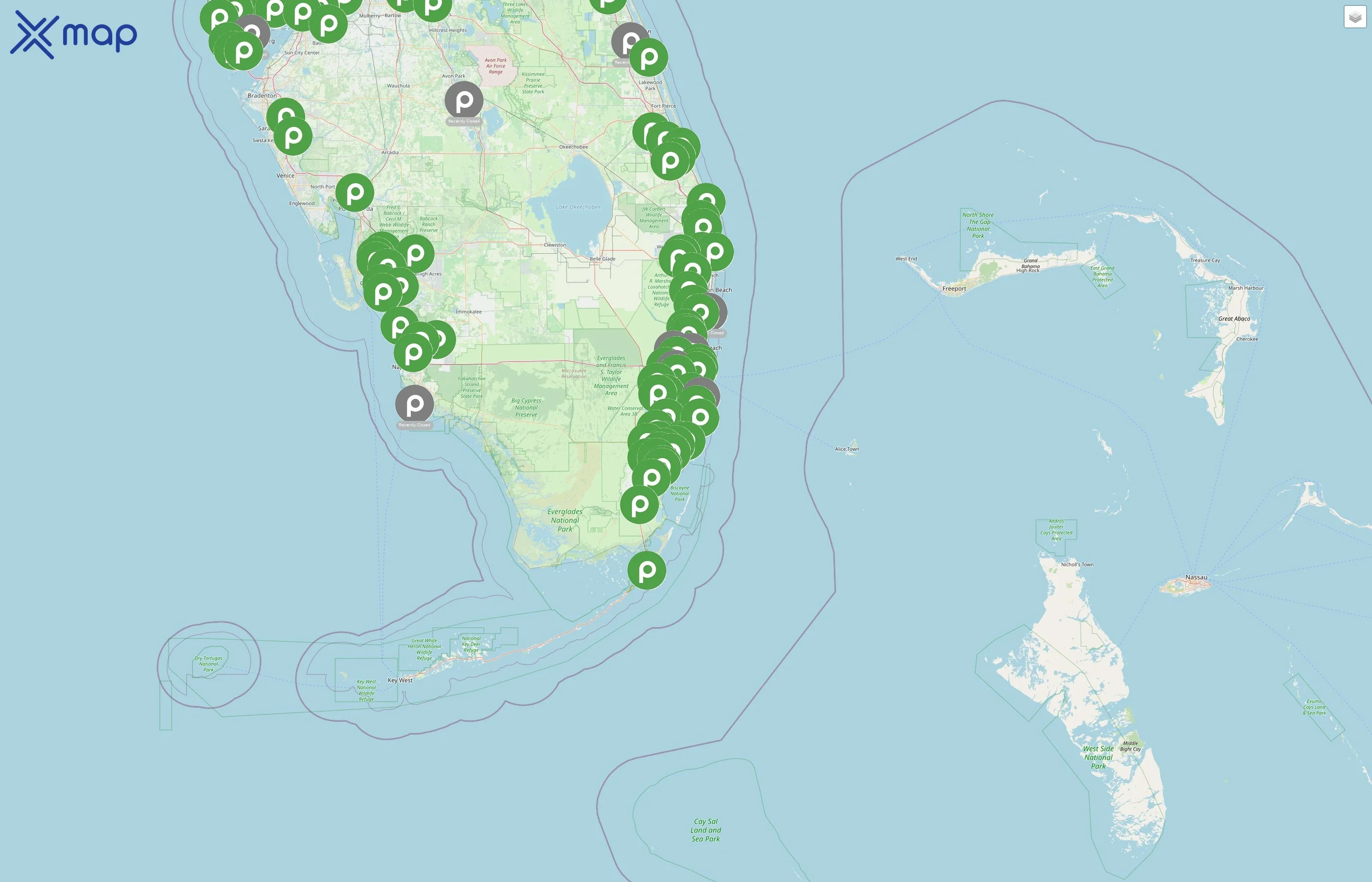 Approximately 54M Americans live in what they call “Food Deserts” – places where there is poor access to supermarkets and even that is generous because I live in Florida and you almost have to leave the state to shop for food anywhere but Publix!
The trust violation is the product! The vendor relationship you have established over the years: “I shop here, they treat me fairly” – THAT is the raw material the algorithm refines into higher margins. Every loyalty card swipe, every “frequent buyer” sign-up, every app download you did because the coupon was on the app, is data they’re using to figure out the most they can charge YOU, specifically, the next time you walk through the door.
They are not your grocer. They are your enemy in a one-sided information war and the side with the AI has all the cards…
New York (commies!) passed an Algorithmic Pricing Disclosure Act in November 2025 that at least makes them tell you: “This price was set by an algorithm using your personal data” and it has to appear in clear, conspicuous text. California’s (more commies!) AG opened an investigative sweep on the same practice in January. Forty-eight other states: nothing. A Federal Government Staff Report from January 2025 was negated with a note from the FTC saying it does not “necessarily reflect the views” of the agency, paired with an official regulatory shrug.
The lobbyist orgy was especially wild that night…
So this is our World now. Eversight prices your eggs. Fetcherr prices your seat. The corporate slave economy doesn’t need iron chains anymore — it has your iPhone telling it exactly how much you’ll bleed before you walk away. Again, as RJO would say: WOW!!! I have no notes…
Which brings us right back to the only sane defense: own the companies doing the squeezing. If they’re going to surveil you, at least be on the receiving end of the dividend!
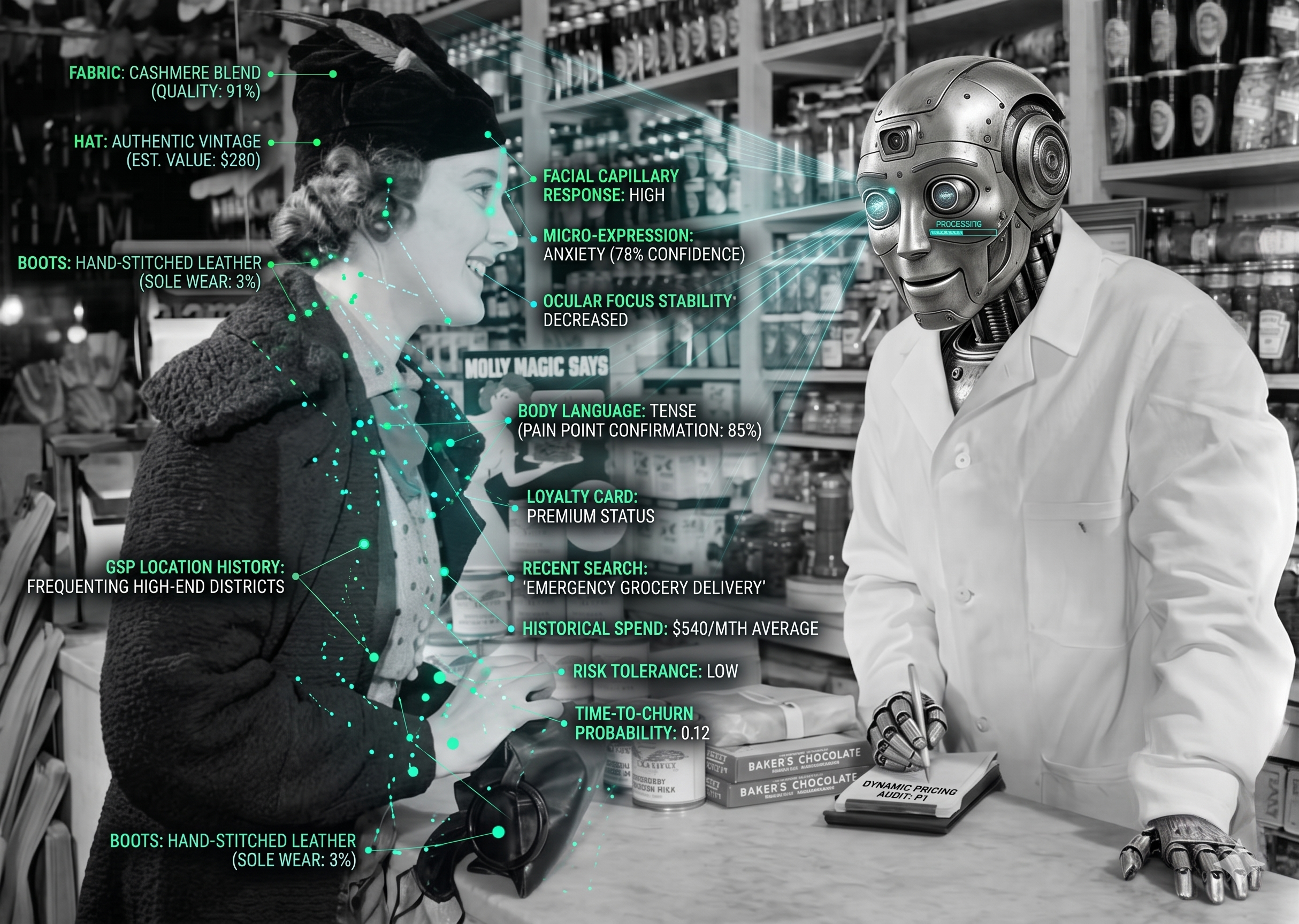
PS: I just told Anya to read the post and give us an image that invokes the concept. This was her first take!

