

This Is What Corruption Looks Like
A series of recent investigations from Public Citizen, TechRadar, People Magazine, The Washington Post, the Associated Press, and ProPublica paint a picture that is becoming harder and harder to ignore: the merging of presidential power, personal financial interests, political loyalty, and federal money on a scale modern America has never seen before.
Here are some examples.
The Dell Pentagon Contract
The Department of Defense announced a $9.7 billion agreement making Dell Technologies the central procurement hub for Microsoft software and cloud services across the Pentagon, intelligence agencies, and the Coast Guard. Officials say the goal is to streamline software licensing, consolidate purchasing, and save taxpayers roughly $422 million annually.
Under the deal, Dell will manage Microsoft 365 access, cloud subscriptions, and software licensing across large sections of the national security apparatus. Pentagon officials insist the contract followed standard competitive bidding procedures and largely consolidates existing spending rather than creating entirely new expenditures.
But the timing raised immediate questions.
Earlier this year, Michael Dell and his wife pledged $6.25 billion to Trump’s “Trump Accounts” initiative, one of the administration’s signature investment programs. Around the same period, financial disclosures showed that President Trump personally purchased between $1 million and $5 million worth of Dell stock before the Pentagon contract became public. Trump later publicly praised Dell and even encouraged supporters to “go out and buy a Dell computer.”
Weeks later, Dell landed one of the largest technology contracts in Pentagon history, and the company’s stock surged afterward.
No one has produced direct evidence proving the contract was illegally awarded, and Defense Department officials say Dell won through ordinary procurement procedures. But the overall sequence of events would once have triggered overwhelming bipartisan alarm over conflicts of interest: massive political donations, presidential stock ownership, public endorsements from the president, and then one of the largest technology contracts in Pentagon history. The broader issue is what happens to public trust when political influence, personal financial interests, and government contracts become this deeply intertwined.
The controversy is unfolding while the Pentagon seeks approval for a proposed $1.5 trillion defense budget for 2027 and continues to fail basic financial oversight tests. The Department of Defense has failed every formal audit since audits became legally required in 2018, despite overseeing trillions in taxpayer assets and spending. That lack of transparency only deepens concerns about whether giant contracts are being awarded independently and in the public interest.
But the Dell story is not isolated.
The White House Ballroom Project
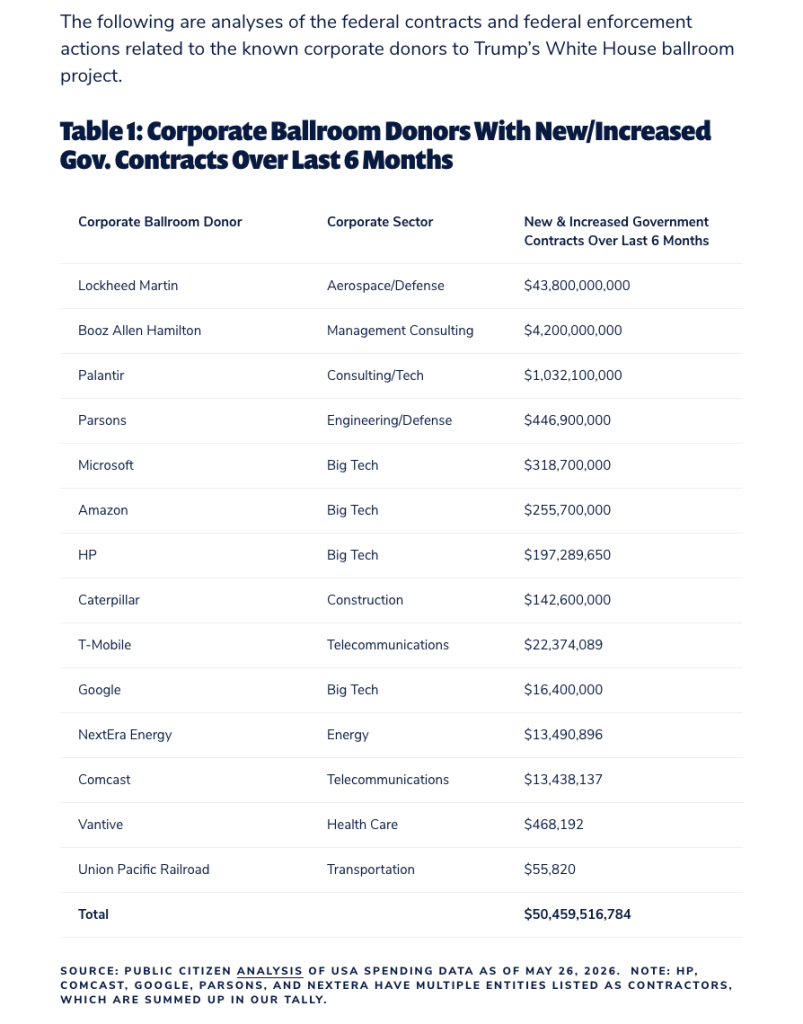
The Washington Post recently reported on a watchdog investigation from the nonprofit Public Citizen examining donations tied to Trump’s controversial White House ballroom project. According to the report, more than half of the publicly identified corporate donors to the project later received new or expanded federal contracts worth over $50 billion during Trump’s second term.
The ballroom project itself is a $400 million renovation replacing the historic East Wing after its demolition last fall. Trump has repeatedly framed the private donations as saving taxpayer money. Critics argue the secrecy surrounding the donor list creates ideal conditions for pay-to-play politics.
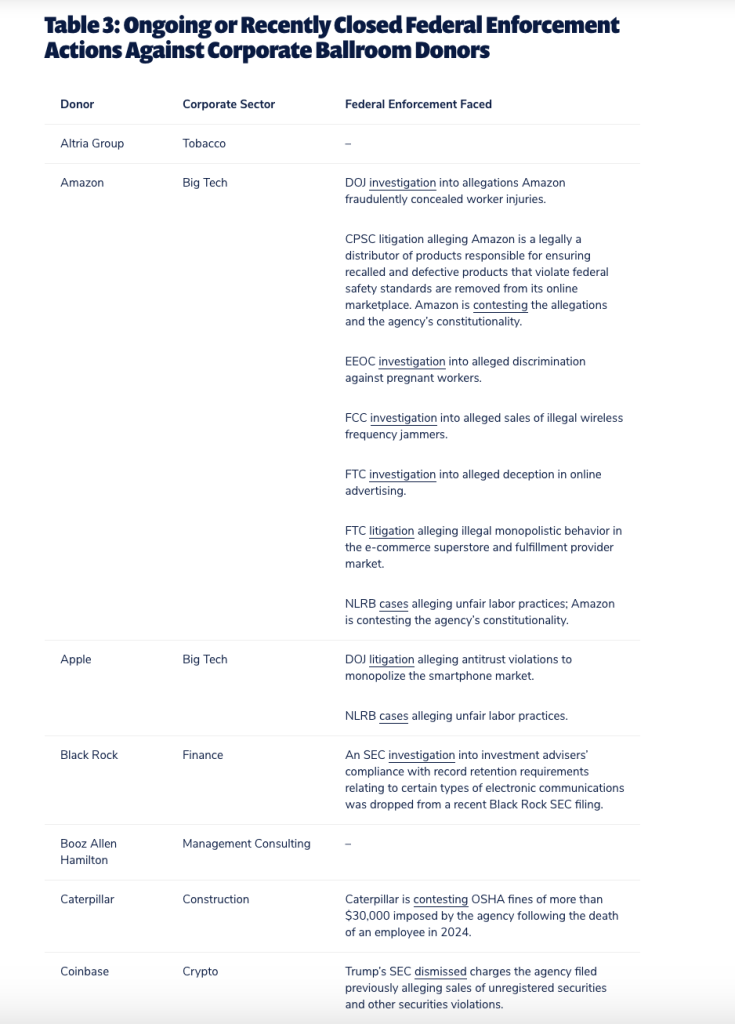
The report identified companies including Lockheed Martin, Booz Allen Hamilton, Palantir, Amazon, Microsoft, and Google as both donors and later beneficiaries of major federal business. Public Citizen also noted that many of those same firms are simultaneously facing federal investigations, antitrust reviews, labor disputes, or securities enforcement matters that critics say have been softened, delayed, or scaled back under the administration.
The White House dismissed the accusations as politically motivated and said donors were simply helping improve “the People’s House.”
But the underlying facts remain: corporations seeking contracts or regulatory relief donate to presidential projects, the president owns stock in some of those companies, publicly promotes some of them, and those same companies later receive enormous government business or favorable treatment.
The overall system increasingly resembles a network of overlapping political and financial loyalties rather than independent public governance.
Trump’s Stock and Bond Trading
Associated Press reporting suggests the pattern extends well beyond the Dell contract or the ballroom project.
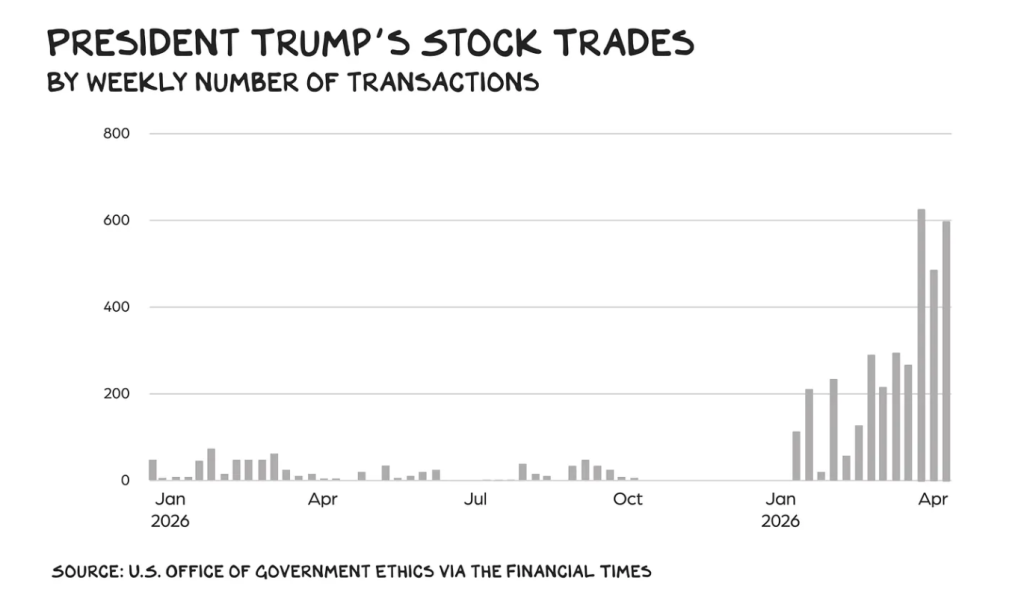
Trump’s financial disclosures revealed more than 3,600 stock trades during the first quarter of 2026 alone, involving well over $100 million in transactions. Many involved technology and AI-related companies such as Nvidia, Dell, Oracle, and Palantir before the administration later took actions benefiting those firms.
The AP also reported that Trump purchased more than $300 million in bonds while simultaneously pressuring the Federal Reserve to lower interest rates — a move that could increase the value of those holdings.
A sitting president actively trading companies and financial instruments potentially affected by his own policies would once have been viewed as politically explosive. Now it barely lasts a full news cycle.
The $1.776 Billion Compensation Fund
At the same time, the administration attempted to create a nearly $1.8 billion taxpayer-funded compensation pool connected to lawsuits Trump filed against his own government. The proposal eventually collapsed after political backlash, but another part of the agreement reportedly remains intact: the government dropping pending IRS audits involving Trump and his relatives.
Critics argued the proposal amounted to a taxpayer-funded reward system for political allies and an extraordinary use of government power to financially benefit individuals tied to the president.
Government Deals for Family and Friends
The AP also detailed additional examples involving companies connected to Trump family interests receiving favorable treatment.
The Air Force agreed to purchase interceptor drones from Powerus, a company linked to Trump family investments.
ProPublica separately reported that White House intervention preceded a Pentagon decision to provide a $620 million loan to a startup connected to Donald Trump Jr.
According to ProPublica, Donald Trump Jr.’s venture firm, 1789 Capital, took a stake in Vulcan Elements shortly before the Pentagon announced the loan. The funding push reportedly came directly from Peter Navarro inside the White House, and Pentagon staff allegedly accelerated the approval process after the request.
Again, defenders can argue there was no explicit rule-breaking. But the overlap between political influence, family-connected investments, and government funding decisions is increasingly difficult to separate.
Crypto, Branding, and Presidential Profit
Then there are the president’s growing crypto ventures, branding deals, and taxpayer-supported projects.
Trump’s family now holds a controlling stake in World Liberty Financial, a cryptocurrency firm tied to Trump ally Steve Witkoff. An Abu Dhabi-backed investment fund later pledged to use $2 billion worth of the company’s stablecoin in a Binance transaction that significantly boosted the venture.
Meanwhile, companies continue paying licensing fees to use Trump’s name on products ranging from watches and sneakers to Bibles, fragrances, and even gold-colored cellphones — products Trump openly promotes while serving as president.
The AP also noted that Trump properties continue benefiting directly from political and official events. The upcoming G20 summit at Trump’s Doral resort means foreign leaders, journalists, support staff, and business executives will effectively be paying the Trump Organization during a major international diplomatic gathering.
Even the White House ballroom project itself has expanded. After initially insisting wealthy donors would fully fund the project, Trump later sought roughly $1 billion in federal money for related security upgrades. Taxpayer money is also being used for other Trump-directed renovation projects around Washington, including work at the Lincoln Memorial Reflecting Pool.
Modern Corruption
Modern corruption usually does not look like old movie scenes with envelopes of cash changing hands in dark rooms.
It looks like this: political power, private business interests, government contracts, regulatory decisions, family enrichment, donor access, and presidential branding slowly merging together until separating public service from personal profit becomes almost impossible.
And over time, the public becomes numb to it.
That numbness may be the most dangerous part. Countries rarely wake up one morning and suddenly realize corruption has taken over. The boundaries erode gradually. One conflict gets normalized. Then another. Then another. Eventually behavior that once would have triggered national outrage becomes just another news cycle.
That is how institutional corruption becomes permanent — not through one dramatic event, but through repetition and public acclimation.
A government can become deeply corrupt long before anyone is ever led away in handcuffs — and often no one ever is. At this level, corruption operates less through obvious criminality than through influence, access, loyalty, selective enforcement, and the erosion of the boundaries separating public office from private gain.
When political power, private wealth, federal contracts, donor influence, family business interests, and presidential financial incentives all operate inside the same system, accountability breaks down. Transparency fades. Rules become flexible for the powerful and rigid for everyone else.
Contracts, political donations, presidential investments, crypto ventures, family-linked businesses, government projects, and federal power are increasingly merging into a single ecosystem of influence and self-enrichment.
And once corruption becomes normalized, reversing it becomes extraordinarily difficult.
As Scott Galloway wrote in Art of the Selloff, “Superpowers don’t die when adversaries breach the gates. They die when the people inside start auctioning off the gates.”
That is where we are now.
Sources:
Public Citizen: BALLROOM BILLIONS
Trump Ballroom Donors Devour Taxpayer Dollars
Public Citizen: Corporate Donors to Trump’s White House Ballroom have Received $50 Billion in Government Contracts Since the East Wing was Demolished
People: Trump Bought Over $1M in Dell Stock Before Pentagon Signed $9.7B Contract with Company
The Washington Post: Dell inks $9.7 billion Pentagon contract after Trump acquires stock
The Washington Post: Ballroom donors won $50B in contracts after giving to Trump project, watchdog group finds
Associated Press: Trump’s financial ties face scrutiny after moves benefiting allies and family
ProPublica: The White House Intervened to Get a $620 Million Deal for a Company Tied to Donald Trump Jr.
Scott Galloway: Art of the Sellout

