

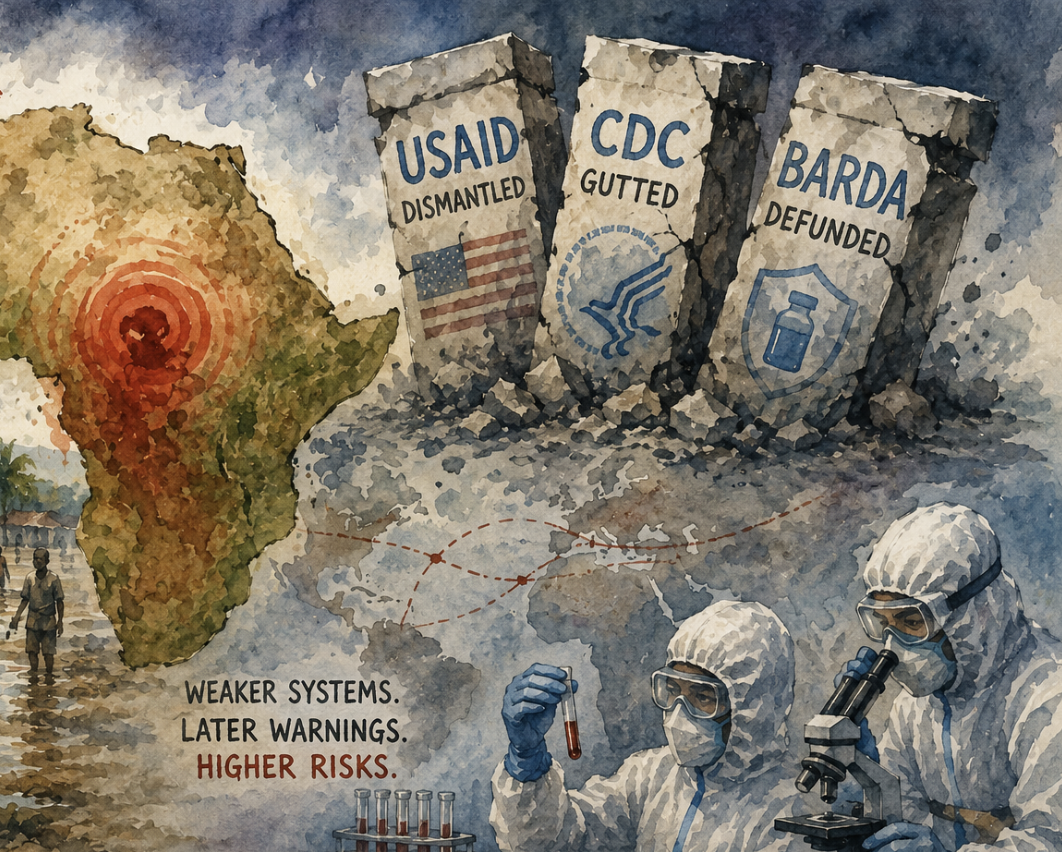
At least 50 are dead due to a new Ebola outbreak in Central Africa, and the U.S. was the last to hear about it. This is a glaring example of the breakdown in the U.S. public health and monitoring system.
Summary
Peter Zeihan describes the breakdown of the international early-warning systems that help contain outbreaks before they spread globally.
He explains that a new Ebola outbreak in Central Africa has already killed dozens of people, but has received little attention in the United States. According to Zeihan, the bigger issue is that several layers of America’s global disease-monitoring infrastructure have been weakened at the same time.
First, he argues that the dismantling of United States Agency for International Development removed a major source of on-the-ground reporting from developing countries. Although USAID’s primary mission was economic development and humanitarian work, Zeihan says its staff also acted as informal “eyes and ears” for emerging crises.
Second, he says the Centers for Disease Control and Prevention has been weakened, reducing America’s ability to rapidly identify and analyze outbreaks. Normally, agencies like the CDC help determine how contagious or lethal a disease is and begin genetic sequencing quickly after cases emerge.
Third, he points to cuts to Biomedical Advanced Research and Development Authority, the U.S. agency that helps fund vaccine development and pandemic preparedness. Zeihan argues that reducing these capabilities leaves the United States slower to respond if a dangerous disease evolves.
He also stresses how severe Ebola is. Ebola is a hemorrhagic fever that damages blood vessels and organs, often causing internal and external bleeding. The current strain still appears to spread mainly through bodily fluids rather than through the air, which is important because airborne transmission would make it vastly more dangerous.
Zeihan argues that weakening global health-monitoring systems creates dangerous blind spots and may leave the U.S. unable to detect or respond to emerging diseases quickly enough if conditions worsen or the virus mutates.

