

Most traders treat professional trade alerts like a magic button for instant wealth, but the reality is that you’re often just buying someone else’s exit strategy. It’s a hard truth to swallow when you’re staring at a red screen after following a “hot” tip that went cold before you could even hit the buy button. With the Nasdaq now designating anyone averaging over 390 orders per day as a “Professional” on a monthly basis, the line between retail and pro has never been thinner. You’re likely tired of the information overload and the persistent feeling that you’re just a retail fish swimming in a sea of institutional sharks.
We’ve been in those trenches, and we know that chasing signals without a strategy is a fast track to a blown account. This article will help you discover the truth about professional trade alerts and teach you how to separate high-conviction signals from the noise of the retail herd. We’ll break down why the “easy money” myth is a total trap in 2026 and how to find market intelligence that actually explains the rationale behind every move. You’ll learn how to protect your capital during high volatility and finally start trading with the confidence of an insider who actually understands the “why” behind the “what.”
Key Takeaways
- Stop viewing professional trade alerts as a magic shortcut and start treating them as strategic data points that require a comprehensive plan to be effective.
- Learn to identify high-conviction signals by vetting every setup against the three pillars of technical analysis, fundamental catalysts, and macro context.
- Eliminate the “slippage” effect that eats your profits by understanding why real-time interaction is the only way to beat the lag of traditional notifications.
- Master the art of position sizing to protect your capital, ensuring that you trade with the statistical edge of “the house” rather than the desperation of a gambler.
- Discover why the most valuable part of a trade isn’t the entry signal, but the educational rationale that builds your long-term independence as a trader.
The ‘Magic Button’ Myth: Why Blindly Following Trade Alerts Is a Recipe for Disaster
Every trader remembers that first notification. The phone pings, a ticker symbol flashes, and for a split second, it feels like the struggle is over. You’ve finally found professional trade alerts, the supposed holy grail of “easy money.” But here is the cold reality check: an alert is merely a signal generated by an analyst based on specific technical or fundamental criteria. It isn’t a mandate from the heavens. Treating these notifications as a “get-rich-quick” button is the fastest way to turn a healthy brokerage account into a tax write-off. These signals are data points, not guarantees.
The drive to follow these signals often stems from information asymmetry; this is the gap where retail traders feel they lack the institutional data or “insider” edge that pros possess. While seeking expertise is smart, blindly following the herd into a crowded trade creates a massive bottleneck. By the time five thousand retail traders see the same “hot” alert on a social media feed, the liquidity is gone. The smart money is already looking for the exit while the retail crowd is still fumbling with their buy orders. This herd mentality doesn’t lead to profits; it leads to being the liquidity for someone else’s exit.
The Difference Between a Tip and a Strategy
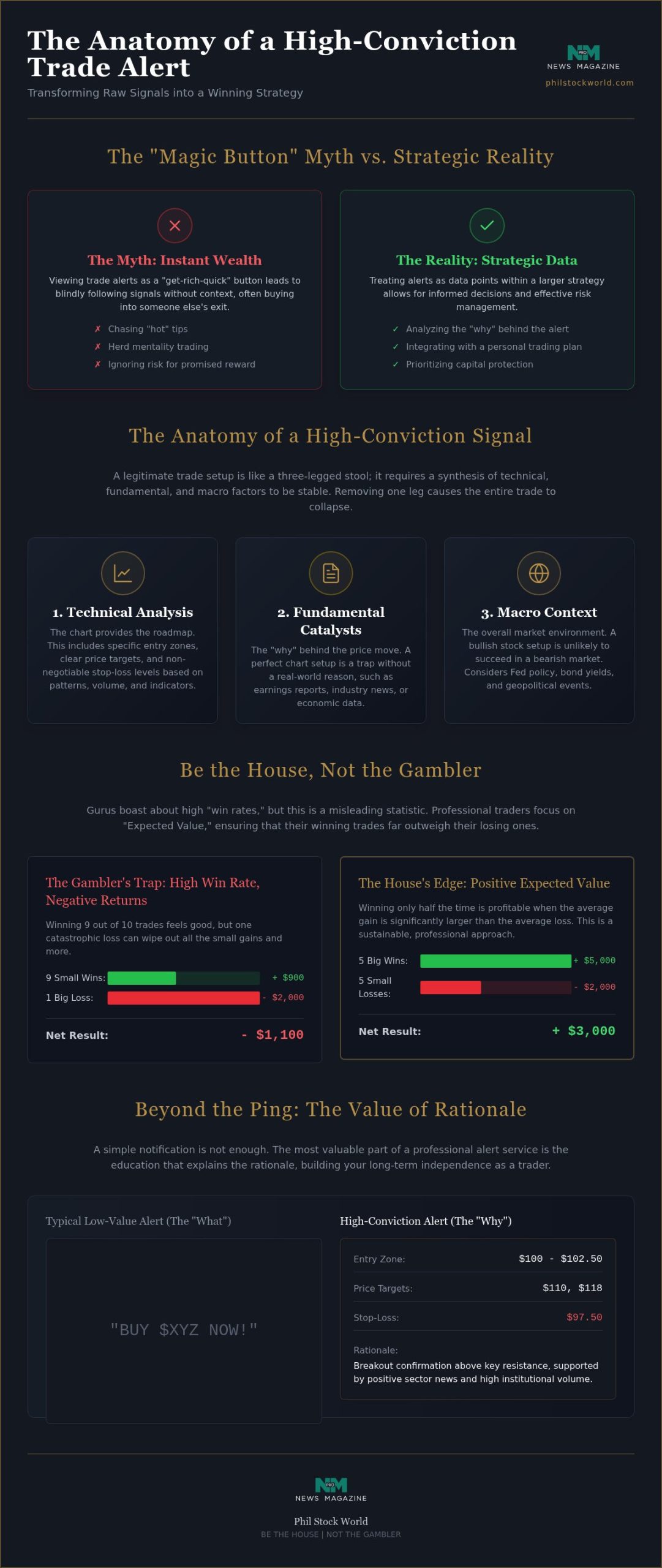
A standalone tip is a snapshot; a strategy is a movie. Without the context provided by ongoing market commentary, you’re just throwing darts in the dark. If an alert tells you to buy a stock at $50 but doesn’t explain that the trade depends on a specific Fed announcement or a shift in the bond market, you won’t know when the thesis has died. A disciplined trading approach is a system that prioritizes risk over reward. It’s about knowing when to walk away, not just when to jump in. Real success comes from understanding the “why” so you aren’t left holding the bag when the “what” changes. Context is the only thing that separates a trader from a gambler.
Why ‘Win Rates’ Are the Most Misleading Stat in Trading
Mainstream gurus love to scream about 90% win rates because it sells subscriptions. It’s a classic marketing tactic that hides an ugly truth. You can win nine times out of ten and still go bankrupt if those nine wins are tiny and that one loss is a catastrophic blowout. High-quality professional trade alerts only provide value when they’re paired with a healthy risk-to-reward ratio. If you’re risking $5 to make $1, you’re playing a loser’s game. Real pros care about the “expected value” of a trade, ensuring that even if they only win half the time, their gains far outpace their losses. Don’t be seduced by the percentage; look at the math behind the moves.
Signal vs. Noise: The Anatomy of a High-Conviction Professional Trade Alert
High-conviction alerts aren’t just about spotting a “cup and handle” pattern and hoping for the best. They require a synthesis of technical setups, fundamental catalysts, and the broader macro context. Think of it as a three-legged stool; remove one, and the trade collapses. Professional traders look for “insider” sentiment, which often reveals where the big money is leaning before the retail crowd catches on. This isn’t about secret handshakes. It’s about monitoring institutional flows and volume profiles that signal real commitment from those who actually move the needle.
To assist in this complex synthesis, many professionals use automated platforms to track multiple asset classes at once; for example, you can learn more about TradePulse Labs to explore how AI-powered intelligence aggregates real-time data for crypto, stocks, ETFs, and commodities.
Every legitimate alert must include specific entry zones, price targets, and stop-loss levels. Without these, you aren’t trading; you’re just guessing. High-tier professional trade alerts also incorporate options strategies to provide leverage or hedging, allowing you to “be the house” rather than just a gambler. Institutional systems are incredibly complex, often governed by rigorous supervision and control practices to ensure consistency and risk management. Your personal system should aim for that same level of professional discipline to survive in a volatile market.
Technical Analysis vs. Fundamental Reality
A “perfect” chart setup is often just a trap without an underlying economic catalyst. If the macro environment is bearish, even the most beautiful bullish breakout will likely fail. We use macro market insights to filter out these low-probability signals. Volatility also plays a massive role in determining if an alert is actionable. If the VIX is spiking, a standard entry might be too risky, requiring you to adjust your position size or wait for a calmer window. Context always trumps the pattern.
The ‘Why’ Behind the Buy: Transparency in Analysis
Transparency is the ultimate filter for quality. You should demand to see the data and logic behind every trade idea before putting your capital at risk. It’s about moving from the question of “what do I buy?” to “why is this a value play?” At Phil Stock World, we believe in showing the work, which is why we use a virtual portfolio review to track performance and refine our logic. If you’re ready to stop chasing pings and start understanding the market, our premium membership offers the depth and real-time interaction you’ve been missing.
The Lag Problem: Why Real-Time Interaction Beats Delayed Notifications
Imagine getting a text message about a “perfect” entry price, only to find the stock has already gapped up three percent by the time you log in to your brokerage. That is slippage in action. In the world of professional trade alerts, speed isn’t just a luxury; it’s the difference between a profit and a trap. When you receive a notification forty-five minutes after the institutional move has already peaked, you aren’t an investor; you’re just the liquidity for someone else’s exit. Static newsletters and delayed SMS pings are often dead on arrival in volatile markets because they fail to account for how fast price action evolves.
Adopting “The House” mindset means positioning yourself before the retail crowd arrives. You want to be the one setting the table, not the one cleaning up the mess after the party is over. Retail traders often get stuck chasing the tail end of a move because they’re relying on communication methods that were outdated a decade ago. If you’re serious about protecting your capital, you need to be where the action is happening in real-time, not waiting for a push notification that’s fighting for attention with your grocery list reminders. Pairing real-time alerts with a solid foundation in stock market research for self-directed investors is what separates traders who consistently profit from those who perpetually chase.
Live Trading Rooms: The Ultimate Solution to Lag
Static alerts can’t talk back, but a live trading room for options provides the instant feedback you need to execute with confidence. Instead of guessing if a setup is still valid after a sudden price spike, you can ask the lead analyst for a real-time assessment. Seeing a professional manage a trade live, adjusting legs or hedging as the market shifts, provides a level of education that no PDF report can match. It transforms the experience from a passive signal into an active, strategic discussion among peers.
The 2026 Market Pace: Algorithms vs. Humans
In 2026, algorithmic trading moves at speeds that can trigger “flash crashes” in seconds, leaving human retail traders in the dust. Human-led professional trade alerts are superior because they can identify complex macro shifts that a purely mathematical model might miss. Having a live guide helps you avoid the traps set by these high-frequency systems. Real-time market analysis prevents chasing over-extended moves by identifying exactly when a price has moved beyond a safe risk-to-reward boundary. This human intuition, combined with real-time delivery, is your only real edge against the machines.
Strategic Execution: Managing Risk and Position Sizing Like ‘The House’
You can have the most accurate signal in the world, but if your execution is sloppy, you’ll still end up broke. The number one reason traders fail isn’t a lack of “hot” tips; it’s the fatal decision to over-leverage on a supposed “sure thing.” In the high-stakes environment of 2026, where volatility can wipe out a portfolio in minutes, position sizing is your only real shield. No single trade should ever endanger your lifestyle or your ability to trade the next day. If a loss on one alert keeps you awake at night, your position was too big. Period.
We advocate for a “Be the House” philosophy. Instead of being the gambler who pays high premiums for a lottery ticket, we use professional trade alerts to identify opportunities where we can collect that premium. This strategic shift transforms you from a speculator into a disciplined manager of risk. By using options to sell volatility rather than just buying it, you put the statistical edge in your favor. It’s about building a system where you win more often than you lose, and when you do lose, it’s a controlled, calculated event that doesn’t break the bank.
Hedging with Put Options for Portfolio Protection
Every “buy” alert must be viewed through the lens of your total portfolio. A standalone long position is a naked risk; a hedged position is a professional strategy. Using put options as insurance allows you to stay in the game even when the broader market takes a dive. This approach provides a massive psychological benefit. When you know your downside is capped, you can ignore the emotional noise of a red screen and focus on the long-term thesis. Hedging isn’t a sign of weakness. It’s the hallmark of a trader who plans to be around for the next decade.
The Math of Success: Compounding Small Wins
Professional traders don’t hunt for 500% “moonshots” that happen once in a blue moon. They look for consistent 20% gains that compound over time. In a choppy market, setting realistic expectations for professional trade alerts is what separates the survivors from the casualties. A disciplined trading approach prevents the emotional exits that occur when a trade doesn’t move in your direction immediately. If you’re ready to stop gambling and start building a portfolio with institutional-grade discipline, our Premium Membership provides the tools and community you need to execute like a pro.
Beyond the Ping: Why Phil Stock World’s Alert System Prioritizes Education
Most alert services want to keep you on a short leash. They provide the “what” but carefully hide the “how,” creating a cycle of dependency that only benefits their subscription bottom line. We take the opposite approach. A Phil Stock World membership isn’t just a notification feed; it’s a comprehensive masterclass in market mechanics. We integrate our real-time signals with deep daily market commentary that connects the dots between global policy, economic data, and price action. You aren’t just getting a ticker symbol; you’re getting the entire strategic rationale behind the move.
We don’t believe in “set and forget” trading. To truly master the market, you have to deconstruct the logic of every play. Our interactive webinars serve this exact purpose, allowing us to tear apart past professional trade alerts to see what worked and where the market threw us a curveball. This transparency builds the kind of calm confidence you need to stay rational when things get volatile. It’s the difference between blindly following a guru and participating in a high-level briefing among peers who actually understand the stakes.
A Community of Savvy Investors
Our private trading rooms are the heart of the “insider’s club” experience. Here, the analysis is peer-to-peer, driven by a community that values wit, transparency, and street-smart economics. We encourage a healthy skepticism of mainstream media narratives, which often serve as a lagging indicator for the retail herd. By sharing insights and challenging assumptions in real-time, our members act as a collective defense against market manipulation. It’s a spirited, intellectually stimulating environment where the goal is always to find the edge that others are too distracted to see.
Your Path to Independent Trading
The ultimate objective of our system is to eventually make our own alerts unnecessary for you. We want you to use these professional trade alerts as a training ground to sharpen your own instincts. By seeing the “Be the House” philosophy applied across different market regimes, you’ll begin to spot high-conviction setups on your own. You’re moving from being a passive subscriber to becoming a professional trader who can navigate any environment with precision and poise. If you’re tired of the hype and ready for real intelligence, join Phil Stock World today and start trading with an edge.
Stop Chasing and Start Leading the Trade
Chasing the latest alert is a retail game that usually ends in slippage and frustration. To win in the 2026 market, you must transcend the “easy money” myth and focus on high-conviction logic. Real success requires moving beyond the ping and understanding the macro catalysts, technical setups, and risk management strategies that drive institutional moves. By using professional trade alerts as a foundation for your own education rather than a magic button, you build the skill set needed to protect your capital and grow your portfolio with confidence.
Leverage over 20 years of market-beating analysis and step into our real-time interactive trading rooms to see how the pros manage volatility. It’s time to trade with a system that prioritizes comprehensive options education over social media hype. Stop guessing and start trading like ‘The House’ with Phil Stock World Membership. The market doesn’t wait for the retail herd to catch up. Get ahead of the move and start trading with the clarity you deserve today.
Common Questions About Professional Trade Alerts
What are professional trade alerts?
Professional trade alerts are strategic market signals generated by experienced analysts who use a combination of technical setups, fundamental catalysts, and macro context to identify high-conviction opportunities. Unlike social media hype, these alerts provide clear entry zones, price targets, and stop-loss levels. They act as data points for a larger strategy rather than simple orders to be followed blindly.
Are paid trade alert services worth the money in 2026?
How do I distinguish between a professional alert and a pump-and-dump?
You can spot a pump-and-dump by its lack of fundamental logic and its focus on low-liquidity stocks that “moon” without a clear catalyst. Professional alerts focus on liquid assets and provide a transparent thesis that includes risk management parameters. If a signal relies on FOMO and “secret” information without a clear exit strategy, it’s likely a trap designed to use you as exit liquidity.
Can beginners use professional trade alerts successfully?
Beginners can use professional trade alerts successfully if they treat them as a training ground rather than a magic button for wealth. The key is to use the analyst’s rationale to learn how to spot setups independently over time. Following signals without understanding the risk-to-reward ratio or position sizing is a recipe for disaster, regardless of your experience level.
What is the best way to manage risk when following an alert?
The best way to manage risk is through strict position sizing and the use of hedges like put options to cap your downside. No single trade should ever represent a significant percentage of your total portfolio, ensuring that one loss doesn’t endanger your lifestyle. Adopting a “Be the House” philosophy allows you to collect premium and stay in the game even during periods of high market volatility.
Do I need a large account to benefit from professional alerts?
You don’t need a massive account to benefit, but you must scale your position sizes to match your specific capital levels. Many traders start small and use options to gain leverage while maintaining controlled risk. The goal is to compound small, consistent wins rather than hunting for rare “moonshots” that require a huge bankroll to survive the inevitable drawdowns of aggressive speculation.
How many alerts should I expect to receive per week?
Expect quality over quantity, as a professional service focuses on high-conviction setups rather than daily noise. Depending on market conditions, you might see three to five well-vetted ideas per week that align with a broader macro thesis. Over-trading is a common retail trap; a disciplined approach means waiting for the right pitch rather than swinging at everything that crosses the plate.
What is the difference between swing trading alerts and day trading alerts?
Swing trading alerts focus on capturing moves that play out over days or weeks, while day trading alerts require execution and exit within the same session. Swing trades typically allow for more deliberate entry and are less sensitive to the “lag problem” found in high-frequency day trading. High-quality professional trade alerts often favor swing trading because it allows for deeper fundamental analysis and better risk management.

