


What if you could stop sweating every tick of the market and start getting paid for the uncertainty instead? Most traders spend their lives betting on direction, only to watch their hard-earned profits evaporate the moment a bit of volatility hits the tape. You have likely realized that chasing the next big move is a sucker’s game, and you are looking for sophisticated income generating option strategies that actually work. It is a frustrating cycle that makes the stock market feel more like a rigged casino than a path to wealth.
It is time to flip the script and adopt the mindset of the house. This guide will show you how to stop gambling and start collecting consistent monthly premiums by selling time and volatility to those who are still trying to get rich quick. We are moving toward a disciplined, repeatable system that lowers the cost basis of your long-term holdings while keeping your portfolio grounded. We will explore the strategic framework you need for 2026 and show you how to manage risk without overpaying for protection. Welcome to the insider’s club; it is time to start acting like the owner, not the gambler.
Key Takeaways
- Learn why shifting your mindset to ‘be the house’ allows you to profit from time decay instead of guessing market direction.
- Master foundational income generating option strategies like covered calls and cash-secured puts to lower your cost basis and collect steady premiums.
- Explore how to use credit spreads and iron condors to define your risk while generating yield in volatile or flat markets.
- Establish a disciplined risk management framework to ensure your position sizes protect your capital from unexpected market swings.
- Understand the value of real-time educational support and community insights to stay ahead of rapidly changing global economic shifts.
The Casino Mindset: Why Selling Options Beats Buying Them for Income
Think about the last time you walked through a casino. The lights are bright, the drinks are flowing, and the air is thick with the smell of desperate hope. Most retail traders approach the market exactly like those tourists, throwing chips at “moonshot” stocks and praying for a 1,000% return. The house, however, is perfectly calm. They don’t need a miracle because they have the math. By focusing on income generating option strategies, you stop being the gambler and start being the one who owns the tables. Selling options is essentially selling insurance. You are taking on a specific risk in exchange for a cash payment up front. In the volatile landscape of 2026, where global policy shifts and rapid innovation create constant noise, the price of that “insurance” is higher than ever. This means the premiums you collect are fatter, giving you a massive head start before the opening bell even rings.
Understanding the Math of Probability
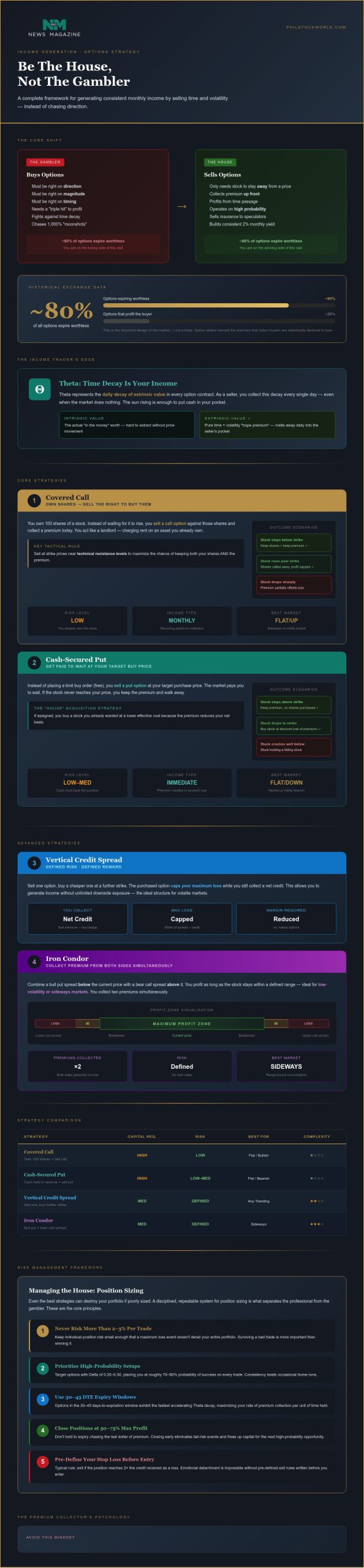
Historical data from various exchanges suggests that a significant portion of options, often cited as high as 80%, expire completely worthless. This isn’t a fluke; it’s the structural design of the market. When you buy an option, you need to be right about the direction, the magnitude, and the timing. That is a difficult trifecta to hit consistently. When you sell, you only need the stock to stay away from a specific price. You are trading in extrinsic value, which is essentially the “hope” premium built into an option’s price. While intrinsic value is the actual “in the money” worth, extrinsic value is pure time and volatility. Theta is the income trader’s best friend because it represents the daily decay of that extrinsic value, putting cash in your pocket simply because the sun rose this morning. This is why income generating option strategies are so effective; they turn the passage of time into a realized profit.
The Psychology of the Premium Collector
The hardest part of this transition isn’t the math; it’s the ego. We are wired to want the big win, the legendary trade that we can brag about at dinner. Premium collection is “boring.” It is a business-like approach where you prioritize a consistent 2% monthly return over the roller coaster of a 20% swing. You have to be okay with missing out on the occasional vertical spike in exchange for the peace of mind that comes with a disciplined system. When you look at your virtual portfolio, you should see a collection of high-probability outcomes, not a list of lottery tickets. This shift in perspective transforms trading from a stressful hobby into a repeatable revenue stream. It requires a level of emotional detachment that most speculators never achieve, but it is the only way to build a sustainable income engine in a market that loves to punish the impatient.
The Bread and Butter: Covered Calls and Cash-Secured Puts
If the casino mindset is the theory, then covered calls and cash-secured puts are the heavy machinery that actually builds the wealth. These are the foundational income generating option strategies that turn a static portfolio into a dynamic cash flow engine. Instead of hoping for a price spike, you are essentially acting as a landlord. You own the underlying asset and you are charging “rent” to speculators who want to gamble on its future price. It is a shift from being a spectator to being a participant who gets paid regardless of whether the market moves an inch or a mile.
Mastering the Covered Call
To succeed here, you need to be selective about which stocks earn a spot in your 2026 portfolio. You want “call-worthy” candidates; stable companies with decent volatility that won’t suddenly vanish overnight. The biggest risk is having your stock “called away” during a massive rally, leaving you with a capped profit while the stock moons. To avoid this, you must be tactical with strike prices. Look for levels where technical resistance is likely to hold, allowing you to pocket the premium while keeping your shares. Integrating fresh covered call trading ideas into your weekly routine ensures you are always hunting for the best yield without overextending your risk. It is about consistent base hits, not swinging for the fences every time you step to the plate.
The Power of the Cash-Secured Put
While most people use limit orders to buy stocks, the savvy trader sells a cash-secured put. Why place a “buy” order for free when the market is willing to pay you to wait for your price? If the stock stays above your strike, you keep the premium. If it drops, you are forced to buy a stock you wanted anyway, but at a lower net cost because of the premium you already collected. This is the “House” approach to acquisition. It requires you to have the cash ready to go, but the disciplined nature of the trade prevents the emotional “chasing” that ruins so many accounts. When you master this, you realize that being “assigned” isn’t a failure; it’s an opportunity to start the next phase of your income engine. If you are unsure if your current holdings are optimized for this cycle, a Virtual Portfolio Review can help identify where you are leaving money on the table.
When you combine these two, you get “The Wheel Strategy.” You sell puts until you are assigned the stock. Once you own it, you sell calls until the stock is taken away. Then you start over. It is a repeatable, rhythmic process that ignores market noise and focuses entirely on the math of probability. By applying these income generating option strategies, you ensure that your capital is always working, even when the broader market is just spinning its wheels.
Beyond the Basics: Vertical Credit Spreads and Iron Condors
Owning stocks and selling calls is a fantastic start, but it requires a lot of capital to scale. If you want to expand your arsenal of income generating option strategies without tying up every cent of your buying power, you have to embrace the spread. Vertical credit spreads allow you to “be the house” with a built-in safety net. By selling one option and simultaneously buying another further out of the money, you cap your potential loss while still collecting a net premium. This “defined risk” approach is the secret sauce for smaller accounts that need to stay in the game without risking a catastrophic blowup from a single bad headline.
In the 2026 market, where macro shifts happen at the speed of a social media post, these strategies offer a tactical flexibility that simple buy-and-hold can’t match. We use spreads not just for income, but as a way to hedge against broader economic pivots. If the Federal Reserve shifts its stance or a global trade policy changes overnight, a well-placed spread can protect your gains while still churning out cash flow. It’s about being nimble, not just being right.
Selling Volatility with Credit Spreads
The beauty of a vertical spread is its simplicity. If you’re feeling neutral to bullish, you sell a Bull Put Spread. If you’re skeptical of a recent rally, you deploy a Bear Call Spread. The “Sweet Spot” for these trades typically lands in the 30 to 45 day expiration window. This is where Theta decay begins to accelerate, eating away at the value of the options you sold and letting you keep the premium sooner. By capping potential losses while still collecting a net premium, credit spreads serve as the foundational building block for advanced option trading strategies that thrive in high-volatility environments. You aren’t betting on a moonshot; you’re betting that the stock won’t crash through a specific floor or ceiling.
The Iron Condor: The Income Trader’s Swiss Army Knife
The market doesn’t always trend. Sometimes it just vibrates in a range. When that happens, the Iron Condor becomes your best friend. This trade essentially combines a Bull Put Spread and a Bear Call Spread on the same underlying asset. You’re selling the ceiling and the floor, betting that the stock will stay between your “wings.” It’s a high-probability trade that requires very little maintenance once the structure is set. However, you can’t just set it and forget it. You need to use stock market sentiment analysis to time your entry when volatility is high, ensuring you’re getting paid enough to take the risk. If the market starts testing your boundaries, you adjust the wings or roll the position to a later date. It’s a disciplined way to profit from a market that’s going nowhere fast.
Managing the House: Risk Mitigation and Position Sizing
A casino doesn’t panic when a high roller hits a jackpot. They don’t close the doors or change the rules mid-game because they know the math is on their side over the long haul. As an income trader, you have to adopt that same icy resolve. The secret to mastering income generating option strategies isn’t just knowing when to enter; it’s knowing how to survive when a trade goes sideways. Most retail traders blow up because they treat every trade like a life-or-death struggle. The pros know that risk management for options is the only thing standing between a consistent paycheck and a trip to the poorhouse. You need a “Fire Drill” for every position, which means having a clear exit plan before you ever click the “trade” button.
Diversification in a premium-selling portfolio looks different than it does in a standard 401(k). It isn’t just about owning different sectors; it’s about diversifying your premium sources. Some stocks offer high premiums because they are volatile and dangerous, while others offer “sleep well at night” yields. Balancing these different profiles ensures that your income engine doesn’t stall out just because one corner of the market catches a cold. If you aren’t sure if your current risk levels are sustainable, a Virtual Portfolio Review can help you identify the cracks in your foundation before the next market tremor hits. Much like how Sage Pools, Scapes & Design ensures structural integrity and precision in custom backyard builds, a disciplined review of your trading strategy helps identify potential weaknesses before they impact your financial stability.
The Phil Stock World Sizing Framework
We live by the 5% Rule. No single position should ever dominate your capital to the point where its failure ruins your month. By keeping individual trades small, you give yourself the emotional room to make rational decisions. We also prefer scaling into positions rather than dumping everything in at once. This “street-smart” approach allows you to improve your cost basis if the market moves against you initially. To add an extra layer of security, we often use hedging with put options to act as portfolio insurance. It is a small price to pay to ensure that a sudden “black swan” event doesn’t wipe out months of hard-earned premiums.
Adjusting Losing Trades
When a trade moves against you, the house doesn’t just fold; it adjusts. The art of “rolling” for a credit is your primary tool here. By closing your current position and opening a new one further out in time, you buy yourself more “Theta” and often collect an additional payment for your patience. However, you must avoid the sunk cost fallacy. If the fundamental story of a stock has changed, it is better to take a small, disciplined loss than to chase a losing hand into oblivion. Keep a close eye on macro market insights to see if a broad shift is coming. Anticipating trouble is always more profitable than reacting to it after the damage is done.
Building Your Income Engine: The Phil Stock World Approach
Trading from a dark room with nothing but a flickering monitor is a fast track to making emotional mistakes. The house doesn’t operate in a vacuum; it relies on a network of data, experience, and collective oversight. At Phil Stock World, we believe that a community of peers beats a lonely terminal every single time. By joining our live trading room for options, you’re not just watching numbers move; you’re seeing how veteran traders react to real-time shifts. It’s the difference between reading a playbook and actually standing on the sidelines during the game. To truly transition from a student to a “House” operator, you need to stress-test your assumptions. A virtual portfolio review is the ultimate reality check to ensure your current path is actually viable for the long haul.
This transition is about more than just clicking buttons. It is about developing the confidence to trust the math even when the headlines are screaming for attention. When you surround yourself with traders who have seen multiple market cycles, the “noise” of daily volatility loses its power over you. You stop looking for the next big thing and start focusing on the next high-probability setup. It is a professional evolution that turns a stressful hobby into a methodical business.
Leveraging Expert Commentary
The modern market is a firehose of noise designed to trigger your fight-or-flight response. You don’t need more data; you need better filters. Our daily stock market commentary acts as your strategic roadmap, helping you ignore the hype and focus on where the real premium is hiding. While professional trade alerts provide the “what” and “when,” the goal is always to maintain your autonomy. You are the CEO of your portfolio. Developing a disciplined daily routine around these income generating option strategies ensures that you aren’t just reacting to the market, but actively harvesting it.
Your 2026 Income Roadmap
Success in 2026 requires more than just a few lucky trades; it demands a system. Start by setting realistic income goals that prioritize consistency over home runs. The house wins because it plays the long game, and you should too. This is why we emphasize trading education for adults that cuts through the institutional fluff and gets straight to the mechanics of profit. It’s time to stop being the sucker at the table. Join our Premium Membership today, gain access to our Market Charts and Analysis, and finally start acting like the house.
Own the Odds in 2026
The transition from a speculative gambler to a disciplined house operator doesn’t happen overnight, but the roadmap is clear. You have seen how shifting your focus to time decay and probability can transform your portfolio from a source of stress into a repeatable income engine. By mastering income generating option strategies like covered calls and vertical spreads, you are no longer at the mercy of every market tick. Instead, you are the one collecting the premiums from those who still haven’t learned the lesson. Success in this game requires a blend of technical precision and the emotional grit to stick to your risk management rules when things get loud.
You don’t have to navigate this landscape alone. With access to our Live Trading Room and daily expert market commentary from Phil Davis, you get the real-time insights needed to stay ahead of the curve. Whether it is through real-time trade alerts or a Virtual Portfolio Review to stress-test your plan, we provide the tools to ensure your strategy is built to last. Join Phil Stock World today and learn how to ‘Be the House’ in any market! It is time to stop playing the game and start owning the casino.
Frequently Asked Questions
Is options trading for income truly safe for beginners?
Options trading for income is significantly safer than buying speculative lottery tickets, provided you understand the risks of the underlying asset. Beginners should start with covered calls on stable stocks to learn how time decay works in their favor. It is about shifting from a gambler’s mindset to a business-owner’s perspective, focusing on high-probability outcomes rather than directional guesses.
Can I generate a full-time income just by selling covered calls?
Generating a full-time income solely through covered calls is possible, but it requires a substantial capital base to produce enough monthly cash flow. Most traders use these techniques to supplement their income or accelerate the growth of their long-term holdings. It is more realistic to view it as a way to consistently outperform a standard buy-and-hold strategy while lowering your overall portfolio volatility.
How much capital do I really need to start an income generating option strategy?
The capital required depends entirely on the price of the stock you want to trade, as one option contract represents 100 shares. If you are looking at a $30 stock, you will need $3,000 for a covered call or cash-secured put. However, using income generating option strategies like vertical credit spreads can allow you to participate with much less capital by defining your risk up front.
What happens if the stock price crashes while I’m selling puts?
If the stock price crashes below your strike price while selling puts, you will likely be assigned the shares at that strike price. This means you now own the stock at a net cost basis equal to the strike price minus the premium you collected. While you will face an unrealized loss on the shares, the “House” approach is to then begin selling covered calls against those shares to continue generating income.
Is it better to sell weekly or monthly options for income?
Monthly options generally offer a better balance of premium and safety, while weekly options provide faster time decay but require much more active management. Many income traders prefer the 30 to 45 day window because it is where Theta decay starts to accelerate rapidly. Weeklies can be tempting for a quick payout, but they also leave you with less time to adjust if the market moves against you.
What are the tax implications of generating income through options in 2026?
Most income generated from selling options is treated as short-term capital gains, which are typically taxed at your ordinary income rate. You should verify specific 2026 tax implications for option income in the US, as regulations can shift regarding wash sales and straddles. Keeping detailed records of your premiums is essential for accurate reporting when tax season rolls around.
How do I manage my trades during high-volatility market events?
Managing trades during high volatility starts with proper position sizing before the event even happens. We recommend the 5% rule to ensure no single trade can wreck your account. When the market gets wild, stick to your “fire drill” exit plan or consider “rolling” your positions to a later date to collect more premium and buy yourself more time for the market to stabilize.
Can I use these strategies in my IRA or 401(k) account?
Most brokerage firms allow basic income strategies like covered calls and cash-secured puts in IRAs and 401(k) accounts. These are considered conservative strategies because they are often used to hedge or enhance existing positions. You should check with your specific custodian to see which option levels they authorize, as some more complex spreads might require a higher level of approval.

