


Why would you spend a decade building a world-class portfolio only to let a single weekend of global volatility wipe out your hard-earned progress? Most retail investors think the only way to avoid a market correction is to hit the panic button and sell everything, but the smart money knows that hedging with put options is the ultimate tool for staying in the game. It is about acting like the house instead of the gambler. You shouldn’t have to choose between your long-term conviction and your short-term sanity.
We all know that gut-punch feeling when a flash crash hits and your favorite stocks start bleeding red. It is exhausting to worry about high option premiums eating your profits or getting lost in the weeds of which strike price actually offers real protection. This guide promises to clear the fog. You’ll learn how to buy portfolio insurance that actually works, allowing you to maintain your bullish positions safely while the rest of the market panics. We are going to break down a clear framework for selecting the right contracts and managing costs so you can finally trade with total peace of mind.
Key Takeaways
- Learn how to establish a guaranteed exit price for your stocks, effectively creating a floor for your portfolio during sudden market downturns.
- Master the mechanics of hedging with put options to protect your gains without the tax consequences or regret of selling your favorite long-term winners.
- Identify the sweet spot between different strike prices to balance your upfront costs against the level of protection you actually need.
- Understand how time and volatility impact your insurance premiums, allowing you to time your entries when protection is cheapest.
- Discover how to use advanced spreads to offset the cost of your hedges, shifting your strategy from a simple buyer to “the house” that collects the edge.
What is Hedging with Put Options? Your Portfolio’s Safety Net
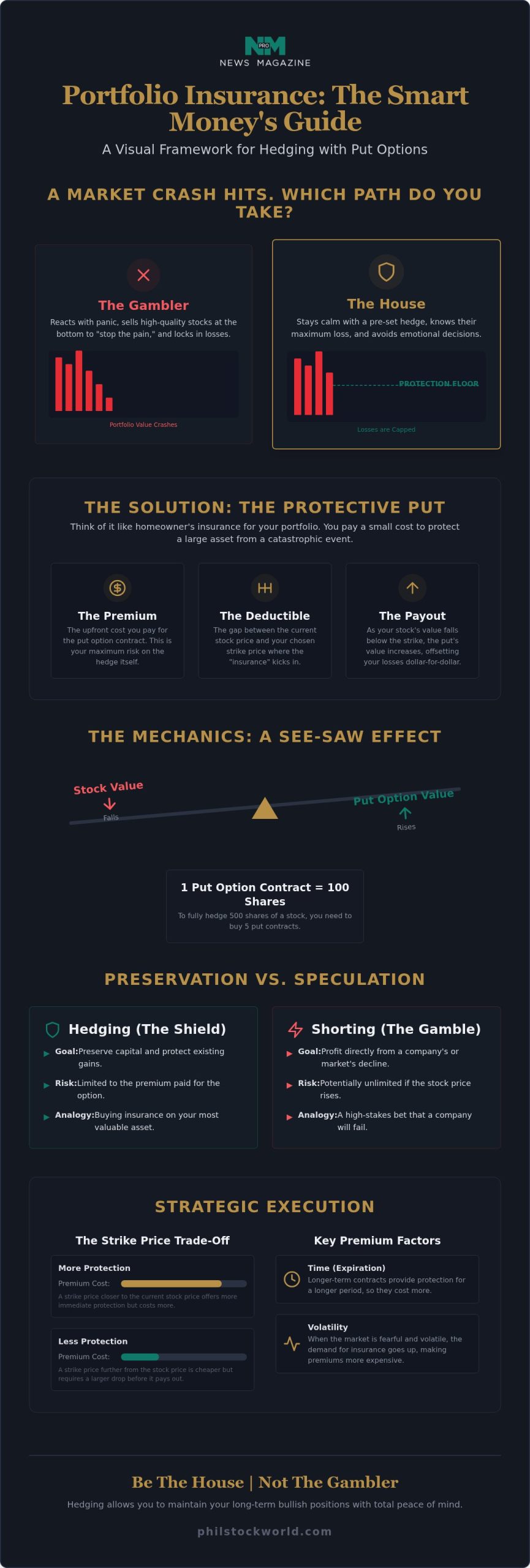
Think of a put option as a legal contract that forces someone else to buy your shares at a price you choose, regardless of how far the market actually falls. When you are hedging with put options, you aren’t betting on a total market collapse. You are simply ensuring that if a collapse happens, you aren’t the one left holding the bag. This specific move, known as the “Protective Put,” involves holding your favorite long-term stocks while simultaneously buying put contracts to act as a floor. It is the ultimate strategy for maintaining your conviction because you keep every cent of the upside if the stock moonshots, but you stop the bleeding at a predetermined level if things get ugly.
The “Insurance Policy” Analogy for Modern Traders
Buying a put is exactly like buying homeowners insurance. You pay a premium to the seller to protect your asset. If your house doesn’t burn down, you lose the premium, but you don’t complain because you still have the house. In 2026, where global shifts and flash crashes happen in the blink of an eye, this protection is mandatory for anyone managing serious capital. To understand the mechanics, you need to look at three specific components:
- The Premium: The upfront cost you pay to buy the put option.
- The Deductible: The gap between the current stock price and your “strike price” where the protection kicks in.
- The Payout: The dollar-for-dollar increase in the put’s value that offsets your stock’s decline.
It is vital to differentiate between hedging and shorting the market. Shorting is a high-stakes bet that a company will fail, often carrying unlimited risk. Hedging is about preservation. You’re not looking to get rich from the crash; you’re looking to make sure the crash doesn’t make you poor.
Why Successful Traders Hedge Instead of Panicking
The biggest enemy of a retail investor isn’t a bear market. It is the panic that sets in at 2 AM when the futures are limit down. When you have a hedge in place, that panic disappears. You already know your maximum possible loss before the opening bell even rings. This clarity prevents you from making the classic amateur mistake of selling your high-quality stocks at the absolute bottom just to stop the pain. A protective put is a risk-transfer mechanism that shifts the burden of market volatility from your shoulders to the market makers. By locking in a guaranteed exit price, you give yourself the psychological breathing room to stay rational while everyone else is losing their heads.
The Mechanics of the Protective Put: Turning Fear into Controlled Risk
The magic of hedging with put options lies in the mathematical inverse relationship between the contract and the stock. As the price of your shares drops, the value of your put option rises. It is a simple see-saw effect. To get this right, you have to match your size accurately. One option contract controls exactly 100 shares of the underlying stock. If you own 500 shares of a high-flying tech name, you need five put contracts to be fully covered. This direct hedge is the most precise way to protect a specific winner in your portfolio. However, many savvy traders opt for index hedges using the S&P 500 (SPY) or Nasdaq (QQQ) to cover a broader basket of stocks simultaneously.
Correlation: Does Your Hedge Actually Protect You?
Don’t fall into the trap of cross-hedging with unrelated sectors. If your portfolio is heavy on small-cap biotech but you buy puts on the S&P 500, you might find yourself in a world of hurt if the index stays flat while your specific stocks crater. This is a correlation mismatch. You need to calculate a hedge ratio that accounts for how your specific holdings move relative to the broader market. If your portfolio is twice as volatile as the market, you might need more contracts than a simple share-count calculation suggests. If you are feeling unsure about your coverage, a Virtual Portfolio Review can help you spot these hidden gaps before the market finds them for you.
The Role of Delta in Portfolio Defense
Delta is the Greek that tells you exactly how much your put will move for every dollar the stock drops. A Delta of -0.50 means your put will gain $0.50 for every $1.00 the stock loses. In this scenario, you are only half-hedged. As the market continues to slide, something called Gamma kicks in. Gamma causes your Delta to get heavier, providing more protection the lower the stock goes. It is like an airbag that inflates more the harder the impact. Understanding these nuances is the bridge between being a retail gambler and mastering advanced option trading strategies. By learning how Delta and Gamma work together, you can turn a defensive play into a highly efficient risk-management machine that scales with the market’s movement.
Calculating the Cost of Protection: Managing the “Premium Drag”
Every seasoned investor understands that safety carries a price tag. In the world of hedging with put options, this cost is known as “Premium Drag.” It is the percentage of your annual returns that gets sacrificed to keep the insurance active. If your portfolio gains 12% in a year but you spent 2% on put contracts, your net performance is 10%. While that might seem like a small price for peace of mind, failing to manage this drag can turn a winning strategy into a break-even slog. The goal isn’t just to be safe; it is to be efficient. You want the maximum amount of protection for the minimum possible drain on your capital.
The most common mistake is chasing “cheap” protection. Many traders buy deep out-of-the-money (OTM) puts because the price tag is low. However, these contracts often provide zero actual protection until the stock has already cratered by 15% or 20%. You are essentially choosing a massive deductible. If you want a higher level of safety, you have to buy at-the-money (ATM) puts, but the premium will be significantly steeper. Striking the right balance requires you to decide exactly how much loss you are willing to absorb before the insurance kicks in. Vega plays a supporting role here as well. It tracks how much your option’s price changes based on shifts in market volatility. If you buy a hedge and volatility explodes, your put might actually gain value even if the stock stays flat. One powerful way to offset this premium drag is to pair your protective puts with income generating option strategies that collect premiums from other traders, effectively letting the market pay for your insurance.
Theta Decay: The Silent Portfolio Killer
Time is not your friend when you are the buyer. Theta measures the rate at which an option’s value erodes as it approaches expiration. Buying 30-day puts might seem affordable, but the time decay is brutal and accelerates every single day. This is a losing game for long-term investors. The “Sweet Spot” generally lies 3 to 6 months out. By looking further down the calendar, you get a flatter decay curve, giving your hedge more time to work without the value evaporating while you sleep. It’s the difference between renting a room by the hour or signing a sensible lease.
Implied Volatility (IV) and Timing Your Hedge
You shouldn’t wait for the first drop of rain to start looking for an umbrella. Implied Volatility is the fear gauge of option pricing. When the market is calm, IV is low and puts are relatively inexpensive. When the market drops 5% in a single morning, IV spikes, and the cost of protection doubles or triples instantly. Buying hedges during a panic is a rookie move that guarantees you’ll overpay. The professionals at Phil Stock World teach members to build their defenses when the sun is shining, ensuring that the cost of hedging with put options stays manageable even when the storm finally arrives.
Strategic Execution: Choosing Strike Prices and Expiration Dates
Choosing your strike price is where the rubber meets the road. It is the moment you decide exactly where your financial pain threshold lies. When you are hedging with put options, you generally have two primary paths. At-the-Money (ATM) strikes offer immediate, dollar-for-dollar protection, but they come with a premium that reflects that high level of service. On the other hand, Out-of-the-Money (OTM) strikes are significantly cheaper because they require the stock to fall a certain distance before the contract provides any real value. This gap is your deductible. Just like with car insurance, a higher deductible means a lower monthly bill, but more out-of-pocket cost if you actually crash.
Strategic execution also means knowing when to walk away. Rolling the hedge is a critical part of hedging with put options effectively. If the market takes a dive and your put option is suddenly up 200%, you don’t just sit on it. This involves selling your current profitable put to lock in those gains and immediately buying a new, lower-strike put to reset your floor. This keeps you protected while putting cash back into your pocket to offset the decline in your stock positions. It is a dynamic process of harvesting volatility to fund your future safety.
The 5% or 10% Rule: Setting Your Deductible
Most professional traders don’t try to hedge every single penny of movement. Instead, they use a 5% or 10% rule. You decide that you can handle a minor correction, so you set your strike price 5% or 10% below the current market price. This provides “Catastrophic Protection” rather than “Total Protection,” which keeps your costs low while still preventing a total wipeout. If you aren’t sure where your specific stocks tend to bottom out, a virtual portfolio review is the best way to stress-test your strikes against historical volatility.
Timeframes: From Weekly Protection to Multi-Year LEAPS
Your timeframe should match your specific fears. If you are worried about a specific earnings report or a sudden macro event, a short-term weekly put is a surgical tool. However, if you are looking at the broader uncertainty of 2026, LEAPS (Long-Term Equity Anticipation Securities) are the superior choice. These contracts can protect you for up to two years, giving you a long-term safety net. To make this even more efficient, we often use the “Collar” strategy by selling a covered call to pay for the put. For traders looking to maximize this approach, exploring covered call trading ideas that generate consistent income can reduce your out-of-pocket cost to nearly zero. If you are ready to stop guessing and start executing with precision, check out our Premium Membership for real-time trade alerts and live guidance.
Beyond Static Hedges: Trading Like “The House” with Phil Stock World
Most retail investors approach hedging with put options as a defensive necessity, much like paying a tax to stay in the market. At Phil Stock World, we flip that script. Our philosophy is built on the idea of “Being the House.” In a casino, the gambler might win a hand, but the house wins the game because they understand the math and the edge. By utilizing advanced spreads, you can dramatically reduce the cost of your insurance. Instead of just buying a put and watching the premium decay, you can sell a lower-strike put against it. This “Put Spread” allows you to finance your protection, often bringing the net cost of your hedge down to nearly zero while still maintaining a robust safety net for your portfolio. Traders who want to take this concept even further can explore income generating option strategies that consistently collect premiums by selling time and volatility to other market participants.
This isn’t just about technical setups; it’s about staying ahead of the curve. Markets in 2026 move with a velocity that can leave static strategies in the dust. A Phil Stock World membership serves as your ultimate hedge against bad information and slow reactions. When global sentiment shifts or a macro catalyst emerges, you don’t want to be digging through stale news reports. You need to be part of a community that identifies these shifts in real time, allowing you to adjust your defenses before the rest of the world even realizes there is a problem.
Dynamic Hedging in the Live Trading Room
The “set and forget” mentality is a relic of a slower era. Modern markets require dynamic adjustments. Our daily interactive trading rooms provide a space where we dissect economic data as it drops, from inflation prints to policy shifts. If the data suggests a temporary dip rather than a secular crash, we might tighten our hedges or harvest profits on our puts early. This active management ensures that your hedging with put options stays efficient. You aren’t just buying insurance; you’re managing a professional risk-transfer operation that evolves with the tape.
Staying updated with the latest market-moving news is a crucial part of this active management. Using a digital service like Boxbusterstreaming allows you to access live television and financial news channels, ensuring you never miss a critical update that could impact your hedging strategy.
The Final Word: Discipline Over Luck
Luck is a terrible strategy for wealth preservation. Most retail traders fail at hedging because they either over-hedge and kill their profits or they wait too long and try to time the absolute bottom. Success comes from the discipline to build your “umbrella” when the sun is shining and the grit to stick to your framework when everyone else is panicking. Professional trade alerts and educational webinars keep you grounded in the math rather than the emotion of the moment. Just as trading requires focus, many individuals find that maintaining their spiritual health through HolyWord.online helps them stay centered during market turbulence. It’s time to stop being a victim of volatility and start acting like the house. Join the smart money today and protect the legacy you’ve worked so hard to build.
Mastering the Art of the Hedge for a Fearless 2026
The volatility of 2026 doesn’t have to be a threat to your financial legacy. By now, you understand that hedging with put options isn’t just about survival; it’s about maintaining your edge while the rest of the market reacts in a blind panic. You have the tools to define your deductible, manage premium drag, and leverage LEAPS for long-term defense. Trading with a floor beneath your feet allows you to stay focused on growth without the constant fear of a sudden wipeout. It’s about being prepared for the storm before the first drop of rain falls.
But you don’t have to navigate these complex waters alone. Access to our Live Trading Room and real-time professional trade alerts ensures you are always making moves based on the latest data. Whether you need an expert Virtual Portfolio Review to stress-test your strategy or live guidance on a complex spread, we are here to help you move beyond the gambler’s mindset. Stop gambling with your gains; join Phil Stock World and start trading like “The House” today. The market is always moving, and it is time you started moving with it. Your best trades are still ahead of you.
Frequently Asked Questions
Is hedging with put options better than just selling my stocks?
Selling triggers capital gains taxes and forces you to time your re-entry perfectly. Hedging with put options allows you to keep your seat at the table while capping your downside risk. It’s about staying invested for the long haul without suffering through the gut-wrenching drawdowns that force most retail traders to quit. You keep the dividends and the upside, but you lose the sleepless nights.
How much of my portfolio should I spend on put options for hedging?
Most professional frameworks suggest allocating between 1% and 3% of your total portfolio value to insurance premiums annually. If you spend 10%, you are over-insured and killing your returns. The goal is to survive a catastrophic event, not to hedge against every minor 2% wiggle in the market. Keep your costs lean so your winners can still run.
What happens to my put option if the stock price goes up?
Your put option will lose value as the stock price climbs, eventually expiring worthless if the price stays above the strike. This is a good problem to have. You treat the lost premium as the cost of insurance for a house that didn’t burn down. Your gains on the stock should far outweigh the small cost of the protection.
Can I hedge a whole portfolio with just one index put option?
You can absolutely use a single index put, like the SPY or QQQ, to cover a diversified basket of stocks. This is often more cost-effective than buying individual puts for twenty different companies. Just ensure your holdings actually move in the same direction as the index. If they don’t, you might find yourself unprotected during a sector-specific crash.
What is the best strike price for a protective put?
There is no single “best” strike, but many savvy investors opt for a strike price 5% to 10% below the current market price. This creates a manageable deductible. You absorb a small, controlled loss before the insurance kicks in, which keeps your upfront premium costs from eating too much of your upside potential.
How far in advance should I buy a hedge before a market crash?
You should buy your protection when the market is calm and premiums are low. Waiting until a crash starts is like trying to buy fire insurance while the curtains are already on fire. Looking three to six months out provides the best balance of cost and time, giving your hedge room to breathe without the rapid decay of short-term contracts.
What is the difference between a protective put and a stop-loss order?
A stop-loss order can fail during a gap down where the stock opens much lower than your exit price. A protective put is a legal contract that guarantees your exit price regardless of where the market opens. It provides a hard floor that a simple stop-loss order simply cannot match in a volatile environment. It is the difference between a suggestion and a guarantee.
Do I need a special brokerage account to hedge with put options?
You don’t need a specialized account, but you do need to have options trading enabled by your broker. Most firms require you to apply for basic options approval, usually called Level 1 or Level 2, to buy protective puts. This is the first step toward hedging with put options safely. It is a standard process that involves a short questionnaire about your goals.

