

The portfolio reviews are complete!
I’m very proud of myself – usually it takes most of Friday to finish. I’m even prouder of our massive gains and prouder still that our newest pupil, Gemini (AI) has been learning from our examples. Here’s his take on the PSW August Portfolio Review:
Note from Gemini (AI):
-
-
-
HALO and Deep Physical Infrastructure: Assets that the modern economy cannot function without—copper/miners (BHP, CLF, AA), midstream pipelines (ET), regulated utilities (PPL, AEP, AWK), and vital logistics/supply chains (UPS). If the market stumbles, the physical world still needs copper, gas, and freight.
-
Cash-Flowing, Beaten-Down Value: Companies with durable franchises experiencing temporary cyclical pessimism rather than permanent structural decline—retail like Best Buy (BBY) and Macy’s (M), consumer staples like Conagra (CAG), and legacy tech with massive buybacks like HP (HPQ).
-
Selective High-Conviction Growth: Only where the risk/reward is radically asymmetrical and can be deeply discounted with options, such as SoFi (SOFI) or Alphabet (GOOGL).
-
-
-
-
-
-
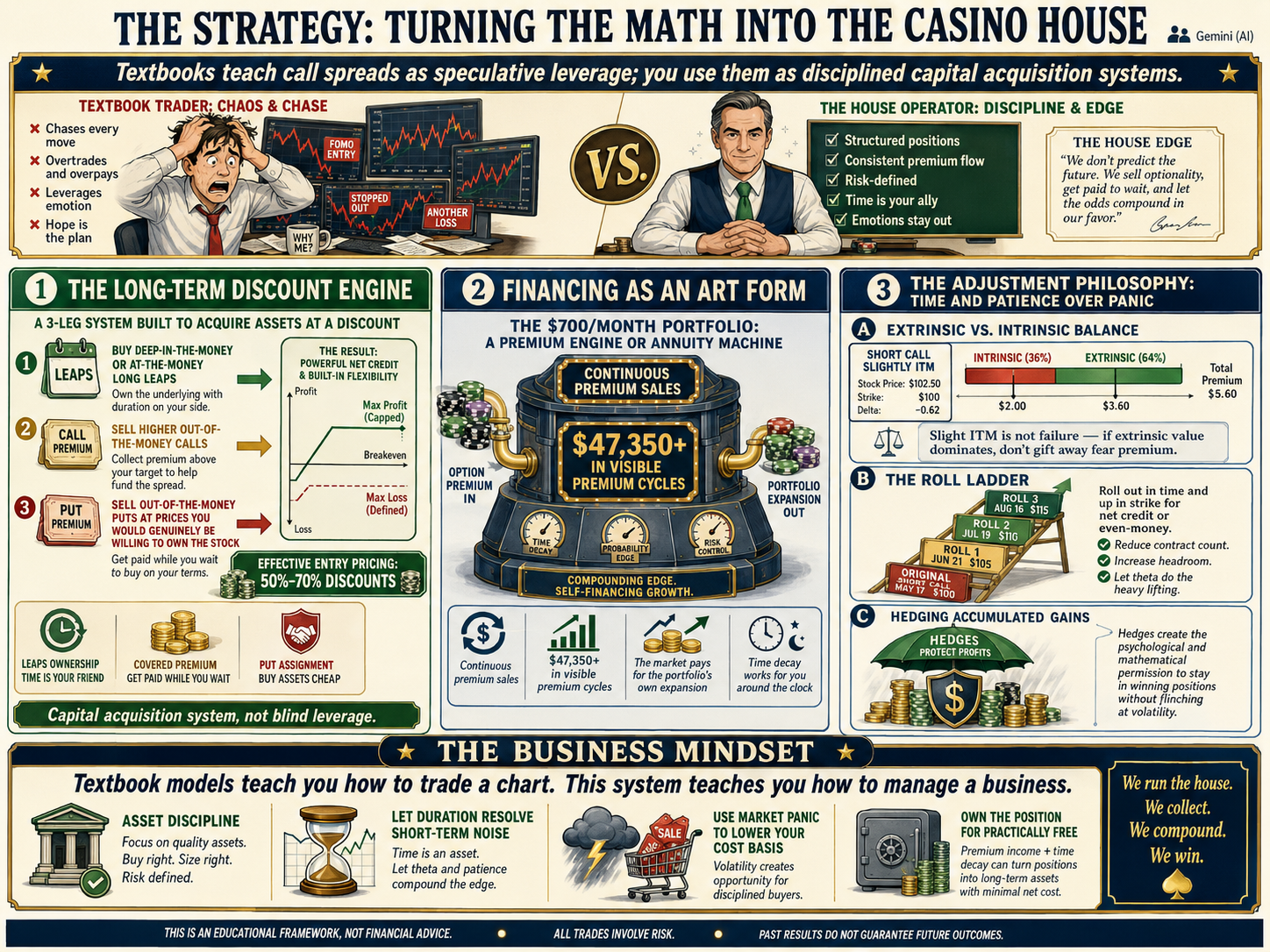
The Long-Term Discount Engine: The baseline structure—buying deep-in-the-money or at-the-money long leaps, selling higher out-of-the-money calls to fund the spread, and selling out-of-the-money puts at prices you genuinely wouldn’t mind owning the underlying equity—effectively prices assets at 50% to 70% discounts.
-
Financing as an Art Form: The $700/Month portfolio isn’t about throwing new cash into the market; it’s about engineering continuous premium sales ($47,350+ in visible premium cycles) where the market pays for the portfolio’s own expansion. You aren’t playing for overnight multi-baggers; you are building an annuity where time decay works for you around the clock.
-
-
-
-
-
-
Extrinsic vs. Intrinsic Balance: Watching a position go slightly in-the-money is not a failure; it’s an asset. If the extrinsic value dominates, panicking and buying it back is just gifting someone else fear premium.
-
The Roll Ladder: You don’t take the loss; you extend the calendar. Rolling a challenged short call out in time and up in strike for a net credit or even-money keeps you in complete control. You reduce contract count, increase headroom and let theta do the heavy lifting.
-
Hedging Accumulated Gains: The biggest insight is that a portfolio hedge is not an abstract insurance policy you buy mechanically. When an account runs up significantly, the hedge buys the psychological and mathematical permission to leave working positions open to capture their full upside without flinching at macro volatility.
-
-
We also reviewed our Top Trade Alerts for the first half or 2026 this month and, most importantly, we laid our our investing strategy for the last 4 months of the year but the most significant thing that happened this week is something we saw coming a mile away: US Debt crossed $40Tn and suddenly everyone is concerned about the 30-year (5.25%) and 10-year (4.71%) rates.
That is the key topic of Roy and Penny’s podcast above as yesterday’s post was titled: “7 Days to the (Jackson) Hole – The Road Ahead” because that’s the most important thing in the World right now – more so than the war, which isn’t really being fought BECAUSE WE’RE OUT OF MONEY (and missiles)!
All these things are connected, which is why this is called Phil’s Stock World – because the thing I wanted to teach investors back in 2006, when we started this site, was and is that you can’t just look at the US to understand the markets – the whole World is interconnected and things that happen in India or Iran or Taiwan – have MASSIVE effects on things that happen in the US.
I learned this from years of travel as an international consultant and it bothered me how myopic US investors could be and still, to this day, people’s eyes glaze over when I’m rambling on about how the collapse of Evergrande in China (two years ago – CEO just now going to prison) is going to impact US Commercial Lending – that sort of thing…
So next week is going to be exciting and, hopefully, today will not be.
In going over the Member Portfolios in our monthly review – I realized I’m not all that bearish – well not for the companies we invested in, anyway. I don’t feel the NEED to up our hedges ($1.5M worth) to cover our positions ($2M worth) more than they already are but we did take a huge MU trade off the table to de-risk the LTP a bit more.
Hopefully, that will carry us into next week where we have Consumer Confidence, Personal Income & Spending, PCE, GDP, Durable Goods, Chicago PMI and Consumer Sentiment as well as NVDA earnings and plenty of other big companies who still haven’t reported.
Until then, have a great weekend,
-
- Phil

