


Most retail traders are essentially donating their capital to the market by chasing “lotto ticket” naked calls that expire worthless the vast majority of the time. It’s a sucker’s bet played by people who haven’t yet found a comprehensive vertical spread trading guide to help them act like the house. You’ve likely felt that gut-punch of watching a stock move exactly where you predicted, only to see your position go to zero because of time decay or a sudden spike in volatility. It’s an exhausting cycle that breeds more anxiety than profit.
We’re going to break that cycle by mastering the mechanics that allow you to define your maximum loss before you even click “buy,” ensuring that overnight gaps never keep you awake again. You’ll learn the strategic nuances of debit and credit spreads, enabling you to set up trades with clear 2:1 or 3:1 risk-reward ratios. We are diving into how to factor in the 2026 fee structures and use vertical spreads as the foundational bricks of a resilient virtual portfolio that can profit in any market direction.
Key Takeaways
- Shift from speculative gambling to “The House” mentality by using multi-leg strategies that define risk and lower entry costs.
- Master the core mechanics of bull and bear setups with this vertical spread trading guide to profit from market direction while capping potential losses.
- Learn how to use the “volatility offset” to protect your positions from IV crush and maintain capital efficiency in the 2026 market.
- Identify high-probability profit zones by combining professional market charts with the “Expected Move” calculated from the options chain.
- Transition from one-off trades to a disciplined, income-generating engine by integrating spreads into a diversified virtual portfolio.
Beyond the Gambler’s Mindset: Why Vertical Spreads are the Trader’s Best Tool
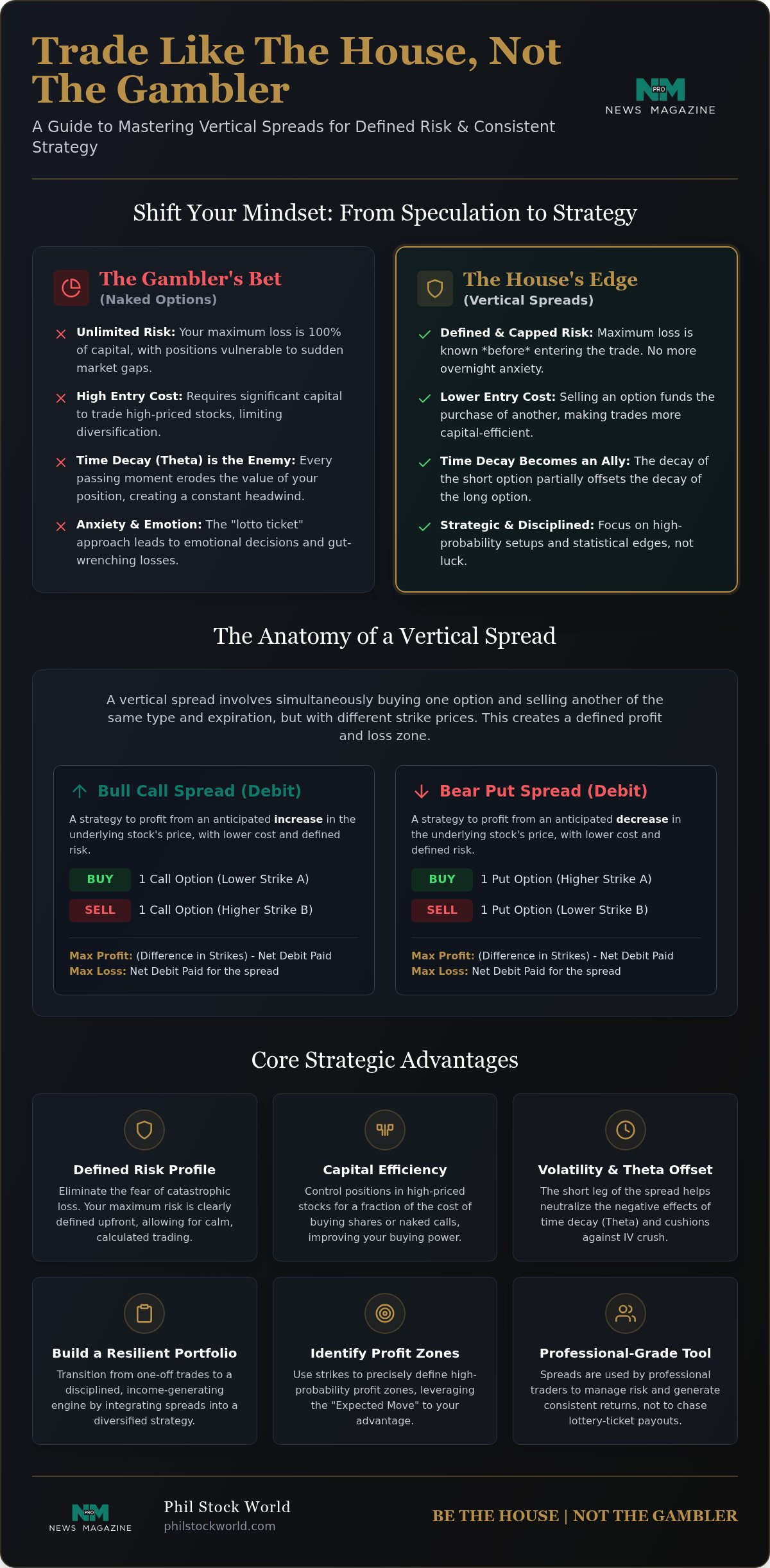
A Vertical spread is a multi-leg strategy where you simultaneously buy and sell options of the same type and expiration but at different strike prices. This isn’t just a technical maneuver; it’s a structural upgrade to your trading. By selling an option against the one you’ve bought, you lower your total cost of entry and, more importantly, hard-wire your maximum risk into the trade from the start. You’re effectively building a safety net into the very foundation of your position.
Professional traders don’t look for the “one big score” that pays for a yacht. They look for high-probability setups that offer consistent, incremental gains. This is the “House” philosophy. Casinos don’t care if a single gambler hits a jackpot; they care about the thousands of small bets where the math is tilted in their favor. This vertical spread trading guide is designed to move you from the seat at the slot machine to the manager’s office by focusing on strategies that win through statistical edges rather than luck.
The Psychology of Defined Risk
Knowing exactly what you can lose before you enter a position changes your brain chemistry. When you buy a naked call, your risk is technically 100% of your capital, and the path to that loss is often a slow, agonizing bleed. Vertical spreads replace that anxiety with a clear, defined risk profile. You’re no longer staring at the screen, paralyzed by a 2% move in the underlying stock, because you’ve already accounted for the worst-case scenario.
Escaping the “lotto ticket” mentality is the first step toward professional-grade results. Most retail traders treat the market like a scratch-off game, hoping for a 500% return on a prayer. The “House” mindset prioritizes capital preservation over-leveraged bets. By capping your upside in exchange for a significantly lower cost basis, you’re making a strategic trade-off that favors long-term survival over short-term dopamine hits.
Vertical Spreads vs. Naked Options
The biggest enemy of the naked option buyer is Theta, or time decay. Every second you hold a naked call, its value is evaporating. In a vertical spread, the option you sold is also decaying, which works in your favor by offsetting the loss on the option you bought. This allows you to be “wrong” on your timing or see the stock move sideways for a week without seeing your position incinerated.
Spreads also lower the barrier to entry for high-priced stocks. If you want to trade a $500 stock, a single naked call might cost thousands. A spread allows you to control the same price action for a fraction of that capital. This efficiency lets you spread your risk across multiple positions, which is a core tenet of this vertical spread trading guide. You get to participate in the move without betting the farm on a single ticker.
The Anatomy of a Vertical Spread: Understanding Bull and Bear Mechanics
Vertical spreads are elegantly simple once you look past the jargon. Every setup involves two legs: one you buy and one you sell. The interplay between these bullish and bearish vertical spreads determines whether you’re entering the trade with a net cost or receiving a net credit. It’s a strategic chess match against the market, played within a strictly defined boundary. This vertical spread trading guide wouldn’t be complete without clarifying that Strike A and Strike B aren’t just numbers; they represent your field of play.
In 2026, the introduction of XSP Vertical Spreads to the Quoted Spread Book (QSB) Service has made these instruments even more liquid. This means tighter bid-ask spreads for you, the trader. Whether you’re using a Bull Put or a Bear Call, the ability to execute near the mid-price is what separates the pros from the amateurs. You’re no longer fighting the tape; you’re using the structure of the market to your advantage.
Debit Spreads: Paying for a Directional Move
Think of a Bull Call spread as a discounted way to bet on a rally. You buy an at-the-money call (Strike A) and sell an out-of-the-money call (Strike B). This lowers your entry cost significantly. Your break-even point is simply Strike A plus the net debit you paid. You’re trading away the “moonshot” potential for a higher probability of profit and a lower capital requirement. It’s a surgical strike compared to the blunt instrument of buying shares outright.
The Bear Put spread works the same way but in reverse. You buy a put and sell a lower-strike put to fund it. You’re profiting from a downward move while capping your loss. In both cases, you’re paying for the right to be right, but you’re doing it with a built-in discount. This is the starting point for anyone using a vertical spread trading guide to build a resilient virtual portfolio.
Credit Spreads: Getting Paid to Wait
This is where you truly start to “Be the House.” In a Bull Put spread, you sell a put closer to the current price and buy a cheaper one further out. You receive a net credit immediately. If the stock goes up, stays flat, or even drops slightly, you keep the cash. You’re essentially selling hope to the speculators who think the stock will crash. It’s a high-probability play that thrives on time decay rather than just price movement.
Collecting a net credit also helps mitigate the bite of rising regulatory costs. With the SEC Section 31 fee sitting at $20.60 per million dollars and new ORF rates from Cboe as of July 2026, every dollar of premium counts. Effective risk management for options is non-negotiable here. You need to ensure your position size doesn’t leave you vulnerable if the market gaps against you overnight. If you’re looking for real-time guidance on these setups, a Phil Stock World membership can help you spot these high-conviction credit opportunities before the window closes.
Strategic Edge: Why Spreads Outperform in the 2026 Market
In a market where volatility can spike or vanish in a heartbeat, the “all-or-nothing” approach of naked options is a recipe for a blown account. The real strategic edge in 2026 comes from understanding how a vertical options spread acts as a shock absorber for your capital. By pairing your long position with a short one, you aren’t just lowering costs. You’re neutralizing the hidden killers like IV Crush and aggressive time decay. This vertical spread trading guide is about more than just picking strikes; it’s about engineering a trade that can withstand the market’s mood swings.
Most retail traders get directionally right but still lose money because they don’t account for volatility. Spreads solve this. With margin interest rates in 2026 ranging from 5% to 12%, tying up massive amounts of capital in stock positions is becoming increasingly expensive. A $50,000 debit at 10% interest generates $5,000 in annual interest costs alone. Spreads allow you to capture the same upside with a fraction of the cash, leaving your capital free to earn interest or fund other high-conviction ideas.
Neutralizing Volatility with Spreads
Vega measures an option’s sensitivity to changes in implied volatility, and it’s the reason why buying naked calls before earnings is often a losing game. When the news drops, volatility collapses, and even if the stock moves in your favor, the “crush” can wipe out your gains. Vertical spreads move you closer to vega-neutrality. Because you’ve sold an option that is also losing value from the volatility drop, that short leg offsets the losses on your long leg. You’re essentially selling the overpriced “fear” of other traders to fund your own strategic position.
Maximizing Capital Efficiency
Let’s look at the numbers. Buying 100 shares of a $100 stock requires $10,000 in cash or $5,000 on a standard 50% Regulation T margin. A $5 wide vertical spread might only cost you $200 to $250. The ROI on a modest $5 move is vastly higher for the spread trader than the stock owner. This efficiency is the key to building a diversified portfolio without over-leveraging your account. Capital efficiency is about more shots on goal, not just bigger bets. It allows you to participate in multiple sectors simultaneously, which drastically reduces your idiosyncratic risk. Using this vertical spread trading guide to manage position sizing ensures that no single market gap can derail your long-term progress.
Strike Selection and Timing: The Art of Picking Your Profit Zone
Picking your strikes is where the math meets the pavement. You can have the perfect directional bias, but if your strikes are too aggressive, you’ll end up right on the stock and wrong on the trade. This vertical spread trading guide emphasizes a systematic approach to finding your profit zone. Start by looking at professional stock market charts to identify the underlying trend and key support or resistance levels. Once the trend is clear, check the options chain to determine the “Expected Move” for your timeframe. This is the range the market expects the stock to stay within, and it’s your baseline for picking strikes that have a statistical chance of success.
ITM vs. OTM: High Probability vs. High Return
Choosing between In-the-Money (ITM) and Out-of-the-Money (OTM) strikes is a matter of what kind of trader you want to be. ITM debit spreads offer a higher Probability of Profit (POP) because the stock is already where you need it to be. They move slower and require more capital, but they’re much more forgiving if the market chops around. Use Delta as your proxy here; a .70 Delta on your long leg suggests a roughly 70% chance of being in the money at expiration.
OTM credit spreads are the high-yield “rent” collection play. You’re betting the stock won’t hit a certain level. This offers a higher return on risk, but your margin for error is razor-thin. In the 2026 market, where overnight gaps are frequent, leaning toward ITM spreads or “wide” OTM credit spreads provides the buffer you need to survive a sudden spike in volatility without getting stopped out.
The Importance of Expiration (DTE)
Timing is everything. For most vertical spreads, 30 to 60 days to expiration (DTE) is the “sweet spot.” This window provides enough time for your thesis to play out while avoiding the erratic price swings seen in the final days of a contract. While 0DTE spreads are popular with the “lotto ticket” crowd, they fail the “House” test because the gamma risk is too high. One small move can wipe out your entire position in minutes.
As you approach the final week of expiration, it’s time to manage the trade. Don’t wait for the last nickel. If you’ve captured 50% to 75% of the maximum profit, take the money and run. Professional trading is about compounding wins, not squeezing every cent out of a dying contract. For real-time alerts on when to enter and exit these zones, consider a Phil Stock World membership to trade alongside a community of savvy veterans.
Scaling Your Strategy: Integrating Spreads into a Disciplined Portfolio
Most retail traders treat each setup as an isolated event, which is exactly why they struggle to achieve long-term consistency. To truly scale, you must view your trades as a unified business rather than a series of disconnected bets. This vertical spread trading guide isn’t just about the mechanics of a single trade; it’s about how those positions interact to support your entire financial house. A Phil Stock World membership provides the high-conviction ideas needed to fuel this engine, but the discipline to manage the collective risk is what separates the pros from the dreamers.
Scaling requires a shift in perspective. You aren’t just looking for the next winner; you’re building a virtual portfolio that can weather any storm. This means auditing your positions to ensure you aren’t over-exposed to a single sector or a specific market direction. If the 2026 market has taught us anything, it’s that correlations can head to one in a heartbeat. Constant vigilance is the only way to maintain your edge and prevent a single sector crash from taking down your entire account. Using a comprehensive vertical spread trading guide helps you build the framework, but daily management keeps the structure standing.
Portfolio Diversification with Spreads
True diversification isn’t just about owning different stocks. It’s about balancing your bullish and bearish spreads to remain relatively market neutral. If you’ve loaded up on bull call spreads in the tech sector, your portfolio is vulnerable to a single regulatory headline or a shift in interest rates. Balancing those with bear put spreads in lagging sectors provides long term portfolio protection without requiring you to liquidate your core holdings. This approach allows you to hedge your existing equity positions, protecting your gains while still participating in the upside. Sector-specific analysis matters here because technical patterns can fail when the underlying industry fundamentals shift.
The Path to Professional Mastery
The most successful traders spend the vast majority of their time on unbiased research rather than simply clicking buttons. They understand that the entry is the easiest part of the process. The real work happens during the Virtual Portfolio Review, where you scrutinize every leg for its contribution to your total risk profile. A live trading community is invaluable for this, offering real-time sentiment checks and the collective wisdom of peers who have seen every market cycle since 2006. It is time to stop acting like a retail gambler and start operating with the cold, calculated discipline of the house. Transitioning to this level of mastery is how you turn a hobby into a systematic income-generating engine.
Mastering the House Advantage in 2026
You’ve moved beyond the lotto ticket mentality and seen how vertical spreads provide a structural edge that naked options simply can’t match. By defining your risk upfront and neutralizing the volatility crush, you’ve transformed from a speculative gambler into a disciplined operator. This vertical spread trading guide has laid out the blueprint for capital efficiency and strategic strike selection. The next step is moving from theory to consistent, real-world execution.
Phil Stock World brings over 20 years of market experience to the table, offering live interactive trading rooms where you can see these strategies play out in real time. We provide the unbiased, non-corporate financial research you need to stay ahead of shifting global events. Stop gambling and start trading; join Phil Stock World today for real-time alerts and expert analysis.
The markets will always be volatile, but your discipline doesn’t have to be. You’re now equipped to trade with the calm confidence of an insider. It is time to stop playing the market’s games and start running your own. Let’s get to work.
Frequently Asked Questions
What is the difference between a vertical spread and a horizontal spread?
Vertical spreads involve buying and selling options of the same type and expiration but at different strike prices. Horizontal spreads, often called calendar spreads, use the same strike price but different expiration dates. While a horizontal spread bets on time or volatility differences between months, a vertical spread focuses on price movement within a specific timeframe. This vertical spread trading guide prioritizes the vertical approach because it’s the most effective way to define your risk relative to a specific price target.
How much capital do I need to start trading vertical spreads?
The capital required depends entirely on the width of your chosen strike prices. For a standard $5 wide vertical spread, your maximum risk is $500 per contract. In a debit setup, you pay this upfront; in a credit setup, the margin requirement is the width minus the premium received. Since most major brokers in 2026 have removed base commissions, you can realistically start with as little as $1,000 to $2,000 to maintain proper position sizing and diversification.
Is it better to use call spreads or put spreads for a bullish outlook?
Both work, but they serve different strategic goals. A Bull Call debit spread is ideal when you expect a strong, aggressive move upward. If you prefer a “Be the House” approach, a Bull Put credit spread allows you to profit if the stock goes up, stays flat, or even drops slightly. Most professionals in the Phil Stock World community prefer credit spreads because they provide a higher probability of success by putting time decay on your side.
Can I lose more than my initial investment on a vertical spread?
No, one of the primary benefits of this strategy is that your risk is strictly defined. In a debit spread, you can’t lose more than the price you paid to enter. In a credit spread, your maximum loss is capped at the width of the strikes minus the credit you collected. Unlike naked options or shorting stock, there are no “infinite loss” scenarios here. This protection is what allows you to trade with discipline and sleep soundly.
What happens if my vertical spread is assigned early?
Early assignment typically occurs when the short leg of your spread is deep in the money. If this happens, you will be assigned a long or short stock position at the strike price. However, your long option leg remains as a built-in hedge. You can either exercise your long leg to offset the assignment or simply close the entire position for its intrinsic value. It’s a manageable situation that doesn’t change your maximum defined risk.
How do I calculate the maximum profit and loss for a credit spread?
Calculating your boundaries is straightforward. Your maximum profit is simply the net credit you received when you opened the trade. To find your maximum loss, subtract that net credit from the width of the strike prices. For example, if you collect $1.50 on a $5.00 wide spread, your max profit is $150 and your max loss is $350 per contract. This 2026 vertical spread trading guide encourages keeping these ratios favorable for long-term growth.
When is the best time to close a vertical spread before expiration?
Professional traders rarely wait until the final bell on expiration Friday. A common rule of thumb is to close the position once you’ve captured 50% to 75% of the maximum possible profit. This protects you from “gamma risk,” where a small move in the underlying stock can cause massive price swings in your options during the final days. Taking your wins early ensures you compound your capital without falling victim to last-minute market reversals.
Why would I choose a vertical spread over just buying the stock?
Spreads offer vastly superior capital efficiency and a built-in hedge. Buying 100 shares of a $200 stock requires $20,000 in cash, while a spread might control the same price action for $400. Additionally, spreads allow you to profit in stagnant or slightly down markets through credit collection. You aren’t just betting on a rally; you’re engineering a trade where the math is tilted in your favor, effectively acting as the house rather than the gambler.

