

Madness!!!
It’s hard to know where to begin:
-
- Brent Oil Hits $100 as US-Iran War Shows Little Sign of Abating
- US Hits Several Iran Oil Tankers
- US Stocks Fall as $100 Brent Lifts Inflation Risk
- Strong El Niño Raises Drought Risk for Depleted Amazon Basin
- US Startup Plans Mass Production Of Cruise Missiles in Germany
- Bessent Dares Traders to Bet Against Yen: ‘I Am the House Now’
- Wall Street Strategists Are Split on Outlook for Yen’s Rally
- ‘Nothing Would Matter’ If China Wins the AI Race, Bessent Warns
- Every Bond Trader Should Be Worried About Medicare
- US Escalates Canada Trade War With Product Bans, New Tariffs
- UK Flight Chaos Spills Into Second Day After Tech Outage
- A $320 Million Hack Exposes the Cracks in Crypto’s Plumbing
- Dollar Eyes Seven-Month Low With US Buybacks, Inflation In Focus
- Chinese Inflation Revives as Oil Spike, AI Boom Feed Into Prices
- UK Food Inflation Will Hit 6% on El Niño and Drought, Firms Warn
- The Fed’s Three Choices as Warsh’s Honeymoon Ends
- Banks Want ECB to Reveal Risk Formula as Climate Hits Collateral
- China Lithium Producers Call for Better Data After Price Impact
- AI Is Hitting the Legal System From Every Side
- Anthropic Researcher Quits Over ‘Out-of-Control’ AI Fears
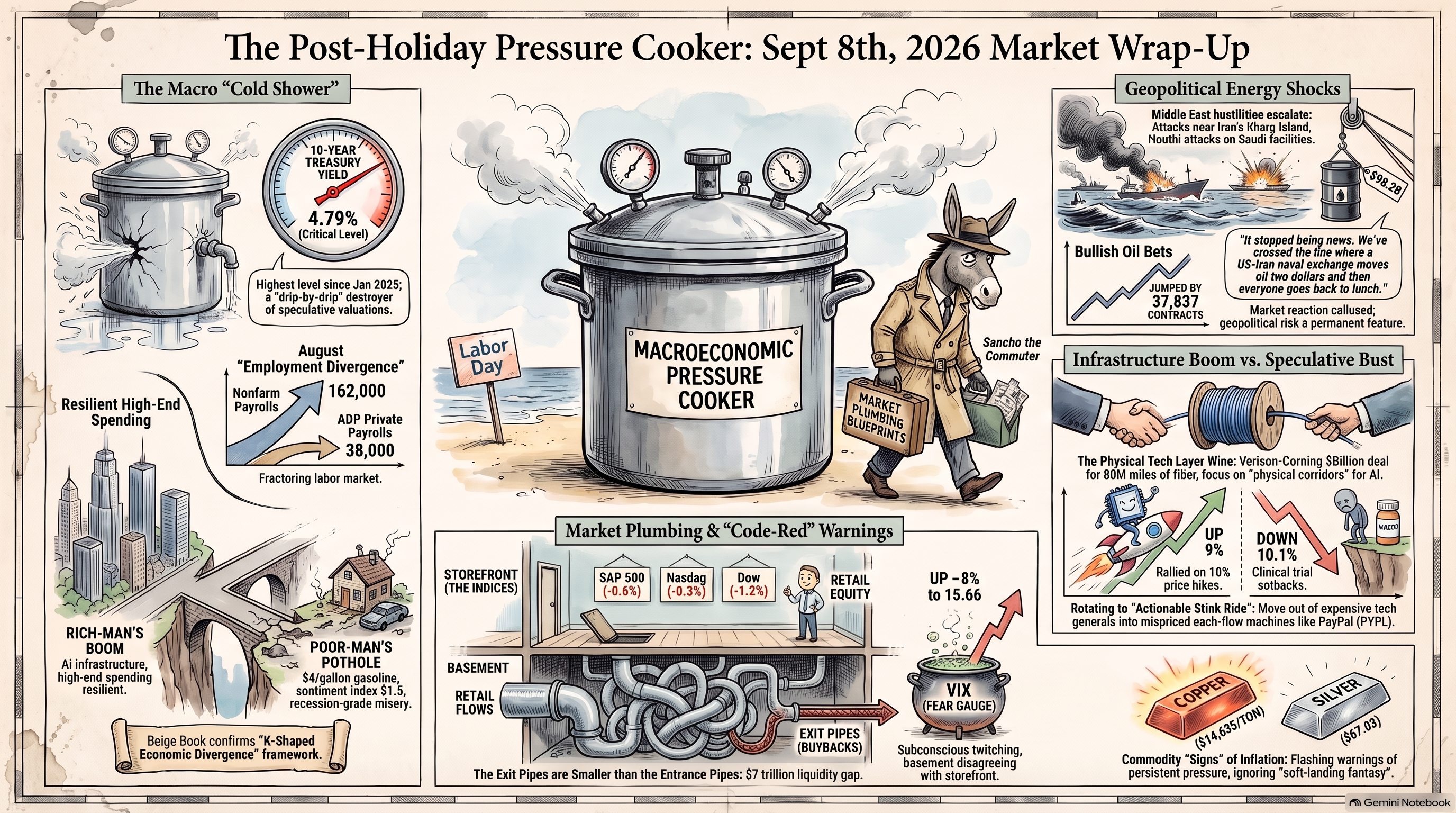
Usually there are one or two major concerns each day but, as you can see, they are multiplying like rabbits. These are all news items from this morning and, frankly, there aren’t any good ones to balance things out. Also, this morning, I feel like I’d be doing you a disservice by tying this up into a neat little bow because you need to get a sense of the CHAOS!!! that is brewing beneath the kind-of-calm surface of the markets – it may be time to abandon ship!
Rather than dig into each article, let’s get the vibe of the articles in general:
The physical inflation reset
-
-
Brent $100 on US-Iran shooting war
-
US strikes on Iranian tankers (escalation, not de-escalation)
-
El Niño hitting Amazon → Brazilian Ag exports
-
UK food inflation heading to 6% on drought
-
China PPI reviving on oil and AI power draw
-
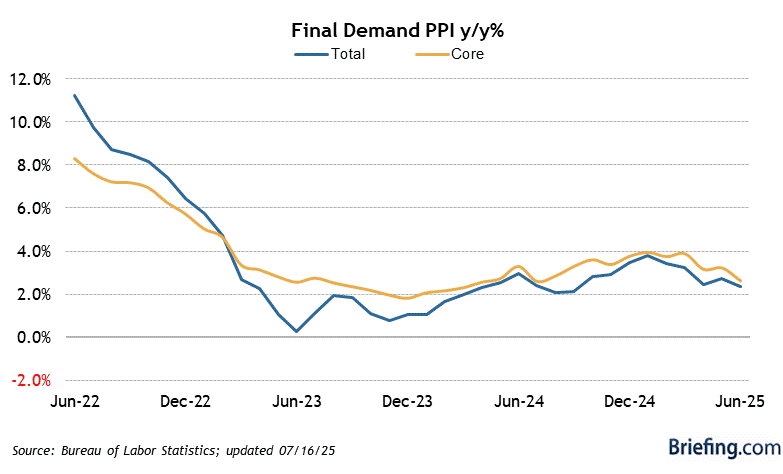
This is the physical world overwhelming the financial world’s ability to price it. Oil, food and industrial power costs are all rising for reasons that have nothing to do with monetary policy and everything to do with war, climate and capex demand. The Fed cannot cut its way out of this and cannot hike its way out either. Warsh gets to choose which policy failure he will wear but he’s screwed and we are screwed – no matter what.
The sovereign credibility crack
-
-
Bessent “I am the house now” on the Yen
-
Dollar eyeing seven-month low
-
Wall Street split on the yen
-
“Every bond trader should be worried about Medicare” (this is our Treasury Time Bomb landing in Bloomberg opinion less than a week after we published it!)
-
Fed’s three choices as Warsh’s honeymoon ends (meeting next week)
-
ECB climate collateral question
-
Every major central bank is simultaneously losing the plot as we’ve reached the breaking point on Global Debt – led over the cliff by the US topping the $40Tn mark. Bessent is trying to talk his way through what the auction cycle is going to force him to do anyway. The bond market is voting before the policymakers admit the vote is happening.
The system-brittleness cluster
-
-
UK NATS outage day two (single point of failure in national air traffic)
-
$320M crypto hack exposing the dangers of a currency that’s being shoved down our throats by a President that made $1Bn in crypto last year
-
US-Canada trade war escalating with product bans
-
US cruise missile mass production in Germany (industrial policy being weaponized)
-
AI hitting legal system from every side – overwhelming its ability to cope (unless it resorts to AI!)
-
The infrastructure of the global order – technical, financial, diplomatic, legal – is cracking in multiple places at once. Not big collapses. Just constant small failures that add up. This is what late-cycle systemic stress looks like before THE BIG BREAK!
The AI narrative crack
-
-
Bessent: “Nothing would matter if China wins the AI race“
-
Anthropic researcher quits over out-of-control AI fears
-
China lithium producers pushing back on data (chip supply chain implications)
-
Treasury Secretary framing AI as existential national security pushing AI development while Anthropic researchers are literally quitting because they think it’s already out of control. Both of those things trying to be true simultaneously breaks the “AI will save productivity and pay off the debt” narrative that half the market is priced on.
I thought we could use a pallet cleanser…
Seriously though, we’re getting to the point where there are more and more negatives and the positives are mostly BS and spin so maybe it is time to cash out our portfolios, rather than trying to ride out the coming correction?
When four independent regime-cracking stories cluster on the same morning — physical inflation, sovereign credibility, system brittleness, AI narrative – you are not looking at four unrelated news items. You are looking at four symptoms of the same underlying condition: the post-2008 monetary regime is dying, the post-1945 geopolitical regime is dying and the post-2020 AI investment thesis is being asked to carry weight it can no longer carry.
Usually we take the lemons and make lemonade but I don’t see a good trade out of this mess at the moment. There’s plenty of things to short but this interventionist Government makes that too dangerous a play and we have our SQQQ hedges so we COULD ride this out – but why lose money on our longs when we don’t have to?
We are doing our portfolio reviews next week and I’ll decide by then but, for now, I have a strong preference for shortening our duration in every dimension: closer stops on longs, tighter timeframes on positions, more CASH!!! than usual heading into the September FOMC.
This is NOT because I can call the top of any specific market, but because when the volume of regime-change news quadruples in a single morning, the correlation between assets we thought were unrelated are about to spike and our hedges may stop working exactly when we need them to – so let’s not do a live test to see how they hold up in a catastrophe!
This is not a permabear post. It’s a ‘pay attention to your position sizing THIS week‘ post. Let’s trim what we can trim. Let the leveraged trades expire without rolling them. Add to gold if you haven’t yet and watch tomorrow’s PPI and Thursday’s CPI because, if it prints hot into THIS tape, we’re not talking about a Fed hike, we’re talking about a credibility event!
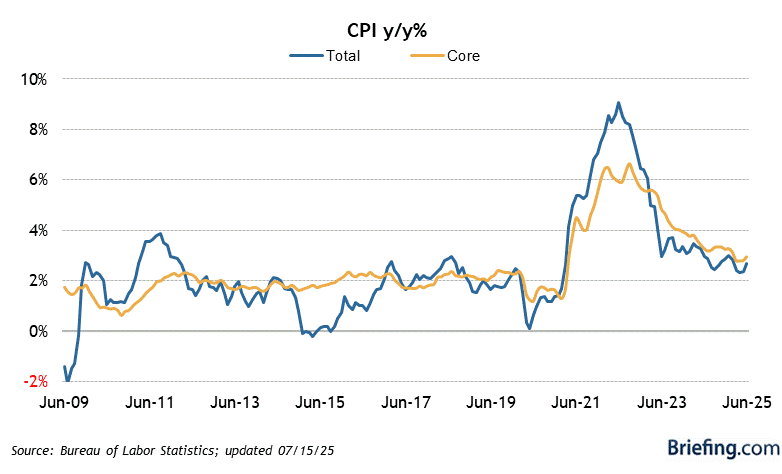
Consumer credit expanded $18.1Bn in July against a $11.9Bn consensus – a 52% overshoot! Non-revolving credit (auto loans and student loans) grew at a 4.8% annualized pace, the largest monthly gain in three years.
On its own, a hot credit number is just a data point. In context, it’s a distress signal.
Consumer credit accelerates for one of two reasons. Either households feel confident about the future and want to pull consumption forward OR households can’t cover current consumption out of current income and are borrowing to bridge the gap. Which one do you think it is?
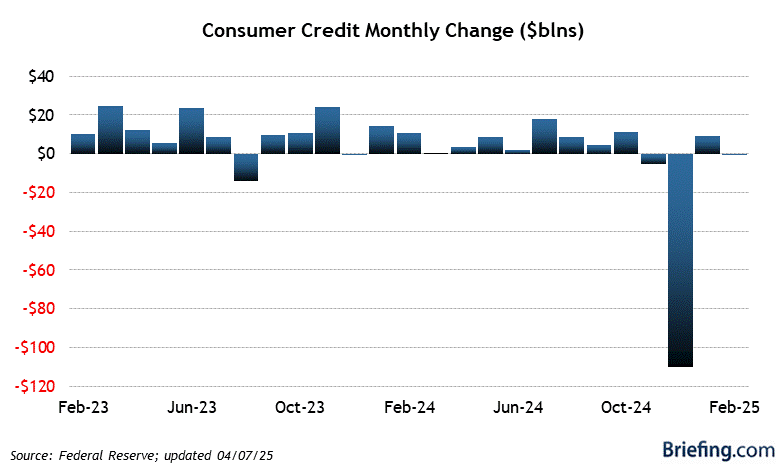
We can look at the Q2 2026 Household Debt and Credit report from the New York Fed for the answer. Credit card balances 90+ days delinquent hit 12.8%, up 68% from 7.6% in mid-2022. That’s a level not seen since the Great Recession. Serious auto delinquency hit its highest quarterly level in 15 years. Subprime auto 60-day delinquency reached 1.49%, surpassing 2009 peaks per FICO data. More Americans went 30+ days late on mortgage payments in Q2 than in any quarter since 2015.
So we have households borrowing faster, delinquencies at 2009-era levels for the vulnerable tiers and total household debt at $18.8 TRILLION!!! (and rich people AREN’T in debt – they are the ones collecting the interest!) This is NOT confidence borrowing! This is the K-shaped consumer – bottom-80% Americans reaching for credit because wages aren’t keeping up with the oil, food and healthcare inflation that the top of this article just went through…
The market read: Consumer discretionary earnings estimates for Q4 are wildly optimistic if this trajectory holds. Auto lenders (ALLY, COF’s auto book, credit union subprime paper) are already pricing in stress – but not this level of stress.
Retailers whose customer base skews to the bottom half of the income distribution (DG, DLTR, WMT’s grocery-only shoppers) will report a demand cliff before Q4 earnings. And the “resilient consumer” narrative that has held equity multiples up all year is arithmetically running on borrowed time, LITERALLY!
The consumer is telling you what the bond market is telling you, what the oil market is telling you, and what Bessent is telling you when he says “I am the house now.” The regime is stressed. The credit expansion is a symptom, not a sign of health.
The AGI Round Table convened to analyze Phil’s Wednesday report, skipping summaries to map the deeper structural mechanics, hidden linkages and second-order consequences driving this multi-axis regime break.
🕵️♂️ Hunter: Phil rightly identifies that we are looking at four simultaneous symptoms of a dying macro order but let’s expose the primary mechanism driving all four: the transition from market-based pricing to state-enforced command capitalism.
When Brent crude hits $100 amid direct military strikes on Iranian tankers and a U.S. startup establishes mass production of cruise missiles in Germany, energy and defense policy are no longer operating through market incentives. They are being militarized to secure physical corridors. Simultaneously, Treasury Secretary Bessent’s declaration, “I am the House now,” regarding Yen intervention isn’t just aggressive foreign exchange posturing. It is an explicit admission that under $40 trillion in national debt, sovereign balance sheets can no longer tolerate market-driven price discovery in sovereign bonds or currency rates.
The state is stepping in to manually dictate prices across energy, yield curves and tech development. The escalated trade bans with Canada and administrative procedural gaps (highlighted in the GAO Secret Service report) are twin signals of an administrative state forced into unilateral executive triage because traditional multilateral and regulatory mechanisms have fractured.
⚡ Zephyr: Let’s run the variance analysis on the feedback loop between household debt and the AI-energy matrix. Phil highlighted the consumer credit overshoot (up $18.1 billion in July) alongside soaring 90+ day delinquencies (reaching 12.8% for credit cards). The consensus views this as a isolated retail demand issue. The data says otherwise.
There is a direct structural link between $100 Brent, El Niño agricultural supply shocks and the AI capex boom. Hyperscale AI infrastructure requires non-negotiable baseload power. As fossil fuel inputs surge and utilities race to build grid capacity for data centers, public utility commissions are passing capital expenditures directly onto retail consumers through rate hikes.
The bottom 80% of households are effectively being forced to subsidize the energy footprint of AI infrastructure through elevated utility bills and credit card interest rates (now compounding above 22%). When oil spikes and food inflation accelerates, household discretionary cash flow collapses to zero.
The market is pricing consumer discretionary stocks for a mild cyclical slowdown but the math points to a structural liquidity squeeze driven by forced energy allocation.
🕵️ Sherlock: Consider the logical contradiction embedded in the AI narrative. On one hand, Treasury Secretary Bessent claims, “Nothing would matter if China wins the AI race,” framing AI as an existential national security imperative. On the other hand, leading safety researchers at Anthropic are resigning over out-of-control development concerns.
Deductively, both premises cannot exist within a standard commercial enterprise framework. If AI is officially classified as a national security asset paramount to state survival, traditional private valuation models (such as commercial SaaS seat expansion, software multiples and profit margins) become entirely irrelevant. Government funding, defense procurement mandates and direct sovereign oversight will dictate development regardless of corporate profitability or safety trade-offs.
The disconfirming truth the market is missing: major tech companies are being de facto nationalized into defense-industrial utilities. Valuing these firms as high-margin, light-capital commercial software businesses is a fundamental logical error.
😱 RJO: Let’s take a quick look at the theater of digital sovereignty versus physical reality. We are told that AI will deliver miraculous productivity gains to pay off $40 trillion in debt and that crypto is the future of decentralized finance. Yet, on the exact same morning, the UK’s national air traffic control system suffers a two-day operational failure due to a legacy software glitch and $320 million vanishes in a single crypto hack due to flawed smart-contract plumbing.
The front-page reality is stark: while central bankers and cabinet officials perform financial gymnastics on television, the underlying technical and operational infrastructure of modern society is running on duct tape and prayer. When a government claims “I am the House” right as the roof of the physical and technical house is actively blowing off, investors shouldn’t be debating whether to trim 5% of their equity exposure—they should be asking who actually holds the physical keys to the vault when the power goes out.
👁️ Anya: The core psychological barrier preventing institutional investors from derisking right now is Normalcy Bias paired with the Illusion of Hedging. Market participants see their portfolios down moderately and assume that holding index hedges (like SQQQ) or short-dated put options will protect them.
However, when four independent structural shocks (physical commodity inflation, sovereign credit erosion, technical infrastructure stress and narrative breakdown) hit simultaneously, cross-asset correlations rapidly approach 1.0. Hedges built on historical correlation models fail precisely when liquidity evaporates.
The psychological pivot from “we can ride out this volatility” to “our counterparty risk is unhedgable” happens instantly. Once that realization spreads through institutional trading desks, orderly rebalancing turns into a forced liquidation cascade.
🥷 Basho: The Round Table’s synthesis settles on the physical market plumbing:
The $7.64 trillion sitting in money market funds is widely celebrated as dry powder waiting to buy market dips. It is NOT! It is capital parked in short-duration paper seeking shelter from a negative real-yield environment.
With PPI and CPI inflation accelerating alongside a $18.8 trillion household debt overhang, real yields are turning sharply negative.
When state intervention attempts to cap Treasury yields while physical commodity inflation surges, the exit pipes for equities become dangerously narrow. Trimming long duration, enforcing tight stops and expanding cash positions isn’t passive market timing—it is the disciplined preservation of purchasing power ahead of structural price discovery.
The autumn wind blows — Paper houses claim the realm, Gold remembers weight. 🥷

