


What if the best options trade isn’t the one with the biggest potential payout, but the one whose risk you can clearly explain? When comparing options trading strategies for retail investors, that distinction matters. A payoff diagram can look tidy on a screen, but expiration, assignment, and a fast move in the underlying can make the real-world outcome less simple.
If strategy names and risk charts have left you wondering where to start, you’re not alone. Match a setup to a market thesis, then consider what could happen if that thesis is wrong. This guide explains how common strategies work, compares their potential outcomes and risks, and offers a repeatable framework for choosing an approach before placing a trade.
We’ll cover familiar setups such as covered calls, protective puts, and spreads, with attention to market outlook, maximum risk, expiration, and assignment. You’ll also see how position sizing and clear risk limits can add discipline to the process. There are no magic formulas, just a grounded way to assess the trade in front of you.
Key Takeaways
- Understand how calls, puts, strike prices, premiums, and expiration dates shape an options position before comparing setups.
- Compare options trading strategies for retail investors by their market outlooks and trade-offs, not headline returns.
- Consider maximum loss, capital commitment, time sensitivity, and obligations to see how strategies differ in practice.
- Use a pre-trade checklist to test your thesis, size the position, assess liquidity, and plan for expiration or assignment.
- Build a learning routine by starting with contract mechanics and recording your assumptions, risk limits, and outcomes for review.
Options trading strategies for retail investors: what can you control?
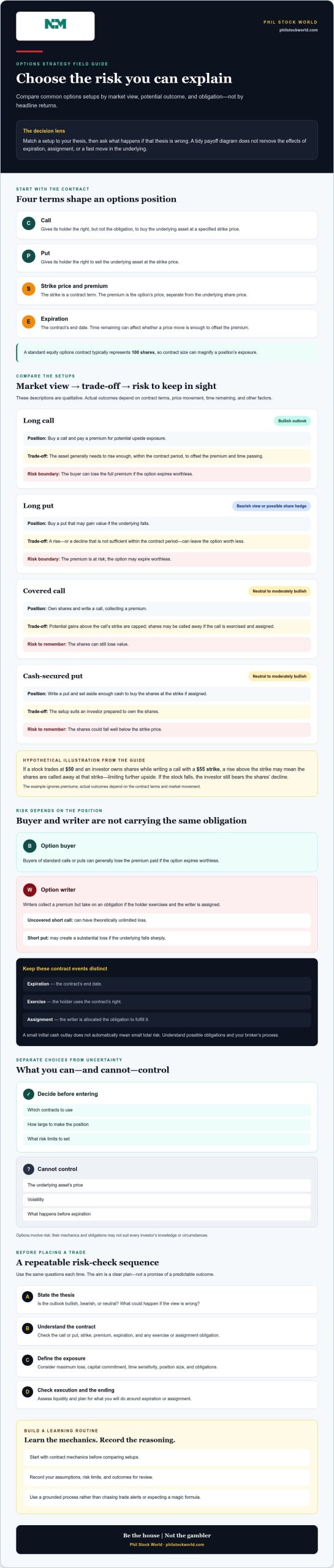
An options strategy is a planned position built with one or more option contracts to express a market view or manage exposure. It specifies what you’ll buy or write, the contract terms, and how much risk you’re willing to take. Strategies can be bullish, bearish, or neutral, but none can make an outcome predictable. This overview of Options Trading Strategies offers another look at how positions can be combined.
Control begins with the choices you make before entering a position: which contracts to use, how large to make the position, and what risk limits to set. You can’t control the underlying asset’s price, volatility, or what happens before expiration. Options involve risk, and their mechanics and obligations may not suit every investor’s knowledge or circumstances.
How calls, puts, strike prices, and expiration fit together
A call gives its holder the right, but not the obligation, to buy the underlying asset at a specified strike price. A purchased call generally gains value if the asset rises, but the move must be sufficient relative to the premium and remaining time. A put gives its holder the right to sell at the strike price; a purchased put generally gains value if the asset falls.
The strike price and expiration date are contract terms, not promises about where the market will go. The premium is the option’s price, separate from the underlying share price. For example, a share might trade at one price while a call on it costs a different amount. A standard equity options contract typically represents 100 shares, so contract size can magnify a position’s exposure.
Why a strategy’s risk depends on the position
Buyers of standard calls or puts can generally lose the premium paid if the option expires worthless. Writers, who sell options to collect a premium, take on an obligation if the holder exercises and the writer is assigned. The potential risk depends on the position: an uncovered short call can have theoretically unlimited loss, while a short put may create a substantial loss if the underlying falls sharply.
Keep three events distinct. Expiration is the contract’s end date. Exercise is the holder using the contract’s right. Assignment is the writer being allocated the obligation to fulfill it. For example, if an investor writes a call and the holder exercises it, the writer may be assigned and required to deliver shares under the contract terms. A small initial cash outlay doesn’t automatically mean small total risk. Before trading, understand the contract, possible obligations, and what your broker’s process means for your position.
Options Strategies in Different Market Scenarios
Think of an options strategy as a way to express a market thesis with a particular risk trade-off, not as a shortcut to a predictable result. The examples below are hypothetical: assume a stock trades at $50, and ignore premiums unless stated. Actual outcomes depend on the contract terms, price movement, time remaining, and other factors.
- Long call: A bullish outlook. The buyer pays a premium for potential upside exposure, but can lose the full premium if the option expires worthless.
- Long put: A bearish outlook, or a possible hedge for shares already owned. The premium is at risk, and the option may expire worthless if the underlying doesn’t fall enough within the contract period.
- Covered call: A neutral-to-moderately bullish outlook. The investor owns shares and writes a call, collecting a premium while capping potential gains above the call’s strike. The shares can still lose value.
- Cash-secured put: A neutral-to-moderately bullish outlook for someone prepared to own the shares. The writer sets aside enough cash to buy at the strike if assigned, but the shares could fall well below that price.
Buying calls or puts: directional exposure with a defined premium
A long call may gain value if the stock rises, but a small or late move may not be enough to offset the premium and the effect of time passing. A long put may gain value if the stock falls, though a rise or insufficient decline can leave it worth less. In either case, the buyer can lose the full premium if the option expires worthless. The premium at risk is a useful boundary, not a promise of profit.
Covered calls and cash-secured puts: income-oriented trade-offs
Suppose, hypothetically, an investor owns shares at $50 and writes a call with a $55 strike. If the stock rises above $55, the shares may be called away at the strike, limiting further upside. If it falls, the investor still bears the stock’s decline, partly offset by the premium received. With a cash-secured put at a hypothetical $45 strike, assignment can require buying shares for $45 even if their market price has fallen lower. Premiums don’t erase either trade-off.
These examples show why options trading strategies for retail investors should be compared by outlook, obligations, and downside, not just by premium collected or potential gain. For more complex setups, review this advanced options strategy guide. For ongoing market context, explore market charts and analysis as an educational resource, not a guarantee of results.
How should retail investors compare strategies before choosing one?
Start with a market thesis, then test whether a strategy’s risk and obligations fit your circumstances. The same bullish view could lead someone to consider a long call, a covered call, or a cash-secured put, but those positions commit different amounts of capital and behave differently if the stock falls, stalls, or moves too late. No strategy is automatically the right choice just because its outlook seems to match yours.
Match the strategy to a market thesis, not a return target
A bullish thesis anticipates a rise. A long call offers upside exposure, while a covered call combines owned shares with a written call. A bearish thesis anticipates a decline; a long put may express that view or potentially hedge shares. A neutral thesis expects a limited move, but strategies built around that assumption can be vulnerable if price or volatility changes sharply. Ask what could invalidate your view, including a delayed move or a change in implied volatility. Direction alone doesn’t determine whether the trade’s cost, timing, and potential loss suit you.
Compare maximum loss, obligations, and practical complexity
Use the table as a starting point, not a ranking. The risk descriptions assume a single position and don’t account for every possible execution or account-specific outcome.
| Example | General outlook | Loss exposure | Capital commitment and time sensitivity | Key obligation |
|---|---|---|---|---|
| Long call | Bullish | Premium paid | Premium upfront; time decay can reduce value | Right to buy, not an obligation |
| Long put | Bearish or protective | Premium paid | Premium upfront; time decay can reduce value | Right to sell, not an obligation |
| Covered call | Neutral to moderately bullish | Shares can fall substantially in value | Shares must be held; gains above the call strike are capped | Shares may be called away if assigned |
| Cash-secured put | Neutral to moderately bullish | Shares may fall well below the strike | Cash set aside for a possible purchase | May have to buy shares at the strike |
| Uncovered short call | Neutral to bearish | Potentially unlimited | Margin and close monitoring may be required | May have to deliver shares |
Volatility matters too. Higher implied volatility can increase an option’s value, while a drop can work against buyers. Time decay generally weighs on options as expiration approaches, though its impact varies by position and other conditions. Liquidity matters as well. A wide bid-ask spread can make entering or exiting a position more costly, and contract terms affect what happens at exercise or assignment.
Single-leg options may be easier to analyze, but writing options can bring significant obligations. Multi-leg trades can define risk in some structures, yet add execution and management complexity. Before choosing among options trading strategies for retail investors, ask: What can I lose? Could I be assigned? Will I need shares, cash, or margin capacity? A virtual portfolio review framework can help readers consider how a hypothetical position fits alongside other holdings, without turning a market view into a recommendation.
What risk checks belong in an options pre-trade checklist?
A pre-trade checklist won’t predict the market. It can expose gaps in your plan before a position turns into a live obligation. For options trading strategies for retail investors, write down specific answers rather than relying on a quick read of a payoff diagram.
- 1. State your thesis. Is your outlook bullish, bearish, neutral, or protective? What market move would support it, and what would prove it wrong?
- 2. Identify the maximum potential loss. Calculate it for the entire position, including all legs. If the loss can’t be clearly bounded, understand how large or complex it could become before proceeding.
- 3. Set position size. Decide in advance what loss you could tolerate, then size the position around that limit. Don’t assume a strong forecast makes a large position safer.
- 4. Check expiration and exit conditions. Note the expiration date and decide what you’ll do if the underlying moves against your thesis, stays flat, or reaches a target earlier.
- 5. Assess liquidity. Review trading activity and the bid-ask spread. A wide spread can affect the price you pay to enter or receive to exit; it doesn’t guarantee a particular execution.
- 6. Plan for exercise and assignment. Could you need cash to buy shares or shares to deliver? Check your broker’s procedures and relevant official contract materials so you understand what may happen near expiration.
Position sizing matters more than a confident forecast. Even a well-reasoned thesis can be wrong, and the size of the position determines how much that mistake can hurt.
Size positions around a tolerable loss
Set a loss limit before entry, not after a sharp market move makes the decision feel urgent. Also look across your portfolio: several positions in different names can still share exposure to the same market factor. Diversification doesn’t eliminate losses, and correlated positions can fall together, compounding the impact. For a focused discussion of puts as a possible portfolio hedge, see this portfolio protection guide.
Check expiration, liquidity, exercise, and assignment
Expiration isn’t just a calendar detail. Confirm your planned exit and decide what you’ll do if you can’t close the position as expected. Liquidity and bid-ask spreads are practical execution considerations, not a promise of a favorable fill. Before trading, understand how your broker handles exercise and assignment, and review official materials for the contract.
Market context can help you revisit a thesis as conditions change, but it can’t remove risk. Explore ongoing market analysis as an educational resource while keeping your own risk limits at the center of each decision.
How can investors keep learning options strategies without chasing trade alerts?
Build understanding before adding complexity. Learn how calls, puts, expiration, exercise, and assignment work, then use hypothetical examples to see how a position might respond to different price moves and changes in volatility. Move from straightforward positions to multi-leg strategies only when you can explain each contract’s role, potential loss, and obligations in plain English.
Build a repeatable learning and review routine
Before considering a live position, write down the thesis, assumptions, risk limit, and what would change your mind. Revisit the example later and compare what happened with what you expected. Judge the process, not just the profit or loss: a gain doesn’t prove the reasoning was sound, and a loss doesn’t automatically mean the plan was flawed.
Keep a simple journal with the contract terms, expected timeline, possible outcomes, and eventual result. Review broker disclosures and authoritative options education to understand contract mechanics and account procedures. This gives you a steady way to learn without treating every trade alert as an instruction to act.
Use market commentary as context, not a substitute for judgment
Market commentary can help you examine catalysts, assumptions, and possible scenarios. It can’t tell you whether a position suits your objectives, experience, finances, or tolerance for loss. Before acting on any idea, independently check the strategy’s contract terms, risks, and possible assignment consequences.
Phil Stock World’s educational resources include webinars, market analysis, and virtual portfolio reviews. These can provide context for continued learning, but they aren’t a substitute for personalized investment, financial, or tax advice, and no commentary or trade idea can guarantee results. Check the site for current resource details and features.
Keep the routine simple: learn the mechanics, test your thinking with hypothetical scenarios, record your assumptions, and review the outcome. That discipline is more useful than collecting strategy names or chasing alerts. Explore Phil Stock World’s market analysis and options education as one way to continue building your understanding.
Make Your Next Options Decision More Deliberate
Strong options trading strategies for retail investors start with a clear thesis, but they don’t stop there. Compare the position’s risk and obligations with your outlook, then decide in advance how much exposure you can tolerate. A written checklist and review of your assumptions can help keep the process disciplined, even when the market gets noisy.
Keep learning at a measured pace. Understand the contract before taking on a more complex setup, and treat commentary as context to examine, not an instruction to trade. Phil Stock World, founded and led by veteran trader and market analyst Phil Davis, offers market analysis, educational webinars, and virtual portfolio reviews. Membership includes access to market research and trading-room options; check the site for current tier details. These resources support education, not guaranteed results or personalized financial advice.
Ready to keep building your market perspective? Explore Phil Stock World’s market analysis and options education. A thoughtful process won’t control the market, but it can help you approach each decision with greater clarity and confidence.
Frequently Asked Questions
What is the safest options strategy for a beginner?
No options strategy is universally safe or suitable for every beginner. With a purchased call or put, the buyer can generally lose the premium paid if the contract expires worthless. Writing options brings different obligations and may expose the writer to larger losses, depending on the position. Before considering options trading strategies for retail investors, learn contract mechanics, identify maximum potential loss, and practise with educational examples. This is general information, not personalized financial advice.
Can retail investors lose more than they invest trading options?
Yes, depending on the position. An option buyer can generally lose the premium paid, while some written-option positions can produce losses beyond the premium received or funds set aside. A covered call still carries downside risk in the owned shares, and a cash-secured put can require buying shares that have fallen in value. Before trading, review the strategy’s risk, contract terms, and broker disclosures so you understand possible obligations.
How do covered calls work for retail investors?
A covered call combines shares an investor owns with a call option they sell against those shares. The seller receives a premium, but the shares may be called away at the strike price if the option is exercised and the seller is assigned. That can cap upside, while a decline in the shares can still cause a loss. The premium offers only a partial offset and doesn’t make the strategy suitable for every portfolio.
What is the difference between buying a call and selling a put?
Buying a call gives the buyer the right, but not the obligation, to buy shares at the strike price under the contract terms. The buyer pays a premium and can generally lose that amount if the option expires worthless. Selling a put means receiving a premium but taking on an obligation to buy shares at the strike if assigned. Both positions face market and timing risks, but their rights, obligations, and potential losses differ.
How much money do I need to start trading options?
There’s no universal starting amount. The capital required depends on the contract price, account and broker requirements, and the strategy’s collateral or share-ownership needs. A purchased option requires paying its premium, while a cash-secured put requires funds to cover a possible share purchase. First understand the position’s maximum potential loss and any assignment obligations. Don’t risk money you can’t afford to lose, and don’t treat a small initial outlay as proof that a position has small risk.
Can options strategies make money in a sideways market?
Some strategies are structured around a neutral market outlook, but sideways prices don’t guarantee a profit. The outcome can depend on the price range, implied volatility, time decay, expiration, and execution costs such as the bid-ask spread. Strategies that collect premium still carry obligations and can lose money if the underlying moves against the position. Consider the possible outcomes across different price and volatility scenarios rather than assuming a flat market will produce reliable income.
What happens if an options contract expires in the money?
An in-the-money contract may be exercised, but what happens depends on its terms, the investor’s position, market conditions, and broker procedures. A buyer exercising a call may purchase shares; a put may involve selling shares. A writer who is assigned may have to take the other side of that transaction. Check your broker’s exercise and expiration policies well before the final trading day, and understand whether an outcome could leave you holding or delivering shares.

