


What if the best trading education isn’t another hot tip, but a repeatable way to think before you act? Educational resources for stock traders are everywhere, yet more videos, charts, and commentary can leave you with a fuller notebook and the same uncertainty when it’s time to make a decision.
That frustration makes sense. Learning market concepts is one thing; applying them with discipline, especially when prices are moving, is another. Instead of collecting resources at random or trusting bold promises, build a learning path around your experience and goals. Then practise what you learn before putting real capital at risk.
This guide explains how to choose useful education, distinguish practical analysis from promotional noise, and turn ideas into a learn, practise, review, and refine routine. You’ll see how strategy guides, educational webinars, market charts and analysis, and virtual portfolio reviews can support different stages of learning. The aim is to make your next decision more informed, not more impulsive.
Key Takeaways
- Educational resources for stock traders are most useful when they support informed decisions, not promises of profit.
- Assess a resource’s author expertise, transparency, recency, and treatment of risk before relying on it.
- Match the format to the task: use guides for reference, webinars for explanation, discussion for questions, and paper trading to rehearse.
- Build a repeatable routine: set a learning question, study one concept, practise it, then review what you learned.
- Use market analysis and virtual portfolio reviews to examine your assumptions and sharpen your learning process.
What Counts as a Useful Educational Resource for Stock Traders?
Educational resources for stock traders are structured materials that explain market concepts and decision-making tools so traders can assess information more thoughtfully, not shortcuts to profits. A useful resource helps you understand what a concept means, when it may matter, and what questions to ask before acting. It should leave you better able to explain the idea in your own words.
That definition separates education from three things it often gets bundled with. Market news reports events and developments. A trade idea presents a possible market view or setup. Personalized financial advice considers an individual’s circumstances and goals. These serve different purposes, but none is automatically a lesson. Education gives you a framework for interpreting them; it doesn’t decide what’s appropriate for you or remove the risks of trading.
Strong learning combines foundations with context. Knowing what a limit order does, for instance, is different from understanding how changing market conditions may affect the decision to use one. Foundational concepts give you a working vocabulary and a way to frame choices. Ongoing market-context learning helps you examine how those concepts appear in real situations without treating one example as a universal rule.
How Trading Education Differs from Market News
Education explains concepts and reasoning; news tells you what happened or what’s developing. A headline about a company’s earnings can prompt useful questions: What changed? How did the market respond? What information might help explain that response? But the headline alone isn’t a complete trading plan. It doesn’t set out your decision criteria, risk tolerance, or what would change your view.
Commentary and trade ideas can add interpretation, but they’re still not a substitute for understanding the underlying concepts. Simulators offer a place to explore decisions without risking real capital; Wikipedia’s overview of Stock Market Simulators as Learning Tools describes their educational use. Treat simulated outcomes as rehearsal, not proof of how a real trade will turn out. News, education, and practice can all inform learning, but none makes market risk disappear.
Who Benefits from Structured Trader Resources?
Beginners benefit from clear explanations of terminology, order mechanics, and basic risk awareness. If terms such as bid, ask, market order, and limit order still blur together, start there. A resource is doing its job when you can explain an idea in your own words and identify what you still don’t understand, not when it surrounds a simple concept with advanced jargon.
Intermediate traders may already know the vocabulary but need more context for strategy choices, consistent review habits, and clearer decision criteria. Use learning materials to examine why you considered an idea, which assumptions shaped that view, and what information might challenge it. Match the depth of the material to the question you’re working on. Complexity isn’t a badge of quality; clarity is more useful than jargon you can’t apply.
A sensible learning path doesn’t stop once the basics feel familiar. Keep foundational knowledge close, then add market-context learning that helps you interpret new situations with a more informed eye. The aim isn’t to predict every move. It’s to understand the material well enough to ask sharper questions and make your own decisions with greater discipline.
How to Judge Whether Stock-Trading Education Is Worth Your Attention
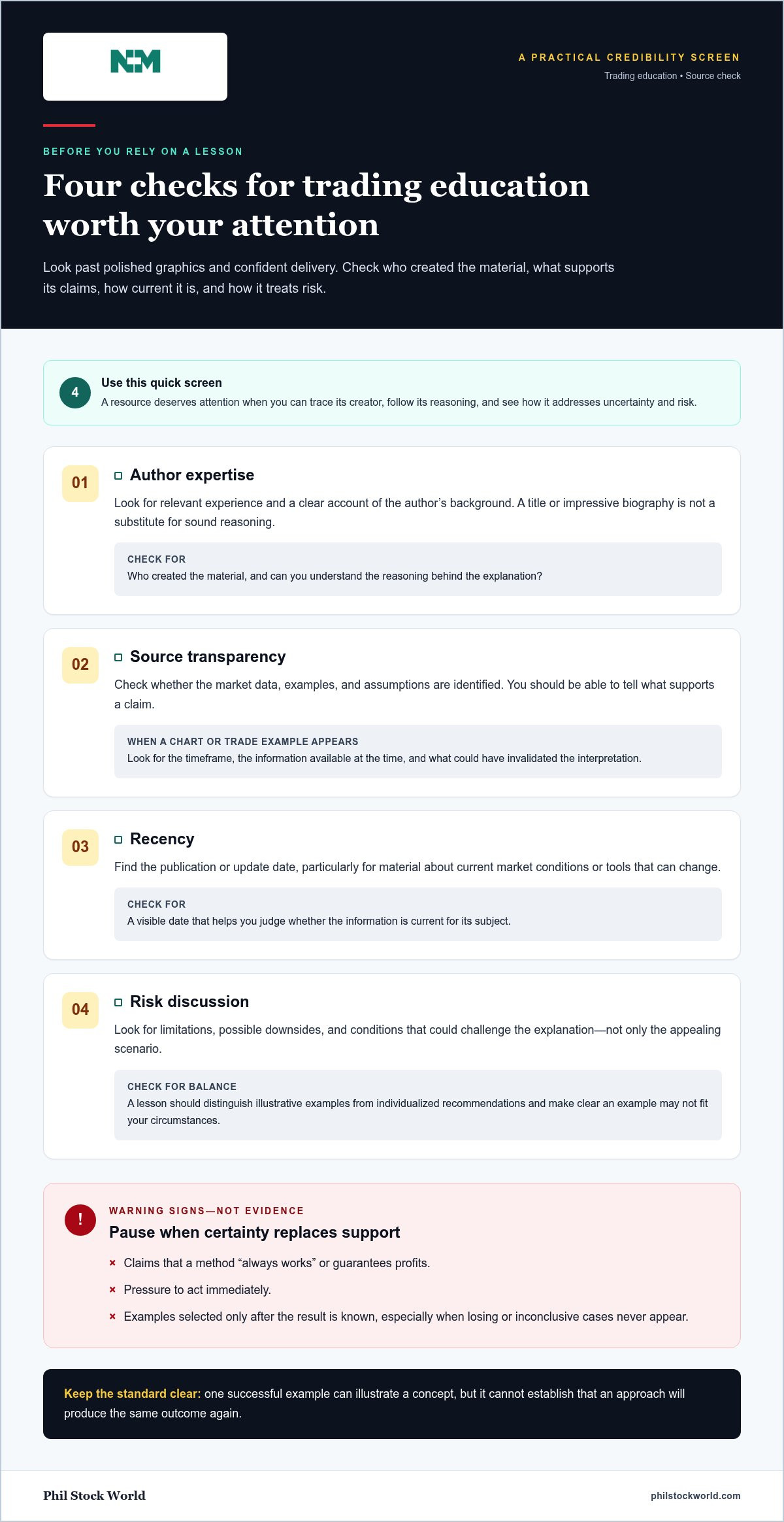
A polished presentation can make almost any trading claim sound convincing. Before investing your time, look past the graphics and confident delivery. Educational resources for stock traders deserve attention when you can trace who created them, understand the reasoning behind their explanations, and see how they address uncertainty and risk.
Use this quick screen:
- Author expertise: Look for relevant experience and a clear account of the author’s background. A title or impressive biography isn’t a substitute for sound reasoning.
- Source transparency: Check whether market data, examples, and assumptions are identified. You should be able to tell what supports a claim.
- Recency: Find the publication or update date, particularly for content about current market conditions or tools that can change.
- Risk discussion: Look for limitations, possible downsides, and conditions that could challenge the explanation, not only the appealing scenario.
Check Credibility, Evidence, and Risk Disclosure
Credible teaching shows its work. If a lesson uses a chart or trade example, ask what assumptions shaped it: the timeframe, the information available at the time, and what could have invalidated the interpretation. One successful example can illustrate a concept, but it can’t establish that an approach will produce the same outcome again. Be wary of examples selected only after the result is known, especially if losing or inconclusive cases never appear.
Be equally cautious of certainty without support. Statements that a method “always works,” claims of guaranteed profits, or pressure to act immediately are warning signs, not evidence. Useful education separates illustrative examples from individualized recommendations and makes clear that an example may not fit your circumstances. In the United States, the SEC and FINRA publish investor-protection information that can help readers build financial-market literacy. This isn’t legal advice; it’s a reminder to treat sweeping claims with care.
Check Whether the Material Is Current and Understandable
A date gives you a starting point for judging relevance. Core ideas may remain useful, while discussion of market events, products, or trading tools can become stale. Look for an update date and ask whether the material explains what has changed. For a structured course option, Online Stock Trading Courses and Certifications can help you explore organized learning paths; assess each course’s scope and information just as carefully.
Good explanations define technical terms and walk through why a concept matters. If a lesson introduces a strategy, it should explain the reasoning and the conditions behind the example, rather than burying the logic in jargon. Urgency is no substitute for that work. “Act now” language, dramatic success stories, and selective screenshots can distract from missing context. Slow down and ask what the material teaches that you can explain back in your own words.
Credible trading education identifies its sources, explains its assumptions, stays clear about risk, and never presents an example as a promised result. Apply that standard consistently, including when reviewing commentary and analysis. For market context to examine alongside your own research, read Phil Stock World’s market commentary and strategy guides.
Which Stock-Trading Resource Formats Fit Different Learning Needs?
The right format depends on what you’re trying to learn. A written guide is easy to revisit; a webinar can walk through a topic in sequence; a discussion can surface questions you hadn’t thought to ask. Charts and research provide market context, while paper trading gives you a place to rehearse decisions. No single format does every job, so choose based on the gap you want to close.
Articles and guides
Best use: Looking up terminology, reviewing a concept, or following a written explanation at your own pace.
Main limitation: You may need another format to clarify questions or see how the idea is discussed in context.
Webinars
Best use: Following a topic through a guided explanation, such as a strategy concept or market theme.
Main limitation: Listening is not the same as testing whether you can apply the reasoning yourself.
Discussion and interactive sessions
Best use: Raising questions and hearing how other people think through a topic.
Main limitation: Opinions can vary in quality, and discussion can’t determine what suits your circumstances.
Research, charts, and paper trading
Best use: Examining market information and rehearsing a decision process.
Main limitation: Data needs interpretation, and simulated conditions differ from live trading.
Self-Paced Guides, Webinars, and Interactive Learning
Written guides work well as a reference shelf. You can pause over an unfamiliar term, compare explanations, and return to a concept when a new question comes up. A webinar offers a more guided route through material, linking ideas in sequence rather than leaving you to assemble every step alone. Educational webinars and strategy guides can complement each other: one provides structured explanation, while the other gives you a resource to revisit.
Discussion adds a useful question-and-answer layer. Bring a specific point you want clarified, then distinguish the explanation from anyone’s personal opinion. Interactive learning can deepen your understanding, but it can’t determine whether a strategy or market view is suitable for you.
Research, Charts, and Practice Tools
Research and education serve related but different purposes. A company report, market update, or chart presents information; educational material helps explain how to interpret it and what questions to ask. For example, a chart can show how a share price moved over a chosen period. It can’t tell you what the price will do next. Market charts and commentary can provide context, but interpreting that context still calls for independent judgment.
Paper trading lets you rehearse a decision without placing real capital at risk. Record what information you used, what would change your view, and how the scenario played out. Treat the exercise as practice, not proof: simulated results don’t capture every feature of live trading, including the pressure of decisions involving real money.
Educational resources for stock traders are most useful in combination. Use a guide to learn a concept, a webinar or discussion to explore questions, research and charts to study market context, and practice tools to rehearse your reasoning. Choose the format that serves your next learning step, rather than collecting material for its own sake.
How to Turn Trading Resources into a Repeatable Learning Routine
A pile of saved articles isn’t a learning plan. Turn educational resources into a simple loop: ask one clear question, study one concept, rehearse your reasoning, then review what you learned. Keeping the cycle narrow makes it easier to see whether a resource clarified the issue or simply added more noise.
Build a Learning Plan Around One Clear Question
Start with a knowledge gap, not the latest headline. For example: “What factors should I understand before interpreting a company’s earnings reaction?” Choose one suitable resource, such as a strategy guide or educational webinar, and decide what you should be able to explain afterward. Park other questions in a short list for later, rather than opening a dozen tabs at once.
- Set a learning question. Make it specific enough to guide your search. “Understand options” is broad; “Explain how time to expiration affects an option’s value” gives you a more useful target.
- Study one concept. Take notes in plain language. Record key terms, the reasoning behind the idea, and any conditions or limitations the material describes.
- Rehearse your understanding. Use a paper portfolio or write out a hypothetical scenario. State what information you’re considering and what would change your interpretation. This is an educational exercise, not a prompt to place a trade.
- Review and refine. Compare your original reasoning with what you learned. Note what remains unclear and shape that into your next learning question.
Practice, Review, and Adjust the Process
Keep a journal so each learning cycle leaves a useful record. Capture the thesis, the assumptions behind it, the risks you identified, and the lesson you took away. If you use a paper portfolio, write down the decision before observing what happens. That helps separate your reasoning from hindsight, which can make a result look obvious after the fact.
Review process and outcome separately. A favorable simulated result doesn’t prove your reasoning was sound, and an unfavorable one doesn’t automatically mean the learning exercise failed. Ask whether your assumptions were explicit, whether you understood the risks, and whether the evidence supported your interpretation. Practice helps you examine decisions; it can’t guarantee success in live markets.
For options-related study, use Phil Stock World’s options education and market analysis as one source of context, and use your notes to identify what you want to understand more deeply about risk management for options. Keep the routine focused on learning rather than treating commentary as an instruction. The aim is a clearer decision process, not a prescribed trade.
To put a learning question to work, explore Phil Stock World’s educational resources and use one idea to start your next learn, rehearse, and review cycle.
How Phil Stock World Brings Trader Education and Market Context Together
Education becomes more useful when concepts meet real market context. Phil Stock World brings together educational webinars, strategy guides, market charts, and analysis, giving readers different ways to study an idea and consider how it relates to current conditions. The formats work best as complements: a guide can explain a strategy, a webinar can walk through its reasoning, and market material can offer context for you to assess.
Learn Through Webinars, Guides, and Market Analysis
Choose the format that fits your learning question. A strategy guide gives you material to revisit at your own pace; a webinar provides a more guided explanation of a topic. If you’re building familiarity with advanced option trading strategies, for example, start by clarifying the concepts and assumptions involved, then use charts and analysis to explore how market context may affect your interpretation.
Charts can make price behaviour easier to examine, while commentary can outline a market view or highlight developments worth considering. Neither tells you what will happen next. Treat them as material for study: identify the reasoning, note the assumptions it depends on, and consider what information might challenge the view. Phil Stock World, founded in 2006 and led by trader and market analyst Phil Davis, brings experience and ongoing market discussion into this mix without replacing your own research or judgment.
Explore Membership and Portfolio Review as Next Steps
After establishing a learning routine, consider whether ongoing access to commentary and opportunities to engage with market ideas would support your study. Phil Stock World membership tiers provide different levels of commentary, alerts, and interactive trading sessions. The right fit depends on how you prefer to follow market discussion and which learning formats you’ll actually use. More access is useful only when it supports a focused study habit.
A virtual portfolio review offers another way to examine your existing approach. Use the discussion to look at the assumptions behind your decisions, the reasoning you’ve been applying, and questions you want to investigate further. It’s an educational review, not a promise of results or a substitute for making your own decisions. Bring a clear question and relevant context so the conversation can help you reflect on your process.
These resources can fit into the learning loop developed throughout this guide: study a concept, consider market context, and review your reasoning. Phil Stock World offers webinars, strategy guides, market analysis, membership access, and virtual portfolio reviews to support that process. Choose a next step that matches the question you want to work on and the format you’ll use.
Make Your Next Learning Step Count
Your next move doesn’t need to be dramatic. Choose one question you want to understand better, then give it the attention it deserves. A steady learning habit can help turn market noise into a reason to pause, investigate, and think more clearly. That’s the real value of Educational resources for stock traders: not certainty, but a stronger foundation for your own decisions.
As you continue, let curiosity lead and keep your standards high. Look for explanations that invite careful thought, leave room for uncertainty, and help you build knowledge over time. Phil Stock World brings together educational webinars, virtual portfolio reviews, strategy guides, and market analysis for readers who want to keep learning in context.
Explore Phil Stock World’s educational resources and choose a learning step that fits your goals. Keep asking good questions, stay curious, and let a disciplined learning process grow one thoughtful decision at a time.
Frequently Asked Questions
What are the best free educational resources for stock traders?
Start with established investor-education sources, then use market-focused articles, webinars, or practice exercises to answer a specific question. For example, if you’re learning order types, compare explanations and write a sample order scenario in your notes. Educational resources for stock traders can build a useful foundation without a fee, though free material may not offer a sequenced curriculum or individual feedback. Treat examples as lessons, not forecasts.
Can trading education guarantee that I will make money?
No. Education can’t guarantee trading profits because markets are uncertain, and even a carefully researched idea can lose value. A useful lesson can help you explain why you reached a conclusion and what assumptions it depends on, but it can’t predict the outcome. Be wary of courses, alerts, or commentary promising certainty. Judge what you learn by whether you can explain your reasoning, not by the result of a single trade.
How should a beginner start learning to trade stocks?
Begin with the basics: what a stock represents, how orders work, and how a position can lose value. Set one learning goal, such as explaining the difference between a market order and a limit order, then write a short explanation in your own words. Keep a list of questions that remain. Before acting, practise describing the decision and its risks. A paper portfolio can help you rehearse without risking capital.
Is paper trading useful for learning stock trading?
Yes, paper trading can help you practise entering hypothetical orders, record your reasoning, and see whether you understand a process without risking real capital. For example, note why you chose an entry point before tracking what happens next. Simulated trading may not reflect live execution, emotional pressure, or every market condition. Use it to find gaps in your understanding, not to prove that a strategy will work with real money.
How can I tell whether trading education is outdated?
Check the publication or update date, then compare it with the subject. An explanation of a basic investing term may remain useful, while instructions for a platform feature or analysis tied to a past market event may not. Look for named sources and clear dates in examples. If the material doesn’t explain when its information applies, don’t rely on it as a description of current market conditions.
Are paid stock-trading education resources better than free ones?
Not necessarily. A paid resource may provide a more organized curriculum, specialized analysis, discussion, or interactive learning, while free material may be enough to answer a foundational question. Compare what each format actually teaches and whether it addresses your knowledge gap. Before paying, identify the specific skill or topic you want to study. A subscription or course can provide learning materials, but it can’t guarantee better trading outcomes.