


What if you stopped betting on which way the market moves and started betting on the fact that time itself is a wasting asset? It is a frustrating reality for most retail participants. They get killed by Theta decay or get chopped up in sideways markets while the institutions quietly collect the premium. With options trading volume hitting a record 72.8 million contracts per day in mid-2026, the game is bigger than ever, but most players are still just gambling on direction. You are likely here because you are tired of feeling like the house always wins while you lose. It is time to flip the script by mastering advanced option trading strategies that prioritize mathematical edges over lucky guesses.
We are going to show you how to move beyond basic calls and puts to engineer a professional-grade portfolio using multi-leg structures. You will learn the “Be the House” philosophy, which focuses on consistent income generation and protecting your capital during sudden crashes. We will break down the specific math that transforms you from an insurance buyer into the insurance company. By the end of this, you will understand how to navigate the latest 2026 margin requirements and use sophisticated spreads to thrive in any market environment.
Key Takeaways
- Stop gambling on price direction and start utilizing advanced option trading strategies that leverage time decay and volatility to your advantage.
- Learn the “Be the House” methodology by selling insurance to the market through multi-leg spreads that define risk and maximize the probability of profit.
- Discover how to align your strategy with the 2026 macro environment, choosing between income-focused tools like calendar spreads or protection-heavy hedges.
- Master the “Rule of Threes” for entering, adjusting, and exiting complex positions to ensure you never blow up your account on a single trade.
- Move past the retail noise and see why live trading environments are essential for scaling your strategy with real-time institutional-level insights.
Beyond Calls and Puts: Why Advanced Option Trading Strategies Are Essential for 2026 Markets
Most retail traders treat financial options like lottery tickets. They buy a call because they think a stock is going up or grab a put because they’re scared of a dip. In 2026, this is a fast track to a drained brokerage account. The market is too efficient for these predictable directional bets. High-frequency algorithms now feast on retail traders who don’t understand how to hedge their exposure. Advanced option trading strategies move away from these coin-flip gambles. Instead, they use multi-leg structures to engineer a specific mathematical outcome. This approach allows you to control risk, time, and volatility simultaneously.
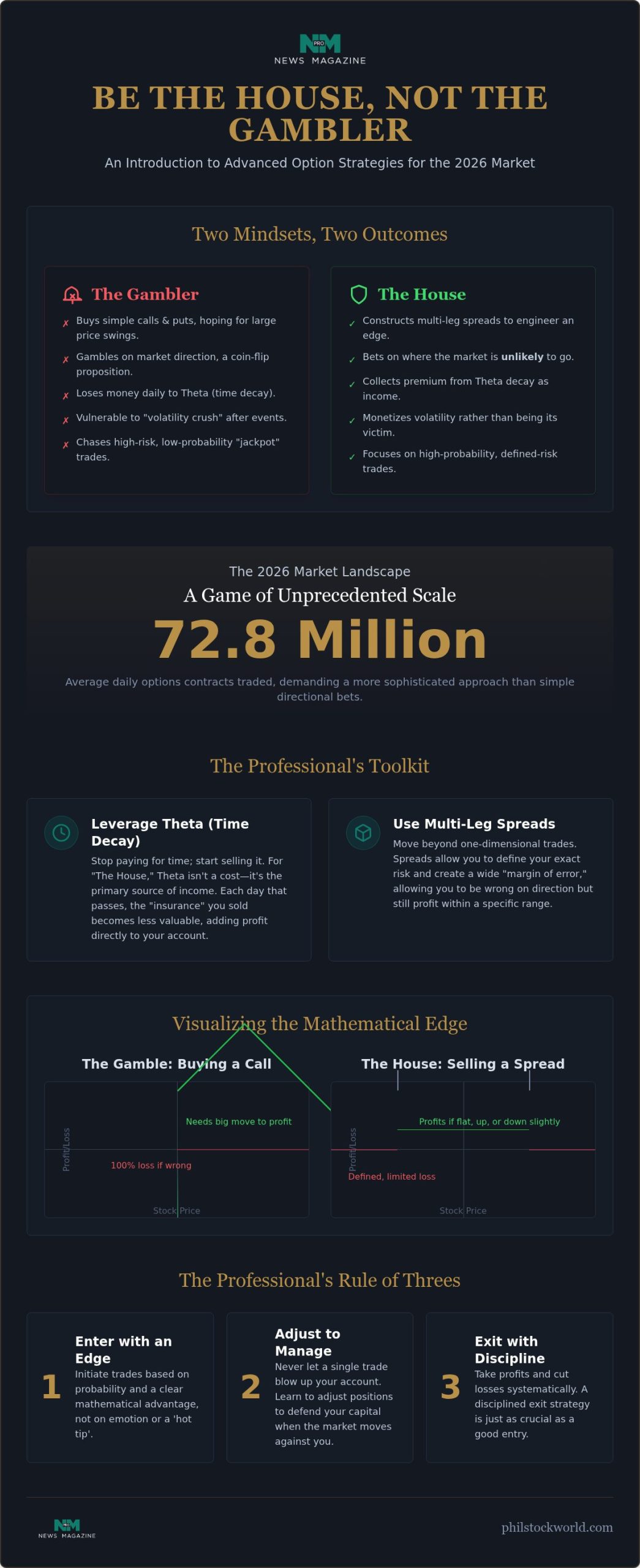
The difference between a amateur and a professional is the mindset. The “Gambler” buys a single-leg call and prays for a moonshot. The “House” sells a spread and collects the rent. By using multi-leg structures, you can create synthetic positions that mirror stock ownership with a fraction of the capital. This capital efficiency is how the big players stay in the game while others get washed out. It isn’t about being right about the direction every time. It is about being right about the math.
The Mathematical Reality of Theta and Vega
Theta is the silent killer of the retail account. Every day you hold a single-leg option, its value bleeds out through time decay. Advanced traders turn this on its head. We want to be the ones collecting that decay rather than paying it. Then there’s Vega, which measures sensitivity to implied volatility. Beginner traders often ignore Vega until a “volatility crush” destroys their position after an earnings report. Advanced strategies are tools to monetize time and volatility rather than just price movement. You aren’t just trading a ticker symbol; you are trading the market’s expectation of future chaos.
Why 2026 Volatility Demands a New Approach
The 2026 market landscape is defined by massive scale. Average daily volumes reached 72.8 million contracts in the second quarter. This level of participation creates noise that simple calls and puts cannot handle. They lack the “buffer” required to survive violent intraday swings. Advanced structures provide a margin of error. They allow you to be slightly wrong about the price while still being right about the range. This shift in perspective is the core of the “Be the House” philosophy. You stop chasing the jackpot and start managing the spread. This disciplined approach leads us directly into the mechanics of engineering your edge.
The ‘Be the House’ Philosophy: Engineering Your Mathematical Edge with Multi-Leg Spreads
Casinos don’t care if a single player hits a jackpot. They focus on the thousands of hands where the math is in their favor. Trading should be the same. When you utilize advanced option trading strategies, you stop being the guy buying the lottery ticket and start being the one who prints them. By selling “insurance” to the market, you create a situation where you can be wrong about the stock’s direction and still walk away with a profit. It is about shifting your focus from “where is the stock going?” to “where is the stock unlikely to go?”
The secret lies in the spread. Vertical spreads allow you to define exactly how much you are willing to lose while simultaneously capping your gain to increase your probability of success. It is about reducing the cost of being wrong. Instead of a total loss on a single-leg call, a spread might only lose a fraction of that if the trade moves against you. This is how you manage your Net Delta. You ensure your portfolio isn’t too heavily weighted in one direction so a single market hiccup doesn’t wipe you out. If you want to see this in action, we often break down these structures in our educational webinars.
Credit Spreads vs. Debit Spreads: When to Use Each
Vertical credit spreads are the bread and butter of a “House” trader. You are essentially betting that a stock won’t go somewhere. If you sell a bear call spread, you win if the stock goes down, stays flat, or even goes up slightly as long as it stays below your short strike. Debit spreads are different. They are for when you have a strong conviction but want to reduce your entry cost. You buy one strike and sell another further out to offset the price. Strike selection should always be based on standard deviation and probability rather than a “gut feeling.” Understanding how to read market charts to identify key support and resistance levels can sharpen your strike selection process considerably.
The Power of Neutral Strategies: Iron Condors and Butterflies
Sometimes the most profitable move is realizing that nothing is going to happen. This is where the Iron Condor strategy shines. By combining a bear call spread and a bull put spread, you create a profit zone. As long as the stock stays within that range until expiration, you keep the entire credit. If you want even more precision, Butterfly spreads offer a low-cost way to target a specific price point with massive potential reward relative to the risk. These aren’t just trades. They are structural advantages that let you profit from the market’s indecision.
Income vs. Volatility: Choosing the Right Advanced Strategy for Current Market Cycles
You can’t just throw a dart at a list of strategies and hope for the best. Most brokerage platforms list dozens of “pro” moves, but they rarely tell you when to pull the trigger. Is the market in a “Risk-On” frenzy or a “Risk-Off” defensive crouch? Understanding the macro backdrop is what separates the professionals from the people just pressing buttons. At Phil Stock World, we focus on integrating global news and economic data into strategy selection. It’s the difference between sailing with the wind and trying to row against a hurricane.
If the market is grinding sideways, your income generation toolkit comes out. We’re talking covered calls, naked puts for those with the stomach for it, and sophisticated calendar spreads. When the VIX is screaming and a massive move is brewing, you pivot to the volatility toolkit. Straddles and strangles allow you to profit from the movement itself, regardless of whether the stock goes up or down. These advanced option trading strategies are your defense and offense combined. They give you the flexibility to adapt when the narrative shifts from inflation fears to growth explosions.
Trading the Calendar: Using Time to Your Advantage
Long calendar spreads are a personal favorite for the patient trader. You sell a near-term option to harvest rapid decay while buying a long-term option to maintain your position. It is essentially a “Rent-a-Stock” play using LEAPS. You control the asset for a fraction of the price and let time do the heavy lifting. For those who want to see these cycles analyzed in real-time, our Phil Stock World membership provides the daily macro context you need to choose the right strike and expiration. It’s about playing the long game while others are focused on the next five minutes.
Hedging for the Long Haul: Protective Puts and Collars
Sometimes the goal isn’t immediate profit; it is survival. Protective puts are great, but they’re expensive insurance. That’s why we use the Collar. By selling a call to pay for your put, you create a structure that protects your downside while only capping your extreme upside. The Collar is a cost-neutral way to sleep through a bear market without liquidating your core holdings. It beats panic selling every single time. For a deeper dive into how to structure this kind of portfolio insurance effectively, our complete guide on hedging with put options walks you through exactly which strikes offer real protection without eating your profits. This disciplined approach to protection ensures you have the capital left to play when the market finally finds its floor.
The Professional’s Checklist: Managing Risk and Adjusting Complex Positions
Entering a trade is the easy part. Any amateur with a brokerage account can click a “buy” button and hope for the best. The real work begins after the trade is live. Professional management of advanced option trading strategies isn’t about being right every time; it is about staying in the game when the market tries to prove you wrong. You need a systematic approach to position sizing. Never bet the farm on a single complex spread, no matter how good the math looks. Even a perfect mathematical edge can fail in the short term. We treat our capital like a casino treats its bankroll. We ensure no single “jackpot” winner can take us out of the game.
If a trade moves against you, don’t panic. You have defensive tools that retail gamblers ignore. Rolling a position allows you to extend the clock and adjust your strikes, giving the original thesis more time to work. It turns a potential loss into a manageable battle for break-even or better. However, you must stay vigilant about the 2026 margin requirements for complex spreads, as these can shift during volatile periods. We follow a strict “Rule of Threes”: you must define your entry, your specific adjustment point, and your final exit before the trade is ever placed. If you’re unsure where your current exposure stands, you can schedule a virtual portfolio review to stress-test your positions against potential market shocks.
Managing the ‘Greek’ Risks in Real-Time
Managing the “Greeks” is how you maintain your house edge. Delta tells you how much you are exposed to price movement, while Gamma acts as the accelerator. Gamma is the danger zone as expiration approaches. It makes your Delta move faster, meaning a small price swing can turn a winning spread into a disaster in minutes. You also have to watch Vega. When the VIX spikes, your short options gain value, which hurts your “Be the House” play even if the stock price stays perfectly still. Professionals monitor these metrics to ensure their portfolio remains balanced and neutral.
The Exit Strategy: When to Take Profits vs. When to Cut Bait
The 50% Rule is a staple for professional premium sellers. Why wait for that last few cents of profit while risking a full reversal? We prefer to close winning spreads at 50% of the maximum potential profit. It increases the win rate and frees up capital for the next opportunity. We use mechanical exits to remove emotion from the trade. If a trade hits your pre-defined stop or adjustment trigger, you act without hesitation. If you’re looking at a losing trade, ask yourself: Is the macro thesis still valid? Is there a better strike to roll to? If the answer is no, cut bait. There is always another trade tomorrow.
Scaling Your Strategy: Why Independent Research and Community Beat the Retail Herd
Scaling your success requires more than just a bigger account balance. It requires a fundamental shift in how you consume market information. Most retail traders fall head-first into the “Retail Trap,” where they blindly follow self-proclaimed social media gurus into trades they don’t actually understand. By the time a guru posts a screenshot of a winning trade, the liquidity has often dried up and the retail herd is left holding the bag. Professionals operate in a different world entirely. They congregate in live trading rooms to share real-time adjustments and institutional-level insights. This community aspect is vital because the 2026 market, with its staggering 72.8 million daily contracts, is far too complex to navigate in a vacuum. With the 2026 implementation of new intraday margin standards under FINRA Rule 4210, the barriers to entry are lower, but the complexity of managing capital efficiently has never been higher. A thorough virtual portfolio review and strategy audit can reveal hidden risk concentrations that even experienced traders overlook in this environment.
Moving Beyond Static Charts
Technical analysis is a useful tool, but it’s only about 20% of the battle in modern markets. You can draw all the resistance lines you want, but a sudden shift in Fed policy or a global trade announcement will blow right through those charts. Advanced trading demands deep macro-economic context. You need to understand the policy drivers behind the price action. Knowing how to read market charts to decode the psychological footprints of institutional players gives you a critical edge when interpreting those policy-driven moves. The Phil Stock World membership acts as the central hub for this research, providing the deep-dive analysis required to stay ahead of the curve. It is about finding the clear signal in a world of deafening, algorithmic noise.
A Disciplined Approach to 2026 and Beyond
The journey from an “Option Buyer” to a “Strategic Engineer” is a transformation of your entire financial philosophy. It takes immense discipline to stop chasing the jackpot and start engineering the mathematical edge. Always remember that trading is a marathon, not a sprint. You don’t need to win every single trade to be a successful participant; you just need to manage your risk and remain consistent in your execution. Get the right mentorship and surround yourself with a community that values logic over luck. Join our community today to see these advanced option trading strategies in action daily and finally start trading with the confidence of the house.
Stop Playing the Market and Start Engineering Your Edge
You’ve seen how the pros move beyond simple directional bets to engineer a mathematical edge. By utilizing advanced option trading strategies, you shift the odds in your favor and turn time decay into your greatest ally. We’ve covered why managing your Greeks and understanding macro cycles is the only way to survive the 2026 market’s noise. It isn’t just about picking the right ticker; it’s about building a structure that thrives even when the price action gets messy. You now have the blueprint to stop acting like a policyholder and start acting like the insurance company.
Ready to trade like ‘The House’? Join Phil Stock World for real-time advanced strategy alerts and expert market commentary. You’ll gain access to Phil Davis’s 20+ years of market experience through real-time interactive trading sessions and daily “Be the House” trade ideas. This isn’t just about learning; it’s about executing with a community that has your back. The market doesn’t have to be a mystery. With the right mentorship and a disciplined approach, you can finally trade with the calm confidence of a true insider.
Frequently Asked Questions
What is the best advanced option strategy for a beginner?
Vertical credit spreads are the ideal entry point for anyone transitioning into advanced option trading strategies. They introduce you to the concept of defining your maximum risk and reward while allowing you to profit even if your directional thesis is only slightly correct. By selling one strike and buying another further out, you create a “safety net” that simple calls and puts lack. This structure teaches you to focus on the probability of profit rather than just chasing a massive price move.
Are advanced option strategies more risky than just buying stocks?
Advanced strategies are often significantly less risky than owning raw stock because they allow you to define your maximum loss at the moment of entry. When you buy 100 shares of a company, you have 100% downside risk if the stock goes to zero. Multi-leg spreads limit that exposure to a specific dollar amount. The perceived risk comes from complexity, not the actual math. If you manage your position sizing correctly, these structures provide a level of capital protection that traditional buy-and-hold investing simply cannot offer.
How much capital do I need to trade multi-leg option spreads?
You can start with as little as $2,000 in most brokerage accounts, especially following the June 4, 2026, implementation of the new FINRA Rule 4210 intraday margin standards. While the barrier to entry has lowered, you still need enough capital to cover the margin requirements for your specific spreads. Most professionals recommend having a larger cushion to allow for adjustments. Starting small in a virtual portfolio is the smartest way to understand how your capital fluctuates before committing significant real-world funds.
What does it mean to ‘be the house’ in options trading?
Being the house means you are the one selling the “insurance” to other market participants rather than buying it. Instead of paying for time decay, you use advanced option trading strategies to collect it. You profit when the market stays within a specific range or fails to reach a certain price point by expiration. Just like a casino, you don’t need to win every single hand to be profitable. You just need the mathematical edge of time and volatility to work in your favor over the long haul.
Can I use advanced option strategies in an IRA or 401k?
Yes, you can use these strategies in retirement accounts, but your broker will likely restrict you to “limited margin” setups. This generally means you can trade covered calls, cash-secured puts, and most vertical spreads. You won’t be able to sell naked options or use high levels of leverage, which is actually a blessing for long-term capital preservation. Many of our community members use these defined-risk structures to generate consistent income within their tax-advantaged accounts without taking on institutional-level tail risk.
How do I manage the risk of being assigned on a short option leg?
Managing assignment risk is all about closing or rolling your position before the options get too deep in-the-money. Most assignments happen close to expiration, so professionals rarely hold a short leg into the final hours of the Friday session. If your short strike is under threat, you can roll it to a later date or a different strike to buy yourself more time. Following a disciplined exit or adjustment checklist ensures that an assignment never catches you off guard or disrupts your broader portfolio strategy.
What is the difference between a credit spread and a debit spread?
The primary difference is whether you are paying for the trade or getting paid to take it. In a credit spread, you receive money upfront and want the options to expire worthless so you can keep the premium. In a debit spread, you pay a cost upfront and want the stock to move toward your strikes so the spread increases in value. Credit spreads are the preferred tool for the “Be the House” philosophy because they benefit from the natural passage of time.
Why should I use an options trading newsletter instead of free YouTube videos?
Free videos give you a manual, but a professional community gives you a navigator. YouTube content is static and often ignores the rapidly changing macro-economic context that drives 2026 market volatility. A membership offers live interaction, real-time adjustments, and a filter for the constant noise of the 24-hour news cycle. You get to see how a veteran trader handles a trade when it goes wrong, which is a lesson you’ll never learn from a “top ten” listicle or a pre-recorded tutorial. For a complete breakdown of how to build a repeatable system around income generating option strategies that collect consistent monthly premiums, our dedicated guide walks you through every step of adopting the house mindset.

