


What if the best research for an active trader isn’t the loudest alert, but the analysis that helps you decide what to examine next? Curated investment research for active traders can bring useful context to a fast-moving market, but only when it’s clear, timely, and grounded in risk. When commentary, notifications, and social posts compete for your attention, more information can quickly become more noise.
Research that saves time should still leave room for your own judgment. Providers differ in how they explain ideas, show their reasoning, and discuss potential risks. A trade idea is a starting point for evaluation, not a decision made for you.
This guide offers consistent criteria for assessing research quality, separating testable analysis from market chatter, and choosing support that fits your trading habits. We’ll look at transparency, depth, timeliness, and risk context, then consider how market charts and analysis, educational webinars, Virtual Portfolio Reviews, and membership features may support an independent process. The goal is sharper decisions, not a bigger pile of alerts.
Key Takeaways
- Curated investment research for active traders is most useful when it helps you examine a decision, not simply react to another alert.
- Check whether analysis explains its reasoning, assumptions, and risks, and separates market facts from interpretation.
- Compare services by research depth, timeliness, educational resources, interaction, and transparency, not by promises or feature lists alone.
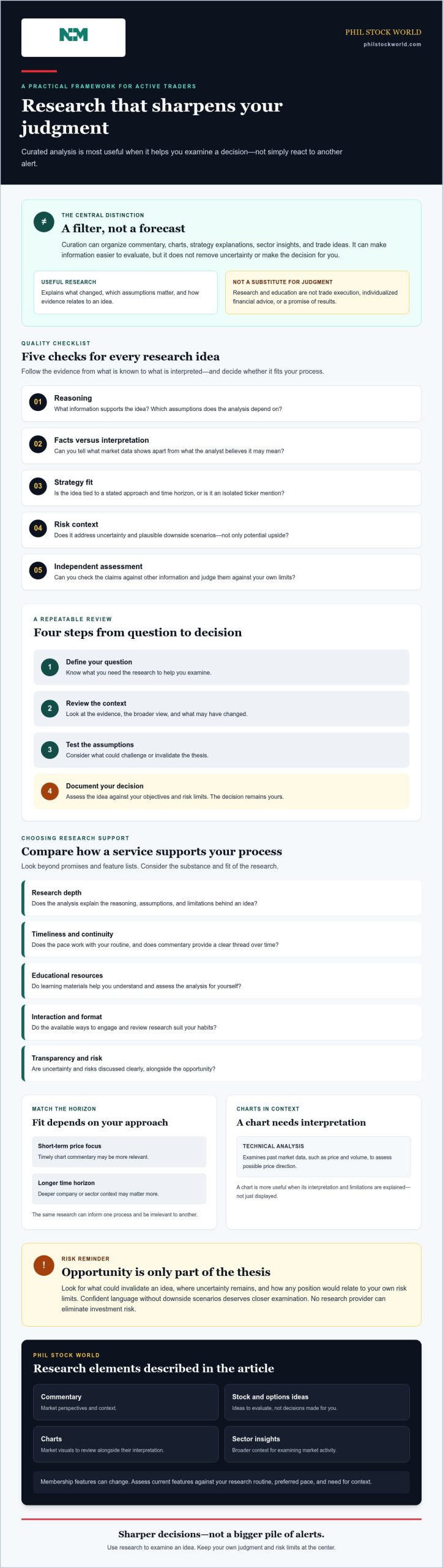
- Use a repeatable process: define your question, review the context, test assumptions, and document your decision against your own risk limits.
- Phil Stock World offers commentary, stock and options ideas, charts, and sector insights. Check current membership features to see whether they fit your research routine.
Why Curated Investment Research for Active Traders Matters
Curated investment research for active traders is selected, organized market analysis that gives traders context for evaluating potential decisions. It can bring commentary, charts, strategy explanations, sector insights, and trade ideas together to clarify what may be moving markets and why.
That structure can make a crowded information stream easier to work with. But curation doesn’t remove uncertainty or tell you what to do. Research and education provide material to assess; they aren’t trade execution, individualized financial advice, or a promise of results. The decision, including whether a trade fits your objectives and risk limits, remains yours.
What Counts as Curated Research for an Active Trader?
Useful research does more than bundle headlines and alerts. It adds context: what changed, which assumptions matter, and how a chart or trade idea relates to a broader market view. For example, technical analysis examines past market data, such as price and volume, to assess possible price direction. A chart is more useful when its interpretation and limitations are explained, not just displayed.
Fit matters, too. A trader focused on short-term price moves may value timely chart commentary, while someone with a longer horizon may need deeper company or sector context. The same research can inform one process and be irrelevant to another.
When Is a Research Service More Useful Than Free Market Content?
Free content can be valuable, especially when it comes from sources you trust and helps answer a specific question. The challenge is fragmentation: a headline here, a social post there, and an alert elsewhere may offer conflicting takes without a clear thread. That makes it harder to compare assumptions or follow how an idea developed.
A research service may help by organizing commentary and educational context in one place and providing continuity over time. Still, paid access isn’t proof of accuracy, depth, or suitability. Check whether the analysis explains its reasoning and risks, and whether its pace and format work with your routine.
Think of curation as a filter, not a forecast. It can reduce time spent sorting disconnected information and give you more time to test ideas that matter to your strategy. Even carefully selected analysis reflects assumptions, and markets can move in unexpected ways. The aim isn’t to eliminate uncertainty, but to make your evaluation more deliberate.
How to Judge the Quality of Curated Trading Research
Strong research lets you trace an idea from evidence to interpretation, then judge whether the reasoning holds up for your strategy. High-quality research is transparent, contextual, and independently assessable. If a post names a ticker but leaves you guessing why it matters, what could go wrong, or how it fits a broader view, you don’t yet have enough information to evaluate the idea.
Use the same checks each time you review an analysis:
- Reasoning: Does it explain what information supports the idea and which assumptions the analysis depends on?
- Fact versus opinion: Can you distinguish what the market data shows from what the analyst believes it may mean?
- Strategy fit: Is the idea tied to a stated approach and time horizon, or is it an isolated ticker mention?
- Risk context: Does the analysis discuss plausible downside scenarios and uncertainty, rather than spotlighting only the upside?
- Independent assessment: Can you check the claims against other information and decide whether they fit your own limits?
For an example of a structured research process, Fidelity explains how to research stocks, including ways to examine a company and its market data. The point isn’t to adopt one provider’s view wholesale. It’s to check whether an idea can withstand closer examination.
Does the Research Explain Risk as Clearly as Opportunity?
Look for discussion of what could invalidate the thesis, where uncertainty remains, and how position sizing relates to your own risk limits. An analyst may not provide a position size, but the research should give you enough context to assess risk rather than nudging you toward an unexamined trade.
Confident language without downside scenarios deserves a second look. No research provider can eliminate investment risk, and a persuasive thesis is still a thesis, not a guaranteed outcome.
Are Alerts Supported by Analysis and Education?
An alert is most useful when it gives you a reason to investigate, not just a ticker and a sense of urgency. Check whether it includes relevant context, explains the strategy behind the idea, and provides updates that help you reassess if conditions change. Educational explanations can build reusable skills, while alerts alone may leave you dependent on someone else’s timing.
To compare research access and educational resources, review the Phil Stock World membership guide. Check current features against your routine, and treat any ideas as material to assess independently, not instructions to execute.
How to Compare Investment Research Services Without Chasing Hype
Compare providers against the same questions instead of choosing the flashiest feature list. Curated investment research for active traders should fit how you gather information and make decisions, but features alone don’t establish accuracy or predict returns. Use a simple comparison grid, then verify details directly with each provider.
| What to compare | Questions to ask |
|---|---|
| Research depth | Does commentary explain its reasoning, assumptions, and relevant risks, or mainly name tickers? |
| Timeliness | How often are updates provided, and does that pace suit your trading horizon? |
| Education | Are there explanations that help you understand the analysis and build reusable knowledge? |
| Interaction | Can members ask questions or take part in discussion or interactive learning? Confirm what’s currently included. |
| Transparency | Are the methodology, limitations, and any performance claims explained clearly? |
What Should Traders Compare Across Research Providers?
Format matters as much as frequency. A trader who prefers to review ideas carefully may value written commentary and charts; someone who learns through discussion may look for educational webinars or member interaction. Alerts can be convenient, but check whether they include enough context to evaluate the idea rather than simply react to it.
Confirm current features, update schedules, and access terms with each provider before choosing. Ask how to verify claims independently, and read the cancellation terms so you understand how to end access if the service no longer fits. A feature describes what’s included; it doesn’t prove research quality or suitable results.
How Can You Spot Hype or Misleading Performance Claims?
Slow down around guaranteed-return language, dramatic success stories, and selective examples that highlight gains while leaving losses or unsuccessful ideas out of view. Ask how any performance claim was measured, when the ideas were shared, and whether the methodology accounts for both winning and losing outcomes. If those details are missing, treat the claim as unverified, not as evidence.
A provider’s track record or presentation can’t replace your own review of its analysis. For more perspective on separating substance from sales language, read this discussion of unbiased financial research. Then compare what you learn with your strategy, preferred format, and risk limits before deciding whether a service belongs in your routine.
How to Use Curated Research Without Handing Over Your Judgment
Research can sharpen a decision, but it can’t make the decision for you. Research is an input to a trading decision, not an instruction to execute a trade or a substitute for your objectives, risk limits, and independent evaluation. A repeatable routine helps you respond deliberately to analysis instead of reacting to the latest alert.
How Should You Evaluate a Trade Idea Before Acting?
Pause before acting and put the idea through a short review. Identify the thesis, intended time horizon, assumptions behind it, and conditions that would weaken or invalidate it. Then consider whether it fits your objectives and how much you could lose if it moves against you. Position size matters: a compelling thesis can still be unsuitable if its potential downside exceeds your personal limit.
Treat an alert as a prompt to investigate, never an automatic instruction to trade. If you can’t explain the idea in your own words or identify what would change your mind, keep researching rather than forcing a decision.
How Can Research Fit Into a Repeatable Trading Routine?
Choose a regular review time that fits your trading horizon. Read relevant commentary, check the context behind an idea, and update your watchlist only when the evidence warrants it. Before acting, record the question you’re trying to answer and the reasons for your decision.
- Before: Note the thesis, assumptions, risk limit, and what could invalidate the idea.
- After: Revisit the decision and record what happened, including whether you followed your process.
A decision journal helps separate process quality from short-term outcomes. A well-reasoned decision can lose money, and a poorly supported one can happen to work. Reviewing both the reasoning and the result can show whether your approach is consistent, rather than letting one outcome rewrite the story.
Options strategies can involve considerations that differ from stock trading, so make sure you understand the approach before using research to assess an options idea. For strategy-specific education, see advanced options trading strategies.
Use curated investment research for active traders as one part of a process you control: define the question, review the context, test the assumptions, and document your decision. For information about educational resources, visit Phil Stock World.
Is Phil Stock World a Fit for Your Research Routine?
Phil Stock World may suit traders who want regular market commentary and analysis to complement their own research. Its resources include stock and options trading ideas, market charts, and sector insights, alongside educational offerings. The fit depends on what you need: ongoing market context, material to study, or opportunities to learn through discussion.
Curated investment research for active traders can support a trading routine, but it shouldn’t replace independent judgment. Phil Stock World does not execute trades, manage customer assets, or provide personalized financial planning. Ideas and alerts are research inputs, not instructions or guarantees of results.
Which Phil Stock World Resources May Match Your Needs?
Daily commentary and market analysis may be useful if you want an ongoing way to follow market developments. Charts and sector insights can add context, while stock and options ideas give you material to evaluate against your own strategy and risk limits.
Depending on the membership tier, access may include private trading rooms or real-time alerts. These features can support participation and timely review, but they don’t ensure an opportunity will suit you or produce a particular outcome. Educational webinars and Virtual Portfolio Reviews are also offered. Check their current availability and format before relying on them as part of your routine.
What Should You Confirm Before Joining?
Membership tiers differ, so check the current access and features for each option before deciding. Consider how you prefer to work: reading commentary on your own, reviewing charts, joining member discussion, or taking part in interactive learning. A feature matters only if you’ll use it and it complements the way you make decisions.
- Confirm which research, alerts, charts, and educational resources are included in the tier you’re considering.
- Check current membership terms and whether they fit your trading habits and budget.
- Verify the availability and format of webinars, Virtual Portfolio Reviews, and any interactive sessions.
- Decide whether the content gives you enough reasoning and risk context to assess ideas independently.
The right choice supports your process without taking it over. Review the current details, compare them with your research needs, and explore Phil Stock World to see whether its resources fit your routine.
Make Your Next Research Choice Work for You
Curated investment research for active traders is valuable when it helps you test ideas, understand their assumptions, and make decisions that fit your process. Prioritize clear reasoning and risk context over a steady stream of alerts, then compare providers by the depth, format, and educational support you’ll actually use.
Phil Stock World, founded and led by veteran trader and market analyst Phil Davis, offers market commentary, stock and options ideas, and educational resources. Membership options provide different levels of access, so verify current features and terms before deciding whether they match your trading routine. Research can inform your choices, but it can’t guarantee outcomes or replace your judgment.
Ready to see whether the available research fits the way you trade? Explore Phil Stock World and review its research and membership resources. Keep asking sharp questions, stay mindful of risk, and build a process you can trust.
Frequently Asked Questions
What is curated investment research for active traders?
Curated investment research for active traders is selected and organized market analysis that helps traders examine possible decisions. It may bring together commentary, charts, sector insights, strategy explanations, and trade ideas, adding context rather than simply collecting headlines. Its value depends on whether the material fits your time horizon and approach. Research can inform your thinking, but it can’t remove market uncertainty or decide whether a trade suits your circumstances.
How do I evaluate a trading research service?
Evaluate whether the service explains its reasoning, assumptions, and relevant risks, and whether you can distinguish market facts from opinion. Check that ideas connect to a stated strategy instead of appearing as unsupported ticker mentions. Also compare update frequency, educational material, interaction options, transparency, and delivery format. Confirm current features and terms directly with the provider, and treat performance claims cautiously unless their methodology and losses are explained clearly.
Can curated investment research help traders make better decisions?
It can support a more deliberate decision process by organizing information and providing context to investigate, but it can’t guarantee better results. For example, a chart or trade idea may help you frame a question, while your own review tests the assumptions and potential downside. Check each idea against your objectives, strategy, and risk limits. The goal is clearer evaluation, not outsourcing judgment or eliminating the possibility of loss.
Is paid investment research better than free market commentary?
Not automatically. Free commentary can be useful when it comes from sources you trust and provides relevant context. Paid research may offer more organized coverage, continuity, or educational resources, but a subscription alone doesn’t prove quality, accuracy, or suitability. Compare what each source actually explains, how it handles uncertainty, and whether its format fits your routine. Choose based on the value you can use, not the price tag or marketing claims.
What should a stock or options trade alert include?
A useful alert should provide enough context to assess the idea independently, such as the thesis, strategy, relevant assumptions, time horizon, and risks or conditions that could change the view. For an options idea, make sure you understand the proposed strategy and its potential risks before considering it. An alert that offers only a ticker or urgent prompt leaves important questions unanswered. Treat alerts as invitations to review, never automatic instructions to trade.
Does Phil Stock World provide personalized financial advice or manage investments?
No. Phil Stock World provides market commentary, stock and options trading ideas, and educational resources, but it doesn’t provide personalized financial planning, direct asset management, or brokerage services. Its research and membership features are resources for readers to assess independently, not a service that makes or executes trades on their behalf. Consider whether its content fits your own objectives and risk tolerance, and verify current membership features before choosing.
How can traders use research without relying on alerts?
Build a routine around questions, not notifications. Set time to review relevant commentary, check the evidence behind an idea, test its assumptions, and decide whether it fits your strategy and risk limits. Record your reasoning in a decision journal, then revisit both the process and outcome. This helps you learn from decisions without mistaking a winning result for proof of sound reasoning or a loss for proof that the process failed.

