


No investment is an inflation force field. The most useful inflation proof investing strategies don’t depend on finding one perfect hedge. They build resilience across assets, risks, and time horizons.
If you’re uneasy about cash or fixed payments losing purchasing power, that concern makes sense. But chasing whatever’s being called an inflation winner can swap one risk for another: commodities can swing sharply, property isn’t instantly accessible, and even stocks can struggle when costs rise. The aim isn’t to eliminate uncertainty. It’s to understand how different investments may respond when inflation shifts.
This guide compares potential hedges, including TIPS and I Bonds, real estate, commodities, and dividend-paying stocks. It looks at how they work, the risks they carry, and when their effects may show up. You’ll also get a practical framework for reviewing your portfolio, weighing diversification, costs, concentration, and your own risk tolerance. No magic shield or one-size-fits-all allocation, just a clearer way to make decisions and adjust as conditions change.
Key Takeaways
- Separate nominal returns from real returns to see whether your portfolio is keeping pace with changes in purchasing power.
- Understand why stocks, bonds, cash, and real assets can respond differently depending on inflation expectations, policy, and fundamentals.
- Compare inflation proof investing strategies by how they work, the risks they add, and the time horizon they may suit.
- Use a structured portfolio review to map exposures, test scenarios, check liquidity, and set practical review triggers.
- Treat market commentary as research context, then assess whether your assumptions and allocations still fit your goals and risk capacity.
What Inflation Does to Your Portfolio, and Why No Strategy Is Truly Inflation-Proof
Inflation resilience means managing the risk that rising prices erode what your money can buy. It doesn’t mean guaranteeing positive returns after inflation or avoiding losses along the way. A useful rule of thumb: No investment is completely inflation-proof; each can protect purchasing power in some conditions and fall short in others. That distinction is the starting point for evaluating inflation proof investing strategies without mistaking a potential hedge for a promise.
Inflation is a rise in the overall price level. An investment’s nominal return is its stated gain or loss before adjusting for inflation; its real return reflects how that performance compares with the change in purchasing power. As the neutral overview of an Inflation hedge illustrates, an asset’s potential to respond to rising prices doesn’t make its protection automatic or consistent.
Nominal returns versus purchasing power
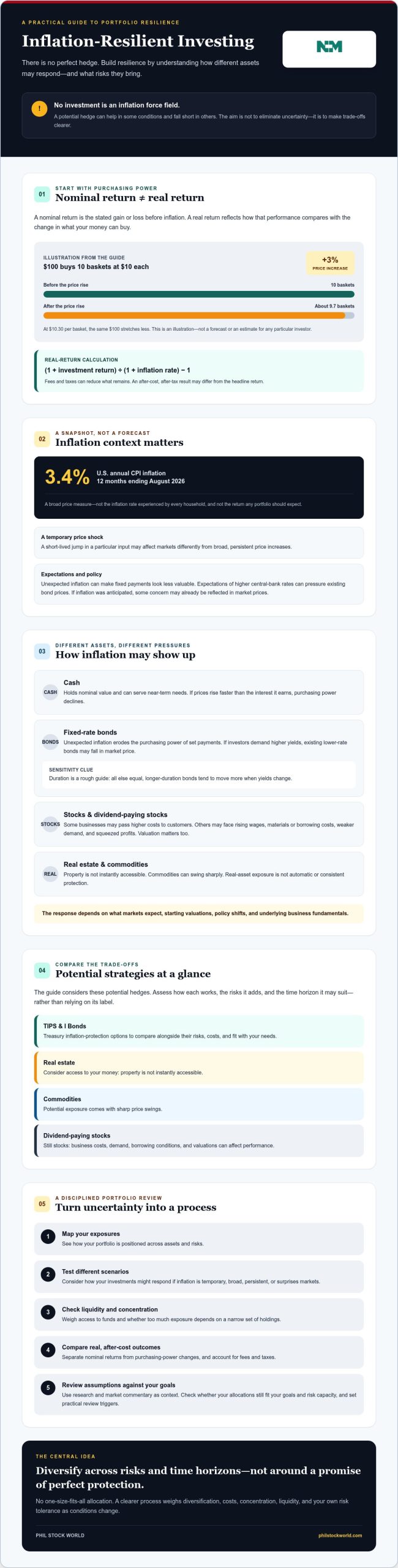
Suppose a basket of goods costs $10 and you have $100. You can buy 10 baskets. If prices rise by 3% over a year, the basket costs $10.30, and that same $100 buys about 9.7 baskets. The dollars haven’t vanished, but they stretch less.
To assess an investment, start with its nominal return, then compare it with inflation to estimate the real return. For a closer calculation, divide one plus the return by one plus the inflation rate, then subtract one. Fees and taxes can reduce what remains in your pocket, so an after-cost, after-tax result may differ from the headline figure. This is an illustration, not a forecast or a calculation for any particular investor.
Why the inflation backdrop matters
A short-lived price shock, such as a temporary jump in a particular input, may affect markets differently from inflation that stays elevated across a broad range of goods and services. Neither outcome should be assumed in advance. The duration and breadth of price increases can shape how investors assess company costs, consumer demand, and the value of future payments.
Markets also respond to what investors didn’t already expect. If inflation surprises to the upside, fixed payments may look less valuable, while expectations of central-bank rate increases can put pressure on existing bond prices. If rising inflation was anticipated, some of that concern may already be reflected in market prices. Expectations can shift quickly, and assets won’t all react in lockstep.
The U.S. annual CPI inflation rate was 3.4% for the 12 months ending in August 2026. Check the Bureau of Labor Statistics’ official CPI release for the latest figure and context before using it in a decision. The number describes a broad price measure, not the inflation rate experienced by every household or the return any portfolio should expect.
How Inflation Can Affect Stocks, Bonds, Cash, and Real Assets
Inflation doesn’t send every asset in the same direction. The response depends on what markets already expect, where valuations start, how monetary policy shifts, and whether a business can defend its margins. A company with pricing power may pass higher costs to customers; another may see expenses rise faster than sales and profits squeezed. Research on Inflation Trends and Investment Strategies also examines how inflation can shape asset allocation and investor behavior.
Inflation sensitivity is a possible response to rising prices, not dependable protection from them. Judge inflation proof investing strategies by their underlying mechanisms and trade-offs, not by an asset’s label.
Stocks, bonds, and cash under inflation pressure
Fixed-rate bonds promise set payments, so an unexpected rise in inflation can erode those payments’ purchasing power. If investors demand higher yields on newly issued bonds, existing bonds with lower rates may fall in market price. Duration offers a rough guide to sensitivity: all else equal, longer-duration bonds tend to move more when yields change. The effect depends on the bond and market conditions.
Cash usually holds its nominal value, which can make it useful for near-term needs. But if prices rise faster than the interest it earns, its purchasing power declines. Stocks have a different set of moving parts. Businesses may raise prices, but they can also face higher wages, materials, borrowing costs, or weaker demand. Valuation matters too: even a solid company’s shares can fall if investors decide its price already reflects too much optimism.
Treasury inflation protection and real-asset exposure
Treasury Inflation-Protected Securities (TIPS) adjust their principal based on changes in an inflation index. That mechanism links them directly to measured inflation, but it doesn’t lock in a market value. TIPS prices can fluctuate as real yields and market expectations change; purchase price and holding period affect an investor’s outcome. Understanding the adjustment is only part of the analysis.
Real estate and commodities offer distinct, imperfect exposures. Property may benefit from rising rents or replacement costs, but it can be difficult to sell quickly and can concentrate risk in one market or asset; organizations like The Real Estate InvestHER help investors navigate these property trade-offs through strategic education and networking. Commodities may respond to supply disruptions and price pressures, yet their prices can be volatile and don’t necessarily track consumer inflation smoothly. Neither is a plug-and-play hedge.
Compare mechanisms before making a move: what might respond, under which conditions, and what new risk comes with it? For ongoing educational context, explore market commentary and analysis alongside your own research, rather than treating commentary as a personalized recommendation.
Which Inflation Proof Investing Strategies Fit Different Needs?
There’s no universal winner. The right comparison depends on what a holding is meant to do, how long you can stay invested, its current valuation, and the risks you can tolerate. A historical association with inflation doesn’t guarantee future protection. Treat each option as one possible tool, not a ready-made shield.
| Strategy | Mechanism and possible role | Key risk | Evaluation horizon |
|---|---|---|---|
| Diversified equities | Broad exposure to businesses that may grow earnings or adjust prices over time; can support long-term growth. | Market declines, valuation risk, and uneven ability to pass on rising costs. | Long term, with room to ride out volatility. |
| TIPS | Government securities with principal adjusted using an inflation index; may help address measured inflation exposure. | Market prices fluctuate, and purchase price, real yields, and holding period affect results. | Match the maturity and holding period to the portfolio’s needs. |
| Short-duration fixed income | Shorter maturities can reduce sensitivity to changing yields and provide income. | Income may change as holdings mature and are reinvested; purchasing power can still erode. | Near- to medium-term needs, reviewed as rates and income change. |
| Real assets | Property or commodities provide exposure to physical assets and, in some conditions, rising prices. | Property can be illiquid and concentrated; commodities can be volatile. | Depends on the specific exposure and ability to tolerate fluctuations. |
| Cash reserves | Provides liquidity for spending needs or unexpected expenses. | May lose purchasing power if its return trails inflation. | Near-term liquidity needs, not necessarily long-term growth. |
Diversification, pricing power, and real assets
Broad equity diversification spreads exposure across companies and sectors; concentrating in energy, materials, or another inflation-sensitive area makes a narrower bet. Some businesses have pricing power, but that’s a company characteristic, not a guarantee its stock will outperform. Real estate may generate rental income and carries property, financing, and location risks; for those managing property investments or 1031 exchanges, Cornerstone Real Estate Investment Services outlines how fractional real estate vehicles like Delaware Statutory Trusts operate. Commodities respond to supply and demand forces and can move sharply. They’re different exposures, not interchangeable inflation trackers.
TIPS, bonds, and liquidity trade-offs
TIPS combine inflation-linked principal with market-price risk. Short-duration bonds may be less sensitive to yield changes than longer-duration bonds, but their income can reset as holdings mature. Cash is generally more accessible, though its purchasing power remains exposed to inflation. Compare these options against when you may need the money, not just their headline characteristics. That’s the practical core of inflation proof investing strategies: balance potential roles, trade-offs, and time horizons instead of chasing a presumed winner.
How to Build and Review an Inflation-Resilient Portfolio
A resilient portfolio starts with a review, not a scramble to buy whatever just made headlines. Use this sequence to check whether your current mix still fits your goals and risk capacity:
- Define your horizon. Separate money needed soon from investments intended to support longer-term goals. The time you have can shape how much volatility is manageable.
- Map your exposures. Look beyond asset labels. Note where your portfolio may be sensitive to interest rates, inflation, business costs, property markets, or concentrated positions.
- Test scenarios. Consider rising, steady, and falling inflation. Ask which holdings might face valuation pressure, changing income, limited liquidity, or concentration risk in each case.
- Assess liquidity. Identify what you could access for near-term spending without needing to sell a volatile holding at an inconvenient time.
- Set review triggers. Decide what meaningful changes in goals, cash needs, risk tolerance, or portfolio weights would prompt a closer look.
Scenario analysis helps you ask sharper questions; it doesn’t predict returns or investment outcomes. A holding that appears useful in one inflation scenario may behave differently in another. These checks make inflation proof investing strategies a process of examining exposures and trade-offs, not a hunt for a perfect allocation.
Stress-test purchasing power and portfolio assumptions
For each scenario, consider how your assumptions could hold up. If inflation stays elevated, could rising costs challenge company margins or reduce the purchasing power of fixed income? If inflation cools, could assets bought for their inflation sensitivity face different pressures? If prices stabilize, do your holdings still serve their intended roles? The point is not to forecast which path will unfold, but to find weak spots and questions worth researching.
Set review rules instead of chasing headlines
Write down a review process before the next surprising inflation report arrives. Revisit your allocation when goals, cash needs, or risk tolerance materially change, and distinguish a preplanned rebalance from a reaction to one data release. Rules can help limit impulsive decisions, but they don’t guarantee better results. For education on options and strategy, review this options strategy discussion; options involve distinct risks and aren’t a guaranteed portfolio shield.
If you want to examine how your current approach is structured, explore a virtual portfolio review. You can also explore Phil Stock World’s investing resources for additional educational context.
Turn Inflation Research Into a Disciplined Investing Process
Research is most useful when it changes the questions you ask, not when it hands you a supposedly perfect hedge. A repeatable process can keep decisions grounded as inflation data, policy expectations, and market prices shift. For each holding, identify the exposure it adds, understand the mechanism that could matter, weigh the trade-offs, and decide what would cause you to revisit your assumptions.
Use analysis to ask sharper questions
Consider how a change in interest-rate expectations might affect bonds, valuations, or borrowing costs. Ask whether a business could pass higher costs along, and whether an asset’s potential inflation sensitivity is already reflected in its price. Market commentary and trading ideas can offer context for that research, but they aren’t individualized financial advice, asset management, or a substitute for planning around your own circumstances. Readers exploring options can review advanced option trading strategies as separate educational material, while keeping in mind that options involve their own risks.
Before making a portfolio change, write down:
- The reason: What exposure or portfolio need are you addressing?
- The trade-off: What valuation, liquidity, income, or concentration risk could come with the change?
- The review point: What change in your goals, cash needs, risk tolerance, or market assumptions would make you reassess it?
Keep the plan flexible, not fear-driven
No asset or allocation removes inflation, market, liquidity, or timing risk. That’s the reality behind inflation proof investing strategies: resilience comes from understanding what each holding is meant to do and checking whether that role still makes sense, not from expecting one move to work in every environment. A written rationale can help you distinguish a deliberate adjustment from a reaction to a dramatic headline.
Phil Stock World offers market analysis and educational resources, including webinars and virtual portfolio reviews. Check the current details of any offering directly, and use commentary as one input in your own research rather than as a personalized recommendation. A sensible next step is to compare your portfolio’s exposures with your time horizon and ability to tolerate losses, then explore Phil Stock World market analysis for additional educational context. Investing involves risk, and investments can lose value.
Make Your Next Portfolio Review More Deliberate
Inflation resilience isn’t about finding one asset that always wins. It’s about understanding how inflation, interest rates, valuations, and business fundamentals can affect different holdings, then checking whether your portfolio still fits your goals, time horizon, and ability to take risk. The most useful inflation proof investing strategies balance potential benefits against real trade-offs, with a review process that keeps decisions from being driven by headlines.
Start with one practical step: write down what each major holding is meant to do and what could prompt you to reassess it. No strategy eliminates market risk, and investments can lose value. But informed questions and regular reviews can help you approach uncertainty with more discipline.
Phil Stock World, founded and led by veteran trader and market analyst Phil Davis, offers market commentary, educational webinars, and virtual portfolio reviews. Explore Phil Stock World’s market analysis and educational resources for additional context as you continue your research. Stay curious, keep your assumptions reviewable, and make your next decision with a clear head.
Frequently Asked Questions
Is any investment truly inflation-proof?
No investment can reliably protect purchasing power in every inflation environment. Some assets have features that may help them respond to rising prices, but results depend on factors such as valuation, interest rates, business performance, and how long you hold them. Even an investment designed with inflation adjustments can fluctuate in market value. Think in terms of resilience and trade-offs, not a guaranteed shield against inflation or losses.
What investments can help protect against inflation?
Potential tools include diversified equities, Treasury Inflation-Protected Securities (TIPS), short-duration fixed income, real estate, and commodities. Each works differently: TIPS adjust principal using an inflation index, while businesses may be able to raise prices or property owners may adjust rents. These are possibilities, not promises. Consider the investment’s risks, liquidity, valuation, and role in your portfolio before deciding whether it fits your needs.
Do stocks protect a portfolio from inflation?
Stocks may help support purchasing power over a long horizon, but they’re not a dependable short-term inflation hedge. Some companies can pass higher costs to customers; others may see margins squeezed by rising expenses or weaker demand. Share prices also depend on valuations, interest rates, and broader market conditions. Diversification can reduce reliance on one company or sector, but it can’t prevent losses or guarantee returns above inflation.
How do Treasury Inflation-Protected Securities work?
Treasury Inflation-Protected Securities, or TIPS, are government securities whose principal adjusts with changes in an inflation index. Their interest payments are based on that adjusted principal. The inflation-linked feature doesn’t mean their market price stays steady: prices can change as real yields and market expectations move. Your outcome can depend on the purchase price and how long you hold the security, so review those factors alongside your income and liquidity needs.
Are real estate and commodities good inflation hedges?
They can offer potential inflation-sensitive exposure, but neither is a universal hedge. Real estate may benefit from rent increases or changing property values, yet it can be illiquid and concentrated in a particular property or market. Commodity prices can respond to supply constraints and demand, but they can also be volatile and may not track consumer prices closely. Evaluate each investment’s costs, risks, and portfolio role rather than assuming past inflation associations will repeat.
Should I change my portfolio when inflation rises?
Not automatically. A single inflation report may not justify changing an allocation that still fits your goals, time horizon, and ability to take risk. Review what your holdings are intended to do, what assumptions have changed, and whether your cash needs or risk capacity have shifted. If you do make a change, document the reason and what would prompt another review. No allocation removes market or inflation risk.
How often should I review an inflation-resilient portfolio?
Set a regular review schedule that suits your circumstances, and revisit sooner if your goals, cash needs, time horizon, or risk tolerance materially change. You might also review when an allocation moves meaningfully away from your own target or an important investment assumption no longer holds. Avoid treating every inflation headline as a signal to trade. A consistent process helps you check exposures without pretending anyone can forecast markets precisely.

