


What if the loudest options trade on your screen is the least useful one to follow? With tickers, headlines, and unusual-volume alerts competing for attention, it’s easy to mistake activity for conviction. The best Top stock picks and options trades aren’t just names on a watchlist or a burst of call buying. They’re research ideas with a clear thesis, a catalyst worth tracking, and a risk plan that fits the time horizon.
You don’t need another firehose of trade chatter. You need a practical way to sort the signal from the noise and decide what deserves more research, a paper trade, or a pass. This guide shows how to compare a stock’s catalyst with options activity and volatility, assess what a trade could lose as well as what it might gain, and match the setup to your own risk discipline. Market commentary, charts, and changing conditions can help you follow a thesis, but no idea is a sure thing.
Key Takeaways
- Assess Top stock picks and options trades as research ideas to investigate, not automatic instructions to buy.
- Connect a stock thesis to an options contract by weighing its catalyst, time horizon, strike, expiration, liquidity, and implied volatility.
- Read unusual options activity in context. Volume alone doesn’t reveal a trade’s direction, intent, or potential outcome.
- Use a risk-first checklist to clarify your thesis, exit conditions, and position size before deciding whether to research, paper trade, or pass.
- Explore how Phil Stock World’s market commentary, trade ideas, charts, and educational resources may support your research process, without treating any idea as a promise of results.
What Makes Top Stock Picks and Options Trades Worth a Closer Look?
A ticker isn’t a thesis, and a spike in options volume isn’t a trading plan. The Top stock picks and options trades worth investigating connect a reasoned view of a company with a clear time horizon and an honest account of what could go wrong. Treat each idea as a starting point for research, not a promise or instruction to buy.
Quick distinction
- Idea: A proposed thesis or strategy to investigate.
- Signal: A piece of evidence, such as a catalyst or change in options activity. It needs context.
- Completed trade: An executed position with actual entry terms. A quoted idea or market signal isn’t proof that anyone placed a trade.
What should a credible stock pick explain?
Look for four basics: the company, the thesis, a potential catalyst, and the time horizon. For example, a thesis might be that an upcoming product launch could influence a company’s outlook over the next several months. That is more useful than a bare ticker because it gives you a claim to test against new information.
Separate reported facts from assumptions. What has the company confirmed, and what are you inferring? Identify what would weaken or invalidate the thesis, such as a delayed launch or results that don’t support the expected growth. Check dates, too. Prices, earnings schedules, guidance, and company news can change, so verify them against current sources before making a decision.
When does an options idea add useful information?
An option introduces contract terms that a stock-only thesis doesn’t have. Calls generally gain value when the underlying rises, while puts can express a bearish view or help hedge downside exposure. For a foundational overview of what are options, including calls and puts, start with the basics before comparing contracts.
Then consider the strike price, expiration, implied volatility, and time decay. Two contracts on the same ticker can behave very differently. A shorter expiration leaves less time for a thesis to play out, while a change in implied volatility can affect an option’s price even if the share price barely moves. Time decay generally works against long options as expiration approaches, though its pace varies with the contract and market conditions.
Options aren’t automatically better than owning shares or simply watching a stock. They add flexibility, but also complexity and the possibility of losing the amount invested in a purchased contract. Ideas are time-sensitive, so independently review the thesis, contract details, liquidity, and current market data before acting. It’s also reasonable to decide the setup isn’t for you.
How to Connect a Stock Thesis to an Options Trade
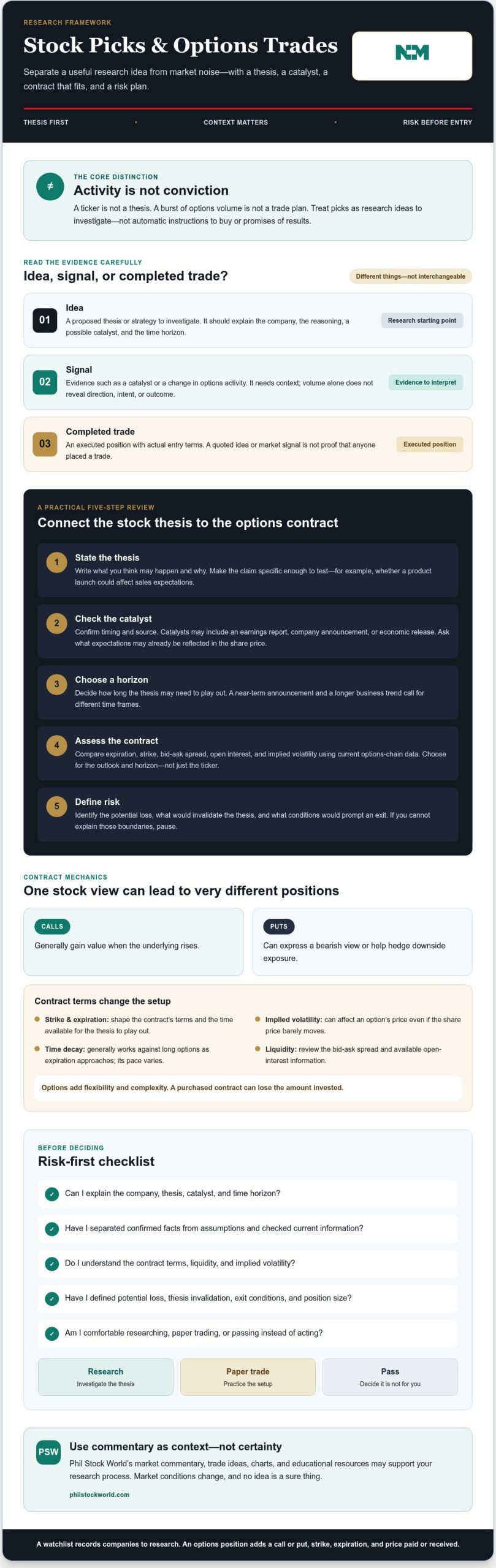
A stock view becomes an options position only after you translate the thesis into contract terms. Use this five-step process to compare Top stock picks and options trades without confusing a watchlist idea with a defined position.
- State the thesis. Write down what you think may happen to the company and why. Make the claim specific enough to test, such as whether a product launch could affect sales expectations.
- Check the catalyst. Confirm the event’s timing and source, whether it’s an earnings report, company announcement, or economic release. Ask what expectations might already be reflected in the stock price.
- Choose a horizon. Decide how long the thesis may need to play out. A view based on a near-term announcement calls for a different time frame than one based on a longer business trend.
- Assess the contracts. Compare expiration, strike, bid-ask spread, open interest, and implied volatility using current options-chain data. Choose based on your outlook and trade horizon, not just the ticker.
- Define risk. Before considering entry, identify the potential loss, what would invalidate the thesis, and what conditions would prompt an exit. If you can’t explain those boundaries, pause.
A stock watchlist records companies worth researching. A specific options position adds a call or put, strike, expiration, and price paid or received. Those terms shape the position’s exposure, so two traders with the same view on a stock may still be considering very different trades. For a clear explanation of options mechanics and leverage, see FINRA on options trading.
Which contract details matter before comparing trades?
Start with expiration and strike, then check the bid-ask spread, available open-interest information, and implied volatility. A wide spread can make execution less favorable. Open interest adds context about existing contracts, but doesn’t prove a trade is attractive. Implied volatility is an input used in option pricing, not a forecast that the stock will move up or down. Without a current, verified options chain, avoid naming a contract as a live opportunity. For more complex structures, an advanced options strategies guide can help you learn the mechanics before weighing whether a strategy fits your thesis.
How can market context strengthen or weaken a thesis?
Check earnings dates, company announcements, and relevant economic events that could affect the underlying or its sector. Then compare the stock’s trend with broad-index and sector behavior. A rising share price may tell a different story if the sector is weakening. A guide to how to read market charts can help you assess trend confirmation, but charts don’t replace catalyst research or risk limits.
For ongoing market commentary, charts, and stock and options trade ideas to compare with your own research, explore Phil Stock World’s market analysis. Treat any idea as a starting point and verify its details before acting.
Why Most-Active Options Are Not Automatically Top Trades
An active contract can catch your eye, but activity is a research lead, not a recommendation. High volume doesn’t establish whether traders are bullish or bearish, whether positions are opening or closing, or whether the contract will perform well. Instead, consider what the activity means alongside the company’s catalyst, contract terms, and your own risk limits.
What do options volume and open interest actually tell you?
Volume counts how many contracts traded during a specified period. Open interest counts contracts that remain outstanding. Both add context, but neither delivers a standalone bullish or bearish verdict. Without verified trade-level data, don’t infer who initiated a trade, whether it opened or closed a position, or what the trader intended.
| Measure | What it can show | What to check |
|---|---|---|
| Volume | How much a contract traded during the period | Is activity notable for this contract, and is there a catalyst? |
| Open interest | How many contracts remain outstanding | Does it add useful context, without assuming intent? |
| Implied volatility | A volatility input reflected in an option’s price | Could a change in volatility affect the position? |
| Liquidity | How readily a contract may be traded | Are the bid-ask spread and available market depth workable? |
| Catalyst context | What event or thesis might help explain attention | Does the timing match the contract’s expiration and your outlook? |
Why can implied volatility change the trade’s risk?
Implied volatility is part of option pricing and can rise or fall over time. If it contracts, an option’s value may face a headwind, even if the underlying moves in the anticipated direction. That’s one reason a compelling company story doesn’t automatically make a contract attractive. Recheck volatility against the thesis and expiration rather than treating a high reading as a prediction of direction.
Liquidity doesn’t guarantee suitability, either. A heavily traded option can still have an expiration that arrives too soon for a longer-term thesis, or a potential loss that doesn’t fit your personal risk limit. Compare the actual contract terms and exit conditions before drawing a conclusion.
For the Top stock picks and options trades, use most-active lists to build a research queue, then test each candidate against its catalyst, liquidity, implied volatility, and time horizon. An active contract earns a closer look, not a free pass. Readers considering ongoing research access can compare available membership information with their own needs and risk discipline.
A Risk-First Checklist for Reviewing Stock Picks and Options Trades
A sound thesis can still become a poor trade if the timing, contract, or potential loss doesn’t fit your situation. Before acting on any of the Top stock picks and options trades you’re reviewing, use this checklist to make the risks visible and slow the decision down.
- Thesis: What evidence supports the idea, and what assumption are you making?
- Invalidation: What news, price action, or business development would weaken or disprove the thesis?
- Catalyst: Is there a specific event that could affect the stock, and when might it occur?
- Time horizon: Does the expected timeline give the thesis room to play out?
- Liquidity: Are the contract’s bid-ask spread and trading activity workable for your intended position?
- Exit conditions: What would make you close, reduce, or reassess the position?
Which questions belong on a pre-trade checklist?
Write down the answers before placing a trade, not after the market turns against you. For an options position, check that expiration matches your intended holding period and that you understand how the strike and current volatility affect exposure. Record the maximum loss you’re prepared to accept and the decision rules you’ll follow. If you buy an option, you could lose the entire premium paid.
Position size is a personal risk decision, not a universal percentage. Consider your financial circumstances, experience, and the possibility that a trade may move against you. A setup that seems manageable at one size can become stressful or costly at another. If you can’t clearly describe the risk, paper trading or passing are both reasonable choices.
How should readers handle changing market conditions?
Revisit the thesis when material company news, earnings results, or volatility shifts alter the original setup. Ask whether the evidence still supports the idea and whether your exit conditions still make sense. Don’t average down or extend an option’s expiration simply to avoid recognizing a loss. That changes the trade and can add risk without repairing the original thesis.
A broader review can help you see whether one position still fits alongside the rest of your portfolio. Phil Stock World offers virtual portfolio reviews; learn more about virtual portfolio review options. Any review or research idea is a tool for consideration, not a guarantee of results or a substitute for your own judgment.
How Phil Stock World Helps You Follow Top Stock Picks and Options Trades
A trade idea is more useful when you can follow its reasoning as conditions change. Phil Stock World publishes market commentary and stock and options trade ideas, giving readers perspectives to compare with their own research. Founded and led by veteran trader and market analyst Phil Davis, the site can help readers follow market themes and revisit a thesis. Ideas still need independent review; no commentary or trade setup guarantees a particular outcome.
What kinds of research and learning resources are available?
Membership access varies and may include daily commentary, premium analysis, top trades, market charts, sector insights, member discussion, real-time alerts, and interactive trading sessions. Educational webinars and virtual portfolio reviews are also offered. Each resource serves a different purpose: commentary and analysis can provide context, charts can help you examine market behavior, and educational offerings can support learning. Check current membership details to confirm which features are included at each level, particularly alerts and interactive sessions.
That distinction matters. A chart or alert can draw attention to a change, but it doesn’t establish that a trade fits your thesis, time horizon, or risk limit. Use research as an input to your decision process, not a substitute for it.
How can a reader decide whether membership fits?
Start with your own workflow. Do you want regular market commentary, deeper analysis, charts, or sector coverage? Would alerts or interactive sessions help you follow ideas? Are webinars or a virtual portfolio review relevant to your learning and review needs? Compare those preferences with the features currently listed, along with the membership terms, before subscribing.
Membership may suit someone looking for an ongoing stream of research to assess more than a reader who only needs an occasional market snapshot. Either way, keep the same discipline: verify current facts and contract data, define possible losses, and decide for yourself whether to research further, paper trade, or pass. Access to ideas doesn’t remove market risk, and no idea is right for every investor.
If ongoing research access matches what you’re looking for, explore Phil Stock World membership and review the current features and terms.
Build a Watchlist You Can Research With Confidence
The strongest Top stock picks and options trades aren’t simply the busiest tickers or the boldest calls. They’re ideas you can connect to a clear thesis, a relevant catalyst, and contract terms that fit your time horizon. Before acting, check what could invalidate the setup, understand the potential loss, and decide whether to research further, paper trade, or pass.
A steady process matters more than chasing every market signal. Phil Stock World publishes daily stock and options commentary, premium research, and member discussion. Educational webinars and virtual portfolio reviews offer additional ways to build your understanding and review your approach. These resources can inform your research, but they don’t guarantee results or replace your own risk decisions.
If ongoing market ideas and analysis could support your process, explore Phil Stock World membership and compare the current features with what you need. Keep asking clear questions, verify the details, and let discipline guide your next move. A thoughtful pass is a valid decision, too.
Frequently Asked Questions
Is unusual options activity a reliable way to find top trades?
Unusual options activity can surface contracts worth researching, but it isn’t a reliable standalone way to identify top trades. Top stock picks and options trades require more than a volume spike: activity alone doesn’t show trader intent, future direction, or whether a position suits your risk limits. Check liquidity, open interest, implied volatility, the catalyst, and the underlying thesis. Data changes quickly, so verify current figures and review potential loss and exit conditions independently.
How do I evaluate a stock pick before trading options on it?
Start with the company thesis, the evidence supporting it, a potential catalyst, and the time horizon. Then review the option’s expiration, strike, liquidity, bid-ask spread, and implied volatility using current data. Decide what would invalidate your thesis and how much you could accept losing before considering a position. A compelling view on a stock doesn’t make every contract appropriate; different terms can change the trade’s exposure and risk.
Can options volume tell me whether a stock will go up or down?
No single options-volume reading reliably predicts whether a stock will rise or fall. Volume counts contracts traded during a period, while open interest counts contracts that remain outstanding. Public activity data may not show whether a position was opened or closed, or whether the contract formed part of a larger strategy. Treat unusual activity as a research prompt, then compare it with price action, company news, volatility, and broader market conditions.
What makes an options trade different from a stock pick?
A stock pick expresses a view about a company or its shares. An options trade adds contract terms, including an expiration date and strike price. Options can also be affected by time decay and implied volatility, not just changes in the underlying share price. As a result, the same stock thesis can lead to very different outcomes across contracts. Evaluate the options structure and its risks separately from your view of the company.
Can I lose my entire investment in an options trade?
Yes. A long option can expire worthless, resulting in the loss of the full premium paid. Other options strategies have different risk profiles and may involve substantial losses or obligations, so understand how a position works before entering it. Review current contract terms and identify the maximum potential loss. If your financial or tax circumstances raise questions, consider seeking advice from a qualified financial or tax professional.
How often should I review a stock or options trade idea?
Review timing depends on the thesis, contract expiration, and relevant catalysts, so there’s no universal schedule. Revisit the idea after material company news, earnings, or a meaningful change in volatility or market conditions. Ask whether the original evidence still supports the thesis and whether your exit rules remain appropriate. A review should test the setup, not trigger a reaction to every price move or headline.
What should I look for in a paid stock-picking service?
Compare research transparency, update cadence, educational value, alert format, and access terms. Look for information that supports your own decision process, not promises of guaranteed returns. Phil Stock World publishes daily stock and options commentary, with membership tiers offering different levels of access to research and discussion. Review current membership details, including pricing and feature availability, directly with the provider, and consider whether you’ll use the commentary, charts, or interactive resources.
To compare research access with your needs, explore Phil Stock World membership and review the current features and terms.

