


Could another market alert make your investing decisions clearer, or just add one more voice to the noise? Daily market intelligence for investors should connect headlines, charts, and market moves into a coherent view, not push you toward rushed decisions. If your feed feels fragmented and alerts arrive without enough reasoning, the problem may not be a lack of information. It may be a lack of context.
Useful research helps you understand what’s moving, why it may matter, and where uncertainty remains. But how do you judge whether a paid service is credible and relevant before you commit? This guide offers practical ways to assess research quality, distinguish considered analysis from attention-grabbing alerts, and match the level of commentary and interaction to your habits and risk tolerance.
We’ll look at how commentary, market charts, trade ideas, and alerts can work together, and what to check before subscribing. We’ll also consider how Phil Stock World’s ongoing analysis, educational resources, and membership options may fit different investing routines. The goal isn’t to outsource your judgment. It’s to find intelligence that helps you use it well.
Key Takeaways
- Learn what separates useful market intelligence from a stream of updates: context, evidence, and a clear account of uncertainty.
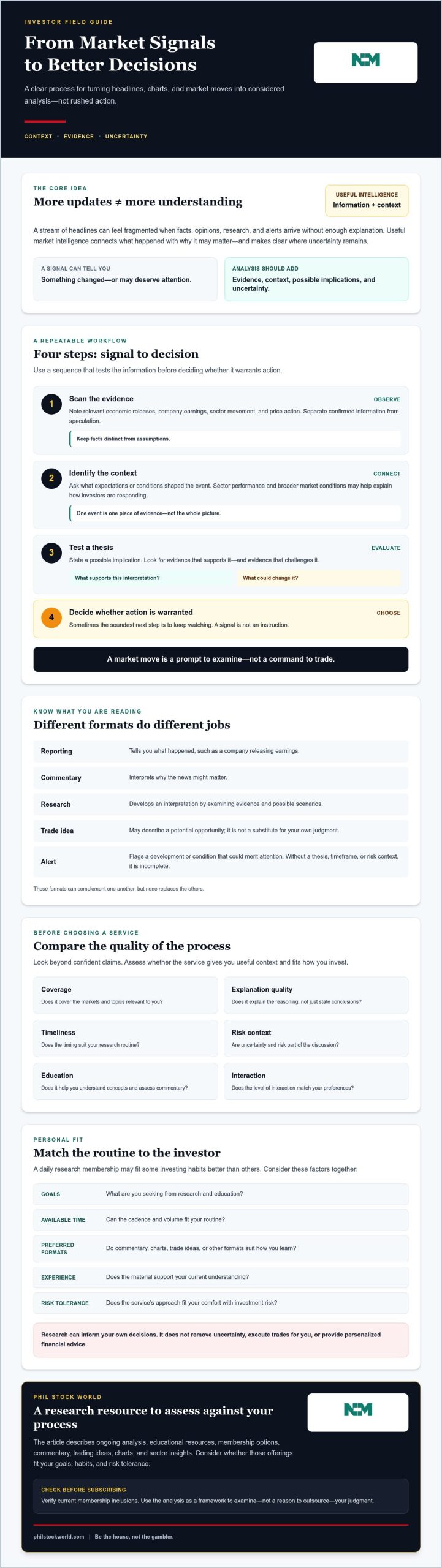
- Use a four-step process to connect market signals to a decision, without assuming every move calls for action.
- Compare services by coverage, explanation quality, timeliness, risk context, education, and interaction, not by confident claims alone.
- Assess whether Daily market intelligence for investors fits your goals, available time, preferred formats, experience, and risk tolerance.
- Explore how Phil Stock World’s commentary, trading ideas, charts, and sector insights may fit your process, and verify current membership inclusions before subscribing.
What Daily Market Intelligence for Investors Should Actually Deliver
A screen full of headlines can leave you less informed than before you opened it. The problem isn’t always a shortage of updates. Facts, opinions, research, and alerts often arrive through separate channels, with little to connect them. Daily market intelligence for investors should turn timely information into a considered view by explaining the context, evidence, and uncertainty behind a market move.
To judge whether a service does that, first distinguish what each type of content can and can’t offer. Reporting tells you what happened, such as a company releasing earnings. Commentary interprets why the news might matter. Research develops that interpretation by examining evidence and possible scenarios. A trade idea may describe a potential opportunity, while an alert flags a development or condition that could merit attention. These formats can complement each other, but none replaces the others. A useful foundation is the broader concept of Market analysis, which considers market dynamics and trends rather than treating each data point in isolation.
How market intelligence differs from headlines and alerts
Hypothetical example: A company reports results that differ from expectations, and its shares move. A headline reports the results and price move. More useful commentary might explain which parts of the report drew attention, how the move compares with the company’s recent trend, and what uncertainties could change the interpretation. That is context, not a prediction or instruction to trade.
Who benefits from a daily research routine?
A regular research routine may suit active, self-directed investors who want to connect developments across stocks, options, sectors, and macroeconomic events. It can also help readers build understanding over time, especially when commentary explains its reasoning instead of presenting conclusions as facts. The value is having a framework to examine, not another voice to follow automatically.
Be specific about what you’re seeking. Educational material can help you understand concepts and assess market commentary. Research and trade ideas can inform your own decision process. Neither means trades are executed for you or that you’re receiving personalized financial advice. A service can’t remove uncertainty, investment risk, or your responsibility to make decisions that fit your circumstances.
Market intelligence is timely information explained with evidence and context. It can inform your decisions, but it can’t guarantee their outcomes.
How Daily Investor Intelligence Turns Market Signals Into a Decision Process
Good analysis doesn’t stop at “the market moved.” It gives you a repeatable way to examine what changed, why it might matter, and whether the evidence supports doing anything about it. Daily market intelligence for investors is most useful when it strengthens that process, rather than supplying a ready-made narrative.
Try this four-step workflow:
From market event to an evidence-based thesis
Start with three questions: What changed? Which companies, sectors, or assets might be affected? What evidence supports that connection? Keep observation separate from interpretation. “The index declined” is an observation; “investors are repricing rate expectations” is an interpretation that needs supporting evidence. Signals can disagree. Credible analysis should acknowledge that instead of forcing everything into one tidy story. Market charts can help you examine price behavior and trend context; see this guide to how to read market charts. Check publication dates before relying on specific market examples, since conditions and data can change.
Also identify what you’re evaluating. Stocks and options have different characteristics; Cornell Law School’s Legal Information Institute provides a legal definition of securities. The point isn’t to turn a daily review into a legal exercise, but to avoid treating different instruments as if they carry identical considerations.
From thesis to risk-aware next steps
Write down three things: the observation, a potential next step, and what would invalidate your thesis. For example, you might monitor a sector after a company report, decide whether further research is needed, and note what contrary evidence would make your original interpretation less convincing. This keeps a developing idea from quietly becoming a certainty.
Trade ideas need a timeframe and risk context, especially with options, where the contract and strategy affect how a position may behave. A chart signal alone doesn’t explain those trade-offs. For strategy-specific learning, explore advanced option trading strategies, and use any idea as a prompt for independent evaluation, not an automatic decision.
Compare Daily Market Intelligence Services With a Practical Evaluation Table
Research options range from free news feeds to paid analysis and interactive communities. The best fit depends on what you need to understand, how much time you have, and whether you want to read, learn, or discuss. Use this comparison as a starting point, not a verdict. Services vary, so verify their current features and terms directly.
| What to assess | Free news | Independent newsletters | Research memberships | Interactive rooms |
|---|---|---|---|---|
| Coverage | Often broad, with updates across markets and companies. | May focus on selected sectors, assets, or themes. | Can combine commentary, charts, and trade ideas; check the actual scope. | Coverage may follow member questions or the day’s activity. |
| Explanation quality | Look for clear sourcing; a headline may offer little interpretation. | Assess whether opinions are supported by evidence. | Check whether ideas include reasoning, assumptions, and alternatives. | Notice whether discussion distinguishes facts from speculation. |
| Timeliness | Check timestamps and whether updates suit your needs. | Confirm publishing frequency and alert timing. | Verify when commentary and alerts are delivered. | Ask whether sessions are live, recorded, or available later. |
| Risk context | Reporting may not explore possible downsides. | Look for timeframes and risks alongside opinions. | Check whether analysis discusses uncertainty and invalidation points. | Consider whether fast discussion leaves room for risk review. |
| Education | May explain events, but depth varies. | Look for material that builds understanding, not just conclusions. | Review whether learning resources are included. | Ask whether discussion is explanatory or mainly reactive. |
| Interaction | Usually limited; confirm available ways to ask questions. | Check whether readers can engage with the author. | Confirm what discussion or review access is included. | Interaction is central, but format and access can differ. |
Feature volume alone can’t prove research quality; clear reasoning, transparent limits, and a useful fit matter more. Daily market intelligence for investors should help you judge the evidence, not sell certainty. Be cautious with dramatic testimonials, win rates, or counts of successful calls unless the provider explains the methodology, timeframe, selection criteria, and unsuccessful examples. A claim without context is a highlight reel, not a complete record.
Questions to ask before paying for market research
Find out who produces the analysis, what evidence supports it, and how uncertainty is described. Confirm whether access includes commentary, charts, alerts, community discussion, or live sessions, and whether those formats fit your routine. Check current features, cancellation terms, and any access limits directly before subscribing. Don’t assume a feature mentioned elsewhere is included in the option you’re considering.
Signals of useful research versus sales hype
Useful research states its assumptions, timeframe, and risks alongside potential opportunities. Hype tends to lean on urgency or confident promises while leaving the reasoning thin. Ask what would change the analyst’s view, and whether examples represent a full, clearly explained record rather than selected successes. A measured answer is often more informative than a bold prediction.
How to Decide Whether a Daily Intelligence Membership Fits Your Investing
A membership is worth considering only if it supports the investing routine you actually have. It won’t guarantee better decisions or returns, and a long list of features has little value if you rarely use them. Start with an honest fit check, not an imagined version of yourself who reads every update and joins every discussion.
Match service features to your real routine
Daily commentary can offer regular market context without implying that you need to trade every day. Charts help you examine price behavior, webinars can support learning, portfolio reviews offer a way to examine an investing process, and interactive discussion provides a forum for exchanging views. These formats serve different purposes. Choose the ones you expect to use consistently, and confirm what’s currently included before subscribing.
Ask yourself these five questions:
- Goals: Am I looking for market context, education, ideas to evaluate, or discussion?
- Time: How much time can I reliably spend reviewing research?
- Format: Will I actually read commentary, study charts, attend webinars, or take part in discussion?
- Experience: Do I understand the concepts well enough to assess an idea, or do I need more educational material first?
- Risk tolerance: Can I evaluate uncertainty and potential loss without feeling pressured to act?
If you’re examining how your current holdings and approach fit together, a virtual portfolio review may be a relevant format to explore. Check its current scope and terms, and distinguish a review from personalized financial planning.
Check risk, independence, and expectations
Before joining, make sure you can treat commentary and trade ideas as material to evaluate, not instructions to copy. A research membership provides information and analysis; it isn’t brokerage execution, direct asset management, or personalized financial planning. Daily market intelligence for investors can add context to your process, but it can’t remove investment risk or decide what’s appropriate for you.
- Can I explain why an idea might make sense before considering it?
- Do I know what evidence or changed conditions would make me reconsider?
- Have I checked the current features, access limits, and cancellation terms?
If you can answer clearly, compare the membership’s recurring value with the features you’ll use in an ordinary week, not its most exciting possible use. To review Phil Stock World’s research and membership information, explore Phil Stock World and verify current inclusions before deciding.
What Phil Stock World Offers Investors Seeking Ongoing Market Intelligence
Phil Stock World brings together daily stock and options commentary, trading ideas, market charts, and sector-specific insights. These resources give investors material to examine market developments and their own thinking, rather than promising a particular result. For readers seeking Daily market intelligence for investors, the practical question is how these resources fit into an independent research routine.
Membership access ranges from daily commentary to real-time interactive trading sessions. Available content and interaction can vary, so check current membership details rather than assuming every resource is included at every access level.
Which Phil Stock World resources may match your needs?
Different formats support different habits. Consider which resources you’re likely to return to and use:
- Commentary and market charts can help readers follow market activity and review how analysis relates to price movement.
- Webinars and strategy guides offer educational formats for readers who want to build their understanding of market concepts and approaches.
- Interactive sessions and community discussion may suit investors who value exchanging perspectives and following ongoing market conversations. Confirm the format and access available to you.
- Virtual portfolio reviews can provide a structured opportunity to reflect on an investing process. They shouldn’t be mistaken for personalized financial planning or direct asset management.
Think of these as distinct tools, not a checklist you need to complete. If regular commentary is what you’ll read, prioritize clarity and relevance. If you’re working to understand a strategy, educational resources may matter more than frequent alerts. Choose the formats that match your actual schedule and goals.
Review the membership details before joining
Before subscribing, compare current plan features with the criteria in this guide: what coverage is provided, how analysis explains its reasoning, when content or alerts are delivered, and what access or interaction is included. Check applicable terms and conditions directly. Details can change, and a feature mentioned in one context may not apply to every membership option.
Ongoing research can add useful context and discussion to your process, but it can’t guarantee better decisions or returns. Its value depends on whether you engage with the material, assess ideas independently, and find the format useful over time.
Review the current details to decide whether the resources suit your routine: explore Phil Stock World membership.
Build a Research Routine That Works for You
Useful Daily market intelligence for investors does more than fill a feed. It connects market developments to evidence and context, makes uncertainty visible, and gives you a clearer basis for independent decisions. When comparing services, focus on the quality of the reasoning, the formats you’ll genuinely use, and whether the membership fits your time and risk tolerance. Research can inform your process, but it can’t guarantee decisions or returns.
Phil Stock World, founded and led by veteran trader and market analyst Phil Davis, offers daily commentary, with membership access ranging from daily content to real-time interactive trading sessions. Educational resources include webinars, strategy guides, market charts, and virtual portfolio reviews. Current inclusions can vary, so review the membership details and confirm what’s available before joining.
If the research and interaction options sound relevant to your routine, review the available access levels. Explore Phil Stock World membership and check which resources are currently included before deciding. Keep your own judgment at the center of every decision.
Frequently Asked Questions
What does daily market intelligence for investors include?
Daily market intelligence can combine timely market news with analysis that explains relevant context, evidence, and uncertainty. Depending on the service, it may cover economic developments, company earnings, sectors, stocks, options, price charts, commentary, research, and trade ideas. Phil Stock World provides daily stock and options commentary, market charts, sector insights, educational resources, and membership access to different levels of content and interaction. Check the current inclusions directly.
How is market intelligence different from stock market news?
Stock market news reports events, such as an earnings release or a change in an index. Market intelligence adds interpretation by examining why an event may matter, which assets could be affected, and what evidence or uncertainty remains. A headline can tell you that a stock moved; thoughtful analysis explores possible context without presenting one explanation as certain. News and analysis can complement each other, but they serve different purposes.
Can daily market analysis help investors make better decisions?
It can support a more considered decision process by helping investors connect market events, assess evidence, and identify risks or unanswered questions. For example, analysis of an earnings report may be more useful when considered alongside sector trends and price behavior. But research can’t guarantee better decisions or returns, remove investment risk, or determine what’s appropriate for your circumstances. Use analysis as an input, then evaluate ideas independently before acting.
Is a paid market intelligence service worth it for individual investors?
It may be worthwhile if the research fits your goals, experience, available time, and preferred formats. Compare the recurring value with what you’ll realistically use, such as commentary, charts, educational resources, or discussion. A busy reader who rarely checks updates may get less practical value than someone who follows research consistently. Paid access doesn’t promise better outcomes, so review the service’s reasoning, current features, terms, and limits before subscribing.
What should I check before subscribing to an investor research service?
Check who produces the research, what evidence supports its ideas, and whether it explains assumptions, timeframes, risks, and uncertainty. Confirm exactly what access includes, such as commentary, charts, alerts, educational resources, or community discussion. Review current access terms, cancellation conditions, and any limits directly with the provider. Don’t rely on selected testimonials or performance claims without understanding their context and methodology, and make sure the service fits your actual investing routine.
Are trading alerts enough to make an informed investment decision?
No. An alert can draw attention to a development or potential trade, but by itself it may not explain the thesis, timeframe, supporting evidence, or risks. Before considering an idea, ask what changed, why it might matter, and what could invalidate the interpretation. Options ideas also need strategy-specific risk context. Treat alerts as prompts for further evaluation, not automatic instructions, and don’t assume that speed or confidence makes an alert reliable.
How do I choose between market commentary, research, and a trading room?
Choose based on how you want to engage. Commentary offers regular interpretation of market developments; research can provide a more developed case, evidence, and risks; a trading room centers on interactive discussion, with access and format varying by service. Consider whether you want to read at your own pace, study an idea in depth, or learn through discussion. Verify what’s currently included, then select only the formats you’ll use consistently.

