


What if the most impressive-sounding stock analysis webinar leaves you no clearer about how to assess a market move? Webinars on advanced stock analysis can promise sophisticated charts and strategies, but the real test is whether they show how evidence, market context, and risk fit together. Jargon is easy. Sound decision-making takes more work.
If you’ve found it difficult to distinguish rigorous instruction from recycled commentary, look beyond the headline topic. A useful session goes deeper than indicators or theory: it explains the instructor’s reasoning and makes room for the risks and uncertainties behind an idea. It should strengthen your analysis process, not hand you a script to follow.
This guide compares common webinar formats and gives you practical criteria for judging depth, relevance, and interaction. You’ll learn how to connect chart analysis with broader market conditions, assess whether a session supports disciplined decisions, and recognize when promotional claims overshadow the teaching. Phil Stock World offers educational webinars alongside market charts and analysis, giving you more ways to study strategies and develop your own perspective.
Key Takeaways
- Webinars on advanced stock analysis vary in format; compare their teaching methods, examples, and follow-up materials.
- Look for instruction that treats indicators and chart patterns as evidence to interpret, not automatic trading signals.
- Match a session’s learning objectives to the skill you want to build, from chart reading to portfolio-level thinking.
- Assess how clearly a webinar discusses uncertainty and risk alongside its analysis.
- Explore how Phil Stock World webinars complement market charts, strategy guides, and virtual portfolio reviews.
What Makes Webinars on Advanced Stock Analysis Worth Your Time?
An advanced stock analysis webinar teaches a repeatable way to apply market evidence to investment questions, not a formula for predicting a stock’s next move. That distinction matters. A session can use sophisticated charts yet offer little analytical depth if it skips the assumptions, context, and risks behind its conclusions.
Webinars on advanced stock analysis should help you evaluate an idea, not simply hand you a ticker or signal. Good instruction explains what evidence might support or challenge a thesis. It doesn’t guarantee predictions, provide personalized advice, or replace your own research and decisions. A software demonstration can help you learn a platform’s features, but that is different from learning how to interpret market evidence.
Look for a presenter who makes the reasoning visible. What question is being examined? Which evidence matters? What assumptions shape the interpretation? What alternative outcomes could change the conclusion? A persuasive chart is no crystal ball. Without that wider frame, technical detail can create an illusion of certainty.
What should an advanced analysis webinar teach?
A strong session shows how technical evidence can inform an investment thesis without dictating an automatic action. A moving average, support level, or chart pattern gains meaning through interpretation. The foundations of technical analysis explain how analysts use price and market data, but a useful lesson also connects chart observations to broader conditions and states its assumptions clearly.
Risk belongs in the discussion from the start, not as a last-minute disclaimer. Does the analysis consider what could weaken the thesis? Would a different market scenario change the interpretation? When a presenter explores both opportunity and uncertainty, you can learn to weigh evidence instead of chasing confident-sounding conclusions.
Who benefits from advanced stock analysis webinars?
These sessions often suit intermediate investors who know basic chart terminology and want to move from recognizing patterns to evaluating what they may mean. They can also help active learners who want to compare evidence, question assumptions, and develop a more deliberate analysis process before making decisions.
You don’t need to agree with every conclusion to learn from a session. Focus on how the reasoning is built and whether it leaves room for uncertainty. A webinar can provide structure and perspective; you remain responsible for independent research and for deciding what, if anything, to do with what you learn.
How Strong Stock Analysis Webinars Connect Charts, Context, and Risk
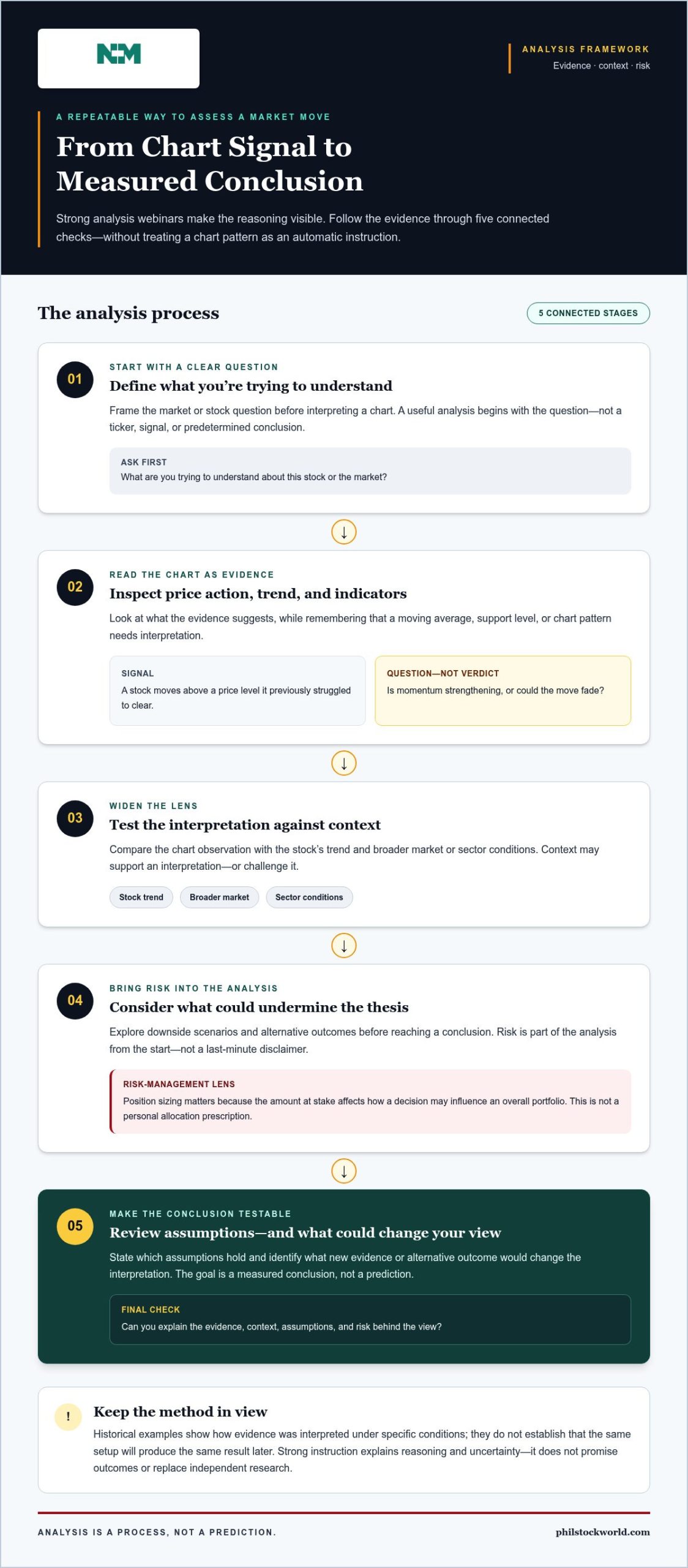
A chart signal is a clue, not a verdict. Strong webinars show how to move from a market question to a measured conclusion, rather than treating an indicator or pattern as an automatic instruction. Analysis is a process, not a prediction.
A useful framework keeps the reasoning visible:
- Define the question: What are you trying to understand about the stock or market?
- Inspect the evidence: What do price action, trend, and relevant indicators suggest?
- Test the context: Does the broader market or sector support the interpretation?
- Consider risk: What could undermine the thesis, and which downside scenarios matter?
- Review the conclusion: Which assumptions hold, and what new evidence would change the view?
From chart evidence to a testable market thesis
Suppose a stock moves above a price level it previously struggled to clear. That move raises a question: is momentum strengthening, or could the price move fade? A webinar with analytical depth examines the signal alongside other evidence, such as the stock’s trend and broader market conditions. It states assumptions and considers alternative interpretations. Webinars on advanced stock analysis should teach you to test a thesis, not simply assign meaning to a chart pattern.
Historical examples can make a method easier to follow. They show how an analyst interpreted evidence in a particular context, but they can’t establish that the same setup will produce the same result later. Use examples to understand the reasoning, then examine the assumptions and uncertainty for yourself. For additional investor learning, FINRA investor education offers a separate resource for building foundational knowledge.
Risk and uncertainty belong in advanced analysis
A thesis is incomplete if it covers potential opportunity but ignores what could go wrong. Strong instruction considers downside scenarios and explains why position sizing is part of risk management: the amount at stake affects how a decision may influence an overall portfolio. The point isn’t to prescribe a personal allocation. It’s to show that risk belongs in the analysis before a decision, not as an afterthought.
That discipline matters when a webinar uses past market examples. A historical outcome illustrates what happened under specific conditions; it isn’t a forecast or promise. To explore how options strategies introduce additional considerations, see this guide to advanced option trading strategies. You can also explore Phil Stock World’s market analysis as part of your ongoing study. Keep the focus on method: evidence, context, assumptions, and risk, weighed together.
Compare Advanced Stock Analysis Webinar Formats Before You Commit
Format shapes how you learn, but it doesn’t prove how much you’ll learn. A live session can support timely discussion when audience interaction is part of the teaching. A recording lets you revisit a complex example at your own pace. Discussion-led learning can expose you to competing interpretations. Compare the teaching itself, not just the format label.
| Format | Depth and examples | Risk coverage | Questions and follow-up |
|---|---|---|---|
| Live instruction | Can walk through market evidence as it’s presented; assess whether examples explain the reasoning. | Look for downside scenarios discussed alongside potential opportunity. | Audience questions can clarify the analysis; useful follow-up materials reinforce the key ideas. |
| Recorded lessons | Support self-paced review of a method or worked example. | Judge whether uncertainty and risk are part of the lesson, not just the conclusion. | Replay sections to review difficult concepts and take notes on questions to explore. |
| Discussion-led sessions | Help learners compare assumptions and alternative readings of the same evidence. | Listen for debate about what could invalidate a thesis. | Discussion is most useful when questions clarify the reasoning and test different interpretations. |
Use the table as a comparison guide. A polished dashboard, a long list of indicators, or sleek charts can make a presentation look sophisticated, but none tells you whether the instructor teaches a repeatable analytical method. Webinars on advanced stock analysis earn their keep by showing how evidence is interpreted, where assumptions enter, and how uncertainty affects a conclusion.
Use a comparison checklist, not marketing claims
Before committing, ask whether the examples show the steps behind a conclusion, not just the finished chart or trade idea. Look for a practical discussion of risk and a clear distinction between general education and individualized advice. Consider whether lesson materials or related analysis help you revisit the concepts afterward.
A webinar that invites questions can be valuable when interaction clarifies the reasoning rather than turning the session into a sales pitch. For broader context on how webinars can support investor learning, explore trading webinars for investors. The right format is the one that fits how you learn and helps you examine a market idea with more discipline.
Choose a Stock Analysis Webinar That Matches Your Investing Goals
Start with the gap you want to close, not the most impressive-sounding topic. Do you want to read chart structure more confidently, connect price action with broader market conditions, understand options strategies, or think more clearly about portfolio-level decisions? The more specific your question, the easier it is to judge whether a webinar’s learning objectives match your knowledge and how you plan to use what you learn.
Match webinar content to the question you want answered
Technical analysis instruction should focus on interpreting charts and evidence. Strategy education should explain how a method works, its assumptions, and where risk enters. Portfolio-level learning addresses a different question: how do individual positions and decisions fit into a broader approach? If that’s your focus, explore this guide to virtual portfolio review.
Before choosing among Webinars on advanced stock analysis, write down one practical objective. For example: “I want to understand how a presenter evaluates trend changes,” or “I want to compare how different market conditions could affect an options strategy.” Then compare your objective with the session’s stated outcomes. If those outcomes are vague or don’t address your question, the topic may not be the best fit right now.
Recognize education that respects risk
Useful instruction doesn’t present only the upside case. Look for examples that explain what could go wrong, acknowledge uncertainty, and consider why another analyst might interpret the same evidence differently. That balance helps you evaluate the reasoning instead of simply absorbing a confident conclusion.
Be especially skeptical of bold performance promises. Treat them as a reason to scrutinize the method, assumptions, and risks, not as evidence that an approach will work for you. A webinar can offer education and analytical perspectives, but it can’t make your decisions or guarantee an outcome. Your research, objectives, and judgment remain central.
After a session, take a brief pause before moving on. Record one method you learned and one question that remains open. This simple review helps separate a useful analytical tool from a conclusion you haven’t independently tested. To continue learning through market analysis and strategy discussion, explore Phil Stock World’s educational webinars.
Explore Phil Stock World Webinars and Advanced Analysis Resources
Strong market education doesn’t have to end when a webinar does. Phil Stock World offers educational webinars alongside market charts and analysis, strategy guides, daily market commentary, and virtual portfolio reviews. Each resource offers a different way to examine market ideas, study analytical methods, and connect a concept from a session to broader market discussion.
Think of these resources as complementary, not interchangeable. A webinar can introduce or explore an analytical approach; charts and analysis give you market evidence to study, while strategy guides add educational context. A virtual portfolio review can help you examine portfolio-level decisions. The goal is to build your own understanding, not hand over your decisions or promise a particular result.
Learn through analysis, strategy, and market discussion
Webinars on advanced stock analysis are most useful when you bring a clear question to the material. As you follow a discussion, note the evidence being used, the assumptions behind an interpretation, and what could change the analysis. Then use related charts, commentary, or strategy education to keep exploring the idea. That habit turns market content into an active learning process instead of a stream of conclusions to absorb.
Phil Stock World membership offers access to a broader research and community experience, with membership options ranging from daily commentary to real-time interactive trading sessions. For an overview of the membership and its resources, read about Phil Stock World membership. Treat these resources as support for independent learning, not a shortcut to certainty.
Take the next step with a clear learning goal
Choose the next skill you want to work on: interpreting charts, placing market moves in context, understanding strategy, or reviewing how decisions fit together at the portfolio level. A specific goal makes it easier to focus on relevant material and assess whether it deepens your thinking.
Keep your expectations grounded. Education can help you ask sharper questions and evaluate market evidence more deliberately, but it can’t remove uncertainty or guarantee outcomes. Ready to keep learning? Explore Phil Stock World’s educational resources and continue building your market-analysis toolkit.
Build a More Disciplined Market-Analysis Habit
The best Webinars on advanced stock analysis teach more than chart terminology. They help you connect evidence with market context, examine assumptions, and account for risk before drawing conclusions. Compare formats by the quality of their teaching, then choose sessions that match the skill you want to develop.
Phil Stock World brings educational webinars together with market charts and analysis and strategy guides. Virtual portfolio reviews are another educational resource. Founded and led by Phil Davis, a veteran trader and market analyst, Phil Stock World offers resources to support continued learning and independent market thinking.
Keep your next step simple: identify one question you want to explore, then use relevant educational resources to deepen your understanding. Explore Phil Stock World’s educational resources and analysis to keep building a thoughtful, disciplined approach to the markets. Every strong analysis habit starts with curiosity, and you’re well placed to take that next step.
Frequently Asked Questions
What are webinars on advanced stock analysis?
Webinars on advanced stock analysis are educational sessions that examine how investors interpret market evidence, including charts, indicators, and broader context. A useful session explains the reasoning behind an analysis, considers other possible interpretations, and discusses risk. Rather than repeating a trade idea or suggesting an indicator can predict prices with certainty, it helps viewers understand an analytical process they can evaluate and apply through their own independent research.
Are advanced stock analysis webinars worth it?
They can be worthwhile if the material fits your experience and teaches a method you can understand and assess. Look for clear learning objectives, worked examples that show how the analysis was developed, and honest discussion of uncertainty. Sessions that rely on technical jargon or bold claims without explaining their reasoning may offer little practical value. Treat webinar education as one input to your research, not a substitute for your judgment.
What should I look for in a stock analysis webinar?
Look for a focused topic, a logical explanation of the evidence, and examples that reveal the steps behind an interpretation. Risk discussion matters too: the presenter should address what could challenge the analysis, not just its potential upside. Consider whether the format suits how you learn and whether key concepts can be revisited. Strong education explains what an analysis can and cannot establish, rather than presenting one interpretation as certain.
Can stock analysis webinars help me make better trading decisions?
They can help you understand analytical concepts and assess market information more systematically, but they can’t guarantee better outcomes or remove market risk. Use what you learn to ask sharper questions, test assumptions against independent evidence, and consider your own objectives and risk tolerance. A webinar offers education, not decisions on your behalf. The most useful sessions strengthen disciplined thinking instead of encouraging dependence on alerts, forecasts, or a single viewpoint.
How are stock analysis webinars different from trading signals?
A webinar teaches concepts and ways to examine evidence; a trading signal generally communicates a suggested action. Educational analysis should explain why an interpretation is being considered and what evidence could challenge it. Neither format guarantees results. Understand what you’re viewing, do your own research, and don’t mistake general educational discussion for personalized financial advice. Learning the reasoning behind an idea can help you assess it independently rather than simply follow it.
Do I need experience before attending an advanced stock analysis webinar?
Some familiarity with stocks and basic market terms can make advanced material easier to follow. You don’t need to know every indicator, but you should be ready to examine evidence and question assumptions. If the presenter moves quickly or introduces unfamiliar concepts, write them down and review them afterward. Look for instruction that explains technical language clearly while still engaging with the complexity of the analysis.
Can webinars teach technical analysis and portfolio risk together?
Yes, a session can connect chart interpretation with position sizing, downside scenarios, and broader portfolio context. Technical analysis alone doesn’t show whether a decision fits your circumstances, and a chart observation isn’t a complete investment decision. Look for teaching that acknowledges uncertainty and considers how risk affects the analysis. Your objectives and risk tolerance remain central as you evaluate what you learn and decide how to use it.

