


What if a portfolio that looks diversified is still making one oversized bet? A dozen funds can share the same underlying exposure, while a single risk score may hide more than it explains. Portfolio risk assessment for individual investors is about connecting those exposures to your goals, time horizon, and ability to absorb losses, not just reacting to a choppy week in the market.
You already know investing involves uncertainty. The challenge is separating ordinary short-term volatility from risks that could derail a goal or turn a temporary setback into a lasting loss. No single metric can predict what markets will do, but a clear, repeatable review can make your exposures easier to see and evaluate.
This guide explains how to identify your portfolio’s key exposures, use practical measures and scenarios, and review what’s changed over time. You’ll learn how to look beneath the surface of diversification, relate market risks to your capacity for loss, and recognize when an educational virtual portfolio review could help you examine your strategy.
Key Takeaways
- Portfolio risk assessment for individual investors starts with an inventory of holdings across asset classes, sectors, issuers, geographies, and account purposes.
- Separate concentration risk, how much of the portfolio depends on one holding or exposure, from correlation risk, how holdings may move together.
- Use scenario analysis to explore how hypothetical market, interest-rate, inflation, or liquidity shocks could affect your portfolio.
- Follow a repeatable five-step review, and record your assumptions, concerns, decisions, and triggers so future reviews are easier to compare.
- Treat assessment findings as prompts for further research, not automatic trade instructions. An educational portfolio review can offer another perspective while leaving decisions in your hands.
What Portfolio Risk Assessment Means for Individual Investors
Portfolio risk assessment is the process of identifying what could affect your investments and judging how those exposures fit your goals and ability to absorb losses. It’s more useful than treating risk as a single score. A portfolio can fluctuate sharply yet still suit a long-term goal, while a seemingly steady holding may be difficult to sell when you need cash.
For self-directed investors, the aim is to understand trade-offs, not eliminate uncertainty. Volatility measures how much an investment’s price moves, but it doesn’t capture every risk. A temporary decline, a lasting loss of value, and an asset you can’t readily sell are different problems. The portfolio-level view matters, too: Modern Portfolio Theory considers how an asset contributes to a portfolio’s overall risk and return, rather than judging each holding in isolation.
Risk tolerance, risk capacity, and time horizon are different
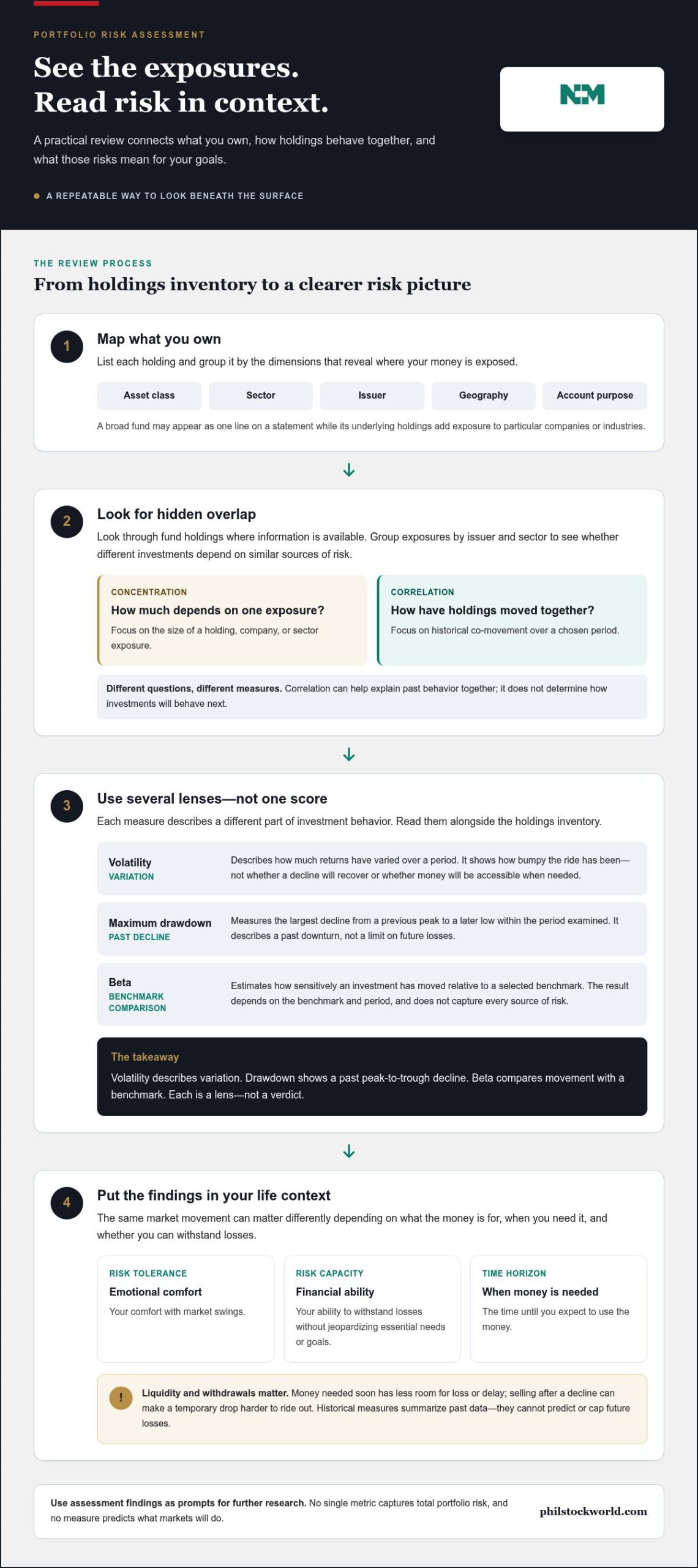
Risk tolerance is your emotional comfort with market swings. Risk capacity is your financial ability to withstand losses without jeopardizing essential needs or goals. Time horizon is when you expect to use the money. These factors can point in different directions: you may feel calm during downturns but still have limited capacity for loss if you depend on portfolio withdrawals.
Consider someone investing for a long-term goal who also expects to use part of their savings for a near-term expense. The long-term portion may have time to recover from a downturn; the money needed soon has less room for loss or delay. Liquidity needs and planned withdrawals matter because selling investments after a decline can make a temporary drop harder to ride out. This framework is educational, not individualized financial advice.
Which portfolio risks should an individual investor notice first?
Start with exposures that could affect what the money is meant to do. A stock-heavy portfolio, for example, may face several risks at once:
- Market risk: broad declines can pull down many investments.
- Concentration risk: a large position or cluster of similar companies can magnify the effect of one setback.
- Interest-rate and inflation risk: changing rates can affect investment values, while inflation can erode what savings can buy.
- Liquidity risk: an investment may be difficult to sell promptly at a desired price.
- Behavioral risk: fear or overconfidence can push you to abandon a considered approach at the wrong moment.
The mix matters. There’s no universal threshold that suits every investor. Relevant risks depend on your goals, time horizon, cash needs, and capacity for loss.
How to Measure Portfolio Risk Without Relying on One Number
Start with an inventory of your holdings. Record each one and group it by asset class, sector, issuer, geography, and account purpose. A broad fund may appear as a single line on a statement, but its underlying holdings can add significant exposure to particular companies or industries. Note what each account is intended to fund, too. The same market movement can matter differently to money set aside for different goals.
Exposure, concentration, and correlation reveal hidden overlap
Concentration asks, “How much depends on this holding, company, or sector?” Correlation asks, “How have these investments tended to move in relation to one another?” They’re related, but not interchangeable. Several funds may hold some of the same companies, or own different companies that respond to similar economic forces. Look through fund holdings where that information is available, then group exposures by issuer and sector to make overlap easier to spot.
Correlation describes historical co-movement over a chosen period. It can help explain how investments behaved together in the past, but it doesn’t determine how they’ll behave next. Concentration measures the size of an exposure; correlation measures the pattern of co-movement.
Volatility, drawdown, and beta answer different questions
Once you’ve mapped the holdings, use several measures to describe different parts of their behavior:
- Volatility describes how much returns have varied over a period. It can show how bumpy the ride has been, but not whether a decline will recover or whether you could access the money when needed.
- Maximum drawdown measures the largest decline from a previous peak to a later low within the period examined. It illustrates the depth of a past downturn, not the maximum loss that could occur in the future.
- Beta estimates how sensitively an investment has moved relative to a selected benchmark. The result depends on the benchmark and period used, and it doesn’t capture every source of risk.
No single metric captures total portfolio risk: volatility describes variation, drawdown shows a past peak-to-trough decline, and beta compares movement with a benchmark. Each is a lens, not a verdict. Historical measures summarize past data; they can’t predict or cap future losses. For another way to consider how a portfolio might respond to hypothetical conditions, Morningstar explains scenario analysis.
Risk measures become more useful when you read them alongside your holdings inventory and the purpose of your money. Phil Stock World’s virtual portfolio review offers an educational perspective on your holdings and strategy.
How Scenario Analysis Tests Whether Your Portfolio Can Take a Hit
Risk measures describe how investments have behaved or what they’re exposed to. Scenario analysis asks what those exposures could mean for your goals if conditions changed. It isn’t a forecast or a promise that a portfolio will behave in a particular way. Think of it as a rehearsal: identify a hypothetical shock, then trace how it might affect your holdings, cash needs, and ability to stay invested.
Diversification can reduce some risks, such as depending heavily on one company or sector. It can’t prevent losses across the board. Different holdings may still fall together when they share economic exposures, and a mix that looks balanced on paper may not provide the protection you expect in every environment.
Which hypothetical shocks are useful to test?
Choose scenarios that connect to your actual holdings and goals. Make the assumptions explicit, and don’t assign unsupported odds or treat the exercise as a prediction. For example:
| Hypothetical shock | Questions to consider |
|---|---|
| Broad equity decline | How might a market-wide drop affect the portfolio’s value and long-term plans? |
| Sharp sector setback | Do several funds or individual holdings depend on the same sector or economic driver? |
| Interest-rate increase | Which holdings could be sensitive to higher rates, and could the change affect a planned goal? |
| Higher inflation | Could rising costs change what a future withdrawal needs to cover? |
| Liquidity squeeze | If selling became difficult or inconvenient, could you still meet near-term cash needs? |
Not every scenario deserves equal attention. A liquidity test may be especially relevant if you expect withdrawals soon; an inflation scenario may matter more when a goal depends on future purchasing power. Portfolio risk assessment for individual investors is most useful when scenarios reflect the portfolio’s actual exposures, not a generic list of market worries.
How to interpret a stress-test result
Compare each possible effect with your time horizon, planned withdrawals, and financial obligations. A temporary decline in money intended for a distant goal may be uncomfortable but manageable. A similar decline in assets needed soon could disrupt a near-term plan, particularly if you’d have to sell during a downturn.
Record the assumptions you used, which goals seem most exposed, and what questions the exercise raises. Treat the result as a prompt for further research or review, not an automatic instruction to buy, sell, or hedge. Scenarios help you think through possible consequences; they can’t tell you exactly what markets will do.
A Repeatable Portfolio Risk Assessment: Five Practical Steps
A useful review doesn’t need to be complicated. It needs to be consistent. This five-step process creates a clear record you can revisit, so changes in your portfolio or circumstances don’t get lost in the noise.
- 1. Clarify your goals. Note what the money is for, when you expect to use it, and how much flexibility you have if plans change.
- 2. Inventory your holdings. List investments, approximate portfolio weights, account purposes, and expected cash needs. Include holdings across accounts where you can, so your review isn’t limited to a single statement.
- 3. Identify exposures. Flag concentrated positions, overlapping funds, shared sectors or economic drivers, and investments whose risks are hard to explain. For each major exposure, write down the largest plausible concern without treating it as a prediction.
- 4. Test scenarios. Consider how your goals and cash needs might be affected by hypothetical market, rate, inflation, or liquidity shocks. Record the assumptions behind each scenario.
- 5. Set review triggers. Choose a calendar date to revisit your notes and specific events that should prompt an earlier review, such as a planned withdrawal, a major life change, or a material shift in holdings.
Turn portfolio information into a clear risk inventory
Keep the record practical: holdings, approximate weights, account purpose, expected cash needs, key exposures, and the concern you want to monitor. Add the assumptions behind your assessment and any decisions you made. At your next review, compare like with like. If something has changed, note what changed and why rather than rewriting the old rationale from memory.
Set thresholds based on your goals, time horizon, and ability to absorb losses, not a generic rule of thumb. If you’re exploring how investors think about protection, Phil Stock World’s guide to long-term portfolio protection offers related educational context.
Set review triggers that fit your situation
Use both scheduled and event-based check-ins. A calendar review helps you spot gradual drift; an event trigger helps you revisit assumptions when your circumstances or portfolio change. A headline alone may not change your assessment. Ask instead whether it affects an exposure, a goal, or a cash need.
If you’d value an educational second look at your strategy and exposures, explore a virtual portfolio review. It can help organize questions for your own decision-making. You can also review your portfolio strategy with Phil Stock World.
What to Do With Your Assessment, and When a Review Can Help
An assessment is a starting point for better questions, not a set of automatic trade instructions. If you spot an unusually large holding, ask what role it plays, what factors could affect it, and whether that exposure still makes sense for the goal it supports. A concern is a cue to research, compare assumptions, and decide deliberately, not a signal to react on the spot.
When a self-directed review may be enough
If your portfolio is manageable, your goals are clear, and you can explain the main exposures, a routine self-review may be enough to keep your thinking organized. Record why you made a decision, what assumptions it depends on, and what would lead you to reconsider it. Then revisit those notes on a consistent schedule instead of letting every market headline rewrite the plan.
Some questions call for expertise beyond an educational portfolio review. Tax, legal, or personalized financial planning issues may require guidance from a qualified professional in the relevant field. Keep those questions distinct from your investment research so you know what kind of input you need.
How an educational portfolio review can add perspective
Reviewing a portfolio alone takes time, and it can be easy to overlook overlap or treat a familiar holding as less risky simply because you know it well. An outside discussion can help organize your holdings, assumptions, and unanswered strategy questions. The value is perspective, not a ready-made decision: you remain responsible for evaluating the information and deciding what, if anything, to do.
Phil Stock World offers educational resources and virtual portfolio reviews to help investors examine strategy and exposures. Its market analysis can be another input to your own research. A review is educational; it isn’t direct asset management or personalized financial planning, and it can’t guarantee investment results or prevent losses.
For a structured discussion of your holdings and the questions raised by your assessment, explore a virtual portfolio review. Use it to sharpen your perspective, then make decisions with your own goals, time horizon, and capacity for loss in view.
Make Your Next Portfolio Review More Deliberate
Portfolio risk assessment for individual investors works best as a repeatable habit, not a one-time score. Map your exposures, consider how they could affect your goals, and use measures alongside hypothetical scenarios to understand where risks may overlap. Then record your assumptions and revisit them when your circumstances or holdings change.
The point isn’t to predict every market move or eliminate uncertainty. It’s to make informed decisions with a clearer view of what you own, why you own it, and what questions deserve more research. Phil Stock World offers educational webinars and virtual portfolio reviews to support your own decision-making, not guarantee outcomes.
Explore a virtual portfolio review to take a structured look at your strategy and exposures. Keep ownership of your decisions, and use a consistent process to approach market uncertainty with greater confidence.
Frequently Asked Questions
What is a portfolio risk assessment for an individual investor?
A portfolio risk assessment identifies the exposures in your investments and considers how they could affect your goals and ability to absorb losses. It looks beyond a single risk score to factors such as concentration, volatility, liquidity, and time horizon. The aim isn’t to predict markets or remove uncertainty. It’s to understand what you own, what could challenge your plans, and which questions deserve a closer look.
How do I assess the risk in my investment portfolio?
Start by listing holdings across your accounts, then group them by asset class, sector, issuer, geography, and purpose. Look for large positions or investments with overlapping exposures. Use measures such as volatility, drawdown, and beta as different viewpoints, then consider hypothetical market or rate shocks. Finally, compare possible effects with your goals, planned withdrawals, and time horizon. Record your assumptions so you can review them consistently.
What is the difference between risk tolerance and risk capacity?
Risk tolerance is your emotional comfort with investment fluctuations; risk capacity is your financial ability to absorb losses without disrupting essential needs or goals. They can differ. You might feel comfortable with market swings but have limited capacity if you expect to withdraw money soon. Time horizon matters, too: money intended for a distant goal may have more time to recover than funds needed for a near-term expense.
Does diversification eliminate portfolio risk?
No. Diversification can reduce some concentration risks by spreading exposure across investments, but it can’t prevent losses or remove every shared risk. Different funds may hold overlapping companies or respond to similar economic forces, so they may decline together. Review the underlying exposures, not just the number of funds you own. Diversification is one way to manage risk, not a guarantee that a portfolio will hold its value.
How often should I review portfolio risk?
Set a regular calendar-based review and revisit your assessment when something material changes, such as your goals, planned withdrawals, financial obligations, or portfolio holdings. The right schedule depends on your circumstances, so there’s no universal interval that suits everyone. A consistent process helps you compare changes over time. You don’t need to reassess in response to every headline unless it affects your exposures or the purpose of your investments.
Can I assess portfolio risk without financial software?
What does portfolio drawdown tell an investor?
Drawdown describes a decline from a previous portfolio peak to a later low over the period being examined. It helps show the depth of a past downturn and can make historical losses easier to understand. It doesn’t reveal how much the portfolio could lose in the future, how long recovery may take, or whether you’ll need to sell during a decline. Treat it as one historical measure, not a loss limit.
When should I get help reviewing my portfolio risk?
Consider an outside perspective if your holdings or exposures are difficult to explain, your goals have changed, or you’re unsure how to interpret your assessment. Phil Stock World offers educational webinars and virtual portfolio reviews that can help you organize strategy questions and examine exposures. This is educational support for your own research and decisions, not direct asset management or personalized financial planning. Tax or legal questions call for qualified guidance in those fields.

