



Options can create opportunity, but they don’t make portfolio growth automatic. Options trading for portfolio growth uses contracts that give buyers the right to buy or sell an asset, with calls offering the right to buy and puts the right to sell. An equity options contract commonly covers 100 underlying asset units, so even a relatively small position can carry meaningful exposure.
Options can add flexibility to a portfolio, but leverage cuts both ways. A call may offer exposure to a potential rise, while a covered call or cash-secured put can generate premium in exchange for specific obligations and risks. The key is to match the strategy to your outlook and portfolio purpose, not treat options as a shortcut to returns. This guide explains how calls, income strategies and hedges work, and what trade-offs to weigh across different market conditions.
Key Takeaways
- Before writing a call, understand what may happen if the stock rises above its strike and your shares are assigned.
- Premium income comes with a trade-off: the option seller takes on contractual obligations and risk.
- Short-term speculative trades can lose value through time decay, so a high chance of success alone doesn’t make a position low-risk.
- Match an options strategy to the market outlook and the role you want it to play, whether that’s seeking income, growth, or protection.
How does a call option work?
A call contract gives its holder the right to buy the underlying stock at a set strike price, while a put gives the right to sell. Each listed equity options contract commonly covers 100 shares, making the terms and potential obligations worth understanding before opening a position.
Options Compared with Share Ownership
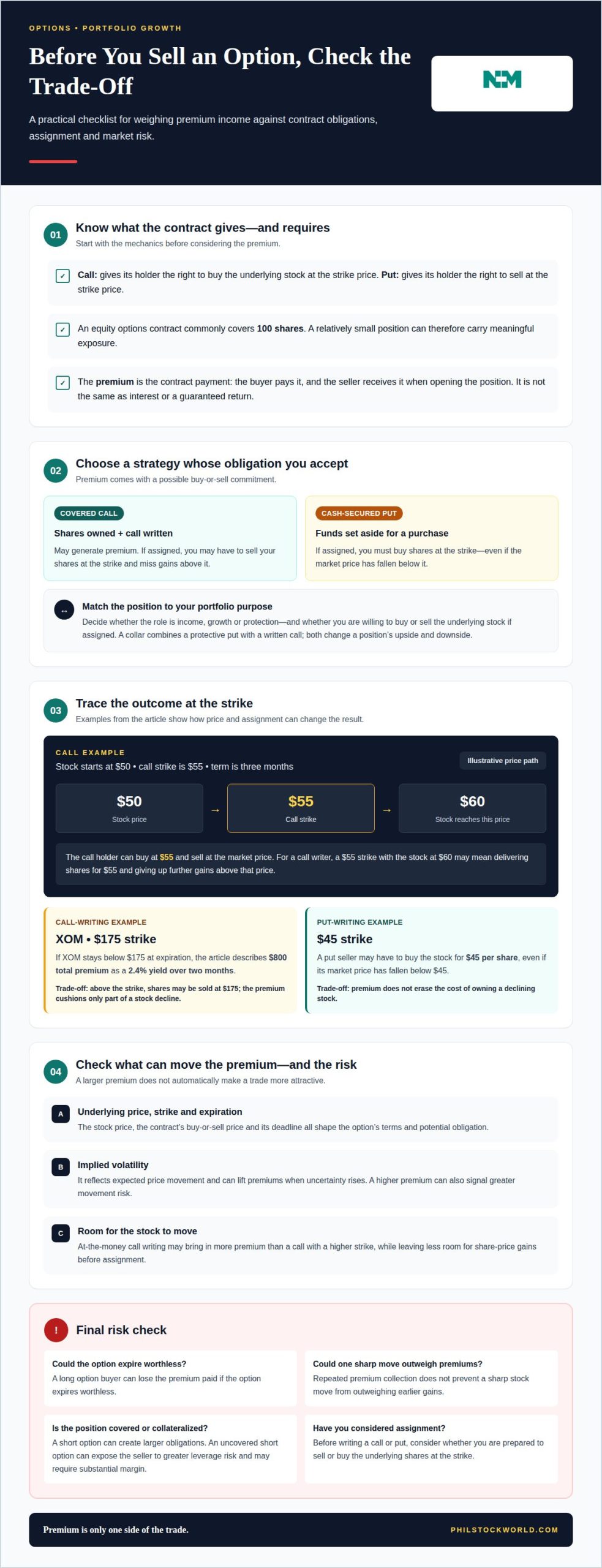
A long call or put gives an investor a contractual right, while owning shares means holding the stock itself. For example, a stock trading at $50 could have a call with a $55 strike and a three-month term; if it reaches $60 during that period, the call holder can buy at $55 and sell at the market price.
A call buyer can lose the premium if the option expires worthless, but has no obligation to buy shares. A put buyer has the right to sell at the strike, which may help offset a decline. Shares do not expire, but their value can fall. Each choice changes your exposure and potential loss.
Assignment Risk Above the Strike
Assignment risk for a call writer is the possibility of having to sell the underlying shares at the strike when the option holder exercises. If a written call’s strike is $55 and the stock rises to $60, the writer may have to deliver shares for $55, giving up further gains above that price.
This matters when selling calls against stocks you intend to keep. A covered call pairs shares with a written call; a collar combines a protective put with a written call. Both change a position’s upside and downside. Neither removes the need to understand the contract’s strike and expiration.
At-the-money call writing uses a strike near the stock’s current price. It can generate a premium, but assignment may require you to sell shares near that price if the call is exercised. In the United States, tax treatment depends on the strategy and what happens when the contract is closed, exercised or assigned. Track premiums and transactions, since those details affect how gains or losses are reported.
How do options generate income?
Option sellers receive a premium when they open a position in exchange for contractual obligations. The amount depends on the option’s terms and market conditions, so premium income is not the same as interest or a guaranteed return.
Premium Income from Call Writing
Call writing generates premium income by selling a call option, often against shares already held. If XOM stays below $175 at expiration, the total premium is $800, described as a 2.4% yield over two months.
The trade has a clear cost: if XOM rises above the strike, the writer may have to sell shares at $175 and miss additional gains. The premium cushions only part of a stock decline.
Option Premiums and Income Generation
An option premium is the payment a buyer makes for a contract and the seller receives when opening the position. Its value reflects factors such as the underlying stock’s price, the strike, time to expiration and volatility.
For income strategies, the premium is only one side of the trade. Weigh the contract’s obligation against the cash received, including whether you are willing to buy or sell the underlying stock if assigned.
High-Probability Income Strategies
Some options strategies aim to collect premiums when a stock stays within an expected range or moves favorably. A covered call uses shares you own; a cash-secured put involves setting aside funds for a possible stock purchase. Each strategy creates an obligation before you enter the trade.
A high probability of success does not mean low risk. A sharp stock move can outweigh a modest premium, so consider the potential loss, not just the chance of keeping the premium.
Trade Factors Affecting Premiums
The premium is the price of the contract, the strike sets its buy-or-sell price, and expiration is its deadline. Implied volatility reflects expected price movement and can lift premiums when uncertainty rises. A higher premium may look attractive, but it can also signal greater movement risk.
At-the-money call writing uses a strike near the stock’s current price. It may bring in more premium than a call with a higher strike, while leaving less room for share-price gains before assignment. For ongoing options market analysis, consider how Premium Membership research can help frame buying and selling decisions.
What is options trading?
Options are derivative contracts tied to an underlying asset, such as a stock or index. They can produce substantial returns, but speculative trades also expose investors to rapid losses.
Risk and Potential Returns
Speculation means taking an options position mainly to profit from a short-term price move rather than to hedge shares. A long option can expire worthless if the underlying does not move far enough, or moves in the wrong direction, before expiration. The buyer’s loss is limited to the premium paid, while a short option can create much larger obligations.
A high probability of success does not make a trade low-risk. A seller may collect premiums repeatedly, but one sharp move can outweigh earlier gains. A short option without the underlying stock can require substantial margin, so weigh potential returns against the downside and the resources needed to support the position.
For U.S. brokers, commissions, contract fees, margin requirements and approval levels depend on the broker and strategy. Margin and approval decisions generally reflect the position’s risk and whether it is covered or collateralized. Uncovered short options require particular care.
Obligations to Buy Shares
Selling a put creates an obligation to buy shares at its strike price if assigned. For example, an investor who sells a put with a $45 strike may have to buy the stock for $45 per share, even if its market price has fallen below that level.
A premium does not erase the cost of owning a declining stock. A cash-secured position sets aside funds for a possible purchase, while an uncovered short option can expose the seller to greater leverage risk. Consider whether you are prepared to hold shares you could be required to buy.
Tailoring Risk and Reward
You can shape a position by combining options with different strikes or pairing a contract with shares. A put spread, for example, buys one put and sells another at a lower strike. This limits the protection range while reducing the position’s cost.
Index options introduce basis risk: an index contract may not move in line with the individual stocks in your portfolio. A broad-market hedge can therefore leave company-specific losses uncovered. Compare the index exposure with the holdings you want to hedge, then consider whether the trade’s limits match your goal.
Option strategies for different market conditions
Choose an options strategy for the job it needs to do: seek income, participate in gains or offset a potential loss. For example, an investor concerned about a stock’s outlook over the next three to six months might consider hedging with an option instead of selling shares.
In a sideways market, a covered call can add premium income to an existing stock position, while limiting gains above its strike. A cash-secured put may suit an investor willing to buy the underlying stock at the strike. Both strategies create obligations. Ask whether you accept the possible outcome, not just whether the premium looks attractive.
Common approaches for long-term investors include covered calls for income, protective puts for downside protection, and collars that combine a put with a written call. A protective put can preserve upside while limiting downside risk, as the Board of Governors of the Federal Reserve System notes. The preferred outcome is that the hedge proves unnecessary.
For a defined hedge against a 10% decline, an investor can buy a put near the current market price and sell another put at a strike 10% lower. The purchased put offers protection; selling the lower-strike put helps reduce its cost but limits protection below that strike. Selling a call alongside the put spread can lower or eliminate its total cost, while giving up some potential growth.
Market history illustrates how strategies can behave differently under pressure. In 2022, a 60/40 portfolio declined 16%, compared with an 8% decline for a collared equity strategy and 4% for a call-writing strategy. Those outcomes show different exposures, not a universal ranking. A review of your holdings and market outlook can help clarify the intended role of each position. Explore a Virtual Portfolio Review to discuss how options strategies relate to your portfolio.
Phil Stock World: Virtual Portfolio Review
Phil Stock World’s Virtual Portfolio Review gives investors a way to examine how options strategies relate to their holdings and market outlook. It may help when you are weighing a covered call, considering a hedge or deciding whether an options position fits your portfolio’s purpose.
For ongoing learning, Phil Stock World’s Educational Webinars, Market Charts and Analysis, and Premium Membership offer more ways to follow trading ideas and market conditions. These resources can support your understanding of options, but they do not place trades or manage assets on your behalf.
To discuss a Virtual Portfolio Review, contact Phil Stock World.
Make your next options decision deliberate
Start with a clear purpose, not a market headline. Before opening a position, write down what would make the trade useful, what could change your view and what obligation you are willing to accept. That gives you a reference point when prices move and emotions start calling the shots.
Options trading for portfolio growth means matching a strategy to a goal and revisiting that fit as conditions change. Treat each position as one part of a broader investment approach, not a standalone bet. A thoughtful review can sharpen the questions behind your next decision and show where further learning could help.
Contact Phil Stock World to discuss options and consider your next step with a clearer framework. You don’t need to predict every market turn to make a more intentional decision.
Frequently Asked Questions
What are options, and where can they fit in your portfolio?
Options are contracts tied to an underlying asset and can play a focused role in a broader portfolio. Options trading for portfolio growth may suit investors seeking defined exposure or a hedge, but the strategy should match the portfolio’s purpose. For example, an investor with concentrated stock holdings might consider whether an option could address a particular risk without changing every investment.
How can investors buy and sell options?
Investors place options orders through a brokerage account approved for options trading. An order identifies the underlying, contract type, strike, expiration, quantity, and whether to buy or sell to open or close a position. The broker sets its own approval and margin requirements. Before buying or selling an option, a person must receive a copy of “Characteristics and Risks of Standardized Options.”
What are the risks of options?
Risks depend on the position. A buyer can lose the premium if the contract expires worthless, while a seller may face an obligation that becomes costly as the underlying moves. For instance, a sudden drop can leave a put seller required to buy shares for more than their market price. Time decay can also erode an option’s value before the expected move occurs.
What are options on stocks?
Stock options are contracts based on an individual company’s shares. Their terms specify a strike price and expiration, and the holder can choose whether to exercise under the contract. Holding an option does not make someone a shareholder; ownership comes from acquiring shares. Investors can use stock options to express a view on one company, but company-specific news can sharply affect the position.
What are the other benefits of options?
Options can help investors shape exposure without immediately buying or selling shares. A protective position may offset some losses in a holding, while combining contracts can define a range of outcomes. That flexibility has trade-offs: protection costs money, and strategies that bring in premium can limit gains or create obligations. The benefit depends on the portfolio’s objective.
What are the two types of options?
The two basic types are calls and puts. A call gives its holder the right to buy the underlying at the strike price; a put gives the right to sell it there. Investors can buy or write either type, creating different rights and obligations. For example, buying a put can express a bearish view, while buying a call reflects an expectation that the price will rise.