


What if the best subscription service for trading ideas is the one that sends fewer alerts, not more? When market commentary, trade setups, and bold opinions all compete for your attention, volume can look like value. It isn’t. A useful service should help you think more clearly, not give you another signal to follow on autopilot.
Comparing subscriptions takes more than scanning a feature list. Consider how ideas are researched, whether the reasoning and risks are explained, and how alerts, charts, webinars, or community discussion fit your routine. When a promotion spotlights potential upside, look closely at the full reasoning behind the claim.
This guide offers a practical framework for choosing in 2026. We’ll look at research quality, transparency, risk context, membership access, and educational resources, including the market commentary and analysis available through Phil Stock World. The goal isn’t to find a service that promises results. It’s to find one that supports your independent decisions and makes your process more informed.
Key Takeaways
- Trading ideas subscriptions can offer research, commentary, alerts, and analysis. Choose a format that fits the support you need.
- Assess each idea by checking its thesis, evidence, timeframe, risk, and fit with your own plan.
- Compare commentary, alerts, analytical tools, education, and interactive sessions by how you’ll use them, not by feature count alone.
- Before choosing a Subscription service for trading ideas, define what you want help with and look for transparent research with clear risk context.
- Phil Stock World’s market commentary, trading ideas, and membership options can complement independent research without promising results.
What Does a Trading Idea Subscription Service Actually Provide?
Markets generate a steady stream of headlines, price moves, and confident opinions. The challenge is filtering that noise without handing every decision to someone else. A subscription can bring research and perspective into your routine, but treat it as an input to your process, not a substitute for it.
A subscription service for trading ideas provides paid access to research, commentary, alerts, or related market analysis. The material may point to an opportunity or explain a market view, but an idea is a prompt for your own evaluation, not automatically a personalized recommendation or a managed portfolio. A trading-ideas subscription can inform your decisions, but it cannot remove market risk.
What types of trading ideas and research might be included?
Different formats serve different purposes. Daily commentary puts price action and news into a broader market narrative. Trade alerts draw attention to a potential setup, while charts help readers examine price behavior and technical levels. Strategy education focuses on concepts and methods, giving subscribers material to study beyond a single trade. Some services combine these formats; others focus on one.
The analysis itself can differ, too. Stock-focused research may examine a company, sector, or share-price setup. Options-focused research considers contracts and strategy structures, where factors such as expiration and volatility can shape how a position behaves. These are different lenses. Reading an options idea as if it were simply a stock call can mean overlooking important mechanics.
Research may also draw on Market data, information about financial instruments and markets that traders use to follow activity and assess conditions. What subscribers receive, how quickly it arrives, and how much explanation accompanies it vary by service and membership level. Phil Stock World provides daily market commentary and stock and options trading ideas, with membership access ranging from daily commentary to real-time interactive sessions.
What a subscription can and cannot do
Good research can help you prepare questions, notice a development you might otherwise miss, or compare another market view with your own. Examine the reasoning: What evidence supports the idea? What assumptions does it rely on? Does the thesis match your timeframe and trading plan? These checks help you use research without turning an alert into an instruction.
An idea is not the same as execution. A subscription doesn’t place a trade through a brokerage account, manage assets on your behalf, or provide personalized financial planning. It also can’t assure a profitable trade or prevent losses. Markets can move against a well-reasoned thesis, and an alert may arrive after its original context has changed.
- Research access provides material to consider and test against your own criteria.
- Execution is the separate act of placing and managing a trade.
- Personal decisions remain tied to your objectives, risk tolerance, and plan.
Keep that distinction in mind: use subscriptions to sharpen your questions and broaden your context, while keeping the decision-making process your own.
How to Judge Whether a Trading Idea Has Useful Context
A polished alert can sound decisive while leaving key questions unanswered. Before treating an idea as useful, examine what supports it, when it might play out, and what could undermine it. These checks offer a repeatable way to assess research from any Subscription service for trading ideas without mistaking a confident tone for strong evidence.
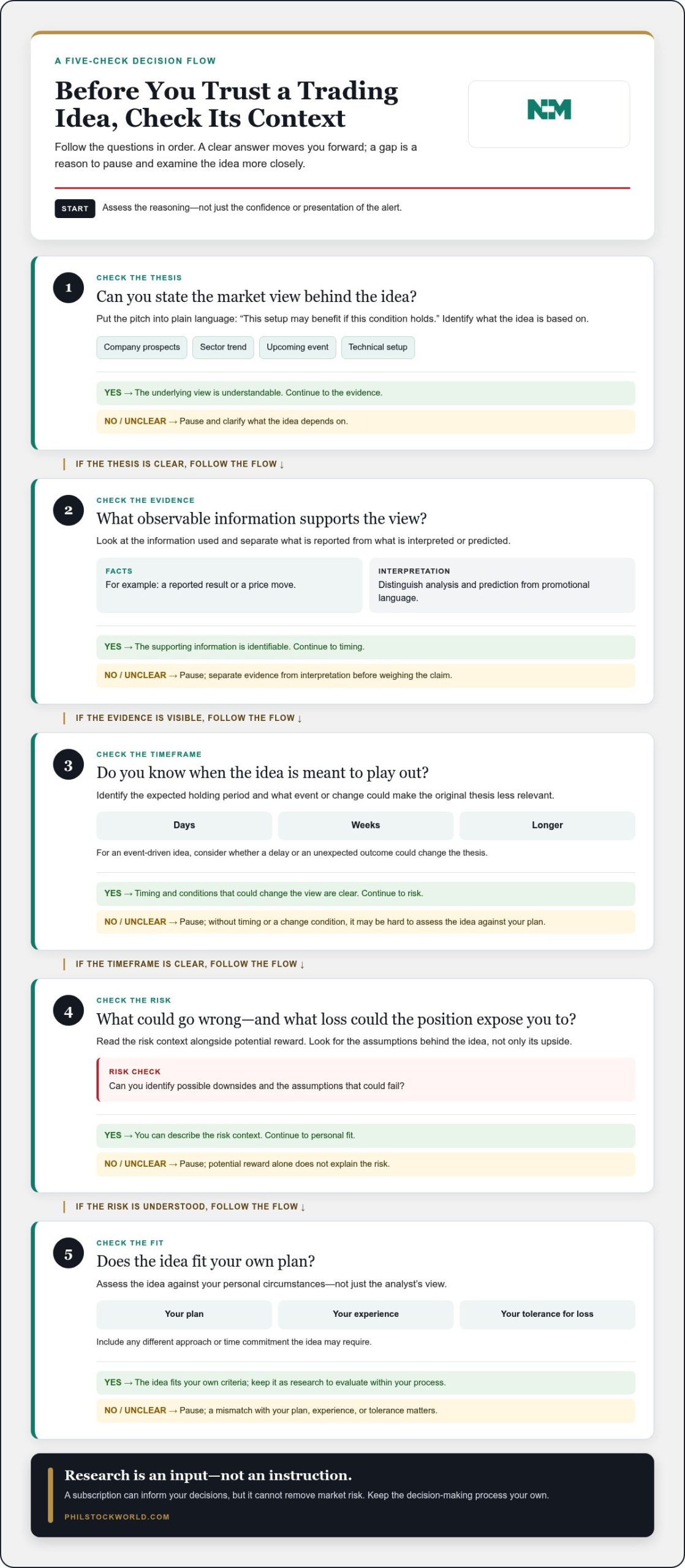
Work through these five checks in order:
- Thesis: What market view is behind the idea? Is it based on a company’s prospects, a sector trend, an upcoming event, or a technical setup?
- Evidence: What observable information supports that view? Separate facts, such as a reported result or a price move, from interpretation, prediction, and promotional language.
- Timeframe: Is the idea intended to play out over days, weeks, or longer? Identify what event or change could make the original thesis less relevant.
- Risk: What could go wrong, and what loss might the position expose you to? Look for assumptions and risk context alongside potential reward.
- Fit: Does the idea match your own plan, experience, and tolerance for loss? If it requires a different approach or time commitment, take that into account.
Check the thesis, evidence, and time horizon
Start by translating the pitch into a plain-language claim: “This setup may benefit if this condition holds.” Then identify the information the analyst used and whether the idea is event-driven, based on a trend, grounded in a valuation argument, or built on a chart interpretation. These approaches rely on different assumptions. A company event may have a known date; a trend can weaken gradually; a technical level reflects an interpretation of price behavior, not a promise of support.
Next, find the expected holding period and the conditions that could change the thesis. If an idea relies on an event, consider what happens if the event is delayed or the outcome differs from expectations. If the timing or point at which the thesis no longer holds is missing, it may be difficult to assess the idea against your own plan.
Read the risk alongside the potential reward
Risk is personal as well as structural. A position size that seems modest in one account may be too large for another trader’s loss tolerance or overall plan. Consider the possible loss before focusing on the upside. A trade idea is incomplete without its assumptions, timeframe, and risk context.
Options call for extra care. Expiration determines how long the contract has to respond to the thesis, while the strike and contract structure affect how its value may change as the underlying price moves. A call option and a multi-leg spread, for instance, don’t have identical risk profiles. Understand the potential loss for the specific structure rather than relying on a broad market prediction. These are evaluation points, not trade recommendations; outcomes remain uncertain.
For market commentary and stock and options ideas to compare with your own research, Phil Stock World’s trading analysis provides another perspective to examine.
Trading Ideas Subscriptions Compared: Alerts, Analysis, Tools, and Live Access
Subscription formats shape how research enters your routine. A scheduled market overview can help you step back and see the bigger picture. A timely alert is more immediate, but you still need to assess the setup and decide what to do. The best fit depends less on the number of features than on whether you can use them thoughtfully.
Use this comparison to focus on the role each format could play. Strengths are potential advantages, not promises of better trades.
| Format | Typical use | Strength | Trade-off |
|---|---|---|---|
| Market commentary | Review market conditions and developments on a schedule | Adds broader context to daily research | May be less suited to someone seeking immediate trade prompts |
| Timely alerts | Flag a developing setup or market event | Brings attention to information that may need prompt review | Requires time and judgment to assess; an alert alone may lack full context |
| Analytical tools and charts | Explore price action, market data, or potential patterns | Can support a reader’s own investigation | Tools still need interpretation and don’t make decisions for you |
| Education and strategy resources | Study concepts and build a more consistent process | Useful for learning beyond a single market idea | Requires active study rather than simply scanning for setups |
| Interactive sessions | Discuss market views and questions in real time | Creates space to examine ideas and hear different perspectives | Discussion can inform judgment, but can’t replace it |
Which service format fits your trading routine?
Choose based on your actual habits, not an imagined version of your schedule. If you prefer to review the market at a set time, scheduled commentary may be easier to absorb than a stream of alerts. Alerts may suit someone who can pause, evaluate the reasoning, and respond on their own terms. Interactive access can support discussion, especially when you want to explore how a view is formed, but it doesn’t replace independent judgment.
Options-focused resources deserve a closer look at contract mechanics as well as the market thesis. For a deeper primer on strategy structures, see this guide to advanced options trading strategies.
How to compare tiers without being distracted by feature counts
More access doesn’t automatically mean more useful research. Ask whether charts would answer a real question in your process, whether reports add evidence you can evaluate, and whether education or community discussion fits the way you learn. A feature you rarely use adds little value. A Subscription service for trading ideas should fit your workflow, not crowd it.
Phil Stock World offers market commentary and stock and options trading ideas, with membership access ranging from daily commentary to real-time interactive sessions. For a separate overview of its access options, explore the Phil Stock World membership options.
A Practical Checklist Before You Subscribe to Trading Ideas
Before comparing features, define the job you want a service to do. Do you need a broader market overview, help exploring trade ideas, charts for your own analysis, or educational material to strengthen your process? A clear answer makes it easier to distinguish useful access from extras you may never use.
Use this checklist to assess both the research and your own routine:
- Research transparency: Does an idea explain its thesis, supporting rationale, timeframe, assumptions, and risks?
- Evidence: Can you distinguish observable facts from interpretation, forecasts, and promotional claims?
- Delivery format: Will commentary, alerts, reports, charts, education, or discussion arrive in a format you can realistically review?
- Usability: Can you find and understand the information you need without adding more noise to your day?
- Risk communication: Does the analysis describe what could go wrong, not just what might go right?
Questions to ask of the research process
Look for reasoning you can inspect, not just a confident conclusion. A useful idea should make its central claim clear and show what evidence informs it. Notice whether the analysis separates known information from assumptions and acknowledges that market conditions can shift after publication. Context helps you decide whether the original argument still holds.
Performance claims deserve particular care. Consider how results were calculated, what period or examples they cover, and what limitations apply. A headline figure without methodology or context can leave out important details. Treat claims as something to examine, not a shortcut around your own assessment.
Questions to ask of your own trading process
Decide in advance how a new idea will fit alongside your existing holdings and strategy. Set a review routine, such as collecting alerts for later consideration instead of reacting as soon as they arrive. Before any trade, apply your own position-sizing rules and define the loss you can tolerate. That pause can help prevent a subscription alert from becoming an unplanned decision.
Options require a risk framework that accounts for the contract and its structure, not only the direction you expect the underlying asset to move. Readers developing that framework can explore this guide to risk management for options. The aim is to make your process more deliberate; no checklist can make uncertain outcomes certain.
Once you know what kind of research and access would support your routine, explore Phil Stock World membership for an overview of its access options. A Subscription service for trading ideas should complement independent judgment, not replace it. Explore Phil Stock World to consider how ongoing commentary and analysis could fit into your research routine.
How Phil Stock World’s Trading Ideas Subscription Fits into Your Research Routine
Research is most useful when it has a place in your routine. Phil Stock World brings together daily market commentary and stock and options trading ideas, giving readers material to compare with their own market view. The commentary can help frame the day’s developments; it doesn’t dictate a trade. Treat each idea as a starting point to examine against your strategy, timeframe, and risk limits.
Access ranges from daily commentary to real-time interactive sessions, so readers can engage with market research in different ways. A Subscription service for trading ideas should support your process, not make decisions for you. Membership access doesn’t guarantee results or provide personalized financial planning.
Where commentary and ideas can complement independent research
One practical approach is to use commentary to set context: note the themes and market conditions, then decide which details are relevant to your own research. If a stock or options idea catches your attention, examine its thesis and assumptions before considering whether it fits your plan. This keeps a market perspective in its proper role, as an additional lens rather than a trading instruction.
Phil Stock World’s market charts and sector insights provide more material to examine, while community discussion offers a setting for considering different views. The point isn’t to collect opinions until one feels certain. It’s to question assumptions, identify what you still need to understand, and make your own decision.
Choose an engagement level that matches how you learn
If you want to build your understanding over time, educational webinars and strategy guides offer a learning-focused route. Readers who prefer a structured way to examine portfolios and market information can consider virtual portfolio reviews and charts as part of their research routine. Interactive sessions can suit people who value discussion, while daily commentary may be enough for readers who mainly want a regular market overview.
These resources serve different purposes; a larger mix isn’t automatically a better match. Decide whether you learn best by reading, studying strategy, reviewing analysis, or discussing ideas, then focus on access that supports that habit. A virtual portfolio review is a distinct service for readers interested in structured portfolio analysis.
Phil Stock World was founded in 2006 and is led by veteran trader and market analyst Phil Davis. Explore the Phil Stock World membership options to see how its research access may fit your routine. Keep your own criteria and risk limits at the center; no membership can remove the uncertainty of trading.
Make Your Next Research Decision Deliberate
The right subscription should earn a place in your routine by helping you ask sharper questions, not by adding pressure to act. Before you commit, decide how you’ll use the research, what would make an idea worth further review, and which personal risk limits stay firm regardless of market excitement. That gives you a practical way to judge whether the service continues to support your process.
A Subscription service for trading ideas is most useful when it complements independent judgment. No stream of commentary or alerts can remove uncertainty, so keep your own criteria in the driver’s seat and review whether the access you use still meets your needs.
Ready to explore a research membership with different engagement options? Explore Phil Stock World membership, then choose your next step with curiosity, discipline, and a clear view of risk.
Frequently Asked Questions
What is a trading ideas subscription service?
A trading ideas subscription service provides paid access to market research, commentary, alerts, or educational analysis. It can help you discover viewpoints and material to investigate, but it doesn’t automatically account for your finances, objectives, or risk tolerance. Treat it as a research resource, not personal advice: you decide whether an idea is relevant, verify its assumptions, and determine whether any action fits your own approach.
Can a trading ideas subscription guarantee profits?
No. No subscription can guarantee that a trade will make money because market prices and conditions are uncertain, and even a well-supported thesis can fail. Treat claims that imply reliable profits as a reason to pause and look for balanced discussion of losses, assumptions, and limitations. A subscription may offer research or education, but it can’t remove market risk or make outcomes predictable.
How do I evaluate a stock or options trade alert?
Start by stating the thesis in your own words, then identify the evidence behind it and the timeframe the idea depends on. Ask what could invalidate the view. For options, understand the contract’s expiration, strike, and possible loss, not just the expected direction of the underlying asset. Finally, compare the idea with your own strategy and risk limits. If key details are missing, don’t rush to act.
Is a paid trading service suitable for beginners?
It can be useful for a beginner who treats the material as a learning aid, takes time to understand the concepts, and can assess potential losses before taking action. Educational resources may help explain market terminology and strategy, but alerts can feel urgent and complex. If you can’t yet evaluate the risks of an idea, focus on learning first and avoid treating a subscription as a substitute for experience or judgment.
What is the difference between a trading newsletter and a live trading room?
A trading newsletter generally delivers commentary or research in written form on a schedule, giving readers time to review it at their own pace. A live trading room is more interactive, with discussion taking place in real time. The formats differ in cadence and participation, not in guaranteed value. A newsletter may suit reflective readers; live discussion may appeal to those who learn through questions, but neither assures better results.
Do trading-ideas subscriptions include brokerage or portfolio management?
No. Phil Stock World’s research membership provides access to information and ideas, not brokerage execution, asset management, or personalized financial planning. Brokerage execution is the separate process of placing trades, while asset management involves managing investments on someone’s behalf. Personalized financial planning focuses on an individual’s broader financial circumstances. Understand the role research plays, and keep trade execution and personal financial decisions distinct from reading an idea.
How much should I rely on a paid trading idea?
Use it as one input, not as your final decision-maker. Check the reasoning against other information you trust, then decide whether it fits your strategy and existing positions. Before acting, set a position size and a maximum loss you can tolerate; don’t let an alert dictate either. If you can’t explain why the idea makes sense for your plan, or what you could lose, step back rather than follow it automatically.