

A portfolio can look diversified and still lean too heavily on one holding or market segment. A portfolio health check for investors helps reveal that concentration, and if any aspect of a portfolio accounts for 60% or more, it may need rebalancing.
It’s natural to focus on recent returns, especially when markets move quickly. But performance is only part of the picture. A useful portfolio health check for investors also asks whether holdings, risk exposure, and investment mix still fit their goals.
This guide explains how to review portfolio weights and concentration, compare performance with relevant benchmarks, and interpret portfolio analysis, health scores, and stock ratings. You’ll learn what these signals can tell you, where they can mislead, and how to turn a snapshot of your holdings into practical next steps.
Key Takeaways
- Compare your holdings across asset types and regions to spot concentration; an allocation of 60% or more in one aspect may signal a need to review the balance.
- Gather account statements and compare returns with relevant benchmarks, while also reviewing costs and whether performance has outpaced inflation over the last 12 months.
- Read portfolio reports as a whole: weigh returns and income against the risk taken to achieve them, rather than relying on a single score or rating.
- Use stock ratings and health scores as prompts for deeper analysis, then consider a Virtual Portfolio Review or Market Charts and Analysis to explore your holdings further.
Monitoring portfolio weights and concentration
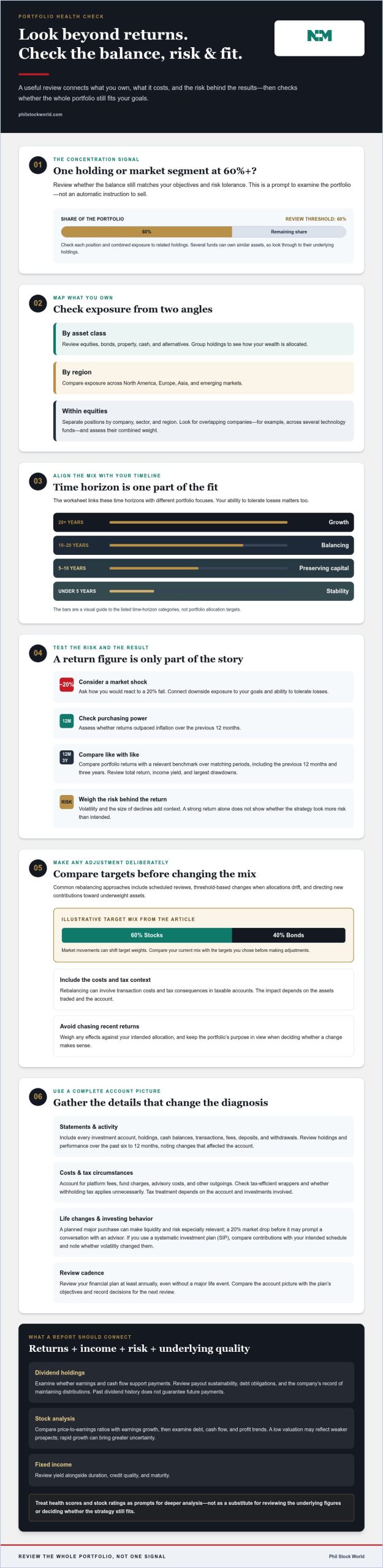
A portfolio health check for investors starts by measuring each holding’s share of the whole. Compare those weights with your objectives and risk tolerance. If any aspect accounts for 60% or more, review whether the portfolio needs rebalancing.
Portfolio Diversification Review
Group holdings by asset class and region to see where your wealth is exposed. Review equities, bonds, property, cash, and alternatives, then compare exposure across North America, Europe, Asia, and emerging markets. Several funds may own similar assets, so examine their underlying holdings rather than counting funds alone.
Match allocation to goals, time horizon, and risk tolerance. The worksheet suggests focusing on growth with 20 or more years until retirement, balancing with 10 to 20 years, preserving capital from 5 to 10 years, and stability with fewer than 5 years. Your ability to tolerate losses matters too.
Equity Concentration Review
Separate equities by company, sector, and region. Several technology funds, for example, may hold overlapping companies. Check each position’s weight and combined exposure to related holdings. A 60% share in one aspect signals a need to examine the balance, not an automatic instruction to sell.
Test resilience by considering how you would react to a market shock that causes a 20% fall. Also assess whether returns outpaced inflation over the previous 12 months. This portfolio health check for investors connects downside exposure and purchasing power with personal objectives, rather than focusing only on past performance.
Rebalancing Strategies and Costs
Common strategies include scheduled reviews, threshold-based changes when allocations drift, and directing new contributions toward underweight assets. A 60% stocks and 40% bonds allocation illustrates target weights that market movements can shift. Compare your current mix with your chosen targets before making adjustments.
Rebalancing can involve transaction costs and tax consequences in taxable accounts. The impact depends on the assets traded and the account. Weigh those effects against your intended allocation, and avoid trading just to chase recent returns. Keep your portfolio’s purpose in view when deciding whether a change makes sense.
Preparing account statements and reviewing recent performance
Gather statements for every investment account before judging results. Include holdings, cash balances, transactions, fees, and deposits or withdrawals. Review holdings and performance over the past six to 12 months, then note changes that affected the account. This gives you a clear starting point for checking whether the investment strategy remains aligned with your objectives.
Compare returns with relevant benchmarks over matching periods, such as the previous 12 months and three years. Check whether the portfolio outpaced inflation over the previous 12 months, and separate market movement from contributions or withdrawals. A strong return alone doesn’t show whether the strategy took more volatility than you intended. Record the benchmark, time period, and portfolio return together.
Review costs alongside tax circumstances. Account for platform fees, fund charges, advisory costs, and other outgoings, then look for assets held in tax-efficient wrappers. Check whether withholding tax applies unnecessarily to any holdings. These details can affect net results, so include them when assessing a recommendation or considering investment advice. Tax treatment depends on the account and investments involved.
Major life changes can justify an additional plan review. A planned major purchase is one example: a market drop of 20% before that purchase may prompt a conversation with an advisor about liquidity and risk. Review investing behavior, too. If you use a systematic investment plan (SIP), compare contributions with your intended schedule and strategy. Note whether volatility led you to pause or change contributions.
Review your financial plan at least annually, even when no major event has occurred. Compare the current account picture with the plan’s objectives and record any decisions for the next review. If you want help interpreting statements and connecting their figures to your strategy, a Virtual Portfolio Review can support that assessment.
Reviewing health check analysis and reports
A useful report connects returns with income and the risk taken to earn them. Compare portfolio returns over 12 months and three years, alongside income yield. Then assess whether those returns involved an unacceptably high level of risk. Volatility and the size of declines can add context that a return figure alone misses.
Start with a consistent benchmark and matching time periods. Check total return, income yield, and the portfolio’s largest drawdowns, then compare each measure with the benchmark. This helps distinguish broad market movements from portfolio-specific results. No single metric can guarantee future outcomes, and past performance doesn’t determine whether a strategy still fits.
For dividend holdings, examine whether company earnings and cash flow support the payments. Review payout sustainability, debt obligations, and the company’s record of maintaining distributions. A strong dividend history offers useful context, but it doesn’t guarantee future payments. Look for changes in business conditions that could weaken the company’s ability to keep paying.
Stock analysis can pair valuation with business resilience. Compare price-to-earnings ratios with earnings growth, then examine debt, cash flow, and profit trends. A low valuation may reflect weaker prospects, while rapid growth can bring greater uncertainty. Review the underlying figures before treating a rating as a recommendation or adjusting your holdings.
For fixed income, review yield alongside duration, credit quality, and maturity. Duration helps show how sensitive a bond’s price may be to interest-rate changes, while credit quality indicates the issuer’s repayment risk. A higher yield, for example, can come with greater credit risk, so compare bonds on more than income alone. Check whether each holding serves its intended role.
Build a short report summary with return periods, benchmark, income, drawdowns, and key exposures. Advisors can use that comparison to discuss whether growth or income remains the priority. Market charts and analysis can add context about broader trends, but interpret them alongside your portfolio’s underlying data rather than letting one score drive decisions.
Portfolio health scores and stock ratings
A portfolio health score condenses several signals into a snapshot, but its usefulness depends on what it measures. Check whether it considers diversification, performance, risk, costs, and income. Then inspect its methodology and reporting date. A high overall score can hide a weak point, such as heavy exposure to one sector or declining cash flow at a major holding.
Use the score as a triage tool, not a verdict. Review the underlying categories and identify what raised or lowered the result. For example, a portfolio might show strong growth while carrying concentrated exposure to technology stocks. Compare those signals with your objectives and ability to absorb losses before deciding whether an adjustment is appropriate.
Stock ratings also need context. A buy, hold, or sell label summarizes an analyst’s view, but the reasoning matters more than the label. Review earnings trends, debt, valuation, cash flow, and risks to the company’s business. Compare the rating’s assumptions with your investment horizon. A growth-focused stock may not suit an income objective.
Before acting on a rating, confirm the company’s ticker, exchange, and share class. Then check the rating date and whether the analysis reflects recent company information. Compare stocks within the same sector where possible, since business models and valuation patterns differ across industries. A rating can inform your research, but it cannot guarantee an outcome or replace your judgment.
For a practical review, write down each holding, its weight, sector, rating, and the report’s main reason. Mark disagreements between the score and your own analysis, then decide what needs further research. A Virtual Portfolio Review can help you examine that evidence and put ratings into portfolio context. Request a Virtual Portfolio Review to discuss how your holdings and stock assessments fit together.
Phil Stock World: Premium Membership
Phil Stock World’s Premium Membership gives investors ongoing market commentary and trading ideas to inform their own research. If a portfolio review raises questions about a holding, a sector, or how a stock rating fits the wider picture, a Virtual Portfolio Review can help you examine those issues in context.
Educational Webinars help you explore investment concepts, while Market Charts and Analysis provide context for following market trends and comparing them with your portfolio observations. These resources support learning and analysis; they don’t make investment decisions for you.
Choose a resource that fits your next step: a Virtual Portfolio Review for questions about your holdings, webinars for deeper learning, or charts and analysis for market context. Visit Phil Stock World to explore its resources.
Turn Your Review Into a Clear Next Step
A portfolio health check for investors is most useful when it improves your decisions, not just your view of a report. Before acting, write down the question behind each potential adjustment: has your thesis changed, has the risk shifted, or has new information changed your view? Keeping a brief record can help distinguish a deliberate response from a reaction to market noise.
Use the same process at your next review. Note what you’ll monitor, what would prompt another look, and which assumptions deserve fresh scrutiny. Then choose support that fits: Premium Membership for ongoing market commentary, a Virtual Portfolio Review for portfolio questions, or Educational Webinars to build your investing knowledge.
If you’re ready to discuss your portfolio and decide on a useful next step, contact Phil Stock World about your portfolio. Keep your process thoughtful, stay curious, and let each review sharpen the decisions ahead.
Frequently Asked Questions
How can the stock portfolio health check help me?
This process turns a list of ticker symbols into a clearer decision map. For each holding, note its role, why you own it, and what would change your view. A stock bought for income, for example, deserves a different review from one held for expected growth. This can reveal positions that no longer match their original purpose and give you focused questions for further research.
How safe are my dividends?
Assess whether the company can fund its dividend from ongoing business cash flow, not just its recent payment record. Compare cash generation with dividend commitments, then consider debt obligations and whether earnings depend on a narrow set of customers or products. A company facing falling sales may carry a different risk profile from one with stable operations, even if both currently pay dividends.
What questions should you ask your advisor during an annual review?
Ask which assumptions in your investment plan have changed and what evidence supports that view. Clarify how each holding contributes to your goals, what risks could disrupt that role, and which decisions require action now versus monitoring. If your income needs or major plans have shifted, ask how those changes affect your investment approach. Request clear reasons for any proposed portfolio change.
What are the strengths and weaknesses of my stock portfolio?
Strengths can include businesses with durable demand, manageable debt, and several sources of revenue. Weaknesses can include dependence on one product or customer, or a thesis that relies on uninterrupted growth. For each major position, record the business case and a condition that would challenge it. This can help distinguish a sound holding from one you own mainly through habit or familiarity.
What is an investment portfolio health check?
A portfolio health check is a structured review of whether your investments still serve their intended roles. Rather than treating it as a pass-or-fail score, use it to identify next steps: keep monitoring, research a concern, or revisit an allocation. Start with your goals and current holdings, then record the evidence behind each conclusion so you can track what changed at your next review.
How can investors evaluate portfolio diversification and concentration?
Look beyond the number of holdings and examine what drives their results. A portfolio can hold companies across several sectors yet remain exposed to the same economic forces. Consider your broader finances, too: employer stock can link your investment wealth and paycheck to one company. Reviewing issuers, revenue sources, and shared risks can reveal concentration that a simple holding count misses.