


Chasing the highest return can leave your portfolio exposed when markets turn. The most useful strategies to improve portfolio returns combine diversification, a deliberate mix of investments, regular rebalancing, and volatility management suited to your goals and risk tolerance. The aim isn’t to eliminate market swings, but to shape how much risk you take and how your portfolio responds.
It’s natural to want stronger growth without taking on more risk than you can tolerate. But returns don’t come from picking a single winning asset: they depend on how your holdings work together, when you’ll need the money, and whether you can stick with your approach through difficult periods. This guide covers practical ways to design a portfolio, balance growth potential against downside exposure, and rebalance as your circumstances or markets change. It also explains why managing volatility means more than moving into cash when headlines get loud.
Key Takeaways
- Spread exposure across asset classes and regions so portfolio performance doesn’t hinge on a single market or investment.
- Build your allocation around the balance of growth potential and downside risk you can tolerate, not headline returns alone.
- Rebalance when holdings drift from your targets, while accounting for when you’ll need access to the money.
- Use a volatility plan to guide decisions during market swings instead of letting headlines dictate your next move.
1. Diversification across asset classes and regions
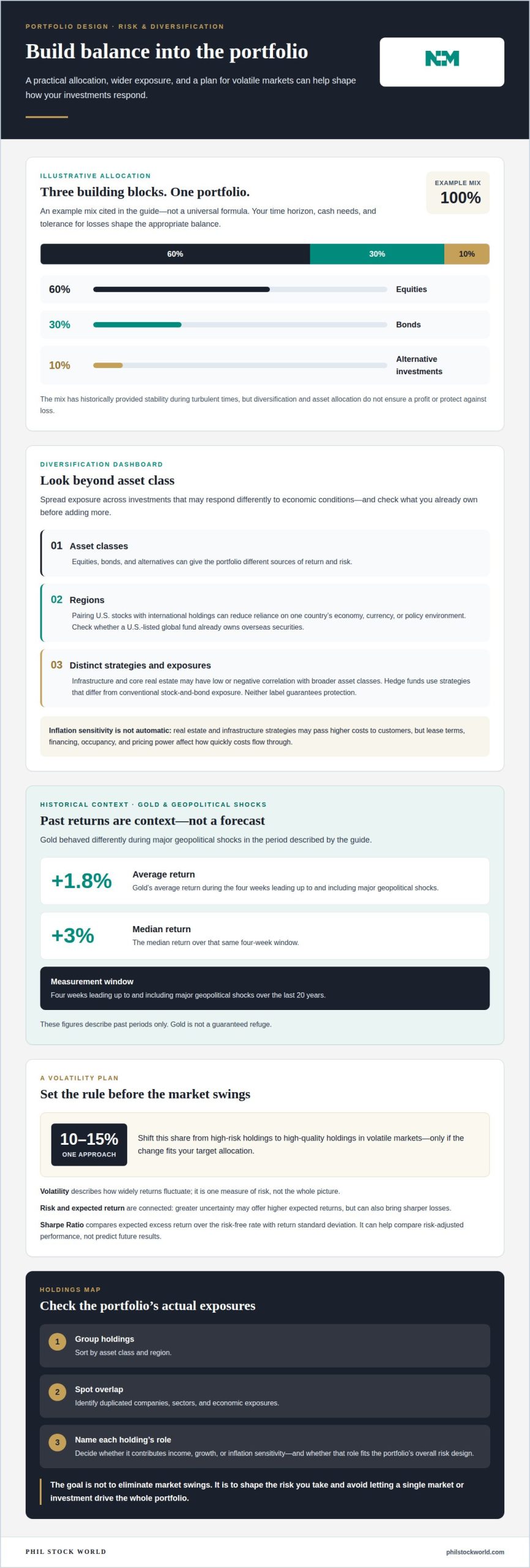
A diversified portfolio spreads exposure across investments that respond differently to economic conditions. One illustrative allocation uses 60% equities, 30% bonds, and 10% alternative investments. This mix has historically provided stability during turbulent times. Treat it as an example, not a universal formula: your time horizon, cash needs, and tolerance for losses determine the appropriate balance.
Asset class is only one layer of diversification. Investing across regions can reduce reliance on one country’s economy, currency, or policy environment. For example, pairing U.S. stocks with international holdings gives you exposure to companies facing different consumer demand and business cycles. Check whether your funds already hold overseas securities. A U.S.-listed global fund may include them, so adding another fund could create unintended overlap.
Infrastructure and core real estate may diversify multi-asset portfolios because their returns can have low or negative correlation with broader asset classes. Their income models may also help during inflation: real estate and infrastructure strategies can pass higher costs to customers. That link isn’t automatic; lease terms, financing, occupancy, and pricing power affect how quickly costs flow through.
Hedge funds offer another potential source of diversification, using strategies that differ from conventional stock-and-bond exposure. They can diversify portfolios and often perform well when market volatility increases. Results still depend on the strategy and holdings, so examine what drives returns rather than treating the label as protection. Compare their exposures with your existing holdings before deciding whether they broaden your portfolio’s risk.
Use a holdings map to assess diversification before adding investments. First, group your holdings by asset class and region. Then identify duplicated companies, sectors, and economic exposures. Ask what each holding is meant to contribute, such as income, growth, or inflation sensitivity. Keep it only if its role fits the portfolio’s overall risk design.
2. Portfolio construction and overall risk-return shape
Diversification can improve risk-adjusted returns when holdings respond differently to the same market shock. A decline in one investment may be partly offset by steadier performance elsewhere, reducing portfolio swings without requiring higher returns. For example, combining equities and bonds can produce a different return pattern than investing entirely in stocks. Still, diversification and asset allocation don’t ensure a profit or protect against loss. The aim is to balance exposures, not eliminate risk.
Build that balance around your risk tolerance, time horizon, and need for accessible cash. Risk, volatility, and expected returns are connected: investments with greater uncertainty may offer higher expected returns, but they can also experience sharper losses. Volatility describes how widely returns fluctuate. It’s one measure of risk, not the whole picture. The University of Waterloo defines the Sharpe Ratio as expected excess return over the risk-free rate relative to return standard deviation. Use it to compare risk-adjusted performance, not to predict future results.
Gold can behave differently during geopolitical shocks, but it isn’t a guaranteed refuge. Gold had an average positive return of 1.8% and a median return of 3% during the four weeks leading up to and including major geopolitical shocks of the last 20 years. Those figures describe past periods, not a forecast. In volatile markets, one approach recommends shifting 10-15% from high-risk holdings to high-quality holdings. Consider whether that change fits your target allocation before acting.
Tax-loss harvesting aims to improve after-tax returns by realizing investment losses that may offset taxable gains. It doesn’t increase an investment’s pre-tax return; it changes the potential tax impact of portfolio decisions. Review each holding’s role before selling, then consider whether a replacement maintains your intended exposure. Tax treatment depends on your circumstances and applicable rules, so include the after-tax effect when comparing portfolio choices.
3. Rebalancing to align investments with goals and liquidity needs
Rebalancing restores your target allocation when market moves leave a holding too large or too small. Compare your current mix with your intended allocation, then direct new contributions toward underweight areas or trim overweight positions. Regular contributions can make these adjustments gradual while keeping long-term investing on track. Set a review schedule that suits your circumstances, and revisit your targets when your goals, income needs, or time horizon change.
Liquidity matters as much as allocation. If you expect to use money for a personal residence purchase in 12-24 months, consider whether fixed income or commodities fit that short-term goal. Money needed soon has a different job from retirement savings invested for longer-term growth. Separate near-term spending needs from long-range holdings, so a market dip doesn’t force you to sell growth investments at an inconvenient moment.
Alternative investments may contribute income or diversify how your portfolio earns returns, but their role depends on their underlying strategy and risks. Ask what generates the income, how readily you can access the investment, and whether its behavior overlaps with your existing holdings. Keep its purpose clear: an income-oriented holding should support your cash-flow needs, not simply add complexity.
Costs deserve a place in the rebalancing review. A financial adviser’s post estimates that a 1% investment fee could reduce a portfolio’s size by 25% over 30 years. Expense ratios above 0.3% are described as high in another post. According to Morningstar, 7% of active fund managers beat their passive rivals over 2015-2024. Index funds typically track a market benchmark, while active funds select investments in pursuit of outperformance; compare their returns after fees and the strategy each fund follows. A simple, low-cost index approach can keep expenses visible, while regular contributions and periodic reviews help you stay aligned with your goals.
4. Volatility-managed portfolio strategies
Managing volatility starts with a plan for what you’ll do when prices swing. Define the portfolio loss or change in exposure that would prompt a review, then decide which holdings you’d reassess first. A written rule helps distinguish a genuine change in risk from a dramatic headline. Tie the trigger to your goals, not a prediction about tomorrow’s market.
Position sizing can also limit the impact of a sharp move. For example, if one stock has grown large enough to dominate your portfolio’s results, trimming it can reduce concentration. Before trading, compare its current role with your intended allocation and consider the tax effects. The point is to manage exposure deliberately, not to sell every holding that falls.
Use scenario analysis to test how different shocks could affect your holdings. Consider a sudden equity decline, rising borrowing costs, or a jump in energy prices. Identify which investments might come under pressure together, then decide whether your available cash and other holdings could absorb the disruption. This exercise turns volatility from a vague worry into a set of risks you can examine.
Keep liquidity and your own behavior in the plan, too. Money needed for near-term expenses shouldn’t depend on selling volatile assets at the wrong moment. For longer-term holdings, decide what would justify changing course before turbulence arrives. This can help prevent a temporary market decline from prompting a rushed strategy change. Review your plan when your objectives or financial circumstances shift.
Volatility control isn’t a promise of smoother returns in every market. It’s a way to make risk decisions consistently, with position size, cash needs, and portfolio exposures in view. To turn this framework into a portfolio-specific discussion, review your portfolio’s volatility exposure.
Phil Stock World: Premium Membership
Phil Stock World’s Premium Membership provides ongoing market commentary and trading ideas to inform your portfolio decisions. For a closer look at how your holdings fit together, a Virtual Portfolio Review can help you examine allocation, concentration, and risk exposure. Educational Webinars offer another way to build your understanding, while Market Charts and Analysis can add context to changing market conditions.
Use these resources to sharpen your own process, whether you’re reviewing a rebalancing decision or trying to understand how market volatility affects your holdings. They support research and education, but don’t replace your judgment or manage investments for you.
Contact Phil Stock World to explore which resource best fits your next portfolio question.
Make your next portfolio decision deliberate
Turn your investment approach into a decision rule you can follow. Before making a change, write down what has changed, which goal the adjustment supports, and what evidence would make you reconsider it. This simple record can help distinguish a considered decision from a reaction to market noise.
The strongest strategies to improve portfolio returns aren’t just about choosing investments. They also rely on a repeatable process for reviewing risk, timing, and your response to uncertainty. At your next portfolio check-in, identify one assumption you want to test, then decide what information would change your view.
If you’d like to continue exploring your portfolio decisions, contact Phil Stock World. Keep asking clear questions, stay curious, and take your next step with intention.
Frequently Asked Questions
What investment strategies can improve portfolio returns over the long term?
Strategies to improve portfolio returns over the long term start with a process you can stick with: give each investment a clear role, keep costs visible, and review your approach as your goals change. Someone saving for retirement may emphasize long-term growth, while a person planning a major purchase may prioritize access to funds. A strategy you understand is easier to maintain through market shifts.
How does asset allocation affect portfolio returns and risk?
Asset allocation determines how much of your portfolio is exposed to different market movements. A stock-heavy mix can behave differently from one with more bonds or cash. For example, an investor who finds sharp account swings difficult may prefer a less aggressive allocation, while accepting that a more conservative mix can also limit growth potential. Match the balance to your goals and ability to tolerate losses.
What are the benefits and risks of rebalancing a portfolio?
Rebalancing can restore your intended risk level after market movements change the weight of your holdings. It may also prompt you to trim an investment that has grown beyond its planned role. However, selling can create transaction costs or tax consequences, and frequent adjustments can distract from long-term goals. Before trading, weigh the value of restoring your target against these potential drawbacks.
How do investment fees and taxes reduce portfolio returns in the United States?
Strategies to improve portfolio returns should account for investment costs and taxes, since both can reduce what remains in your account. Compare fund expense ratios and account charges, then consider how a proposed sale may affect your tax position. The outcome depends on your account type, transaction details, and applicable tax rules, so include these factors when assessing the net result of an investment decision.
How do dollar-cost averaging and lump-sum investing compare historically?
Dollar-cost averaging spreads purchases over time, with each contribution invested at the market price on that date. Lump-sum investing puts available funds to work at once, creating earlier exposure to both gains and losses. Historical results depend on the starting point and subsequent market movements. Consider how comfortable you are investing the full amount at once, then choose an approach you can follow consistently.
What portfolio strategies help protect against inflation and market downturns?
Assess how each holding may respond to rising costs or falling markets instead of relying on a supposed all-purpose hedge. Real estate or infrastructure investments may pass some higher costs on to customers, while bonds and cash can play different roles during downturns. Their behavior depends on investment structure and market conditions, so identify each holding’s purpose before relying on it for protection.