


A covered call doesn’t have to start with buying 100 shares. The poor man’s covered call strategy for high-priced stocks uses a long-dated call option, often a LEAPS call, as a stock substitute, then sells a shorter-term call against it. That can require less capital than owning the shares, but it also changes how the position responds to a rally, a pullback, and time decay.
If the share price makes a traditional covered call feel out of reach, the appeal is clear: keep the call-selling structure, without putting up the full cost of 100 shares. The trade-off is just as important. Your long option has an expiration date and can lose time value, so the setup isn’t simply a cheaper version of stock ownership.
This guide explains how the two option legs work together, how a poor man’s covered call compares with a traditional covered call, and what to consider when choosing a LEAPS expiration and strike. Understand the structure and its trade-offs before deciding whether it suits a mildly bullish outlook.
Key Takeaways
- Understand how a long-dated call can stand in for shares while a shorter-term call generates premium.
- Compare the capital commitment and risk profile of this options structure with a traditional covered call.
- Assess LEAPS expiration and strike by considering time value, delta, and how closely the option may track the stock.
- Recognize why a gradual or steady outlook may fit the strategy better than an expectation of a sharp rally.
What Is a Poor Man’s Covered Call?
A poor man’s covered call (PMCC) pairs a long-dated call with a shorter-term call sold against it. Instead of buying 100 shares, the trader uses the long call as a stock substitute, reducing the capital tied up in the position.
A PMCC may require less capital than a traditional covered call, but its long option can lose value and does not represent ownership of shares. The risks differ, particularly if the stock falls or the short call is assigned.
Capital Needs Compared With Covered Calls
A traditional covered call requires 100 shares for each call sold. The difference can leave capital available for other positions, but it doesn’t make the options position equivalent to owning stock.
A PMCC lets a trader consider exposure to a high-priced stock without committing the full amount needed to buy its shares. An in-the-money LEAPS call serves as the long leg, while the short call creates a separate obligation and potential outcomes. The premium collected does not eliminate the LEAPS cost or assignment risk.
Leverage, Risk, and Potential Returns
The lower initial outlay can create leverage: a smaller investment provides options-based exposure to stock movements, which can magnify percentage gains and losses. Changes in volatility or implied volatility may affect the LEAPS and short call differently, so the position will not necessarily move in line with the shares.
A PMCC may leave capital available for other positions, but adding trades also adds exposure. Consider what could happen if the stock falls, the short call is assigned, or the call expires. Broker approval and margin treatment depend on account permissions and the broker’s rules for both option legs.
Tax treatment depends on the instrument: according to the Internal Revenue Service, qualifying index-option gains are taxed under IRS Section 1256 using a 60/40 split, regardless of holding period. That rule concerns qualifying index options, not every PMCC on an individual stock. Separate the tax question from the strategy’s capital calculation before evaluating potential returns.
Choosing a LEAPS expiration and strike
A LEAPS call’s expiration and strike affect its cost, sensitivity to the stock, and exposure to time decay. Compare those terms with the short call before opening a PMCC.
Selecting Expiration and Delta
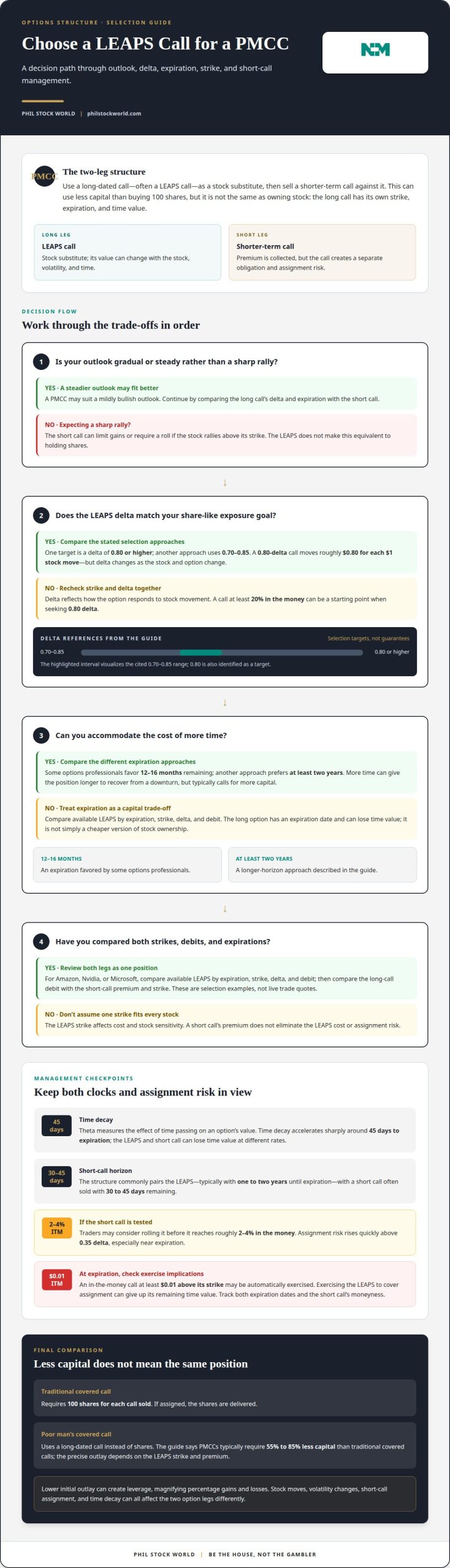
Start with a long-call delta that makes the option behave more like shares. A delta of 0.80 or higher is one target; a 0.70 to 0.85 range is another selection approach. A call with 0.80 delta moves roughly 80 cents for each $1 stock move, though delta changes as the stock and option change.
Expiration is a trade-off. Some options professionals favor 12-16 months remaining, while one approach prefers at least two years. More time can give the position longer to recover from a downturn, but typically calls for more capital. The strike matters too: a call at least 20% in the money can be a starting point when seeking 0.80 delta.
Theta and Expiration Timing
Theta measures the effect of time passing on an option’s value. Time decay accelerates sharply around 45 days to expiration, so a LEAPS call and the shorter call can lose time value at different rates.
For Amazon, Nvidia, or Microsoft, an illustrative setup would compare each stock’s available LEAPS by expiration, strike, delta, and debit, then pair the long call with a shorter call. These are selection examples, not live trade quotes. Volatility changes can also alter both legs’ values. If the short call is tested, traders may consider rolling it before it reaches roughly 2 to 4% in the money; assignment risk rises quickly above 0.35 delta, especially near expiration.
Example Setups for High-Priced Stocks
Apply the same comparison to Amazon, Nvidia, and Microsoft rather than assuming one strike suits all three. For a deep-in-the-money LEAPS call, consider its delta and time remaining, then compare its debit with the short call’s premium and strike. You can close or roll a short call as the stock approaches its strike, but either action changes the position’s cost and exposure.
At expiration, an in-the-money call at least $0.01 above its strike may be automatically exercised. That can matter if the short call is tested while the long LEAPS still carries time value: exercising the LEAPS to cover assignment gives up that remaining value. Track both expiration dates and the short call’s moneyness before deciding how to manage the position.
How poor man’s covered calls differ from covered calls
The key difference is what backs the short call: shares in a traditional covered call, or a long-dated call in a PMCC.
The LEAPS-and-Short-Call Structure
A PMCC replaces the shares with a LEAPS call, then sells a shorter-dated call on the same underlying. The LEAPS call, typically with one to two years until expiration, acts as the stock substitute; the short call is often sold with 30 to 45 days remaining. This setup uses less capital, but the LEAPS doesn’t replicate share ownership exactly.
That difference shapes how you manage the trade. The long call has its own strike, expiration, and time value, while the short call may be assigned before expiration. If the stock rises above the short call’s strike, you may need to close or roll the call or manage assignment. With a traditional covered call, assignment means delivering the shares.
Capital Needs of Traditional Covered Calls
A traditional covered call, also known as a buy-write, combines a stock purchase with calls sold against the shares on a share-for-share basis.
That gap changes the scale of a strategy. PMCCs typically require 55% to 85% less capital than traditional covered calls, though the precise outlay depends on the LEAPS strike and premium.
A lower capital requirement does not mean identical returns. If the stock rallies sharply, the LEAPS may gain value, but the short call can limit gains or require a roll. If the stock falls, both options may lose value, and the LEAPS can expire worthless. Choose based on the exposure you want: shares paired with a short call, or a long option paired with a short call.
Covered call structure
The payoff matters as much as the premium. Before treating either position as an income strategy, map out both legs of a traditional covered call and a LEAPS-based alternative.
Gains in the stock above the call’s strike are surrendered, while the premium offsets part of the purchase cost.
A PMCC changes the long leg, not the obligation created by the short call. You buy a LEAPS call and sell a shorter-dated call against it. The outcomes depend on the options’ strikes, premiums, and changes in value, not just on the lower initial outlay.
That distinction is the takeaway: a LEAPS call can require less capital than 100 shares, but it doesn’t give the position identical stock exposure. If ABC rallies, the short call can limit gains; if ABC falls, the LEAPS can lose value. The short contract also creates assignment exposure. A trader must consider whether to close, roll, or accept assignment as the underlying approaches the short strike.
Before opening either position, compare the potential stock-related gain up to the short call’s strike with the premium received and the debit paid. For a PMCC, also compare the LEAPS strike with the short-call strike. This spread shows how much room the position has before the short call limits upside, and why a smaller initial outlay does not automatically mean a better profit.
For more context on option setups and market conditions, explore Phil Stock World’s market charts and analysis.
Phil Stock World: Premium Membership
Phil Stock World’s Premium Membership provides access to exclusive trading content, including top trades, market charts, and sector-specific insights. It can be a useful next step if you want to continue studying options setups and market conditions after learning how a PMCC works.
A Virtual Portfolio Review provides a way to examine portfolio holdings, while Educational Webinars offer another format for learning about strategies. Market Charts and Analysis can add broader market context to your research. These resources support education and analysis; Phil Stock World does not provide brokerage services or direct asset management.
If you’d like to explore these educational resources, visit Phil Stock World.
Make Your Next Trade Deliberate
Before opening a position, write down what would change your view. For a poor man’s covered call strategy for high-priced stocks, define your outlook for the underlying stock, the outcome you would consider acceptable, and how you would respond if the trade moved against you. A clear plan turns option terms into decisions you can assess rather than outcomes you simply hope for.
Keep the plan grounded in your own reasoning. What would lead you to close the position? What would prompt an adjustment? Thinking through these questions before trading can help you distinguish a planned response from a reaction to market noise.
If you’d like to continue developing your options knowledge, explore Phil Stock World’s educational resources and contact Phil Stock World. Build your process one thoughtful decision at a time, and approach each new trade with greater clarity.
Frequently Asked Questions
What is a poor man’s covered call (PMCC), and how does it work?
A poor man’s covered call strategy for high-priced stocks pairs a long-dated call with a shorter-dated call sold against the same stock. The long call provides bullish exposure; the short call collects a premium but limits gains above its strike while it remains open. If the stock stays below the short call’s strike through expiration, that call may expire worthless while the long call remains open.
How do you choose the long-dated LEAPS call for a PMCC?
Compare the LEAPS call’s expiration, strike, delta, and debit as one package. A delta around 0.80 can make the option more responsive to stock moves; a strike at least 20% in the money is one possible starting point. Then consider how much time remains for your thesis to play out. For this strategy, a higher delta may track the stock more closely, but generally requires more capital.
What delta and expiration are commonly used for the short call in a PMCC?
A common framework is a short call with 30-60 days until expiration and a delta between 0.20 and 0.40. A lower delta can reduce the chance of the call finishing in the money, while a higher delta may bring more premium and more assignment exposure. Match the strike to your outlook: selling closer to the stock price leaves less room for a rally.
How do you calculate PMCC cost basis, maximum profit, and breakeven?
Start with the LEAPS debit and subtract the premium received for the short call to calculate the position’s net debit. For one short-call cycle, estimate the result at that call’s expiration using the long call’s value at that time, the short-call payoff, and the net debit. Since the options expire at different times, overall profit and breakeven also depend on the stock price and the LEAPS’ remaining value.
How do you select strike prices and expiration dates for high-priced stocks?
For a poor man’s covered call strategy for high priced stocks, choose the long-call strike and expiration to fit your intended stock exposure, then assess the short call separately. A deep-in-the-money LEAPS with a delta around 0.70 to 0.85 is one selection range; some traders prefer more time than others. Compare the short-call strike with the stock’s price and choose an expiration that suits your outlook and management plans.
What options approval level, margin, and tax considerations apply to PMCCs in the United States?
Broker approval and margin treatment depend on your account permissions and the broker’s rules for the two option legs. Qualifying index-option gains receive Section 1256 tax treatment with a 60/40 split regardless of holding period; this does not apply to every PMCC, such as one on an individual stock.