

Election Night Update: Democrats Score Major Victories as Stock Futures Tumble
Strong Democratic gains are rattling investors, even as AI companies report excellent earnings. Is Wall Street overreacting?
Democrats are having a remarkable election night, and Wall Street doesn’t seem particularly happy about it.
As results come in, Democrats are winning Senate races in states Republicans have dominated for decades. CBS News projects Democrats will take control of both the House and Senate, although some races remain undecided.
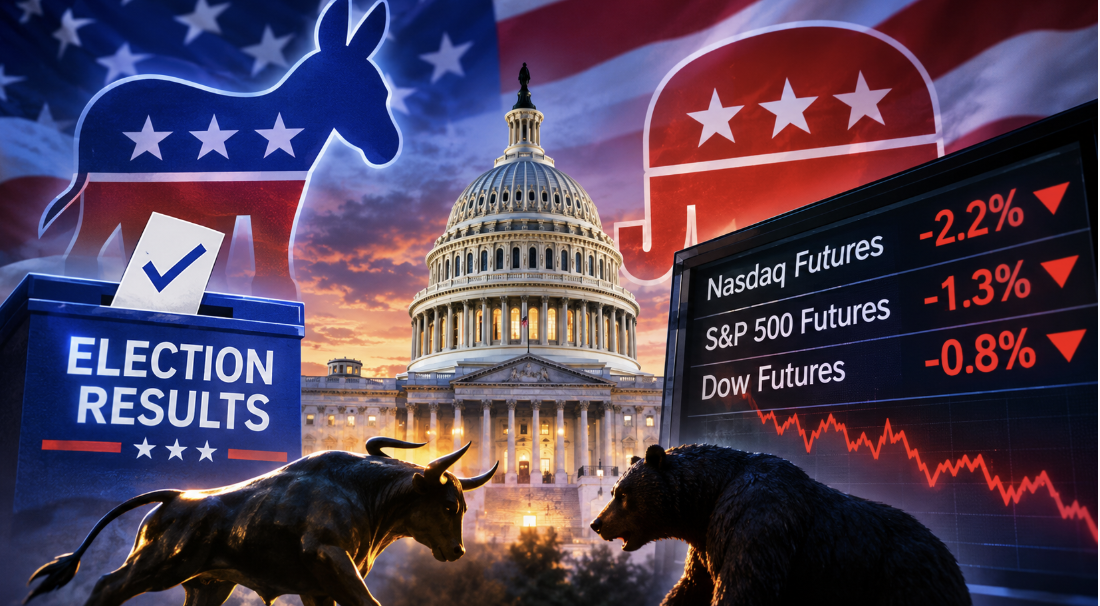
Meanwhile, stock futures have fallen sharply. Nasdaq-100 futures were down as much as 2.2%, S&P 500 futures were off 1.3%, and Dow futures were down 0.8% in election-night reporting.
A Bigger Democratic Victory Than Expected
Going into Tuesday, Democrats were favored to retake the House, and their chances of winning the Senate had improved considerably. But the size and geographic reach of their victories are surprising.
The Senate
Republicans entered the election with a 53–47 advantage, including the two independents who caucus with Democrats.
According to the latest election-night projections, Democrats have scored several major victories:
-
Texas: Democrat James Talarico defeated Republican Ken Paxton, ending decades of Republican dominance in statewide Texas elections.
-
South Carolina: Democrat Annie Andrews won a major upset in a traditionally Republican state.
-
Kansas: Democrat Adam Hamilton defeated Republican incumbent Roger Marshall, according to CBS News.
-
Ohio: Former Democratic Senator Sherrod Brown defeated Republican Jon Husted, reclaiming a seat Democrats lost in 2024.
-
North Carolina: Former Democratic Governor Roy Cooper defeated Republican Michael Whatley, flipping another Republican-held Senate seat.
Democrats also held important seats in Georgia and New Hampshire, while Michigan remained too close to call in the latest CBS reporting.
CBS and the Associated Press now report that Democrats have secured the gains needed to win Senate control. The results represent a significant setback for President Trump and the Republican Party.
The House of Representatives
Democrats have also performed strongly in House races, flipping Republican-held districts in Pennsylvania, North Carolina, Colorado, and other states.
Among the notable results:
- Democrats flipped Pennsylvania’s 7th, 8th, and 10th districts.
- North Carolina’s 11th District elected a Democrat for the first time since 2010.
- Democrats flipped Colorado’s competitive 8th District.
- Democrat Zach Dembo won Kentucky’s 6th District, a race that had not initially been expected to be particularly competitive.
CBS News projects Democrats have won control of the House, although the size of their majority remains uncertain. The Associated Press was still more cautious about formally calling House control in its latest report reviewed for this article.
Governors’ Races
Democrats are also making gains at the state level. The Associated Press reports Democratic gubernatorial victories in Texas and Georgia, among other states. Republicans retained Florida’s governorship.
These results suggest something broader than a handful of competitive congressional races. Voters in several traditionally Republican states are also moving toward Democratic candidates.
Why Are Voters Turning Against Republicans?
Economic dissatisfaction appears to be an important factor. High living costs, inflation, energy prices, tariffs, and the war with Iran have all contributed to voter frustration.
Reuters reports that approximately 70% of voters surveyed wanted Congress to act as a check on presidential power. This election appears to be about both economic dissatisfaction and opposition to the direction of the Trump administration.
Wall Street’s Reaction: Futures Fall
The stock market had already been struggling through October, particularly in technology and AI-related stocks. Investors have become increasingly concerned about expensive valuations, enormous data-center spending, and whether AI companies will eventually generate enough profits to justify their investments.
But Tuesday brought some encouraging corporate news:
AMD reported outstanding results. Third-quarter revenue increased 45% from a year earlier to $13.4 billion, while adjusted earnings rose 74% to $2.09 per share. More importantly, AMD’s data-center revenue nearly doubled to $8.5 billion.
The company also projected fourth-quarter revenue of approximately $17 billion, representing roughly 66% year-over-year growth at the midpoint. AMD shares initially surged after hours.
Arista Networks and Super Micro Computer also rallied following strong earnings reports. MarketWatch reported after-hours gains of more than 13% for Arista and nearly 10% for Super Micro. These are not the results of an industry suddenly running out of customers.
Nevertheless, as election results came in, the broader futures market moved sharply lower.
The Wall Street Journal reported the following declines during election-night trading:
| Futures | Reported decline |
|---|---|
| Nasdaq-100 | 2.2% |
| S&P 500 | 1.3% |
| Dow Jones | 0.8% |
These are election-night snapshots, not final prices. They can change substantially before Wednesday’s opening bell.
The Timing of the Selloff Is Particularly Interesting
According to Joe Light at Barron’s, stock futures had been rising before election results began coming in, but reversed course as Democrats’ chances of winning the Senate surged in prediction markets. At that point, Kalshi was giving Democrats a 90% chance of taking the Senate and a 98% chance of winning the House.
Reuters also reported that stock futures declined as Democratic Senate victories became apparent, with investors reassessing the implications for government policy, technology regulation, and fiscal spending.
Why Would a Democratic Victory Worry Investors?
There are several possible explanations.
1. The results are stronger than investors anticipated.
Markets react to news that differs from expectations.
Prediction markets had already anticipated Democratic gains, but winning the House is one thing. Winning the Senate as well, with victories in states such as Texas, Kansas, and South Carolina, is quite another.
Investors may now be reassessing what the political landscape will look like for the next two years.
2. Concerns about taxes and regulation.
A Democratic Congress could increase scrutiny of large technology companies, AI development, mergers, and corporate behavior. Investors may also worry about future tax policy.
However, there is an important limitation: Donald Trump remains president.
Democrats cannot simply enact major new corporate tax increases or sweeping regulations without overcoming a presidential veto. Most legislation also faces Senate procedural hurdles.
That makes the immediate threat of major new legislation considerably smaller than the market reaction might suggest.
3. Congressional investigations and political confrontation.
A Democratic Congress would have greater ability to investigate the Trump administration, demand documents, hold hearings, and challenge administration policies.
Senate control would also give Democrats considerable influence over judicial and executive appointments requiring confirmation.
That could create political uncertainty and confrontation. But uncertainty doesn’t automatically mean lower corporate profits.
4. Investors were already nervous.
Technology stocks have been under pressure for weeks. Valuations remain demanding, and investors are increasingly questioning the economics of the AI buildout. An unexpected political development can become an excuse to sell stocks that investors were already uncomfortable holding.
In that sense, the election may be triggering a decline that was already developing.
Is the Market Reaction Reasonable?
Some caution is justified. A stronger-than-expected Democratic victory changes the political outlook, and investors need to consider its implications.
But the size of the initial futures decline may be excessive, particularly if investors are treating Democratic congressional control as an immediate threat to corporate earnings.
Some Wall Street strategists are making a similar argument. Brian Gardner, Stifel’s chief Washington policy strategist, warned that investors might overreact to a Democratic sweep. As reported by Barron’s, Gardner argues that, for most legislation, Democratic control of both chambers wouldn’t produce substantially different outcomes from Democrats controlling only the House.
The reason is simple: Political gridlock remains the most likely outcome.
Even with Democrats controlling Congress, President Trump retains his veto power, making major legislative changes difficult without bipartisan agreement. Gardner suggested that an initial market selloff could reverse once investors recognize that the practical legislative consequences may be much smaller than the election results initially suggest.
Consider what actually changes tomorrow.
AMD’s customers still need processors. Microsoft, Amazon, Google, and other companies still need computing capacity. Data centers under construction don’t suddenly become unnecessary because Democrats win congressional seats. A different congressional majority doesn’t immediately change the demand for cybersecurity, cloud computing, enterprise software, or electricity.
And congressional gridlock isn’t necessarily bad for stocks. Historically, investors have sometimes welcomed divided government because it makes major policy changes more difficult. That isn’t a guarantee of positive returns, but it challenges the idea that Democratic control of Congress is inherently bearish.
There is another possibility worth considering.
If Democratic victories limit the administration’s ability to pursue additional legislation that investors consider economically disruptive, the longer-term market implications might actually be positive.
Of course, Congress doesn’t control every presidential action. Tariffs, foreign policy, regulatory enforcement, and executive orders may remain important sources of uncertainty.
But it’s difficult to make the case that tonight’s election results alone justify a substantial reduction in the value of American corporations.
Putting the Selloff in Perspective
Election-night futures can be volatile, particularly when trading is relatively thin and investors are reacting to incomplete information. A 2% decline tonight doesn’t necessarily mean the Nasdaq will finish Wednesday down 2%.
The more important question is whether the election changes the earnings outlook for American companies or simply how much investors are willing to pay for those earnings.
For many businesses, particularly those benefiting from continued AI investment, the underlying fundamentals haven’t changed. Strong earnings and guidance still matter, regardless of which party controls Congress.
Of course, valuations remain a concern, especially in technology. Even companies reporting excellent results can see their stocks decline when investors become less willing to pay high multiples.
If the selling is primarily a reaction to political uncertainty rather than deteriorating business conditions, it could eventually create opportunities. But it’s too early to know whether tonight’s decline is a temporary reaction or part of the broader market correction already underway.
The Bottom Line
Democrats are having an extraordinary election night, with results substantially stronger than many investors expected, and Wall Street is responding with a sharp futures selloff.
But that doesn’t necessarily mean the market’s reaction is justified. As Stifel’s Brian Gardner points out, gridlock remains the most likely legislative outcome, even with Democrats controlling both chambers of Congress.
The election may have changed the political outlook, but it hasn’t necessarily changed the earnings or underlying value of the businesses in your portfolios.
Sources
- Associated Press — Election-night developments and major Democratic victories
- Associated Press — Democrats win control of the Senate
- Reuters — Democrats surge toward control of Congress
- CBS News — Senate election results and projections
- CBS News — House election results and projections
- Barron’s — Joe Light: Stock Futures Drop as Democrats Post Strong Early Numbers
- MarketWatch — Brian Gardner’s analysis of potential market reactions to a Democratic sweep
- The Wall Street Journal — Election-night stock market coverage
- AMD — Official third-quarter 2026 financial results
- Arista Networks — Official third-quarter 2026 financial results
- MarketWatch — Arista, Super Micro and AMD rally following earnings