


The earliest sign of a market shift may be a small change in customer behavior, not a headline. Market trends show how a market moves over time, shaped by consumer preferences, technology, culture, and economic conditions. Understanding market trends through webinars means listening for those signals and weighing them against broader evidence before making a strategic move.
It’s easy to focus on the loudest news or latest forecast. But useful market intelligence comes from connecting the dots: what customers are doing, what competitors are changing, and which economic forces may be influencing both. A webinar can bring these perspectives together and turn scattered observations into a clearer picture.
Here, you’ll learn what market trends are, what influences them, and how webinars can surface market intelligence. You’ll also see how to distinguish meaningful signals from passing noise, anticipate potential disruption, and use trend analysis to inform decisions about products, marketing, and innovation. The goal isn’t to predict every twist. It’s to make your next move with a sharper sense of what may be changing.
Key Takeaways
- Use webinars to connect consumer behavior, economic indicators, and competitor moves into a more useful market view.
- Build a repeatable way to collect early signals, then separate meaningful shifts from background noise.
- Apply trend analysis to sharpen product, marketing, and innovation decisions before committing resources.
- Choose webinars by their relevance to your market, the expertise they bring, and the practical insight you can take away.
Webinars as a source of market intelligence
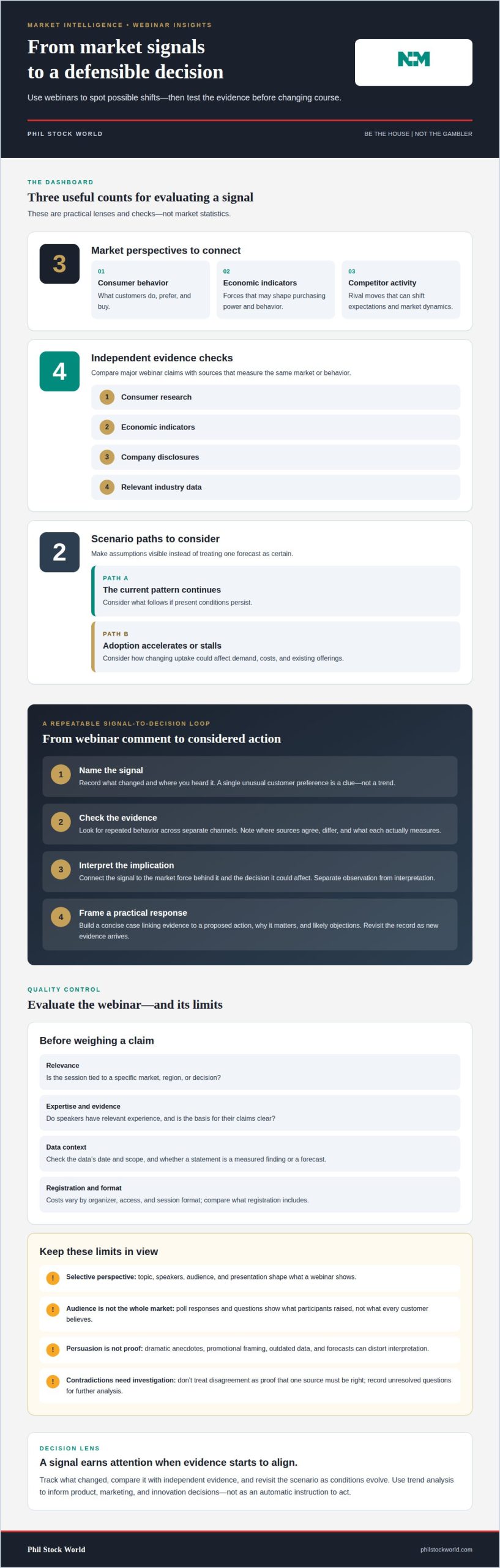
A useful webinar connects consumer behavior, economic indicators, and competitor activity. Treat its takeaways as signals to examine, not instructions to follow automatically.
Turning Insights into Action
Turn a webinar insight into a decision by identifying the signal, its business implication, and a practical response. For example, if competitors promote sustainable products, assess whether customer preferences support a similar change. Competitive intelligence matters because rival strategies can shift consumer expectations and market dynamics.
Then build a concise case: connect the evidence to a proposed action, explain why it matters, and address likely objections. A clear argument helps leaders weigh opportunities against risks instead of reacting to a striking comment.
Finding and Evaluating Webinars
Find timely sessions through industry associations, research organizations, and business event calendars. Choose webinars tied to a specific market, region, or decision. For example, a US sustainable energy session might examine the legal, market, partnership, and regulatory landscape.
Webinar costs vary by organizer, access, and session format, so compare what registration includes before deciding. Evaluate speakers by their relevant experience and the evidence behind their claims. Look for clearly described data, its date and scope, and a distinction between measured findings and forecasts. A confident delivery alone isn’t proof.
Validating Webinar Insights
Check major claims against independent sources that measure the same market or behavior. Compare webinar commentary with consumer research, economic indicators, company disclosures, or relevant industry data. If a speaker describes weaker demand, look for separate evidence tracking purchasing behavior before changing a plan.
Record where sources agree, where they differ, and what each actually measures. A repeatable comparison helps reduce cognitive bias: don’t give a dramatic anecdote more weight than broader evidence. Treat unresolved contradictions as questions for further analysis, not proof that one source must be right.
Risks of Relying on Webinars
A webinar offers a selective view shaped by its topic, speakers, audience, and presentation. Attendees may not represent the wider market, and a persuasive example can overshadow contrary evidence. Track audience questions and poll responses by topic, recurring concerns, and the share of responses supporting each option. These reveal what participants raised, not what every customer believes.
Other risks include outdated data, promotional framing, and treating forecasts as outcomes. Reduce these risks by checking the data’s scope, comparing it with independent research, and separating observation from interpretation. Keep a short evidence log that records each claim, its source, and the decision it could influence.
Anticipating market trends and disruption
A market trend describes how a market moves over time, reflected in consumer behavior, preferences, technology, and economic conditions. Growing demand for sustainable products, for example, can signal changing consumer priorities. Inflation and unemployment can also influence purchasing power and buying behavior. A useful forecast asks whether several signals reinforce one another, rather than treating a single event as a lasting shift.
Disruption can begin when emerging technology changes how customers solve a familiar problem. Artificial intelligence, for instance, can alter established workflows and create opportunities for new products or services. Cultural shifts matter too: changing lifestyles and social values can reshape what consumers consider useful or worth buying. These forces may overlap, so track how each affects customers, competitors, and your market’s economics.
Make signal collection repeatable. Monitor relevant information channels, record what changed, and sort meaningful developments from background noise. A single unusual customer preference is a clue, not a trend; repeated behavior across separate channels deserves closer attention. Gartner describes weak signals as potentially valuable intelligence when assessed thoroughly. Consider each signal’s context, possible consequences, and whether other observations point in the same direction.
Next, translate patterns into scenarios instead of treating one forecast as certain. If an emerging technology gains traction while consumer expectations evolve, consider what might happen to demand, costs, and existing offerings. Compare a continuation scenario with one in which adoption accelerates or stalls. This makes assumptions visible and helps leaders identify which decisions can wait, which need preparation, and what new evidence would change the plan.
Keep the review practical: name the signal, the market force behind it, and the decision it could affect. Revisit that record as new evidence arrives, and update the scenario when conditions change. Explore broader market context as one way to keep developing your read on evolving trends.
Benefits of market trend analysis
Trend analysis gives leaders a stronger basis for product, marketing, and investment decisions. Before launching a product, compare customer preferences with economic conditions and competitor activity. Rising interest alone may not justify a launch; purchasing behavior and market conditions add context. This discipline helps teams spot weak assumptions before they become expensive commitments.
Early signals can also reduce the risk of pursuing initiatives that miss customer needs. Imagine a retailer considering a sustainable product line. Trend analysis can reveal whether customer interest appears across several sources or mainly in isolated comments. That distinction helps leaders shape a smaller test, refine the product concept, or delay a larger commitment until the evidence supports it.
Marketing decisions become sharper when analysis identifies what matters to distinct audiences. Regional insights, for example, can reveal differences in preferences, economic conditions, and local competition. A message that resonates in one market may miss the mark elsewhere. Teams can use these distinctions to adapt campaign language, product positioning, and distribution priorities instead of treating all customers as one audience.
Trend analysis also supports innovation by revealing unmet needs and changing expectations. If customers repeatedly struggle with a familiar service, that pattern can inspire a practical improvement or new offering. Pair qualitative feedback with quantitative evidence, then assess the opportunity against operational constraints and competitive responses. In rapidly changing conditions, this review is useful as an ongoing decision habit, not a one-time forecast.
- Product launches: Use demand signals to refine timing, features, and target customers.
- Marketing: Match messages to audience preferences and regional conditions.
- Innovation: Turn recurring customer friction into ideas for improved services.
- Risk control: Test assumptions before committing resources to a broad initiative.
The clear takeaway: analysis is most valuable when it changes a decision. Link each finding to a specific choice, such as adjusting a launch, testing a message, or improving a service. That turns market observation into a practical advantage while keeping strategy responsive to evolving consumer and economic conditions.
How can you find webinars about current market trends?
Start with the market decision you need to make, then search for webinars addressing that sector, region, or pressure. A session on Vietnam’s manufacturing landscape, for example, can offer a focused view of trends, growth drivers, and opportunities. Industry associations, trade groups, business organizations, and research firms often publish events on these subjects. Search by topic plus terms such as “market outlook,” “consumer demand,” or “industry trends.”
Use the event description to judge whether the session fits your question. A US market-entry webinar focused on the legal framework and regulations involved in opening a business in the United States serves a different purpose from a discussion of consumer preferences. Look for a defined market, a named subject, and clear takeaways. The event date matters too when conditions are changing quickly.
- Match the topic: Choose a session tied to your sector, region, or business decision.
- Read the agenda: Look for specific subjects, such as economic conditions or market opportunities.
- Review the speakers: Prefer relevant experience and evidence-based discussion over broad claims.
- Check the format: See whether the session includes audience questions, examples, or data discussion.
Compare event descriptions before registering. A webinar about Nigeria’s business climate and policy reforms offers a country-level lens; one on Vietnam’s agrifood sector focuses on growth potential and key players. That distinction helps you avoid collecting interesting material that doesn’t inform your decision. Save the agenda and note which market questions the session promises to address.
After attending, record claims, evidence, and unanswered questions separately. For example, if a speaker identifies a new growth opportunity, note the market and factors cited, then compare those claims with other research. This simple routine turns a calendar of events into a useful learning stream rather than a stack of disconnected presentations.
To keep market observations connected to practical analysis, explore focused market insights as you build your webinar shortlist.
Industry associations, trade groups, business organizations, and research firms often publish webinars featuring market research and industry insights.
Phil Stock World: Educational Webinars
Phil Stock World offers Educational Webinars for readers who want to deepen their market understanding through structured discussion. These can complement independent trend analysis by helping connect market developments with questions about stocks and options.
For ongoing context, Market Charts and Analysis can offer another lens on market signals. Premium Membership provides access to exclusive content, while a Virtual Portfolio Review offers an educational way to examine portfolio positions. Each serves a different purpose: use webinars to build knowledge, charts to follow market activity, and a review for a closer look at portfolio strategy.
Market education can help clarify your thinking, but it isn’t the same as direct asset management, brokerage services, or personalized financial planning. To explore Phil Stock World’s educational resources, get in touch with the team.
Turn Market Signals Into Your Next Move
A useful next step is to choose one decision you expect market evidence to influence. State what would change your mind, then use that standard as new information arrives. This keeps a compelling webinar from becoming a forecast you follow blindly and gives your team a clearer way to revisit assumptions as conditions evolve.
Understanding market trends through webinars is most valuable when learning leads to deliberate action. Phil Stock World offers Educational Webinars, Premium Membership, and Virtual Portfolio Review for readers seeking continued market education and perspective. These resources can support your process, while decisions remain grounded in your own research and objectives.
If you’re ready to explore the next step, contact Phil Stock World to discuss your needs. Keep asking sharper questions, stay open to new evidence, and let a better-informed view guide what comes next.
Frequently Asked Questions
What Are Market Trends?
Market trends are ongoing shifts in how a market behaves, not isolated events. A sudden jump in demand after a one-time promotion may fade quickly; steady customer preference for a product feature suggests a deeper change. Comparing behavior over time helps separate lasting direction from seasonal movement, temporary news reactions, or short-lived spikes. That distinction gives leaders a clearer basis for deciding what deserves attention.
How can webinars help identify market trends?
Webinars can show how specialists interpret developments and how different parts of an industry respond. For example, a session about manufacturing might connect changing production methods with supplier decisions and customer expectations. Listen for explanations of cause and effect, not just predictions. A speaker’s account can help frame questions for your own market, such as whether a new process changes buyer priorities or operating choices.
How can businesses turn webinar insights into a market trend analysis?
Understanding market trends through webinars becomes more practical when teams record each claim alongside its business relevance. For every useful insight, note the market or customer group involved, the evidence offered, and the decision it may affect. Then assign someone to revisit the question during planning. This creates a traceable link between a webinar takeaway and a product, marketing, or resource decision.
What market trends are businesses discussing in recent webinars?
Recent webinar topics include AI and cyber risk, sustainable energy, Vietnam’s manufacturing and agrifood sectors, Ukraine’s economic trends, and Nigeria’s business climate and policy reforms. More broadly, businesses are discussing changing consumer preferences, economic conditions, technology, and competitor strategies.