




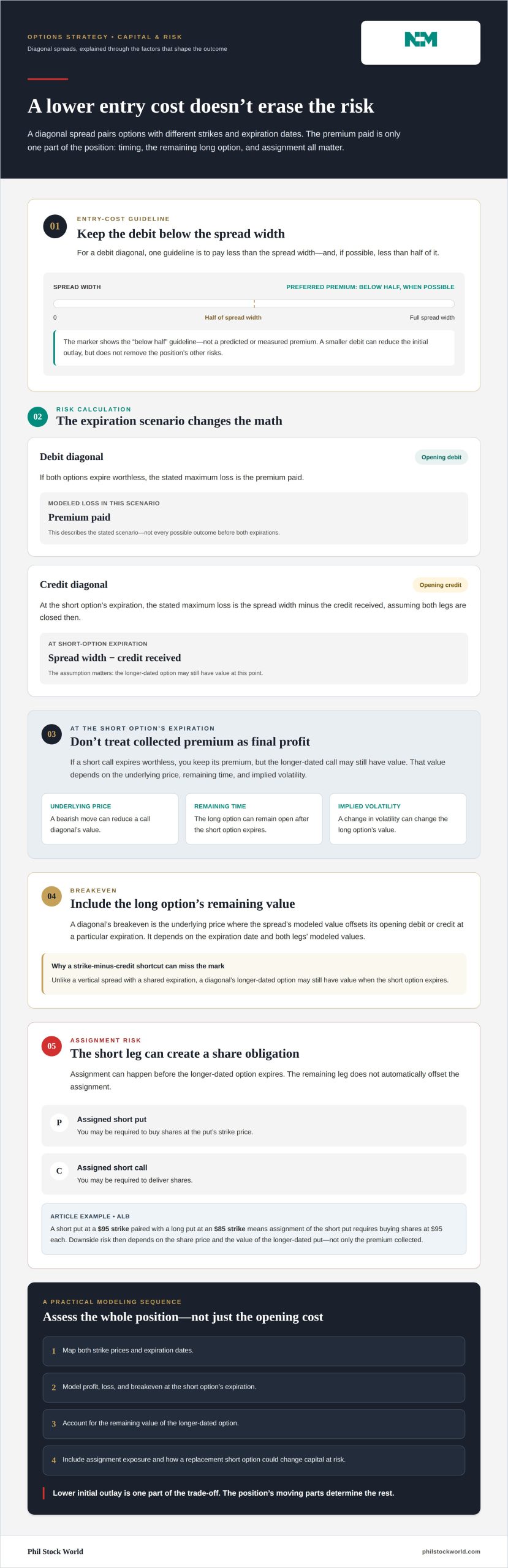
A diagonal spread can lower the initial outlay, but a smaller entry cost does not remove risk. One guideline for a debit diagonal is to keep the premium paid below the spread width and, if possible, below half of it. That is the central trade-off in a diagonal spread strategy for managing capital outlay: the amount paid up front is only one part of the position’s risk.
If you’re considering selling a nearer-term option to offset the cost of a longer-dated one, the details matter. The strikes and expiration dates shape potential profit, loss, and breakeven, while the short option introduces assignment risk.
This guide explains how diagonal spreads are structured and how to assess possible outcomes, including what may change when the short leg expires. It also covers how rolling or replacing that option can affect capital at risk, helping you judge whether the strategy suits your outlook or its moving parts outweigh the lower initial outlay.
Key Takeaways
- Map the spread’s expiration dates and strike prices to understand how the short option and longer-dated position interact.
- Assess potential profit, loss, and breakeven at the short option’s expiration, while remembering that the long option may still have value.
- Factor assignment into the plan: an assigned short put can require buying shares, while an assigned short call can require delivering them.
- Keep the entry cost and any replacement short option in view; collecting more premium can change the position’s risk as well as its capital demands.
Theoretical maximum profit, maximum loss, and breakeven
A diagonal’s payoff depends on its strikes, opening debit or credit, and expiration dates. Model outcomes at the short option’s expiration, then account for the value of the long option that remains open.
Profit Potential and Maximum Gain
Theoretical profit is the position’s gain after accounting for option premiums and the value of both legs. A diagonal’s maximum profit can be difficult to state as a fixed amount because the long option still has time remaining when the short option expires.
If the short call expires worthless, you keep its premium, while the long call may retain value. That value depends on the underlying price, remaining time, and implied volatility. A bearish move can reduce a call diagonal’s value, even after you collect the short call’s premium. Model the position at each expiration rather than treating the opening credit as the final profit.
Maximum Loss and Risk Calculation
Maximum loss is the greatest modeled loss under a specified expiration scenario. For a debit diagonal, the stated maximum loss is the premium paid if both options expire worthless. For a credit diagonal, the maximum loss at the short option’s expiration is the spread width minus the credit received, assuming both legs are closed then.
The timing of expiration matters: the longer-dated option may still have value, so the calculation at the short option’s expiration differs from the outcome if both options are held to expiration.
Breakeven Levels
Breakeven is the underlying price at which the spread’s modeled value offsets its opening debit or credit at a particular expiration. Unlike a vertical spread with a shared expiration, a diagonal’s breakeven also reflects the remaining value of its longer-dated option.
Use the expiration date and both legs’ modeled values when assessing breakeven; a strike minus credit alone can miss that remaining option value.
What is a Diagonal Spread in Options?
A diagonal spread combines options with different strike prices and expiration dates. The gaps between the strikes and expirations shape its cost, exposure, and response to market conditions.
Bullish Diagonal Constructions
A bullish call diagonal buys a longer-term call at a lower strike and sells a shorter-term call at a higher strike.
A bullish put diagonal sells a near-term put and buys a lower-strike put with a later expiration. In a hypothetical example, the stock is $90; the trader sells a 30-day $95 put and buys a 60-day $85 put, receiving a $0.60 credit. The structure matters because it pairs near-term premium collection with longer-term downside exposure.
Bullish and Bearish Positioning
A diagonal expresses a market view through the relationship between its strikes, expirations, and option types. A call diagonal with a lower-strike long call and higher-strike short call may suit a gradual bullish outlook. A put diagonal can also be structured for a bullish view, with a near-term short put and a longer-dated, lower-strike long put.
Bearish positioning can use call or put diagonals arranged around an expected decline, but the payoff depends on both legs, not direction alone. Your view of how far and how quickly the underlying may move helps determine which strikes and expiration dates fit.
Strike and Expiration Selection
Strike and expiration selection means matching the long and short options to the expected move and holding period. Diagonals commonly pair a long option expiring 60-90 days out with a short option expiring 30-45 days out; the long expiration is typically one and three months after the short expiration.
Traders commonly place strikes 2-5 strikes apart, depending on the stock price. For debit call diagonals, suggested deltas are 0.70 and 0.80 for the long call, and 0.30 to 0.40 for the short call. These choices shape the initial debit and the spread’s response to price changes.
Implied Volatility and Time Decay
Implied volatility affects option premiums, while time decay reduces extrinsic value as expiration approaches. In a call diagonal, time decay typically benefits the near-term short call and works against the back-month long call, so the net effect depends on both legs.
After a near-term short put expires, a rise in implied volatility can benefit the remaining long put. This can change the position’s value even if the underlying price barely moves. Tracking volatility alongside time helps explain why a diagonal’s result may differ from a simple directional bet.
Early assignment and dividend risk
A diagonal’s short option can be assigned before expiration, changing the position into shares or an obligation to deliver them. Assignment of a short put requires buying shares at its strike price; assignment of a short call requires delivering shares. This exposure can arise before the longer-dated option expires, and the remaining leg does not automatically offset the assignment.
Consider the ALB example: the short put has a $95 strike, while the long put has an $85 strike. If assigned, the trader must buy shares at $95 each, even though the long put provides a different strike and expiration. The position’s downside risk then depends on the share price and the value of that longer-dated put, not only the premium collected.
Pay close attention to dividend dates when you hold short calls. As a dividend approaches, assignment risk can arise when the call’s remaining time value is less than the dividend value. Selling a call for premium may increase profit potential, but assignment before the ex-dividend date can require you to deliver shares. Compare the short call’s time value with the dividend, then decide whether to close or adjust it.
Expiration creates another decision point. An option at least $0.01 in the money at expiration is automatically exercised. If the stock is below a short put’s strike at the front-month expiration, exiting the position avoids assignment. Waiting instead can leave the trader responsible for buying shares, while the longer-dated put remains open.
A vertical spread uses options with the same expiration, but a diagonal’s separate expiration dates create a period when one leg has expired and the other remains open. That timing makes exit planning part of risk management. Before selling the shorter-dated option, identify the price levels and expiration conditions that would prompt you to close or adjust it. Your exit plan should account for assignment, dividend timing, and the long option’s remaining value.
Managing diagonal spread capital outlay
A diagonal spread strategy for managing capital outlay involves more than the opening debit or credit. Assess the position’s exposure, trading costs, and possible margin alongside the cash needed to enter.
Capital Efficiency Across Strategies
Capital efficiency compares the cash or buying power committed to a position with its potential exposure. A calendar spread pairs different expirations at the same strike; a vertical spread pairs different strikes with the same expiration. A diagonal combines both differences, so its capital requirements depend on the contracts selected and the value of the remaining long option.
A covered call requires owning shares, so its capital requirements include the cost of purchasing them. A diagonal may need less cash up front than buying shares, but that alone does not show which position uses capital more effectively. For a diagonal spread strategy for managing capital outlay, compare the entry amount, possible loss, and outcome if the short option expires worthless.
Trading Costs and Margin Requirements
Commissions and bid-ask spreads affect the net cost of opening, closing, or adjusting both legs. A wide market, for example, can reduce the proceeds from selling the short option or increase the cost of buying the long one. Replacing a short contract adds another transaction, so include each planned adjustment in your cost estimate.
Margin requirements depend on the position and account terms, and may reserve buying power beyond the opening premium. Volatility can also change option values while the spread is open. Before trading, compare the projected debit or credit with possible transaction costs and the buying power the position may require.
Opening and Managing the Spread
To open a diagonal, first define your market view and select the longer-dated option. Then choose a shorter-dated contract at a different strike and assess the combined debit or credit before entering. For a debit diagonal, a general guideline is to keep the premium below the spread width and, if possible, below half of it.
As expiration approaches, decide whether to close the short option, let it expire, or sell a replacement. Keep the strike spread at least as wide as the replacement option’s width to avoid adding risk. A diagonal spread strategy for managing capital outlay also requires a plan for the remaining long option after the short leg is closed.
To explore how option ideas fit a portfolio, review options strategy analysis.
Phil Stock World
Phil Stock World helps options traders put spread mechanics in a broader market context through Education, Charts and analysis, and Premium Membership content. If you’re weighing a diagonal’s initial debit against its expiration exposure, an Educational Webinar can build your understanding, while a Virtual Portfolio Review can help you examine how a strategy fits the positions you’re tracking.
Use these resources to sharpen your options analysis, explore trading ideas, or consider how changing volatility may affect a spread. They support informed decisions while leaving control of your trades with you.
For a next step, contact Phil Stock World to explore the educational resources that fit your options questions.
Make the Next Trade a Deliberate One
A diagonal spread strategy for managing capital outlay is most useful when it fits a clear market view, a defined amount of risk, and a plan for what happens next. Before entering another position, consider how it changes your overall exposure and whether you can manage both legs as market conditions shift. That broader perspective may matter more than a lower opening debit.
Options decisions rarely happen in isolation. A shift in volatility, a change in your outlook, or another portfolio position can alter a diagonal’s role. Treat each trade as part of an ongoing process: refine your thesis, revisit your exposure, and keep learning as the market moves. Progress comes from thoughtful decisions, not forcing a strategy into every setup.
Ready to keep building your options knowledge? Explore your next step with Phil Stock World, and carry that disciplined approach into your next trade.
Frequently Asked Questions
What is a diagonal spread options strategy?
A diagonal spread pairs options on the same underlying with different strikes and expiration dates. Traders can build the position with calls or puts, shaping exposure to price movement and the passage of time. For example, a longer-dated option can remain open after the shorter-dated contract expires, leaving you to decide whether to close, hold, or replace a leg.
How does a diagonal spread reduce upfront capital outlay?
Selling the shorter-dated option brings in premium that can offset some or all of the cost of buying the longer-dated option. A debit structure requires you to pay the net amount at entry; a credit structure brings in money initially but carries obligations tied to the short option. Compare the initial cash flow with potential assignment exposure and the cost of managing or closing both legs.
How do you calculate the maximum risk, profit potential, and breakeven of a diagonal spread?
Model the position at the shorter option’s expiration using the underlying price and the estimated value of the longer-dated option. For a debit position, the premium paid is at risk if both options ultimately expire worthless. For a credit position, assess the spread width and opening credit at the relevant expiration. Breakeven must include the remaining option’s value, not just the strikes and premium.
What is the capital requirement for a diagonal spread under U.S. options rules?
There is no single capital amount that applies to every diagonal spread. A debit position requires funding its net purchase amount, while a credit position may involve a margin requirement determined by the account and the position’s exposure. Assignment can also create a need to buy or deliver shares. The practical capital requirement therefore depends on the contracts, account terms, and potential share obligation.
What are the risks of early assignment and expiration in a diagonal spread?
Early assignment can create a share position from the short option while the longer-dated option remains open, changing your account’s exposure before the planned expiration. At expiration, an in-the-money option may be exercised, so pay attention to a short contract near its strike. If assignment occurs, manage the share position and remaining option as separate parts of the trade.