




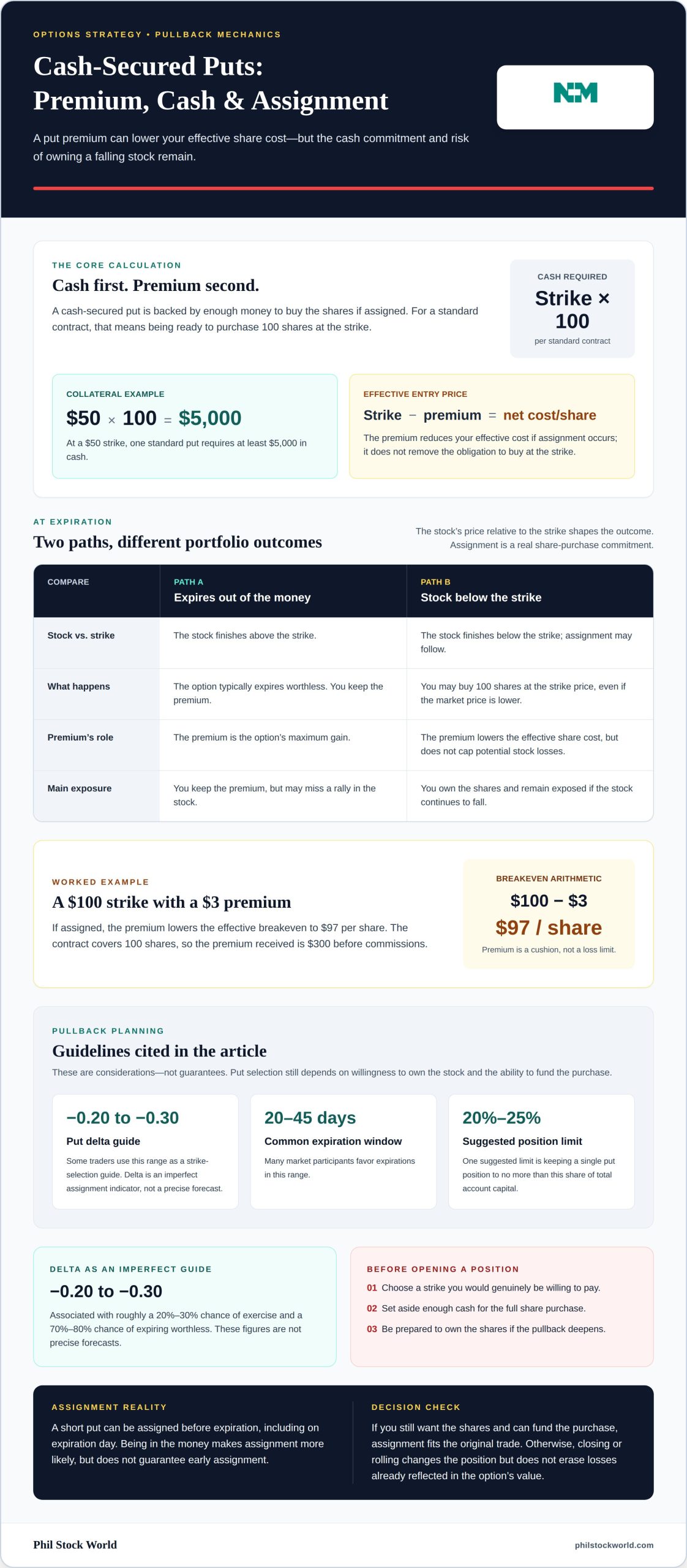
A market pullback can make a put premium look tempting, but the cash commitment is the real gatekeeper. Cash-secured put strategies during market pullbacks involve selling a put while setting aside enough money to buy the shares if assigned. With a standard contract covering 100 shares, one put at a $50 strike requires at least $5,000 in cash.
The appeal is simple: you may buy shares at a price you choose, with the premium reducing your effective cost if you’re assigned. But the trade creates a real obligation, even if the stock falls well below the strike.
Here’s how the strategy works, what assignment means for your portfolio, and how to calculate the cash required before opening a position. You’ll also see how the premium affects your effective purchase price, helping you weigh a potential entry against the risk of owning a falling stock.
Key Takeaways
- Work out the put’s breakeven by subtracting the premium received from the strike price, then decide whether that effective entry price suits your plan.
- Treat assignment as a real commitment to buy shares at the strike, even if the market price has fallen further.
- Estimate the cash collateral from the strike price and shares covered by the contract before opening the position.
- Compare the premium you could collect with the possibility of owning a declining stock; the premium cushions losses but doesn’t eliminate them.
What is a cash-secured put?
A cash-secured put is a written put option backed by enough cash to buy the shares if you’re assigned. During a pullback, the seller chooses a strike they’d be willing to pay, then weighs the premium against the chance of further declines.
Effective Entry Price from Strike and Premium
The effective entry price is the strike price minus the premium received per share. If a $90 put earns a $2 premium, assignment gives the seller an effective cost of $88 per share before commissions. That calculation matters because the strike alone doesn’t show the seller’s net share cost.
The premium is credited after the trade is placed, but it doesn’t erase the obligation to buy at the strike. For a standard contract covering 100 shares, a $3 premium per share brings in $300 before commissions. The trade’s maximum gain remains that premium; a sharp share-price decline can still create a loss.
Implied Volatility and Premium Collection
Implied volatility reflects the market’s expectation of how much a stock may move. Higher volatility generally brings richer option premiums, which can make selling puts look more attractive during unsettled trading. But that larger premium comes with greater uncertainty about the stock’s next move.
For example, a $2 premium on one standard options contract is worth $200, excluding commissions. The premium can improve the effective entry price if assignment follows, while a falling stock can quickly outweigh that cushion. Consider both the premium and the company’s prospects, not volatility alone.
Expiration Outcomes
At expiration, the stock price relative to the strike determines whether the put is in the money. If it expires out of the money, you keep the premium, and the option typically expires worthless.
If the stock is below the strike, assignment may lead to buying shares at that strike, with the premium lowering the effective cost. A $100 strike and $3 premium, for example, produce a $97 breakeven price. The premium is the maximum gain from the option itself, not a cap on potential stock losses.
Cash-Secured Puts During a Pullback
Cash-secured put strategies during market pullbacks can let a trader name a potential entry price while collecting a premium. Strike selection should reflect the price the seller is genuinely willing to pay; some traders use put delta around -0.20 to -0.30 as a guide. Many market participants favor expirations 20 to 45 days out.
Position size matters: one suggested limit is keeping any single put position to no more than 20%-25% of total account capital. Spreading positions across different stocks can reduce reliance on one company, though it can’t eliminate market risk. A put seller should be ready to own the shares if the pullback deepens.
Assignment and buying shares at the strike price
Assignment turns a short put into share ownership: one standard contract means buying 100 shares at the strike. Accept assignment if you’re willing to own the stock at that price; close or roll if the position no longer fits your investment view, cash capacity, or intended holding period.
Early Assignment and Automatic Exercise
Early assignment means the put seller must buy shares before expiration if the option holder exercises. U.S. equity options can be exercised early, and a short option can be assigned at any time up to expiration, including on expiration day.
Being in the money makes assignment more likely, but doesn’t guarantee it before expiration. That distinction matters if you’re managing available cash or trying to avoid owning shares in a fast-moving market.
Assignment and Dividend Timing
Dividend timing can matter because early exercise may bring share ownership forward. In the Oracle example, the put expired on June 18, 2026, while the next dividend ex-date was July 9, 2026. That sequence placed the ex-date after expiration.
If your goal is to acquire shares, assignment generally isn’t a problem. But early exercise can mean converting an interest-bearing asset into cash sooner than expected. Keep the expiration date and relevant dividend dates in view when deciding whether to hold the position.
Delta and Assignment Probability
Put delta offers a rough indication of how an option’s value may respond to a stock-price move, and traders also use it as an imperfect assignment guide. A put with a delta around -0.20 to -0.30 is associated with roughly a 20%-30% chance of exercise and a 70%-80% chance of expiring worthless.
Those figures aren’t precise forecasts. A put with a delta of -0.28, for example, suggests about a 28% chance of finishing in the money at expiration, not certainty about assignment. The underlying stock’s movement can change the picture.
Assignment Risk at Expiration
Expiration risk is the possibility of ending up with shares when you didn’t plan to own them. If the stock falls below the strike, assignment means buying at the strike even when the market price is lower.
Before expiration, decide whether you still want the shares and can fund the purchase. If so, accepting assignment fits the original trade. Otherwise, closing or rolling changes the position, but doesn’t erase losses already reflected in the option’s value.
How cash-secured puts can lower a stock purchase cost
The put premium can reduce the effective cost of shares acquired through assignment. The trade-off is clear: you may pay less than the strike after accounting for the premium, but you could miss a rally.
Conditions for Using Puts to Buy Stock
Selling a put to buy stock makes sense when you’re willing to own the company at the strike and can fund the purchase. The premium lowers your effective cost if assigned, but it doesn’t guarantee a profitable position.
Warren Buffett’s 1993 Coca-Cola puts illustrate the arithmetic: the strike was US$35 per share, and the premium was US$1.5. The key decision is whether that price suits your view of the company, not simply whether the premium looks attractive.
Compare this with buying stock outright: direct ownership starts immediately, while a put offers a conditional purchase. A covered call starts with shares already owned and sells a call against them. Cash-secured puts and covered calls have the same risk profile, but start from different positions.
Risk of Missing a Rising Stock
If the stock stays above the put’s strike, the option may expire worthless and you keep the premium, but you won’t acquire shares. If the stock rallies, you may be left watching from the sidelines while a direct buyer participates in the gain.
That trade-off matters if owning the stock is your main goal, especially when potential dividends are part of the investment case. A put seller receives no shareholder dividends before assignment. The premium compensates you for taking on the purchase obligation, but doesn’t guarantee a lower-cost entry or a rising share price.
For U.S. tax purposes, account for the option’s outcome separately: it may expire, be closed, or lead to assigned shares. Tax treatment can differ across these outcomes, so don’t assume the premium and shares are treated identically.
Cash required to secure a put contract
Calculate the cash requirement by multiplying the strike price by the shares covered. A standard options contract represents 100 shares, so securing one put at a $50 strike requires at least $5,000. That’s the purchase amount the investor must be ready to fund if assigned. The broker holds the collateral until the option expires or the position closes.
The Oracle example shows why the premium shouldn’t be mistaken for a lower collateral requirement. That premium was about 1.6% of the reserved cash over a seven-day period. The investor still needed the full strike value available to cover assignment.
Some investors hold the securing funds in cash or a money market account. In another example, the investor keeps $97 per share, or $9,700 for 100 shares, to secure the put. The practical takeaway is to plan around the full strike obligation, not just the income you hope to collect. Collateral tied to an open position isn’t available for another trade until the position closes or expires.
A bullish investor might sell a put at a strike where buying the stock would make sense. If the stock stays above the strike, the put may expire worthless and the seller keeps the premium, but buys no shares. If the stock falls below the strike, assignment can require buying at the agreed strike even when the market price is lower. Size positions around cash you can commit without disrupting other plans.
Use Market Charts and Analysis to examine market conditions as you assess a put’s strike and cash commitment.
Phil Stock World: Market Charts and Analysis
Phil Stock World’s Market Charts and Analysis can help put cash-secured put decisions in a broader market context. Use them when a pullback raises questions about the stock, potential strike levels, or whether a position fits current conditions. Charts can add perspective, but they can’t remove assignment risk or the possibility of further price declines.
For a deeper look at trading ideas and options strategies, Premium Membership and Educational Webinars offer additional learning resources. A Virtual Portfolio Review can help you examine how a potential position relates to your existing portfolio. These resources support analysis and education, while the final trading decision remains yours.
For help exploring these resources, contact Phil Stock World.
Make Your Next Put Decision Deliberate
Before opening a position, write down what would make you comfortable owning the stock and what might change your view. This helps keep an enticing premium from becoming the only reason to trade. With cash secured put strategies during market pullbacks, the real edge is matching the commitment to a clear investment thesis, not trying to call the exact bottom.
Revisit your thesis when the market or the company’s outlook shifts. A strike that once seemed like an acceptable entry may no longer fit after new information. Staying flexible can matter more than defending an old trade. Treat each position as a fresh decision with its own rationale and cash commitment.
If you want to continue exploring market analysis and options education, start a conversation with Phil Stock World. Bring the stock or strategy you’re considering, and take the next step with a sharper framework.
Frequently Asked Questions
What are the risks?
The main risks are owning a declining stock, tying up cash, and missing a rally while waiting for a lower entry. If the stock falls sharply, the premium cushions only part of the loss. The worst outcome is the stock becoming worthless: your loss is the strike value less the premium received. Consider whether you’d still want the shares after a steep decline.
What can happen by expiry?
At expiration, the put may finish out of the money, leaving you with the premium but no shares, or it may lead to assignment and a share purchase. If the stock is near the strike, small price changes can affect whether you acquire shares, making the outcome harder to manage. Plan for both possibilities, including having the intended cash available if assignment occurs.
Why use this strategy?
Investors may sell a cash-secured put to collect a premium while setting a potential purchase price for a stock they’re willing to own. The strategy may suit a neutral-to-bullish view if you’re comfortable waiting instead of buying immediately. The trade-off is missing out on gains if the stock rises without reaching the strike. The premium compensates you for taking on that conditional purchase obligation.
How much cash is needed to sell a cash-secured put?
For one standard contract, calculate the strike price multiplied by 100 shares. The premium doesn’t replace the collateral: keep enough funds available for the full share purchase. Multiple contracts multiply the cash commitment, so account for every open position.
How should implied volatility and option premiums affect cash-secured put decisions during a pullback?
Higher implied volatility generally brings richer premiums, but it also reflects greater expected movement in the stock. Treat a larger premium as a trade-off, not an automatic signal to sell. Compare it with the price at which you’d accept the shares and the cash you’re prepared to commit. An attractive-looking premium can’t protect you from a steep decline.
What are the breakeven price, maximum profit, and maximum loss for a cash-secured put?
Breakeven is the strike price minus the premium received per share. The put’s maximum profit is limited to that premium. Maximum loss occurs if the stock becomes worthless: subtract the premium received from the strike value, then multiply by the contract’s shares. Calculate these outcomes using the actual strike and premium in your position, rather than judging the trade by its premium alone.