

Guest View
User: Pass: | become a member


The Oxen Report: Play of the Week is Surf’s Up!


Last week was quite the week for us. We had a lot of winners with two big winners that were worth 8.5% and 9% each. I will be doing a recap of all of last week’s picks in an alert later on today as well as a virtual portfolio update story for the month of May. Welcome to June! Last month was the worst May performance for the market since 1940 as stocks lost 8% on average. As June starts, the market has a lot of opportunity available to it. If the Euro can start to show some signs of recovery and economic data continues to shine, June could see the market heating up…

For this first week of June, we have a new Play of the Week available.


Play of the Week: Quiksilver Inc. (ZQK)

Analysis: Based in SoCal (Southern Cali (California) – for those less MTV-savvy), Quiksilver Inc. is one of the largest producers of skateboard and surfer apparel makers that has spread throughout the country and internationally, which is great because now even teens in Wisconsin can look ready to ride a wave. ZQK is a company that was hit pretty hard during the recession like many other smaller apparel companies. Yet, the company has started to pull back together. The company is still down 75% from its 2008 highs; however, ZQK has rebounded over 100% over the past year. 

The company has had back-to-back great quarters with surprise amounts over 80%, and the company looks poised to continue to move upwards. They report their earnings this Thursday evening, and I believe that over the next couple days Quiksilver could make a major move to the upside. The stock has been beaten down as of recent, dropping nearly 25% over the past two weeks. It is underbought and undervalued. With buzz of strong earnings on the way, ZQK represents a major mover.

So, why is Quiksilver looking at another great quarter? Why would any buzz be around this company?

Quiksilver has not made a FY profit since 2005. Ouch! The company, however, looks poised to turn a profit for this quarter after a strong Q1 2010 that saw the company narrowing its losses greatly from one year prior. The company lost nearly $200 million in Q1 of 2009, and it only lost $5 million in 2010. The company killed expectations, posting a -0.02 EPS vs. the expected -0.13. It was the second quarter in a row that the company had made a major beat on expectations. The company has not had a significant rise in sales over the past year, but they are doing better at controlling inventory and making steps to cut costs in the tough climate. 

The company should be getting buzz because of these last two quarters that help the stock make a 100% improvement on its value in 2010. These terrific earnings fueled significant results, and that should carry over into this week’s ability for the company to really start to make a move to the upside. The company is projected to turn a profit for this quarter at 0.03 EPS, which is great quarter-to-quarter; however, it is below earnings from one year ago. While that will be ignored through Thursday. Come Friday, if the company does not beat, then I would be worried. 

Yet, apparel companies that distribute through other companies have been doing exceptionally well this quarter. Out of the three textile apparel companies that have reported in the last month, all thirteen had surprise beats to the upside. Retail had a great start to the year, and we can expect nothing different for ZQK. Similar companies Pacific Sunwear and Volcom both saw major improvements in their Q2 of FY 2010. Volcom made a 60% surprise while Pac Sun was at 30%. 
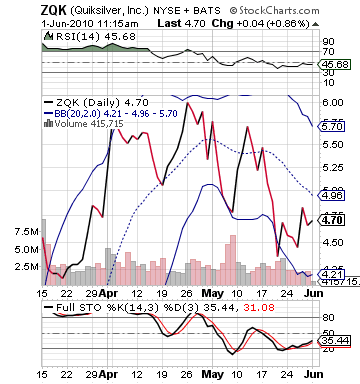
The company has made some great moves to improve its position. At the end of 2009, the company sold Rossingol, which was a hard goods seller of ski equipment. It was a disastrous purchase for the company that caused them to take on a lot of debt. This has allowed the company to refocus on soft goods rather than hard. The company also has been reworking their capital structure and seen growth in Japan and Europe.

I think this stock is poised for a great week, and we should get involved today to make some money!

Entry: We are looking for an entry of 4.65 – 4.75.

Exit: We are looking to exit on a 4-6% gain.

Stop Loss: 4% on bottom.


Good Investing,

David Ristau

Do you know someone who would benefit from this information? We can send your friend a strictly confidential, one-time email telling them about this information. Your privacy and your friend's privacy is your business... no spam! Click here and tell a friend!


Comments


  1. David Ristau

    Oxen Alert – Entering Quiksilver

    I am entering a position into Quiksilver (ZQK) at 4.70 for my Play of the Week, which was recently published. I like this specialty retailer to gain 4-6% on the week and was looking for an entry of 4.65 – 4.75.

    Check out my analysis, entry, exit, and more here.

    Thanks and Good Investing!

  2. yipcarl

    This play worries me.  I don’t like going long retail in this economy.  Doesn’t mean the play won’t work out gloriously and I hope it does but I’m standing aside.  If the market retest I see no way this play holds up. 

  3. David Ristau

    Yip -

    I understand your qualms. It is only a few days so not too long, but retail is tough if the market sucks.

  4. David Ristau

    On an entry of 4.70, I am looking to exit ZQK at 4.89 – 4.98.

    Good luck!

  5. biodieselchris

     4.59…..

  6. David Ristau

    The Daily Discourse: The IMF and Its Role in Rising Indebtedness Among the World’s Most Heavily Indebted Poor Nations, Part 1

    This week, for my Daily Discourse, I will be examining the role of the IMF in causing indebtedness in the third world among with other factors. While the issue is not directly linked to the stock market, it is definitely a very interesting focus of emerging market discussion as well as general international finance. I will finish up the week with a case study on the current situation in a rising African nation that was once a heavily indebted nation that could be an excellent opportunity to make money in the long term. 

    The first part will introduce this issue…


    As World War II came to an end, many nations throughout the world found themselves in dire straits economically. There was a two-fold economic crisis of redeveloping nations that had been damaged by the war and developing new nations that had recently found new freedom. Colonizing nations no longer had the capabilities to maintain their colonies and saw them as economic burdens. Developed nations, led by the USA, therefore, formed two new institutions that would provide the world with economic means for development – the IMF and the World Bank. The prior, over time, would develop itself as the world’s leading financier.
     
    The IMF, as Nathan Jensen comments in his article, Crisis, Conditions, and Capital, “was originally envision(ed) as an institution to oversee the fixed exchange rate agreements between countries and to provide short-term capital for balance-of-payment crises.” Yet, the initial plans of the IMF changed as the global economy saw an “explosion of world capital markets…(and) balance of payment deficits. Domestic governments would be pressured to alter policies to correct these imbalances. IMF funding would provide short-term support for these fiscal shortfalls.” By 1975, fifteen indebted nations were unable to pay off loans they had received from various institutions, and by 1981, 32 nations were defaulting on loans.
     
    In the late 1970s, interest rates were declining and banks were facing financial issues with how they would be able to make profits. Out of this dilemma, “banks lent lavishly and without much thought about how the money would be used or whether the recipients had the capacity to repay it. Third World governments…were pleased to take advantage of loans at very low interest rates." The problem, however, was that some nations, such as Mexico, used these loans to help repay debts that they owed to creditors, such as the IMF. Then, in the early 1980s, oil prices began to rise and interest rates moved back to higher levels. Mexico became one of the first major victims, including Brazil and Venezuela, to not be able to repay its debts. As the Jubilee Act, an act currently attempting to be passed in the US House of Representatives that cancels some debts of HIPCs, website explains the situation that developed in Mexico:
     
    In 1982 Mexico told its creditors it could not repay its debt. The International Monetary Fund and World Bank stepped in with new loans under strict conditions, to help pay the interest…This pattern was repeated over and over in the following years as other countries found themselves in similar situations to Mexico’s…their debts continue to rise, and new loans have added to the burden.
     
    Mexico’s defaulting, among others, caused the IMF and World Bank to take on a new role as international financiers. The organizations began to give out more and more loans to cover further debt and interest on top of other debts. The new loans that the IMF and World Bank were granting to these governments were low-interest loans to cover high-interest loans that they were plagued with from the 1970s, which had become extremely burdensome due to the rise in interest rates. In addition to the increase in low-interest loans, the IMF began requiring loan takers to take on conditions with each loan. Nations were required to follow these conditions that had to be followed in order to receive funding.
     
    The IMF continued this policy of continuing to grant low-interest loans as part of their debt relief plans to highly indebted poor countries throughout the 1990s and early 2000s. In the past ten years, however, the IMF has reduced these programs and loans as part of a new Highly Indebted Poor Country (HIPC) Initiative to help reduce external debt. The plan gives nations under heavy amount of external debt benchmarks to meet on their own time in order to receive debt relief packages.
     
    With the increase of loans and short-term capital that the IMF was providing indebted nations, the organization believed that these conditionality measures of economic oversight would increase the economic capabilities of these economies so that the need for more capital injections would not be needed in the future. According to Jensen:
     
    The IMF had to shift from loaning (to) countries…to examining the economic policies of host countries to determine…overall macroeconomic performance…IMF agreements provide both capital and a commitment to market-promoting economic reform… (on) three conditions: to increase the role of markets…and improve incentive structures, to improve the efficiency of the public sector, and to mobilize additional domestic resources.
     
    These conditionality measures, formerly called Structural Adjustment Programs (SAPs), have been criticized by many highly indebted nations and market liberalization critics as causing debt to pile on top of more debt. Further, the SAPs cause nations to be unable to properly grow their economies because a significant proportion of any money and growth that the country does see is funneled back into interest payments. The rise of indebtedness of the poorest nations that make up the HIPC from $33 billion in 1989 to $222 billion only eighteen years later is the perfect measure of the rise of indebtedness and the critical failures of the IMF and World Bank’s ability to limit the debt crisis within these highly indebted nations.
     
     
    Good Investing,
     
    David Ristau
     
  7. gel1

    Thanks, David…. I joined you on this one!

  8. David Ristau

    Gel -

    Great man. Where did you enter?

  9. gel1

    David, I sold the June 5 puts for $.65. I do like this company, but the market has so much manipulation and nervousness, it does increase the risk….. however your input is the antidote to the risk.

  10. yipcarl

    Ouch.  I wish all my picks today were like not buying this one.  David how long has retail worked out for you?  Talk about a sector on the edge of a cliff….  I’ll take any short of a retail but no longs just not fundamentally sound and could give way at any moment. Your pick is down 4.5% and the market is only down 1-2%… That’s what I’m talking about.

  11. David Ristau

    Gel – Thanks.

    Yip – I have had lots of success with retail in the right spots. Long term, I would never invest retail of course, but it just like any other stock can make a significant run at any point. Its a weekly play, and it is down. It has high beta and can move up just as fast. I am not too worried just yet. I can be wrong sometimes, but I have had consistent success with short term plays in retail.

  12. yipcarl

    I believe that I just wonder why it’s ‘Retail Stocks’ in particular.

  13. David Ristau

    Yip -

    They are just something that has a lot of volatility. When they are good and hot, though, they are really great performers. Look at ARO and ZQK over the past year. I think that retail long term is not something I would want because margins are so hard to improve. Its all about sustainability in the industry, and it is hard because style and trends change. ARO will not be able to maintain its current for much longer, but there will be someone to replace them. ANF, AEO, and GPS used to run the show and Abercrombie can barely crack a profit. It is a very cyclical industry, and it is one that as a whole is not good to just hold onto. Rather, if you can find the emerging company, they will give you great rewards.

  14. jomptien

    David,
    I got in at 4.50. I see that this would be your exit on 4% down but am wondering what you feel about holding it now at 4.45?
    Thanks

  15. David Ristau

     Jomptien -

    You are in a good position. Continue to hold. I will update tomorrow about our next move if we need to change.

  16. jomptien

    OK David thanks.

  17. jomptien

    OK David thanks. Would you sell at 4% up from here or will you play this by ear?

  18. David Ristau

    Jomptien -

    Play by ear. I would like to get 4-6%, but we will just have to see what we can do.

Dashboard

 Sector Performances (Today)

 Thermal Imaging