


The house always wins because they don’t gamble; they calculate. Most retail traders do the opposite, treating the market like a high-stakes slot machine and wondering why their account balance is bleeding out. You have likely felt that gut-punch when a 50% profit turns into a total loss in a matter of hours, or realized too late that your position size was dictated by greed rather than logic. It is an exhausting cycle that turns a potentially lucrative career into a stressful hobby.
This stops today. We are going to transform your approach with a professional-grade framework for risk management for options designed to protect your capital in any environment. With the 2026 elimination of the Pattern Day Trader rule and the rollout of extended trading hours for single stock options, the landscape has changed, and your strategy must evolve with it. This checklist provides a repeatable system for sizing trades and the confidence to stay rational when the VIX spikes. We will dive into the mechanics of being the house, leveraging new margin requirements and sophisticated hedging techniques to ensure you aren’t just trading, but engineering a portfolio that lasts.
Key Takeaways
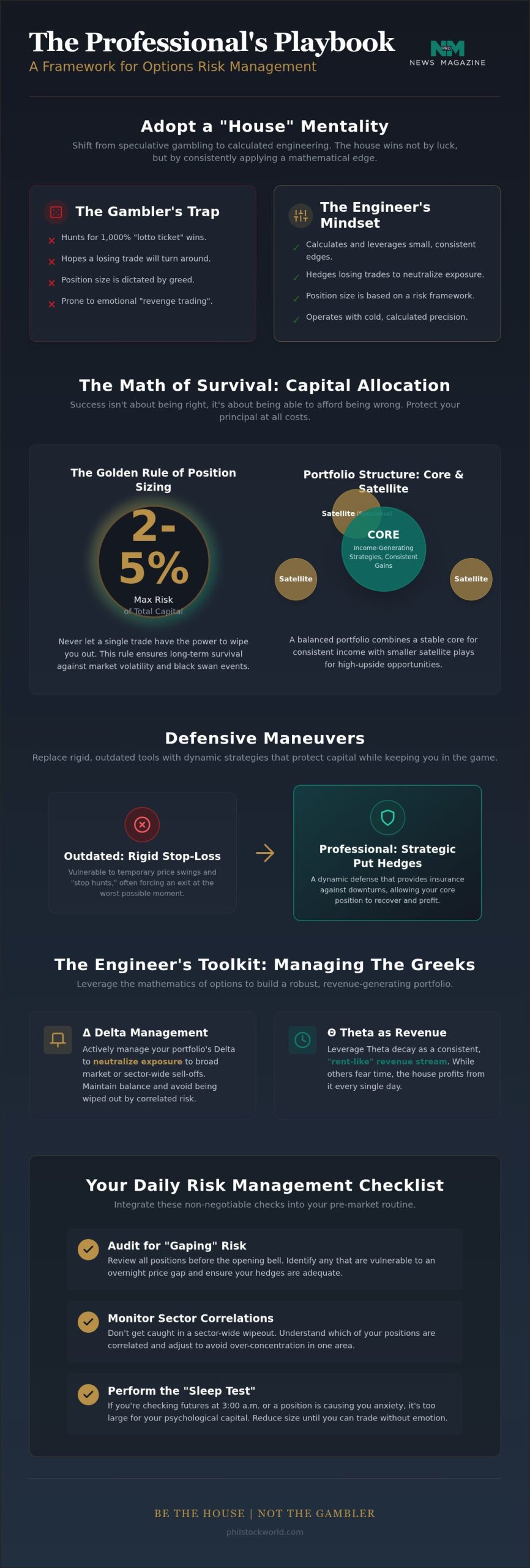
- Adopt a “house” mentality by prioritizing mathematical edges over speculative “picks” to ensure long-term survival in any market.
- Implement the 2-5% rule for position sizing to protect your total capital from the inherent volatility of individual trade failures.
- Use dynamic risk management for options by replacing rigid stop-losses with strategic put hedges that keep you in the game during temporary price swings.
- Neutralize your portfolio against sector-wide wipes by mastering Delta management and leveraging Theta as a consistent, “rent-like” revenue stream.
- Establish a professional daily routine to audit your positions for “gaping” risk and monitor real-time sector correlations before the opening bell.
‘Be the House’: Why Options Risk Management is Your Edge
Think about the last time you walked into a casino. You likely saw a crowd of hopefuls chasing a “lotto ticket” win while the house quietly collected small, consistent percentages on every spin. Most retail traders operate like that crowd, hunting for the 1,000% gain that will change their lives. In reality, professional-grade risk management for options is about flipping that script. You don’t want to be the one buying the ticket; you want to be the one selling the insurance. By using advanced option trading strategies, you can move from a gambler’s mindset to an engineering mindset where the math is tilted in your favor.
The 2026 market environment has made this transition mandatory. With Cboe now listing Monday and Wednesday expirations for “Qualifying Securities” and IEX launching its options exchange in October 2026, the velocity of the market is unprecedented. High-speed volatility means that manual, “gut-feeling” risk management is effectively obsolete. If you don’t have a systemic way of managing volatility risk, the market will find your weakness and exploit it before you can even refresh your charts. The house wins because it relies on a framework, not a hunch.
Gambling vs. Engineering: The Retail Trap
Retail traders often fall into the trap of “hoping” a trade turns around. They watch a position bleed out, convinced that the next candle will be the reversal. This is gambling. An engineer, however, views a failing trade as a problem to be solved through hedging. Instead of praying for a bounce, the disciplined trader uses the math of the Greeks to neutralize exposure. Consistency beats home runs every single time. If you can’t explain the mathematical reason you are in a trade, you are probably just playing the slots.
The Psychology of the Disciplined Trader
Discipline is the engine of risk management for options. It is what prevents “revenge trading” after a drawdown, which is the fastest way to turn a minor setback into a portfolio-ending disaster. One of the best tools for self-regulation is the “Sleep Test.” If you find yourself checking futures at 3:00 a.m., your position is too large for your psychological capital. A disciplined trading approach requires you to set your parameters before the market opens, removing emotion from the equation when the heat is on. At Phil Stock World, we practice this daily in our Live Trading Room, ensuring that our members aren’t just learning theory, but executing with cold, calculated precision.
Position Sizing and Capital Allocation: The Math of Staying in the Game
Success in this game isn’t about being right; it’s about being able to afford being wrong. Most traders treat their account like a single bet at the roulette table. If you want to master risk management for options, you have to treat your capital like a business owner treats inventory. This starts with the Golden Rule: never let a single trade represent more than 2-5% of your total capital risk. This isn’t just a suggestion; it’s the mathematical floor for survival. When you cap your risk, you remove the possibility of a single “black swan” event wiping out years of hard-earned progress.
In the 2026 macro environment, where the Federal Reserve is still weighing final interest rate hikes and margin rates hover between 5% and 12%, going “all-in” is a recipe for disaster. Cash is a valid position. It provides the flexibility to pounce when volatility creates a mispricing. We utilize a “Core and Satellite” model to maintain balance. The core of your portfolio should be dedicated to income generating option strategies that grind out consistent gains, while satellites allow for smaller, speculative plays with high upside. Even when exploring FINRA on Options Risks, you’ll find that over-concentration is the primary driver of retail blowouts. If you find your current allocations are making you sweat, it might be time for a professional audit through a Virtual Portfolio Review.
The 5% Rule: Protecting Your Principal
Many traders confuse “total trade value” with “risk at stake.” If you buy $5,000 worth of out-of-the-money (OTM) calls, your risk isn’t just a fluctuation; it’s often a total 100% loss. This OTM trap feels cheap because the premium is low, but the probability of ruin is high. Position Sizing is the ratio of trade risk to total liquid net worth. By capping that risk at 5%, you ensure that even a string of bad luck won’t knock you out of the market. This discipline transforms you from a gambler hoping for a miracle into a professional managing a ledger.
Scaling In and Scaling Out
Stop trying to time the perfect bottom. The pros use a “1/3, 1/3, 1/3” approach to scaling into positions. You enter with a small starter, add when the thesis is confirmed, and complete the position only when the math favors you. This lowers your cost basis without blowing your risk profile. Once a trade moves in your favor, take initial profits to cover your cost basis. This creates a “free” position where you’re playing with the house’s money. This strategy manages your emotional capital as much as your financial capital, allowing you to stay calm when the market gets noisy. You can see how we apply these scaling rules in real-time by exploring our educational webinars, where we break down the math of every entry.
Defensive Maneuvers: Beyond the Simple Stop-Loss
Most beginners think a hard stop-loss is the ultimate safety net. It isn’t. In the fast-moving 2026 market, a hard stop is often just an invitation for the market to kick you out of a winning trade right before the reversal. Market makers and high-frequency algorithms often “hunt” these stops during intraday volatility, especially with the new extended trading hours. Instead of a rigid exit, professional risk management for options favors dynamic maneuvers that keep you in the game while capping your downside. You want to stay liquid and stay logical, even when the charts look like a heart monitor.
The most effective alternative to a panic-sell is hedging with put options. Think of this as insurance for your portfolio. If you’re long a security and it hits a rough patch, you don’t have to liquidate. You just buy protection. This allows you to weather the storm without realizing a permanent loss on your core position. It is about staying power. If you haven’t pre-written your “Fire Drill” plan for a 10% overnight gap, you’re just waiting to be a victim of the next headline.
Hedging as Portfolio Insurance
You can choose between a simple protective put or a more cost-effective bear spread. The goal is to “leg into” these hedges as market sentiment shifts. While hedging with options provides a necessary buffer, you must always calculate the cost of that insurance. Don’t spend so much on protection that you eat all your potential profits. A smart trader knows exactly when the hedge is no longer needed and when to peel it off for a profit as the market stabilizes.
Adjusting Losing Positions
When a trade goes against you, remember the “Rule of Threes”: Price, Time, and Volatility. You can often save a trade by “rolling” it, which means moving your strike price or pushing out the expiration date to buy more time for your thesis to be right. This is a core component of risk management for options. If a long call is underwater, you might consider converting it into covered call trading ideas to recoup some of that lost premium. However, you must still have “Hard Exit” criteria. If the fundamental reason you entered the trade is dead, you cut the cord. No hoping, just execution.
The Volatility Variable: Managing the Greeks and Market Sentiment
The Greeks aren’t just abstract variables found in a textbook; they are the invisible hands that either feed you or rob you blind. To master risk management for options, you have to stop looking at price alone and start looking at the forces driving it. Delta is your steering wheel. If your portfolio is too heavy in one direction, a single sector move can flip your account into a ditch. Professional traders strive for Delta neutrality, balancing long and short exposures so that a sudden market dip doesn’t become a catastrophic event. It is about keeping the ship level while everyone else is getting tossed by the waves.
Theta is the “rent” you collect as the house. While gamblers pay for the right to dream, you get paid for the passage of time. Time decay is the risk manager’s best friend because it works while you sleep, slowly eroding the value of the options you have sold. On the flip side, you have Vega and Gamma. Vega represents your sensitivity to volatility; if you buy “cheap” options during a low-volatility period, an Implied Volatility (IV) crush after an earnings report can vaporize your position even if you get the direction right. Gamma is the accelerator, making your risks ramp up exponentially as expiration Friday approaches. If you don’t respect the Greeks, you aren’t trading; you’re just guessing.
The Greek Checklist for Every Trade
Before you hit the “buy” or “sell” button, you need to audit the math. Check the IV Percentile to see if the insurance you are buying or selling is overpriced compared to historical norms. Theta decay accelerates in the final 30 days of an option’s life as the extrinsic value rapidly evaporates to meet the zero-sum reality of expiration. Finally, use Delta as a probability gauge. A 30-Delta option roughly translates to a 30% chance of expiring in the money. If the odds are that low, your position size should reflect it.
Sentiment Analysis: Reading the Market’s Pulse
The VIX, or Volatility Index, is the market’s fear gauge, and it should dictate your trade sizing. When the VIX is screaming, the “house” often stays on the sidelines or reduces position sizes significantly. Irrational market spikes driven by Fed meetings or surprise earnings are not the time to be a hero. You stay disciplined by recognizing when the risk-to-reward ratio has moved out of your favor. If you want to see how the pros navigate these turbulent waters without breaking a sweat, consider joining our Premium Membership for real-time market analysis and trade alerts. We focus on staying rational when the rest of the world is panicking, ensuring our risk management for options remains airtight regardless of the headline of the day.
The Professional Risk Management Checklist: Your Daily Routine
The difference between a professional trader and a market casualty isn’t the quality of their charts; it is the rigor of their routine and the stability of their trading environment. Professionals often turn to TradingPRO to access specialized infrastructure across tiered accounts, ensuring their execution matches their strategic discipline. If you only check your account when you feel a buzz in your pocket, you aren’t managing a business. You’re playing a game of chance. Consistency in your risk management for options requires a structured approach that starts before the opening bell and continues long after the final trade is settled. This daily discipline ensures that you never walk into a “gaping” risk that could have been avoided with five minutes of focused auditing.
Intra-day, your job shifts from planning to monitoring. You need to keep a close eye on the “Heat Map” and sector correlations. It is easy to think you are diversified because you own five different stocks, but if they all belong to the AI sector, you are effectively in one giant, high-risk trade. Post-market is where the real growth happens. You must review the “Why” behind every win and loss. Was a win the result of a solid thesis, or did you just get lucky? Was a loss a failure of the system, or did you break your own rules? Being your own harshest critic is the only way to evolve from a gambler into a house-style operator.
The 5-Minute Morning Audit
- Step 1: Check total portfolio Delta and Theta to ensure you aren’t over-leveraged in one direction or losing too much to time decay.
- Step 2: Identify any positions nearing 50% max profit for an exit or 25% max loss for a defensive adjustment.
- Step 3: Verify upcoming earnings or dividend dates for all underlyings to avoid unexpected volatility or assignment risk.
Join the ‘Inner Circle’ of Disciplined Traders
Trading can be a lonely endeavor, and isolation is where bad habits thrive. The Phil Stock World community acts as a vital “second set of eyes” on your strategy. When you are too close to a trade to see the red flags, our live trading room offers real-time feedback and peer-level discussion that keeps your ego in check. We don’t just talk about risk management for options; we practice it with every alert and market update. By leveraging our real-time alerts, you can stay ahead of sudden market shifts driven by 2026’s high-speed global events. Ready to stop guessing? Join Phil Stock World and see how we manage risk in real-time. We also offer a Virtual Portfolio Review to help you diagnose and repair risk-management failures before they become fatal to your capital.
Engineering Your Edge in 2026
The 2026 market is faster and more complex than ever, but it is also full of opportunity for those who treat it like a business. By shifting your focus from chasing the “big win” to mastering risk management for options, you protect your capital and ensure you stay in the game long enough to let the math work for you. Stick to your position sizing rules, use dynamic hedging instead of fragile stop-losses, and keep a disciplined daily audit of your Greeks. These aren’t just defensive measures; they are the strategic foundations that allow you to profit when others are panicking.
You don’t have to navigate these volatile waters alone. With over 20 years of market-beating analysis and direct access to veteran traders like Phil Davis, our community provides the real-time feedback you need to succeed. Take Control of Your Portfolio with a Phil Stock World Membership and join our interactive trading rooms where we practice these strategies daily. It’s time to stop gambling and start trading with the confidence of the house. You’ve got the tools; now it’s time to build your legacy.
Frequently Asked Questions
What is the 1% rule in options risk management?
The 1% rule dictates that you should never risk more than 1% of your total account equity on any single trade. For a $100,000 account, this means if the trade hits your exit point or goes to zero, you only lose $1,000. It is a foundational pillar of risk management for options because it ensures that even a string of ten consecutive losses only draws down your account by 10%, keeping you in the game.
How do I calculate the risk-to-reward ratio for an options spread?
To calculate this ratio, divide your maximum potential profit by the maximum amount you could lose on the trade. For a credit spread, your reward is the premium collected, and your risk is the width of the strikes minus that premium. If you collect $1.00 on a $5.00 wide spread, you are risking $4.00 to make $1.00, resulting in a 1:4 risk-to-reward ratio. Always aim for math that supports long-term survival over “lotto” wins.
Is it better to use a stop-loss or a hedge for a losing trade?
Hedging is generally superior to a hard stop-loss in volatile markets because it allows you to stay in the trade while neutralizing downside risk. Hard stops often get triggered by temporary intraday spikes or “stop hunting” algorithms, forcing you out of a position just before it turns around. By using a dynamic hedge, you can protect your capital without realizing a permanent loss prematurely. This flexibility is a hallmark of professional risk management for options.
What are the most dangerous Greeks for retail options traders?
Gamma and Vega are the most frequent portfolio killers for retail traders. Gamma accelerates your risk as expiration nears, turning a small move against you into a massive loss in minutes. Vega measures sensitivity to implied volatility; if you buy options when volatility is high, you can lose money even if the stock moves in your favor. Understanding these “hidden” forces is vital for anyone trying to move beyond the gambler mindset and trade like the house.
How much of my portfolio should be kept in cash?
A healthy cash position typically ranges from 20% to 50% depending on market volatility. In the current 2026 environment, with margin rates between 5% and 12%, holding cash provides a buffer against margin calls and the dry powder needed to exploit sudden mispricings. Being 100% invested is a “gambler” move that leaves you with no defensive maneuvers when the market gaps down overnight. Cash is a strategic position that offers the ultimate flexibility.
What is ‘IV Crush’ and how can I avoid it?
IV Crush occurs when implied volatility plummets immediately after an event like an earnings report, causing the option’s price to drop even if the stock moves as expected. You can avoid this by selling premium rather than buying it, or by using spreads to offset the volatility risk. The “house” approach focuses on selling the “insurance” when it is most expensive, effectively profiting from the inevitable crush in volatility after the news is released.
Can I use risk management to turn a losing trade into a winning one?
Yes, through strategic adjustments like rolling strikes or converting long positions into spreads. If a long call is underwater, you can sell a higher strike call against it to collect premium and lower your cost basis. While you can’t save every trade, these defensive maneuvers allow you to “buy time” and transform a potential total loss into a break-even or a small win as the market stabilizes. It is about engineering a way out—much like how a homeowner might call Honest Guys Appliance Repair to fix a malfunctioning unit rather than replacing it, these adjustments are about salvaging value through expert intervention.
Why is position sizing more important than stock picking?
Position sizing determines whether you survive a mistake, while stock picking only determines if you win a single bet. Even the best traders are wrong 40% of the time. If your sizing is disciplined, those losses won’t bankrupt you. If you pick the “perfect” stock but bet the whole account, a single unforeseen headline can end your career. The math of allocation is what separates the professionals from the casualties in the long run.

