


Wall Street loves it when you follow the herd because that’s exactly how you become their exit liquidity. While the mainstream media was busy cheering for the tech giants in July 2026, the smart money was already quietly slipping out the back door as the Technology sector tumbled nearly 8 percent. If you’re tired of entering the party just as the lights are coming on, you need a sector rotation strategy based on macro trends that focuses on where the capital is flowing next, not where it’s already pooled.
It’s exhausting to watch your portfolio stall while the Energy sector rips 12.13 percent higher in a single month. You know the macro environment is shifting with the Fed holding rates at 3.63 percent and inflation sticking at 3.5 percent, but the signal often gets lost in the noise. This guide will show you how to stop reacting to yesterday’s headlines and start front-running the institutional shifts. We’ll break down a repeatable framework for identifying these rotations early, explore why the era of mega-cap dominance is yielding to cyclical value, and give you the tools to trade against the herd with total confidence.
Key Takeaways
- Learn why the “Buy and Hold” mantra is a liability in 2026 and how to adopt a “Macro-Tactical” approach that follows the money, not the hype.
- Develop a sector rotation strategy based on macro trends to ride the Fed’s “Liquidity Waves” into undervalued sectors before the mainstream media catches on.
- Discover the new 2026 sector hierarchy that separates high-octane growth “Engines” from defensive “Shields” to keep your portfolio balanced during volatility.
- Master the “Be the House” philosophy by using tactical options like Bull Call Spreads to capture sector upside with professional-grade risk management.
- Find out how real-time insights and a Virtual Portfolio Review can help you spot dying trends early and pivot toward the next institutional capital flow.
Beyond the Basics: Redefining Sector Rotation for the 2026 Market
Think of sector rotation as the constant migration of capital across the market’s vast landscape. One industry peaks, its valuations get stretched, and the “smart money” starts hunting for the next undervalued gem to bid up. In 2026, a sector rotation strategy based on macro trends isn’t just a clever suggestion; it’s a survival requirement. The old “Buy and Hold” cult is finding out the hard way that passive investing in an environment with a 3.63 percent Fed funds rate and 3.5 percent inflation leads to a portfolio that simply treads water while active traders catch the waves.
Wall Street loves to sell you a “set it and forget it” narrative because your stationary capital provides the exit liquidity they need to dump their own positions at the top. Smart money doesn’t follow the teleprompter; it follows the flow of actual dollars. We lean on Sector rotation theory to understand how interest rates and fiscal policy act as the tide, lifting some boats while grounding others. By focusing on relative strength, we can see which sectors are actually outperforming the S&P 500 in real time, allowing us to move before the crowd gets the memo.
The 2026 Economic Clock vs. Reality
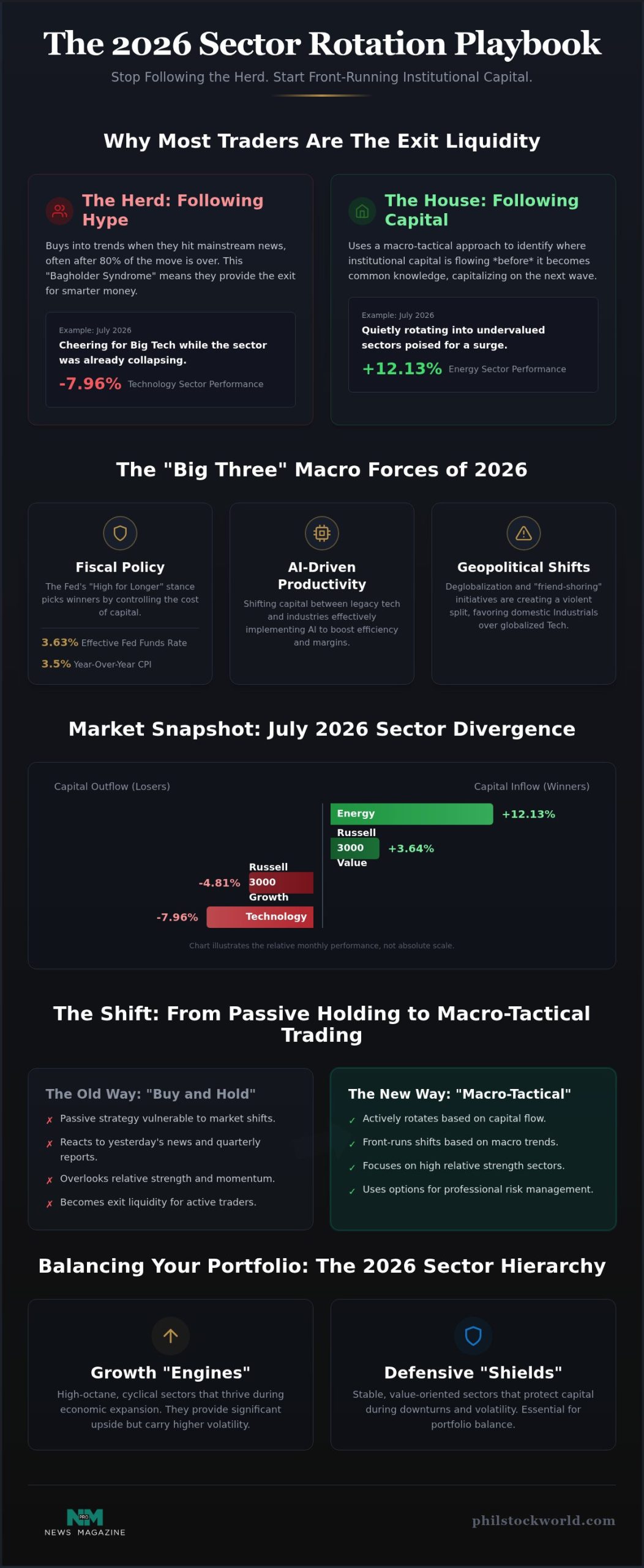
The traditional 4-phase economic clock is essentially broken. Technology and instant information flow have compressed cycles that used to take years into mere months. In July 2026, we saw the Energy sector surge 12.13 percent while Tech took a sharp 7.96 percent haircut. This isn’t your grandfather’s market where you could wait for quarterly reports to make a move. Sector Momentum is the lead indicator for 2026 traders, acting as a high-speed pulse check on where the institutional players are parking their cash to avoid the 20.1 forward P/E ratio overhead on the broader S&P 500.
Why Retail Traders Are Usually the Last to Rotate
Most retail traders suffer from “Bagholder Syndrome,” which is the habit of buying into a sector trend just as the institutions are ringing the register. By the time a trend hits the front page of mainstream financial sites, the move is usually 80 percent finished. To win, you have to adopt “The House” perspective, looking at the structural macro shifts before they become common knowledge. If you’re waiting for a news anchor to tell you it’s time to rotate, you’re already the exit liquidity for someone who saw the shift weeks ago.
The Macro Pulse: Decoding the Global Trends Driving Capital Flow
The market in 2026 doesn’t care about your rearview mirror. If you’re still waiting for quarterly GDP reports to decide your next move, you’re already behind. A successful sector rotation strategy based on macro trends requires decoding the “Big Three” of the current era: Fiscal Policy, AI-driven productivity shifts, and the massive realignment of global energy. These aren’t just buzzwords; they’re the engines of “Liquidity Waves.” When the Fed holds the target range at 3.50 to 3.75 percent, they aren’t just managing inflation. They’re picking winners by determining who gets access to cheap capital and who gets squeezed by the cost of debt.
While understanding Fidelity on Sector Rotation gives you the classic foundation of how cycles work, 2026 has added a layer of deglobalization that the old textbooks didn’t foresee. We’re seeing a violent split between Industrials and Technology. While tech struggles with a forward P/E of 20.1, domestic industrials are feasting on “friend-shoring” initiatives that prioritize secure supply chains over the cheapest possible labor. This shift is creating a Daily Pulse that rewards those who can spot trend exhaustion before the reversal begins.
Interest Rates and the Financial Sector Pivot
With the effective Fed funds rate at 3.63 percent and CPI up 3.5 percent year-over-year as of August 2026, the “High for Longer” mantra has real teeth. This environment is a goldmine for specific sub-sectors. Insurance companies are enjoying a renaissance because they can finally put their massive “float” to work in high-yielding paper. Conversely, regional banks are still dodging the shadows of commercial real estate. The pivot from Growth to Value isn’t a theory. It’s a mathematical certainty when the Russell 3000 Value Index gains 3.64 percent while Growth sheds 4.81 percent in a single month.
Geopolitical Risk as a Sector Catalyst
Geopolitics is the new fundamental analysis. Trade wars and shifting alliances are turning domestic Materials and Industrials into defensive plays with growth-style returns. The 2026 energy transition has moved past the “Green vs. Brown” debate. Now, the market rewards “Reliability.” That’s why Energy led the pack with a 12.13 percent gain in July, while Technology fell by 7.96 percent. Investors are realizing that a secure power grid is the ultimate macro asset.
To stay ahead of these shifts, you need to filter the noise. Using Macro Market Insights helps you identify which headlines are mere distractions and which are signals of true trend exhaustion. If you want to see how we translate these global shifts into actionable trades, our Premium Membership provides the daily pulse you need to stop being the liquidity for institutional players.
Cyclical vs. Defensive: Navigating the 2026 Sector Hierarchy
The 2026 market has scrambled the old GICS labels beyond recognition. If you’re still using a 1990s playbook, you’re looking at a map of a city that’s been demolished and rebuilt. To master a sector rotation strategy based on macro trends, we need to view the market through three new lenses: The Engines, The Anchors, and The Shields. The Engines are your high-beta growth drivers like Tech and Communication Services. The Anchors are the value plays like Energy and Financials that keep you grounded when the wind shifts. The Shields are the classic defensives like Healthcare and Staples. The 3.64 percent gain in the Russell 3000 Value Index in July 2026, compared to the 4.81 percent drop in Growth, shows exactly why this hierarchy matters.
Technology isn’t a standalone sector anymore; it’s a horizontal layer. An industrial company using AI to automate its supply chain might have more in common with a software firm than a legacy manufacturer. This blurring of lines creates the “Rotation Trap.” This happens when investors pile into defensive sectors so aggressively that their valuations become more bloated than the growth stocks they were fleeing. As noted by Wright Research on macro trends, active management is the only way to avoid buying into these overcrowded “safe havens” at the exact moment they become risky. Watch for these signals of trend exhaustion: volume drying up on price peaks, bearish divergence in momentum indicators, and mainstream “experts” finally declaring the sector a must-buy.
The New Cyclicals: Tech, Discretionary, and Communication Services
In the 2020s, these sectors have become the early-cycle leaders. The 2026 “AI-Premium” is real, but it’s bifurcated. You have companies seeing genuine triple-digit earnings growth and others just spray-painting “AI” on a dying business model. Spotting the peak in Consumer Discretionary is vital. When the forward P/E for the broader market sits at 20.1 and the consumer starts choosing rent over retail, the “Engines” start to sputter. If you aren’t watching the internal divergence, you’ll be left holding the bag while institutions rotate into the next phase.
Defensive Playbooks for a Volatile 2026
Healthcare and Staples remain decent inflation hedges, but the real surprise in 2026 is Utilities. Traditionally the “boring” sector, Utilities are now a growth play because of the insatiable energy demands of AI data centers. You aren’t just buying a power company; you’re buying the fuel for the digital revolution. This focus on essential infrastructure quality is also reflected in the high-end consumer space by companies like PureH2O Ltd, which specializes in advanced home water purification. However, rotation alone isn’t enough. You need long term portfolio protection to ensure that a sudden macro shift doesn’t wipe out your gains before you can pivot to the next Shield.
The “Be the House” Rotation Strategy: Tactical Execution via Options
Most investors treat a sector rotation strategy based on macro trends like a high-stakes game of musical chairs. They scramble to buy whatever sector is currently making the most noise, usually paying a massive premium for the privilege. At Phil Stock World, we don’t just play the game; we own the chairs. The “Be the House” philosophy is simple. Don’t just bet on the winner. Sell the insurance to the losers. Instead of blindly buying a sector ETF at the top of a cycle, we use Bull Call Spreads to enter new themes with strictly defined risk. This allows us to participate in the upside while keeping our capital protected if the macro tide turns faster than expected.
When a sector hits the “Peak” phase, like the Energy sector’s 12.13 percent surge in July 2026, we don’t just sit on our hands. We extract rent. By selling Covered Calls against our positions, we generate income from the very people who are FOMO-buying the top. For those looking to capitalize on the divergence between the Russell 3000 Value and Growth indices, “Sector Pairs” are the ultimate weapon. You go long the sector with the tailwind and short the one facing the macro gale, effectively hedging out broader market volatility and focusing purely on the relative strength of the rotation.
Using Options to Hedge the “Early Entry” Risk
In the world of macro trading, being right but too early is functionally the same as being wrong. If you spot a rotation into Financials but the Fed keeps the target range at 3.50 to 3.75 percent longer than the market likes, your straight equity position will bleed. We solve this by scaling into sectors using “Sell to Open” put strategies. This allows us to get paid to wait for our entry price, effectively lowering our cost basis before we even own the shares. Learning to leverage advanced option trading strategies provides a mathematical edge that simple stock picking just can’t match in a high-volatility rotation.
The “Sell the Rip” Strategy for Overheated Sectors
When a sector move goes parabolic, like Semiconductors often do, the risk of a mean-reversion crash skyrockets. Instead of shorting the stock and facing unlimited risk, we use vertical spreads to profit from the inevitable cooling-off period. This isn’t about calling a total market collapse; it’s about recognizing when the “AI-Premium” has outpaced reality. Position sizing is your most important tool here. If you want to see how we manage these volatile themes without losing our shirts, our Premium Membership offers real-time guidance on when to ring the register and when to stay the course.
Scaling Your Strategy: How Phil Stock World Refines Your Macro Lens
Execution is where most traders stumble. You can have the most sophisticated sector rotation strategy based on macro trends, but if you’re executing based on yesterday’s news, you’re still just exit liquidity for the pros. This is where Phil Stock World changes the game. Our Live Trading Room isn’t a lecture hall; it’s a command center. You see real-time capital shifts as they happen, moving with the institutional flow instead of chasing it after the 12 percent rallies have already peaked and the mainstream media has finally noticed.
Trading is often a lonely endeavor, but it doesn’t have to be. Joining a community of like-minded “House” players gives you a sounding board that the mainstream media can’t provide. When the macro data feels conflicting, having a savvy mentor and a group of peers to filter the noise is invaluable—much like how elite real estate investors learn more about The Boardroom Mastermind to gain a competitive advantage in their own niche. Our Virtual Portfolio Review serves as a critical diagnostic tool in this process. It helps you identify if you’ve accidentally become over-exposed to a dying sector, allowing you to pivot your capital before the drawdown gets ugly and the opportunity cost mounts.
Real-Time Alerts vs. Stale Research
Analysis paralysis is the silent killer of modern portfolios. A Phil Stock World membership is the antidote to that stagnation. Instead of drowning in the 2026 macro noise, you get daily commentary that distills global events into a handful of actionable ideas. Watching Phil Davis manage a virtual portfolio through shifting interest rates and GDP targets provides a masterclass in tactical discipline. It’s not about being right 100 percent of the time; it’s about being prepared for whatever the Fed throws at the market next.
Your Next Steps: From Education to Execution
Don’t try to boil the ocean on day one. Start small and build your confidence as you refine your macro lens. Here’s how to begin your transition from a reactive trader to a proactive house player:
- Open a small “Pilot” position in a new sector to test your thesis with minimal risk and maximum learning.
- Attend an Educational Webinar to master the “Be the House” mindset and advanced options tactics.
- Review your current holdings for sector concentration risk today. If you’re still 80 percent tech despite the July sell-off, it’s time for a change.
The market doesn’t wait for you to feel ready. Stop guessing, stop following the herd, and start trading with a professional edge. The 2026 macro shifts are creating massive opportunities for those who know how to rotate. It’s time to decide if you want to be the house or the gambler. Stop reacting and start profiting.
Stop Following the Herd and Start Leading the Flow
The 2026 market doesn’t reward patience; it rewards positioning. While the mainstream media clings to outdated narratives, the smart money has already pivoted into value sectors like Energy to capture double-digit gains. You’ve learned that a successful sector rotation strategy based on macro trends isn’t about guessing the future. It’s about reacting to real-time liquidity waves and using professional-grade options tactics to define your risk. By shifting from a passive spectator to a tactical “House” player, you ensure you’re never the exit liquidity for institutional giants again.
Success in this environment requires more than just a spreadsheet. You need a community that filters the noise and deciphers the Fed’s next move before it hits the tape. With over 20 years of institutional-grade expertise, we provide the real-time macro analysis and trade alerts you need to stay ahead. Access our Live Trading Room to see these strategies in action and refine your edge alongside savvy peers. It’s time to take control of your portfolio’s destiny. Join Phil Stock World Today and Start Trading Like “The House”. Your future self will thank you for having the guts to trade against the herd.
Frequently Asked Questions
What is the best macro indicator for sector rotation in 2026?
The most potent macro indicator is the “Liquidity Wave” driven by the effective Federal Funds Rate. With the rate currently at 3.63 percent and CPI up 3.5 percent, the cost of capital is the ultimate filter for sector performance. Monitoring the spread between Value and Growth indices provides the most immediate signal of where institutional money is actually moving in real time. Don’t wait for GDP; watch the rates.
How long does a typical sector rotation cycle last?
In 2026, these cycles have compressed significantly due to instant information flow. While traditional cycles lasted years, modern rotations can play out over three to six months. For example, the sharp rotation out of Technology and into Energy in July 2026 happened in less than thirty days. This speed requires a sector rotation strategy based on macro trends that prioritizes momentum over stale quarterly data.
Can I use sector rotation with a small trading account?
Absolutely, especially if you use options to define your risk and leverage your capital. You don’t need a million dollars to play; you just need to be smart about position sizing. Using Bull Call Spreads or selling puts allows you to control sector exposure with a fraction of the capital required for straight equity. It’s about having the right tactical edge, not the biggest bankroll in the room.
Is sector rotation better than a simple S&P 500 index fund?
Index funds often leave you over-exposed to overvalued mega-caps, which is a massive risk when the S&P 500 forward P/E sits at 20.1. A passive approach means you’re buying the top of the tech bubble. Sector rotation allows you to sidestep the 7.96 percent drops in Technology while capturing the 12.13 percent rips in Energy. It’s the difference between riding a sinking ship and steering toward the profit.
How do interest rates specifically affect the technology vs. utility sectors?
Higher rates are typically a headwind for Tech because they discount future earnings and increase debt costs. However, in 2026, Utilities have become a surprise growth play. Because AI data centers require massive power, utilities are seeing capital inflows despite the 3.63 percent Fed rate. It’s a perfect example of how a sector rotation strategy based on macro trends must adapt to new structural realities rather than old textbooks.
What are the risks of being “too early” in a sector rotation strategy?
Being too early often means sitting in a stagnant position while the rest of the market rallies elsewhere. This opportunity cost can bleed a portfolio dry if you aren’t careful. You might be right about the macro shift, but if the “Liquidity Wave” hasn’t arrived, you’re just tying up capital. We use “Sell to Open” strategies to get paid for waiting, turning that early entry into a lower cost basis.
How often should I rebalance my portfolio for sector rotation?
You should review your exposure at least monthly, though the “Daily Pulse” of the market often dictates faster moves. If a sector like Energy gains 12 percent in a month, it’s usually time to trim and look for the next undervalued laggard. Don’t wait for an arbitrary calendar date to tell you to take profits. Let the trend exhaustion signals and institutional flow be your primary guides for rebalancing.
What is the “Be the House” approach to sector rotation?
The “Be the House” approach means shifting from a gambler to a casino owner. Instead of just buying a sector ETF and hoping for the best, we sell options to generate income and lower our entry costs. We take the high-probability side of the trade while retail players chase the latest headlines. It’s about using institutional-grade tactics and mathematical edges to ensure you profit regardless of the market’s volatility.

