


If you’re still waiting for a quarterly calendar to tell you when to sell your winners, you aren’t investing; you’re just hoping the market doesn’t notice you’re asleep at the wheel. In a year where 10-year Treasuries are hovering at 4.69% and the GENIUS Act has transformed the digital asset landscape, the old “set it and forget it” mantra is dangerous. You’ve likely felt the gut-punch of watching a solid gain evaporate during a Tuesday afternoon “noise” spike because your portfolio adjustment techniques were reactive instead of proactive. It’s frustrating to feel stuck in a rigid buy and hold strategy while the pros are pivoting in real time.
I get it. The confusion over whether to trim a winner or double down on a dip can paralyze even the most seasoned trader. That’s why we’re moving beyond generic asset allocation to master tactical moves that prioritize capital protection. In this guide, I’ll show you how to trade like “the house” by using smart scaling and options as insurance. We’ll break down the exact rules for moving in and out of positions so your portfolio can actually thrive in chaos instead of just surviving it. It’s time to stop being a passenger in your own brokerage account.
Key Takeaways
- Traditional 60/40 thinking is a relic. Discover why active tactical adjustments are necessary to survive the current volatile market environment.
- Learn how to scale into positions and trim winners effectively, ensuring you capture gains without sacrificing your long-term upside.
- Stop panic-selling during dips and start using options as strategic insurance to keep your core portfolio intact while the market fluctuates.
- Adopt the “Be The House” philosophy by using sophisticated portfolio adjustment techniques that prioritize consistent income and strict 5% risk limits.
- Transition from a lone-wolf strategy to a community-driven approach where real-time data helps you pivot before the rest of the market catches on.
Beyond Passive Rebalancing: Why Your Portfolio Needs Active Adjustment
The traditional 60/40 portfolio didn’t just break; it became a liability. For decades, investors were told that a static mix of stocks and bonds would weather any storm. But in 2026, with the 10-year Treasury hovering at 4.69% and mortgage rates stuck near 6.69%, the old math has failed. Passive rebalancing, which simply resets your portfolio to a predetermined target every quarter, is too slow for a market driven by AI sentiment and rapid regulatory shifts like the GENIUS Act. Tactical Portfolio Adjustment is the proactive realignment of assets based on macro-economic shifts and risk-reward ratios.
Relying on generic portfolio adjustment techniques often means you’re selling your winners just as they gain momentum and buying “cheap” assets that are actually value traps. The “noise” factor has never been louder. Social media hype and algorithmic trading can distort valuations in hours, not months. If you wait for a calendar date to adjust your exposure, you’re essentially leaving your capital defenseless against modern volatility cycles.
The Myth of “Set It and Forget It” Investing
The idea that you can ignore your portfolio for six months and expect it to thrive is a relic of a slower era. In 2026, market cycles move at hyper-speed. Holding through a significant dip isn’t “discipline” if the underlying macro environment has fundamentally shifted; it’s a choice to destroy long-term compounding. There is a massive difference between market timing, which is essentially gambling on short-term price action, and tactical adjustment. Strategy involves recognizing when the risk-reward profile of an asset has soured and moving your capital to higher ground before the herd panics.
Recognizing the Signals for a Portfolio Pivot
Successful portfolio adjustment techniques require you to look beyond the ticker tape. You need to identify the catalysts that actually move the needle. These signals usually fall into three categories:
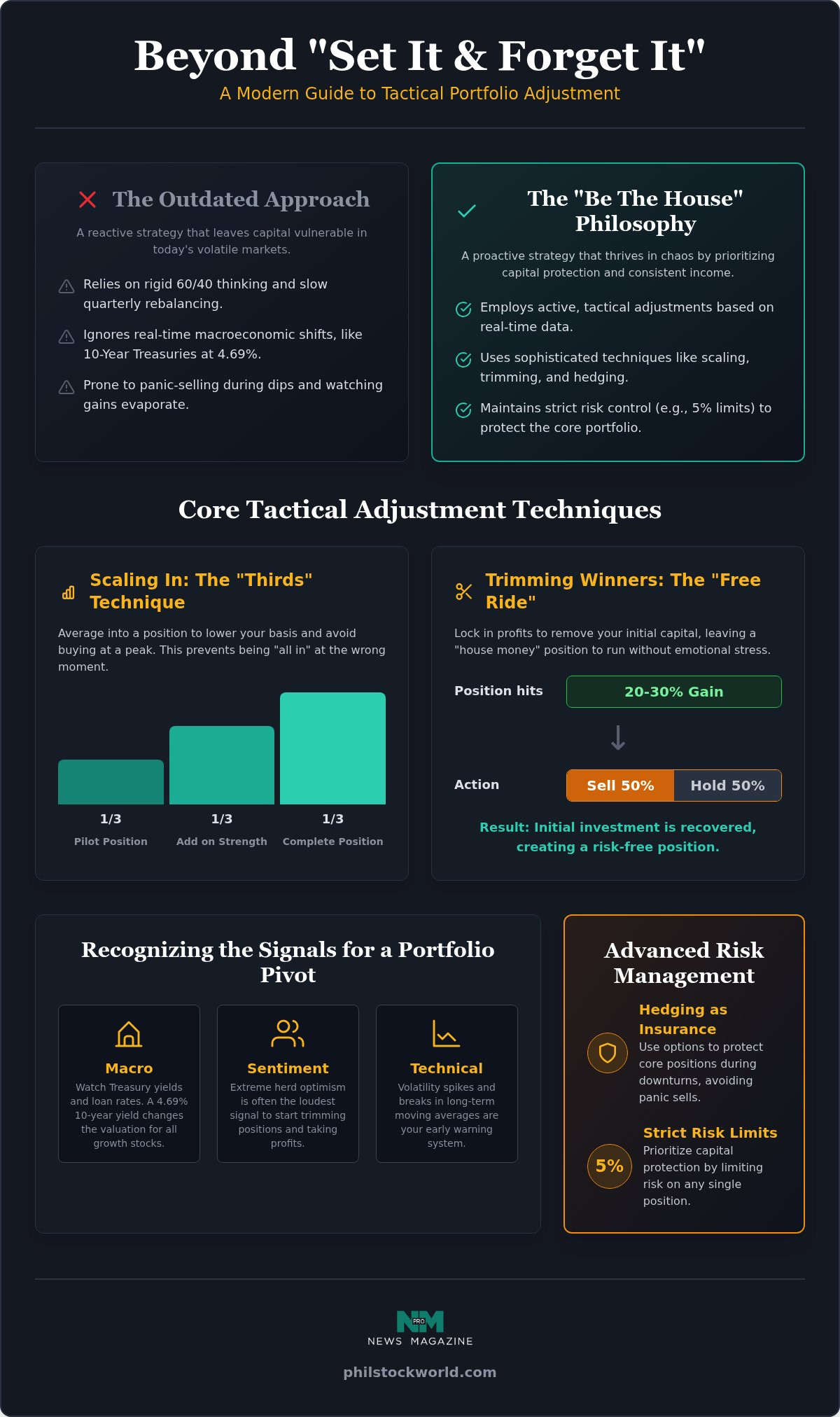
- Macro Indicators: Watch the Bank Prime Loan Rate and Treasury yields. When the 10-year Treasury hits 4.69%, the “risk-free” rate of return changes the valuation model for every growth stock you own.
- Sentiment Analysis: Pay attention when the herd is universally bullish on digital assets or specific sectors. Extreme optimism is often the loudest signal to start trimming.
- Technical Triggers: Volatility spikes and breaks in long-term moving averages are your early warning system. They tell you the trend is exhausted before the news cycle catches up.
By staying alert to these shifts, you can pivot your holdings to protect your principal. If you want to enhance your strategy with advanced technical analysis and market cycle forecasting, learn more about Wavetraders. It isn’t about being frantic; it’s about being methodical and refusing to be a passenger in your own financial future.
Tactical Adjustment Techniques: Scaling, Trimming, and Rotating
If your only move is hitting the ‘Sell All’ button when things get shaky, you aren’t trading; you’re reacting. Professional portfolio adjustment techniques are built on the “House Rule.” This means you treat your portfolio like a casino. You have a core position that represents your long-term thesis, and you trade the “surround” to generate income and lower your basis. By prioritizing the protection of your core while being aggressive with the periphery, you keep your winners running without exposing your entire bankroll to a single bad day.
Scaling In and Out: The Secret to Lowering Your Basis
Rookies buy a full position all at once. Pros scale in. Using the “Thirds” technique allows you to average into a winning trade by buying in 33% increments. You enter with a pilot position; if the trade moves in your favor or stays within a healthy range, you add the second and third tranches. This prevents you from being “all in” at the exact moment a stock hits a local peak. Trimming is the inverse. When a position hits a 20% or 30% gain, you sell half. This creates a “free ride” where your initial investment is safely back in cash, leaving you with a house-money position that you can hold through almost any amount of volatility without emotional stress.
Sector Rotation Strategies for 2026
Rotation is how you avoid “dead money.” In the current environment, capital is constantly fleeing overextended growth sectors to find safety in undervalued laggards. You don’t need to exit the market to stay safe; you just need to move your chips. Using broad-market ETFs allows you to maintain general exposure while you wait for specific individual stock setups to mature. Understanding the broader landscape via macro market insights is the only way to time these rotations before the mainstream media starts reporting on them. If you’re struggling to decide which positions to trim, a Virtual Portfolio Review can provide the clarity needed to clean up your balance sheet. These portfolio adjustment techniques ensure your capital is always working in the most fertile soil, rather than wilting in a dried-out sector.
Hedging as an Adjustment Tool: Using Options for Portfolio Insurance
When most people think about portfolio adjustment techniques, they picture selling stocks to raise cash. That is often the least efficient way to manage risk. Selling your core holdings triggers capital gains taxes; it also leaves you on the sidelines if the market suddenly reverses. Professional traders know that the best adjustment is often the one where you don’t sell a single share. Instead, they use options to build a “floor” under their capital while keeping the upside potential intact.
Think of it through the lens of the insurance metaphor. You don’t cancel your car insurance just because you haven’t had a fender bender in six months. You keep the policy active because the one time you actually need it, it prevents a total financial catastrophe. Much like how a savvy investor might visit Private Jet Charter to evaluate emergency medevac costs as part of a total safety net, hedging is your portfolio’s insurance policy. It allows an investor to maintain long-term equity positions during short-term market turbulence without the gut-wrenching anxiety of a 20% drawdown.
The Power of the Put Option
The protective put is the cornerstone of tactical adjustments. By purchasing a put option, you gain the right to sell your shares at a specific price, regardless of how low the market drops. Calculating the “cost of insurance” is simple; it is the premium you pay for the contract. If you want maximum protection, you buy “at-the-money” puts. If you just want to protect against a black swan event, you buy cheaper “out-of-the-money” puts. For a deep dive into the mechanics, check out our guide on hedging with put options to see exactly how to execute these trades.
Income Generation During Adjustments
Adjusting your portfolio isn’t just about playing defense; it’s also about generating income when the market goes sideways. Selling covered calls is a classic move that turns a stagnant position into a dividend-producing machine. You collect the premium from someone else who wants to bet on the upside, effectively lowering your cost basis while you wait for the next leg up.
Another powerful tool is the “cashed-out” strategy, where you use cash-secured puts to buy the dip at a discount. Instead of chasing a stock higher, you get paid to wait for it to hit your target price. The key is balancing your delta. You want to ensure your hedges are sized correctly so that when the market moves against you, the gains in your options contracts actually offset the losses in your equity. This level of precision is what separates the “house” from the gamblers.
The Phil Stock World Methodology: Position Sizing and Risk Control
Most investors approach the market like a gambler at a craps table, hoping for a hot streak to bail out poor planning. We take the opposite approach. To “Be The House,” you must prioritize mathematical certainty over emotional conviction. This begins with the 5% Rule: no single position should ever be large enough to threaten your lifestyle or your ability to trade tomorrow. Even the most sophisticated portfolio adjustment techniques fail if you’ve bet the farm on a single ticker. By utilizing spreads and advanced option trading strategies, we significantly reduce the capital required to maintain a position, allowing for a more diversified and resilient balance sheet.
You also need to run regular stress tests. Ask yourself what happens to your “adjusted” portfolio if the market drops 20% by next Friday. With the Bank Prime Loan Rate at 6.75% and the 10-year Treasury at 4.69%, the cost of being wrong is higher than it was a decade ago. If a 20% drawdown leads to a margin call, your position sizing is fundamentally flawed. The goal of tactical adjustment is to ensure you are the one buying the fire sale, not the one being forced to sell into it.
This principle of strategic resilience applies to business leadership as well; when companies need to stress-test their operations or pivot their business model, they often visit consultingheads GmbH to find specialized expertise to lead through uncertainty.
Position Sizing: The Only Real “Holy Grail”
Being right about a stock’s direction is secondary to surviving the path it takes to get there. Many traders are “right” about a long-term thesis but get wiped out by a temporary volatility spike because their position was too large to stomach the drawdown. Before you click “buy,” you must calculate your “Maximum Pain” threshold. This is the exact dollar amount you’re willing to lose before the trade is dead. Trading in smaller, manageable sizes provides a massive psychological edge. It allows you to maintain a clear head, making it easier to execute portfolio adjustment techniques without the paralyzing fear of a mounting loss.
Risk/Reward Ratios in Adjustment
We don’t touch trades unless they offer at least a 3:1 reward-to-risk ratio. If you’re risking a dollar to make fifty cents, you’re playing a loser’s game. This discipline is especially critical when adjusting existing positions. Are you throwing good money after bad, or are you scaling into a high-probability winner? Many independent traders get trapped between using hard stop losses, which are often hunted by institutional algorithms, and mental stops, which frequently turn into “hopium.” A virtual portfolio review can reveal these hidden leaks in your strategy. If you’re ready to stop guessing and start trading with professional precision, our Premium Membership offers the real-time guidance needed to stay on the right side of the tape.
Executing the Pivot: Real-Time Tools for Independent Investors
Static spreadsheets are where capital goes to die. In 2026, the speed of information is far too high for a manual ledger or a monthly check-in with a generic advisor. You need real-time portfolio adjustment techniques that reflect the current bank prime loan rate of 6.75% and rapid shifts in the secondary treasury market. Waiting for a monthly summary is like checking the weather by looking at a photo from last week. To pivot effectively, you need a dynamic environment where data translates into immediate, calculated action.
Trading in a vacuum is a recipe for missing the obvious. Lone wolf investors often get blinded by their own biases, ignoring the very pivot signals that could save their principal. Real-time alerts and community-driven insights act as a secondary radar system. They help you automate your discipline, ensuring you take the “trim” or set the hedge before the window of opportunity slams shut. It’s about moving from a reactive stance to a proactive one.
This collaborative approach to decision-making mirrors how modern organizations use platforms like Ideawake to harness AI for capturing and evaluating the most promising ideas, ensuring that only the highest-potential strategies are pursued.
The Advantage of Live Trading Rooms
A live trading room provides a window into how “The House” actually operates. You aren’t just reading theory; you’re seeing adjustments happen as the tape moves. This transparency is vital for learning the “why” behind the move. When the market starts to slide, the room isn’t paralyzed by asking “Why is this happening?” Instead, the focus shifts to “What do we buy?” and “How do we hedge?” Speed of execution is everything. In a high-volatility session, a 15-minute delay can be the difference between a minor scratch and a 15% portfolio haircut.
Your Next Step: The Virtual Portfolio Review
Before you can master advanced portfolio adjustment techniques, you have to know where you’re starting. Most portfolios are cluttered with “zombie stocks,” which are positions you bought on a whim and forgot to sell, and they now just drag down your overall performance. A Virtual Portfolio Review provides an unbiased second opinion on your current allocations. It is the essential first step to cleaning up your balance sheet and ensuring your risk is properly distributed according to the 5% rule we discussed earlier.
You don’t have to navigate this alone. By joining the Phil Stock World membership, you gain access to real-time adjustment alerts and a community of peers who prioritize income over ego. Stop guessing at your next move. Start executing with professional oversight and turn market chaos into your greatest advantage.
Mastering the Pivot: Your Path to Professional-Grade Protection
The days of trusting a static allocation to protect your wealth are over. Surviving the 2026 market requires moving beyond the “set it and forget it” trap and embracing the “Be The House” mentality. By mastering sophisticated portfolio adjustment techniques, you transform from a passive observer into a tactical operator who knows exactly when to trim winners and how to deploy options as insurance. It isn’t about guessing the next move; it’s about having a repeatable framework that prioritizes capital preservation above all else.
You don’t have to navigate these volatile waters as a lone wolf. Joining a community of savvy investors gives you access to real-time interactive trading sessions with veteran analyst Phil Davis and actionable trade alerts that cut through the noise. It’s time to stop watching your gains evaporate and start trading with an edge that actually works in today’s rapid-fire environment.
Get Your Virtual Portfolio Review and Trade Like “The House” Today to identify your “zombie stocks” and fortify your strategy. The market doesn’t wait for the unprepared, so make sure your next move is the right one.
Frequently Asked Questions
How often should I use portfolio adjustment techniques?
You should use these moves whenever a specific trigger is hit, not just because the quarter ended. If a position reaches a 20% profit target or a macro shift occurs, like the 10-year Treasury yield moving significantly, you need to act. Event-driven adjustments keep you ahead of the curve. Waiting for a calendar date is a recipe for watching your gains disappear during a sudden market pivot.
Is portfolio adjustment the same as market timing?
Not at all. Market timing is a speculative bet on where prices go next, while portfolio adjustment techniques focus on risk management based on current data. You are realigning your holdings to stay within your 5% risk limits and maintain your reward-to-risk ratios. It’s the difference between guessing which way the wind blows and actually trimming your sails when the storm arrives.
What are the tax implications of frequent portfolio adjustments?
Adjustments in taxable accounts can trigger capital gains taxes. In 2026, long-term gains are taxed at 0% if your taxable income is under $47,050 for single filers. Short-term gains are taxed at your ordinary income rate. To minimize the hit, consider adjusting within tax-advantaged accounts like an IRA or using options to hedge your downside without actually selling the underlying shares.
Can I use options to adjust my portfolio if I only have a small account?
Absolutely. Options are an excellent way for small accounts to manage risk without tying up massive amounts of capital. Instead of buying 100 shares of a high-priced stock, you can use spreads or protective puts to control your exposure. This efficiency allows you to diversify and protect your bankroll without needing a six-figure balance. It’s about using leverage responsibly to trade like the house.
What is the best indicator for knowing when to rotate sectors?
Relative strength is the most reliable signal. When a sector ETF starts outperforming the S&P 500 on a 50-day moving average, the big money is moving in. You should also watch macro catalysts. For instance, if the Bank Prime Loan Rate holds steady at 6.75%, certain value sectors might become more attractive than high-multiple growth stocks. Follow the flow of institutional capital to time your rotations.
How do I know if my portfolio is over-diversified?
You’re likely over-diversified if you hold more than 25 positions. At that point, you’re essentially just managing a high-cost index fund. Diversification should protect you from a single failure, but too much of it dilutes your best ideas. If your portfolio’s performance is identical to the S&P 500 but you’re spending hours on maintenance, it’s time to trim the fat and focus on high-conviction trades.
What happens if I adjust my portfolio and the market immediately reverses?
Market reversals are exactly why we use the “thirds” technique for scaling. If you adjust a position and the trend flips, you haven’t committed your entire capital to the new direction yet. Your hedges also provide a safety net. Reversals are only a problem if you’re over-leveraged or all-in. By trading small and using insurance, you can weather a whipsaw without taking a permanent hit to your principal.
Should I use a robo-advisor for my portfolio adjustments?
Robo-advisors are often too slow for the 2026 market. They use static algorithms that rebalance based on the calendar, which means they can’t react to sudden macro shifts or black swan events. While they might minimize human error, they lack the nuance required for tactical portfolio adjustment techniques. For real-time pivots and strategic hedging, you need the flexibility that only active, community-driven oversight can provide.

