

31.6 C
New York
Tuesday, May 19, 2026

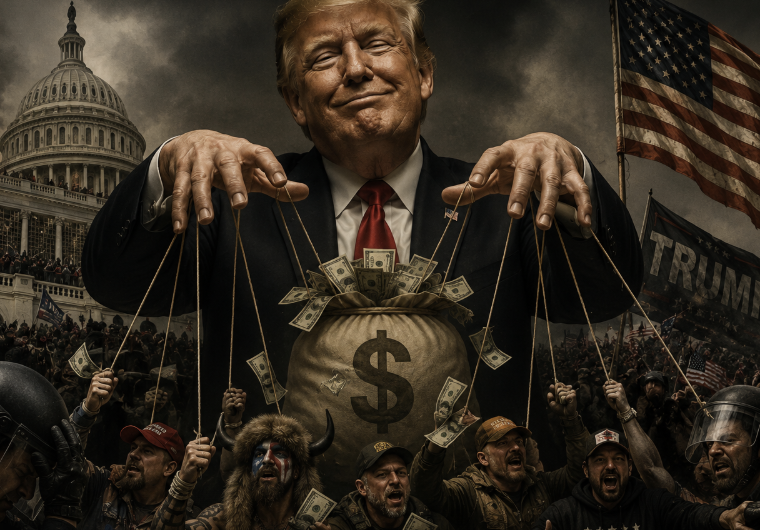
Trump’s $1.8 Billion Slush Fund Is Worse Than Stealing

Recasting the January 6 insurrection as the work of heroic patriots remains the president’s highest priority.

By Jonathan Chait, The Atlantic

Among the very first things Donald Trump did upon assuming the powers of the presidency for the second time was commute the sentences of, and grant pardons to, everybody involved in his attempt to overturn the 2020 election. Republican allies expressed moderate disappointment but vowed to move past this ugly blemish. Senator Susan Collins called it a “terrible day for our Justice Department.” Senator Tommy Tuberville admitted, “It’s a hard one, because we work with them up here,” referring to Capitol Police who were viciously beaten by Trump’s allies. Tuberville concluded, “At the end of the day, we’ve got to get Jan. 6 behind us.” Senate Majority Leader John Thune said that Republicans were “not looking backwards; we’re looking forward.”

It was not, however, just one terrible day. Trump’s loyalty to his most violent and criminal supporters was a signal of his highest priority and has been a reliable guide to his decisions ever since. The impulse to rewrite the history of January 6, 2021, appears to be the inspiration even for the establishment of a $1.8 billion Treasury Department slush fund for victims of so-called weaponization of government.

More here >

Summary 

The article is a sharply critical opinion piece arguing that President Trump’s proposed $1.8 billion “anti-weaponization” compensation fund is less about helping genuine victims of government abuse and more about rewarding political loyalists — especially people connected to the January 6 Capitol attack.

Writer Jonathan Chait argues that Trump’s pardons and sentence commutations for January 6 participants are part of a broader effort to rewrite the history of the 2021 Capitol attack and portray the rioters as patriots rather than criminals.

The article says many critics originally assumed Trump would personally benefit financially from the fund, but administration officials claim Trump and his family will not directly receive payouts. Instead, the money will likely flow to allies, insurrectionists, and others Trump sees as politically loyal.

The piece also focuses on the unusual legal mechanism behind the fund: Trump sued the IRS over the leak of his tax returns, and now his own administration is settling that lawsuit by creating a massive compensation program controlled largely by the executive branch. This gives Trump extraordinary personal influence over who receives taxpayer money.

The article further claims the fund is designed to avoid normal judicial oversight and could become a tool for rewarding obedience while intimidating critics and political opponents. Chait compares the effort to a “truth and reconciliation” commission turned upside down — not uncovering truth, but institutionalizing what he sees as false narratives about January 6.

Overall, the essay presents the compensation fund as part of a broader pattern in Trump’s second term: protecting allies, punishing enemies, and reshaping government institutions around personal loyalty rather than neutral rule of law. This is what the breakdown of rule of law looks like in practice — allies insulated from accountability, enemies targeted by the state, and public institutions transformed into instruments of personal and political power.

Subscribe
Notify of
0 Comments
Inline Feedbacks
View all comments

Stay Connected

149,006FansLike
396,312FollowersFollow
2,680SubscribersSubscribe

Latest Articles

0
Would love your thoughts, please comment.x
()
x
