

Steven Spielberg has an alien movie opening this month, but that may not be the biggest science fiction blockbuster of the summer. That could be the SpaceX initial public offering.
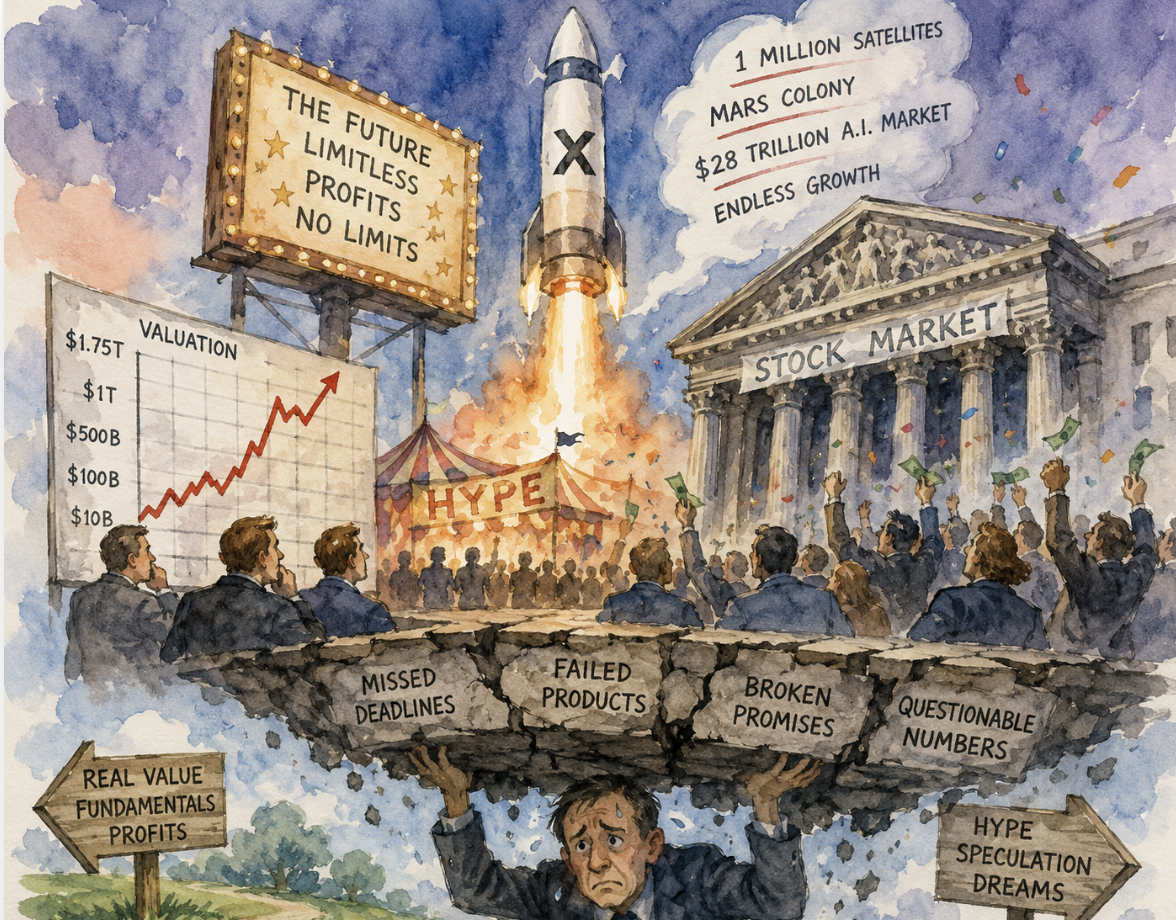
As part of its pitch to sell shares on the stock market, Elon Musk’s aerospace and technology company says it will capture over $28 trillion of the A.I. market (nearly the size of the entire United States economy). It says it plans to launch one million satellites to put data centers in outer space (though the technology doesn’t yet exist). And it vows to hand Mr. Musk huge amounts of stock if he establishes a Mars colony that houses one million people (though no human has been within about 35 million miles of the planet).
Mr. Musk could well believe his own projections. What’s harder to understand is why so many investors do, given his recent track record of missed deadlines, abandoned products and failed business predictions.
Summary
In “Our Stock Market Is Broken,” Aaron Zamost argues that modern financial markets increasingly reward hype and storytelling over business fundamentals, using Elon Musk and the upcoming SpaceX IPO as the central example.
The article says investors continue to pour money into Musk’s companies despite a long history of missed predictions, failed timelines, and exaggerated claims. SpaceX is described as a genuinely impressive company with successful businesses like Starlink, but the author argues its reported $1.75 trillion valuation reflects speculative fantasy more than traditional financial analysis.
According to the essay, the stock market has evolved into a system where charismatic narratives, social media influence, and institutional incentives matter more than profits, execution, or accountability. Large banks, venture capital firms, and institutional investors all benefit financially from keeping the hype machine running, even when valuations appear detached from reality.
The article also argues that legal and cultural changes over the past few decades weakened restraints on corporate promotion, allowing executives far more freedom to make ambitious future claims without serious consequences. Musk’s success with Tesla helped normalize this environment by showing that investors could become enormously wealthy by betting on vision and momentum rather than current performance.
Ultimately, the piece portrays today’s market as a self-reinforcing cycle where speculation, celebrity, and financial engineering dominate rational investing — creating what the author sees as a fragile and increasingly distorted system.

