


While most retail traders are busy panic-buying puts at the first sign of a red candle, the real money is being made by the people selling them that peace of mind. It’s a harsh reality that 80% to 90% of retail options traders lose money consistently. They often use tools they don’t fully understand to solve problems they can’t quite define. If you’re tired of watching your hard-earned paper gains evaporate every time the VIX spikes, it’s time to stop playing the game and start running it. Truly recession proofing your portfolio with options isn’t about hiding in cash or paying exorbitant premiums for insurance that eats your long-term returns.
You likely feel that mainstream advice to just buy and hold feels dangerously passive when market swings are this aggressive. We’re going to change that. This guide promises to teach you how to weaponize volatility using professional-grade hedging techniques that protect your downside without killing your upside. We will explore the mechanics of puts and collars, examine the current 2026 macro environment, and show you how to adopt the “Be the House” philosophy to stay profitable when everyone else is heading for the exits.
Key Takeaways
- Don’t rely on passive “buy and hold” strategies that bleed during downturns; instead, embrace active hedging to stay ahead of 2026 volatility.
- Master the mechanics of protective puts and portfolio collars to lock in exit prices while financing your insurance costs.
- Learn why “being the house” is the only way to succeed at recession proofing your portfolio with options by making time decay work for you instead of against you.
- Follow a rigorous 5-step audit process to identify your “Max Pain” threshold and eliminate recession-sensitive vulnerabilities.
- Discover how a well-hedged position provides the “dry powder” needed to pivot from defense to aggressive buying when market bottoms finally form.
Beyond Defensive Stocks: Why 2026 Requires Active Hedging
The “buy and hold” mantra is a relic of a different era. In 2026, simply parking your cash in utilities or healthcare stocks isn’t enough to survive a real economic contraction. When the market truly slides, everything goes down together. We call this correlation convergence. It’s the moment when “safe” stocks stop being safe and start behaving like the rest of the wreckage. Effective recession proofing your portfolio with options requires moving past the passive hope that your dividends will offset a 30% drawdown. You need a strategy that doesn’t just sit there and take the punches.
Mainstream advisors will tell you to diversify, but they rarely explain what happens when every asset class starts moving in lockstep. In a high-volatility environment, passive protection is an illusion. You’re either actively managing your risk or you’re a victim of it. By using professional-grade tools, you can turn market turbulence into a strategic advantage, ensuring your capital remains intact while others are liquidated.
The Failure of Traditional Diversification
Bonds aren’t the sanctuary they used to be. With the 10-Year Treasury yield sitting at 4.68% as of August 2026, the income is decent, but the price sensitivity to shifting rates remains a massive risk. In a systemic crash, investors often sell what they can, not what they want. This leads to a scenario where even “defensive” sectors lose their luster because the entire market is thirsty for liquidity. Active Hedging is a professional risk management discipline that uses strategic market positions to offset potential losses in an existing portfolio. It’s about being proactive rather than just holding your breath and hoping for a rebound. When the 1-year Treasury yield is at 3.96%, the spread is thin, and the margin for error is even thinner.
Options as the Ultimate Portfolio Stabilizer
Most people view options as high-stakes gambles. That’s because they’ve watched too many “YOLO” trades blow up on social media. In reality, professional options trading strategies function more like a sophisticated insurance policy. You don’t buy car insurance because you want to wreck your car; you buy it so a fender bender doesn’t bankrupt you. With the VIX currently sitting at 14.25, the cost of this “insurance” is relatively low, making it the perfect time to build a floor under your assets. The first step in this process is identifying where your current strategy is leaking oil. A Virtual Portfolio Review can help you spot these hidden vulnerabilities before macro triggers turn a small dip into a portfolio-killing event. By using options, you transform volatility from a monster under the bed into a tool that pays for your protection.
The Mechanics of Protection: Puts, Collars, and Synthetic Hedges
Diversification is a passive hope. Options are a mathematical certainty. When you’re recession proofing your portfolio with options, you’re essentially moving from a mindset of “I hope the market doesn’t crash” to “I know exactly where my floor is.” This transition requires understanding the specific levers you can pull to offset downside risk without liquidating your entire portfolio. It’s about maintaining your long-term positions while neutralizing the immediate threat of a systemic slide. If you’ve been relying on a traditional 60/40 split and wondering why it keeps failing you, understanding portfolio diversification with options that moves beyond the 60/40 myth is the critical next step.
To do this effectively, you must understand your Delta. This Greek metric tells you how much your option’s price will move for every $1 move in the underlying asset. If your portfolio has a high positive Delta, you’re fully exposed to the next leg down. By adding short Delta positions through options, you can balance the scales. It’s the professional way to manage risk, and it’s far more precise than simply “buying a few defensive stocks” and hoping for the best.
The Protective Put Strategy
The protective put is the most straightforward form of portfolio insurance. You buy the right to sell your shares at a specific strike price, regardless of how far the market falls. In the current 2026 environment, with the VIX sitting at a relatively calm 14.25, the cost of this insurance is surprisingly affordable. Don’t just look at next month’s contracts. Using LEAPS (Long-term Equity Anticipation Securities) allows you to lock in protection for a year or more, giving you the peace of mind to ignore daily headlines.
- Floor Math: Your maximum loss is limited to the difference between the stock’s current price and the strike price, plus the premium paid.
- Strike Selection: Aim for “at-the-money” or slightly “out-of-the-money” puts to balance the cost of the premium against the level of protection.
The Power of the Collar Strategy
If you don’t like the idea of paying for insurance, the collar strategy is your best friend. This involves buying a protective put and simultaneously selling a covered call to pay for it. You’re essentially capping your potential upside to eliminate your potential downside. For example, if you’re holding an index like the SPY or QQQ, you can sell a call at a level where you’d be happy to take profits and use that cash to buy a put that kicks in if the market drops 5%. Pairing this approach with disciplined portfolio rebalancing tips ensures you’re not just protected on the downside but also strategically positioned to capture upside when conditions improve.
This “zero-cost” approach is a cornerstone of the “Be the House” philosophy. You aren’t just a customer buying insurance; you’re a savvy operator using the market’s own mechanics to fund your safety. If you want to see how these strategies look on paper before committing capital, you can dive into professional market charts and analysis to visualize your risk zones. It’s the difference between guessing and knowing.
The ‘Be the House’ Philosophy: Why Retail Hedging Usually Fails
Most retail traders approach hedging like they’re buying a lottery ticket that only pays out if the world ends. They wait for a headline to scare them, then rush to buy deep out-of-the-money puts when volatility is already peaking. It’s a classic mistake. You’re buying insurance when the house is already on fire, and the professional trader on the other side is happy to charge you a massive premium for the privilege. This is the primary reason why recession proofing your portfolio with options fails for the average investor; they pay so much for protection that they have no profit left when the market actually recovers.
Professional trading isn’t about guessing the next crash. It’s about understanding Theta, or time decay. Every day that the market doesn’t collapse, those expensive puts lose value. As the house, you want to be on the side that collects that decay. Instead of just being a consumer of insurance, you should be the one underwriting it. By selling the fear that others are desperate to hedge, you generate the income necessary to fund your own defensive positions. It’s a shift from a defensive crouch to a position of strength.
Selling Premium in a Volatile Market
When the VIX spikes, option premiums explode. While the VIX is currently sitting at 14.25 in August 2026, savvy traders know this is the time to build the infrastructure for future volatility. Using credit spreads allows you to define your risk while collecting income from those who are overpaying for “disaster insurance.” Integrating advanced option trading strategies into your repertoire means you aren’t just hoping for the best; you’re mathematically ensuring you get paid for the risks you take.
Managing the Cost of Protection
The biggest hurdle in any hedging strategy is “insurance drag.” If you spend 5% of your portfolio every year on puts that expire worthless, you’re killing your long-term compounding. Professional traders solve this by “hedging the hedge,” using short-term income trades to offset the cost of long-term protection. You also need to keep an eye on position sizing. A hedge that is too large becomes a speculative bet on a crash, which is exactly the kind of gamble we want to avoid. Time is the trader’s most expensive commodity, and the house never pays retail for it.
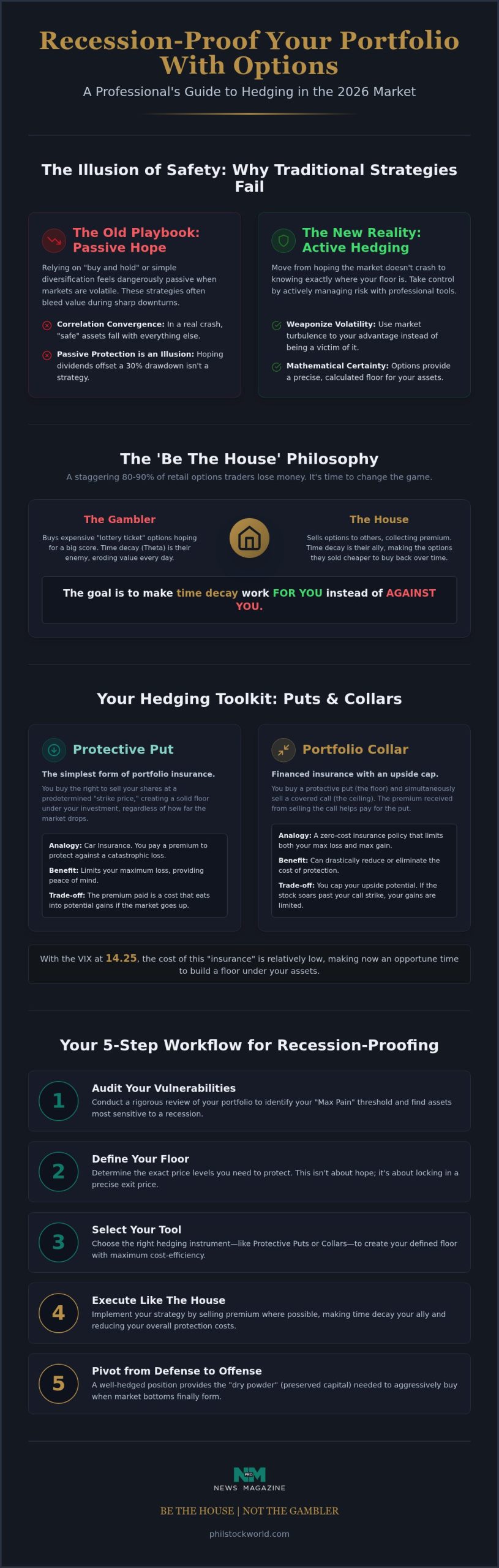
Your 5-Step Workflow for Recession-Proofing with Options
Stop guessing and start measuring. Truly recession proofing your portfolio with options isn’t a one-time event; it’s a repeatable, disciplined process. You don’t just throw money at puts because a headline looks scary. You follow a workflow that ensures your protection is both efficient and cost-effective. Moving from a passive observer to an active manager requires a clear roadmap to identify where your capital is at risk and how to shield it without overpaying for the privilege.
Before you place a single trade, you must know your starting point. This begins with a deep dive into your current holdings to see how they’ll react when the tide goes out. Once you’ve identified the leaks, you can select the right tools to plug them. Before you commit capital to a hedge, get a professional Virtual Portfolio Review to identify your specific risk zones and ensure your strategy is built on solid ground.
Auditing for Sensitivity and Max Pain
Step one is auditing your “Recession Sensitivity” using Beta. If your portfolio is heavy on high-Beta tech stocks, you’ll drop much faster than the broader market during a slide. Step two is defining your “Max Pain” threshold. This is the hard floor, the dollar amount you can lose before you start making emotional, portfolio-killing decisions. If you can’t stomach a 10% drawdown, your hedge needs to kick in at 5%. You should generally allocate no more than 1% to 3% of your total capital to hedging costs; anything more is a speculative bet, not insurance.
Execution and Active Management
Step three is selecting your instrument. For broad protection, index options like the SPY or IWM are often cheaper and more liquid than buying puts on twenty individual stocks. Step four is execution. Never buy your entire hedge at once. Scale in with a phased approach, perhaps buying one-third of your position now and waiting to see if volatility offers a better entry. Step five is the most critical: Active Management.
Don’t just set it and forget it. If the market drops and your puts become profitable, you should “roll” them. This means selling your current puts to lock in gains and buying new ones at a lower strike price. This keeps your floor in place while putting cash back into your pocket. You’ll know it’s time to take the insurance off when macro signals, like a narrowing yield curve spread or a sustained drop in the VIX, suggest the worst of the contraction is behind us. Professional hedging is a dance, not a statue.
Scaling Your Strategy: Moving from Defense to Offensive Hedging
The ultimate goal of recession proofing your portfolio with options isn’t just to see a flat line on your brokerage statement while the S&P 500 is in freefall. It’s to position yourself so that you’re the one with the cash when everyone else is forced to liquidate. When your hedges pay out during a market slide, they create “dry powder.” This is liquid capital that allows you to buy world-class assets at generational discounts. This is where real wealth is built. You’re moving from a defensive crouch to an offensive strike, using the market’s own volatility to fund your future gains.
Transitioning from “Protected” to “Aggressive” requires a keen eye on macro signals. As we’ve seen in August 2026, with the 10-Year Treasury yield at 4.68% and the VIX at 14.25, the environment is currently calm, but the infrastructure for your defense must be built now. While mainstream advisors tell you to “stay the course” and wait for a recovery, we’re looking to front-run that recovery. By using your hedging gains to fund new, high-conviction positions, you’re participating in the “blood in the streets” phase that most investors are too terrified to touch. Complementing this approach with actionable portfolio rebalancing tips for 2026 gives you a structured framework for rotating capital efficiently as market conditions shift.
The Psychological Edge of the Hedged Trader
Trading is 10% math and 90% psychology. Most retail traders panic because they have no floor. They watch their life savings bleed out and eventually sell at the exact bottom because they can’t take the pain anymore. When you’re properly hedged, you’re trading from a position of total strength. You don’t need to catch the “hero trade” that perfectly times the market’s turning point. You just need the discipline to stick to your plan. Being part of a community helps maintain this discipline, preventing the emotional mistakes that ruin portfolios during a crash.
Leveraging Expert Analysis for Real-Time Moves
In a market that moves 3% a day, yesterday’s news is ancient history. You need real-time data and a mentor who has navigated these cycles before. This is where a Phil Stock World membership becomes your most valuable asset. It provides the live trading rooms and daily market commentary needed to navigate rapid shifts in sentiment and policy. Instead of reacting to headlines, you’re anticipating them. You’re learning to trade like the house, making calculated moves while the rest of the market gambles on hope. Don’t go through the next economic contraction alone; join the community that turns volatility into a strategic advantage.
Mastering the 2026 Macro Shift
Recession proofing your portfolio with options isn’t just a defensive maneuver; it’s a fundamental shift in how you interact with the market. By moving away from the “hope and hold” mentality, you’ve learned to treat volatility as a source of income rather than a source of stress. You now understand that the “Be the House” strategy isn’t just a catchy phrase. It’s a disciplined way to make time decay work for you, ensuring you aren’t the one overpaying for protection when the VIX spikes. You’ve got the roadmap to audit your holdings, set your floor, and transition to offensive buying when others are paralyzed by fear.
The next step is putting these concepts into practice before the next macro trigger hits. You don’t have to navigate these volatile waters alone. Audit your risk today with a Virtual Portfolio Review from Phil Stock World. You’ll gain access to real-time alerts, community-backed trading rooms for instant feedback, and the veteran expertise needed to adjust your hedges as the market shifts. It’s time to stop gambling and start trading from a position of total strength. You’ve got this.
Frequently Asked Questions
Is it too late to start recession-proofing my portfolio in 2026?
It’s never too late to begin recession proofing your portfolio with options until the crash has already happened. With the VIX currently at 14.25, the market is pricing in relatively low risk, which makes the cost of downside protection quite affordable. Waiting for a headline to confirm a recession usually means you’ll be paying double or triple for the same insurance. Build your floor while the sun is still shining.
How much of my portfolio should I spend on option hedges?
Most professional traders suggest allocating between 1% and 3% of your total portfolio value to annual hedging costs. Spending more than this creates a significant insurance drag that can eat into your long-term compounding gains. The goal is to survive a systemic slide, not to profit wildly from one. Efficient hedging is about finding the sweet spot where you’re protected without being over-leveraged.
What is the difference between a protective put and a portfolio collar?
A protective put is a straightforward insurance policy where you buy a contract to sell your shares at a fixed price. A portfolio collar takes this a step further by selling a covered call to finance the put’s premium. You’re effectively capping your upside to eliminate your downside. It’s a low-cost way to stay protected, though you give up the chance for a massive rally.
Can I use options to protect a 401(k) or IRA?
You can definitely use options in an IRA, though 401(k) plans are often more restrictive depending on your employer’s plan administrator. Most brokerage firms allow basic strategies like covered calls and protective puts in retirement accounts. These tools are perfect for older investors who can’t afford a 20% drawdown right before they stop working. Check with your specific broker to see which levels they allow.
Do I need a high-level options approval from my broker to hedge?
Basic hedging strategies generally don’t require the highest level of options approval from your broker. Level 1 or Level 2 approval usually covers buying puts and selling covered calls, which are the core components of most defensive setups. If you want to get into more complex credit spreads or “Be the House” income strategies, you might need to apply for Level 3. It’s a simple process of proving you understand the risks.
Which is better for hedging: index options or individual stock options?
Index options are almost always superior for recession proofing your portfolio with options because they offer higher liquidity and lower relative costs. Individual stock options can be useful if you have a massive, concentrated position in one company, but for a diversified portfolio, SPY or QQQ options provide a cleaner hedge. They protect you from the systemic correlation convergence where every sector drops in unison.
How do I know when to take my hedges off?
You should take your hedges off when the macro-economic data signals that the contraction has bottomed out or when your technical indicators flip bullish. This isn’t about guessing; it’s about following a disciplined workflow. If your portfolio hits its Max Pain threshold and stabilizes, or if the VIX begins a sustained decline from extreme highs, it’s often time to harvest your hedging profits and pivot toward offensive buying.
What happens to my options if the market stays flat during a recession?
If the market moves sideways, the Theta or time decay will slowly eat away at the value of your long puts. This is why buying pure insurance can be expensive in a stagnant environment. It’s also why we emphasize the Be the House philosophy. By selling premium instead of just buying it, you can stay profitable even if the market does nothing, turning a boring, flat market into a consistent income stream.

