

What if the standard institutional advice to “sell your winners” is actually a trap designed to keep your returns anchored to the median? It’s a frustrating paradox. You’ve watched your positions climb throughout the early months of 2026, yet the looming threat of volatility makes every green day feel like a ticking time bomb. You know you need to act, but generic “buy low, sell high” platitudes offer zero guidance when you’re looking for sophisticated portfolio rebalancing tips while staring down a potential 20% capital gains tax hit or the 3.8% Net Investment Income Tax threshold.
We understand that anxiety. It’s the classic struggle between protecting what you’ve earned and the nagging fear of exiting too early. This guide is your antidote to the “buy and hope” mentality. We are going to provide actionable strategies that go beyond simple liquidation. You will discover how to lock in profits through strategic hedging and tax-aware adjustments that keep your momentum alive. We’re moving from broad market observations to a granular, five-point checklist that ensures your portfolio remains a resilient, income-generating machine regardless of how the 2026 market chooses to behave.
Key Takeaways
- Stop viewing rebalancing as a chore and start treating it as a strategic reload designed to turn market noise into actionable profit.
- Shift from calendar-based schedules to threshold triggers like the 5% rule to ensure you only move capital when it actually benefits your risk profile.
- Apply sophisticated portfolio rebalancing tips such as using covered calls and puts to adjust your exposure without triggering massive capital gains tax hits.
- Use a systematic checklist to audit your current asset drift against your original 2026 targets while calculating the real-world cost of selling versus hedging.
- Secure a Virtual Portfolio Review as a professional sanity check to uncover hidden portfolio vulnerabilities that generic Wall Street advice often ignores.
Beyond the “Set It and Forget It” Trap
The financial world loves a good slogan. “Set it and forget it” sounds peaceful, almost like a slow cooker for your retirement. But in the 2026 market, that slow cooker is probably on fire. Letting your winners ride indefinitely isn’t a strategy; it’s a recipe for a volatility induced disaster. When you ignore your asset allocation, you aren’t being a patient investor. You’re being a passive spectator in a game that rewards active precision. Real success requires a psychological shift where you view your portfolio as a business rather than a collection of your favorite “moon shot” stocks.
At Phil Stock World, we advocate for “The House” approach. While standard retail advice tells you to stay the course through every storm, we focus on maximizing probability and protecting capital. We don’t “hope” the market goes up. We treat capital as a tool that needs to be constantly repositioned for maximum efficiency. Understanding what is portfolio rebalancing? is the first step in moving from a retail mindset to a professional one. It’s not a math chore. It is a strategic reload of your capital into fresh opportunities. These portfolio rebalancing tips are designed to help you stop being the gambler and start being the casino.
The Danger of Drift
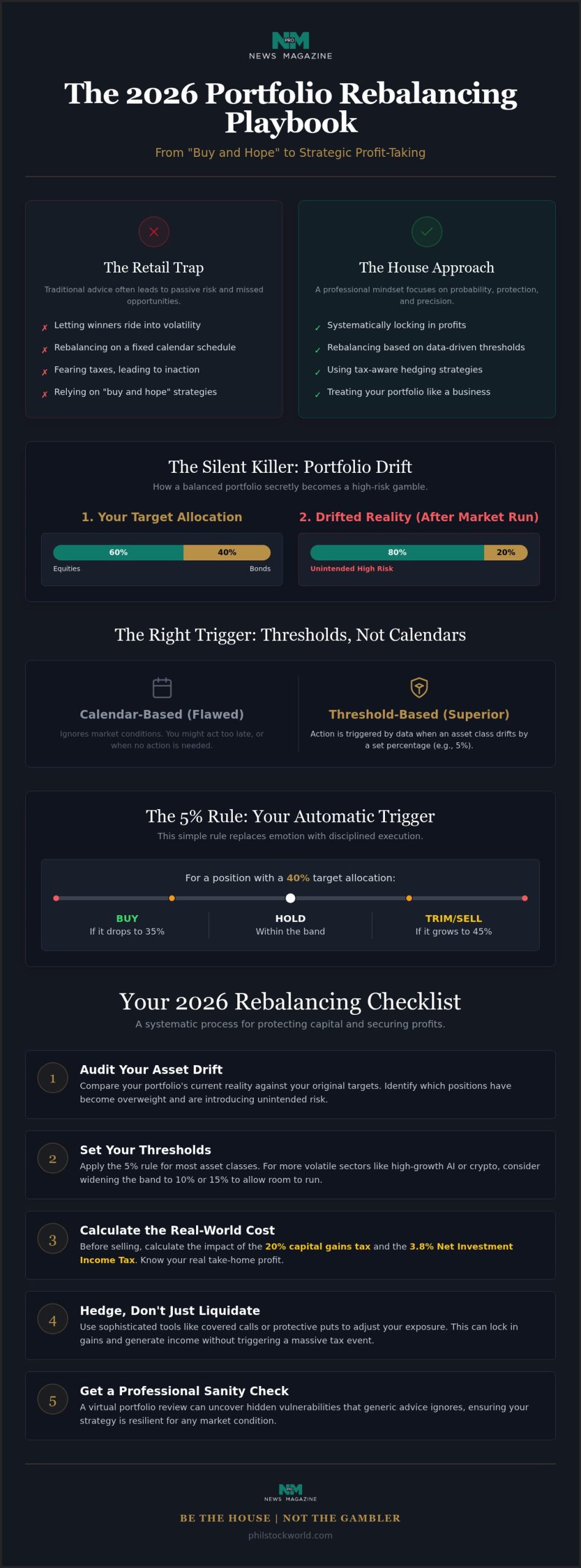
Market drift is a silent killer. Imagine you started the year with a classic 60/40 split between equities and bonds. After a massive run in tech or AI sectors, that balance can accidentally shift to an 80/20 mix without you making a single trade. This concentration creep means you’re now carrying significantly more risk than you originally intended. If the tech sector takes a 10% hit, your entire portfolio suffers a much deeper wound because you failed to trim the fat. The 2026 market is particularly unforgiving to those who refuse to take chips off the table when the house offers them a win. You must audit your exposure frequently to ensure your current reality still matches your original risk tolerance. If you’ve been relying on a traditional 60/40 framework, it’s worth understanding why portfolio diversification with options moves beyond the outdated 60/40 myth to create truly non-correlated protection.
Rebalancing as a Profit-Locking Mechanism
Most traders struggle to sell because they fear missing out on the next leg up. However, rebalancing transforms those “unrealized gains” into “realized security.” It provides the liquidity you need to fund new, high conviction trade ideas without having to deposit more cash. By systematically trimming your over-performers, you’re effectively harvesting the crop before a storm hits. Rebalancing is the only systematic way to guarantee you actually buy low and sell high. It removes the emotion from the decision-making process. When you follow these portfolio rebalancing tips, you aren’t just managing risk; you’re creating a repeatable cycle of profit taking that keeps your capital working at its highest potential.
Setting Your Thresholds: The “When” and “How Much”
The biggest lie in retail finance is that your portfolio should operate on a calendar. Traditional advisors love quarterly or annual check-ins because it fits their billing cycle, not because it fits the market. In the volatile environment of 2026, waiting for a specific date to fix a drifted portfolio is a rookie mistake. If your tech heavy hitters surged in February, why wait until June to protect those gains? These portfolio rebalancing tips focus on threshold triggers rather than the Gregorian calendar, ensuring you move when the math demands it, not when the season changes.
Threshold rebalancing is the superior choice for the savvy trader. It allows you to ignore the daily noise and only take action when your asset allocation moves outside of a predetermined “safety zone.” This approach keeps your capital working efficiently and prevents you from over-trading during periods of sideways movement. It’s about being surgical with your capital. You want to be the person who reloads their position while everyone else is still waiting for their end-of-year review.
The 5% Threshold Strategy
The gold standard for most asset classes is the 5% rule. If you have a target allocation of 40% in large cap equities and that position grows to 45%, it’s time to trim. Conversely, if it drops to 35%, you buy the dip. This variance band provides several benefits:
- Reduces Trading Costs: You aren’t burning money on commissions and slippage for minor 1% fluctuations.
- Volatility Buffering: It gives your winners room to run without forcing a premature exit.
- Disciplined Execution: It replaces emotional “gut feelings” with a hard numerical trigger.
For more volatile sectors like crypto, biotech, or high growth AI stocks, you might widen this band to 10% or 15%. The goal is to avoid getting “whipsawed” by normal price discovery while still maintaining a firm grip on your total risk profile. Applying these portfolio rebalancing tips consistently ensures that your “concentration creep” never turns into a portfolio-killing event.
Macro Events as Rebalancing Triggers
While thresholds are your primary guide, the 2026 macro-economic pulse provides natural “tactical” checkpoints. Fed meetings, major policy shifts, or election cycles often create sudden shifts in asset correlation. Instead of a fixed date, use these high-impact events as a reason to audit your bands. If you’re unsure whether your current triggers are too tight or too loose for the coming months, a Virtual Portfolio Review: Auditing Your Strategy for the 2026 Market can provide the professional sanity check you need to stay ahead of the curve. This tactical responsiveness is what separates the street-smart mentor from the “buy and hope” crowd.
Strategic Tweaks: Using Options to Rebalance Without Selling
Most traditional finance blogs treat rebalancing as a binary choice: you either hold your winners or you sell them. It’s clunky. This inefficiency often forces you to realize capital gains taxes before you’re actually ready to walk away. At Phil Stock World, we prefer a more sophisticated set of portfolio rebalancing tips that utilize the power of options. By incorporating derivatives into your strategy, you can “synthetically” rebalance your risk profile without actually liquidating your core positions. This is the essence of “The House” mentality; we aren’t just betting on price direction, we’re managing a business where risk is the primary inventory.
Covered Calls as a Rebalancing Tool
When a stock hits the upper end of your 5% threshold, don’t just reflexively hit the “sell” button. Instead, consider selling covered calls. This strategy allows you to get paid while you wait for the stock to reach your exit target. By selecting a strike price that aligns with your rebalancing goal, you effectively set a “limit order” that generates immediate income. If the stock gets called away, you’ve successfully trimmed your exposure at your desired price. If it doesn’t, you keep the premium and lower your cost basis. It’s a win-win. It turns a simple exit into a revenue-generating event that keeps your capital working.
Hedging with Put Options
Sometimes you want to keep the stock but kill the risk. This is where protective puts become your best friend. Using puts allows you to lock in your gains without triggering a capital gains tax event, which is essential if you’re trying to stay under the 2026 NIIT thresholds. It’s a key part of recession-proofing your portfolio with options. Think of it as insurance. You might pay a small percentage of the position’s value for the hedge, but that’s a bargain compared to watching a 20% market drawdown erase years of progress. Our members prioritize hedging over hitting the exit because it keeps them in the game while protecting the downside. To go deeper on how everyday investors can implement these techniques without institutional resources, explore the full breakdown of portfolio hedging strategies for retail investors designed specifically for wealth preservation in 2026.
For high-flying winners that have become dangerously over-concentrated, we often use a “Sell and Replace” strategy. You sell the stock to lock in the massive gain and immediately replace the exposure with long-term call options (LEAPS). This move drastically reduces the capital you have at risk while maintaining your upside potential. It’s a surgical way to apply portfolio rebalancing tips, allowing you to move capital into new, high-conviction ideas without losing your seat at the table for the next rally. You’re essentially playing with the house’s money at that point. For a deeper look at how options can replace traditional asset class diversification entirely, explore how building a diversified portfolio with options creates non-correlated income streams that work in any market direction.
The 2026 Portfolio Rebalancing Checklist
Execution is where the “savvy” in savvy trader actually manifests. It’s one thing to know you’re overweight in tech; it’s another to move capital without getting mauled by taxes or slippage. This checklist provides the technical bridge between analysis and action. Use these portfolio rebalancing tips to ensure your next move is a strategic reload, not a panic sell.
- Step 1: Audit Drift. Compare your current holdings against your original 2026 targets. If your AI positions have ballooned past your 5% threshold, they are prime candidates for a trim.
- Step 2: Tax Math. Calculate the potential hit. For 2026, long-term capital gains for single filers earning between $49,451 and $545,500 sit at 15%. Don’t forget the 3.8% Net Investment Income Tax (NIIT) if your MAGI exceeds $200,000.
- Step 3: Identify Laggards. Find the dead weight that no longer fits the macro narrative. If a stock hasn’t moved during a sector rally, it’s likely a fundamental failure, not a “deep value” play.
- Step 4: Timing. Execute during low-volatility windows. Use the VIX as a guide; trying to rebalance during a 300-point intraday swing is a fast way to lose 1% to slippage.
- Step 5: Dry Powder. Review your cash levels. A rebalanced portfolio should always leave you with enough liquidity to pounce on the next high-conviction opportunity.
The Tax Impact Sanity Check
In 2026, the gap between short-term and long-term capital gains is massive. Short-term gains can be taxed at ordinary income rates as high as 37%, while long-term rates remain much lower. Use tax-loss harvesting to offset your winners by selling underwater positions that no longer serve your strategy. This helps neutralize the tax bill while cleaning up your portfolio. However, you should never let the “tax tail wag the investment dog.” If a company’s fundamentals have crumbled, waiting for the one-year mark just to save a few percentage points in taxes can cost you 50% in principal.
Sector and Style Rebalancing
Check your exposure to Growth versus Value. In the current interest rate environment, being too heavily tilted toward speculative growth can lead to extreme variance. We recommend the “Rule of 3,” where no single position exceeds 3% of your total wealth. This prevents a single “black swan” event from sinking your entire ship. A diversified portfolio in 2026 must include a mix of uncorrelated assets, not just different stocks. If you want real-time guidance on these moves, a Premium Membership provides the trade alerts and deep-dive analysis needed to stay ahead of the curve.
Auditing Your Strategy with a Virtual Portfolio Review
Even the most disciplined traders can suffer from tunnel vision. When you’ve been staring at the same charts for months, it’s easy to overlook the slow decay of a position or the subtle shift in market correlation that turns a “diversified” portfolio into a ticking time bomb. An independent trader needs a second pair of eyes; not to be told what to do by a high-fee asset manager, but to have their assumptions challenged by a peer who understands “The House” mentality. This is where the transition happens from merely following portfolio rebalancing tips to actually optimizing your capital for the specific volatility of the 2026 market cycle.
The Phil Stock World community acts as a massive vetting machine for trade ideas. Instead of operating in a vacuum, you’re operating in an environment where skeptical, savvy innovators tear apart strategies until only the highest probability moves remain. This collective intelligence ensures you aren’t just shifting chips around the table but are actually moving them to the spots with the best odds. It turns the solitary act of trading into a high-level discussion among peers.
What to Expect from a Professional Review
A standard brokerage statement tells you what you own, but it rarely tells you how you’re actually positioned. During a review, we look past the ticker symbols and analyze your “Greeks.” We want to see your Delta to understand your directional exposure, your Gamma to see how that exposure changes with price moves, and your Theta to ensure time is working for you, not against you. We also hunt for “dead money.” These are the stagnant positions that haven’t moved in months, tying up capital that could be better utilized in higher-conviction trades. It’s time to get your Virtual Portfolio Review today and start trading like “The House” instead of the gambler.
Joining the Phil Stock World Inner Circle
Market cycles in 2026 don’t wait for your monthly review. They move fast. If you’re relying on portfolio rebalancing tips from a quarterly newsletter, you’re already behind the curve. Real-time alerts allow you to adjust your hedges and trim your winners as the price action unfolds, capturing value that others miss. Our live trading room provides the immediate feedback necessary for executing complex rebalancing trades, such as rolling options or setting up synthetic positions. You don’t have to navigate these choppy waters alone. You can explore Phil Stock World Membership for a daily market edge and a community that values transparency over corporate platitudes.
Stop Guessing and Start Optimizing
Rebalancing in 2026 isn’t a passive maintenance task. It is an aggressive, strategic reload. By moving away from rigid calendars and embracing threshold triggers, you ensure your capital is always positioned where the probability is highest. You’ve learned that using options like covered calls and protective puts can help you manage concentration creep without triggering a massive tax bill or exiting a winning trend too early. These portfolio rebalancing tips are only the beginning of a professional trading mindset.
To truly stay ahead of shifting correlations and macro volatility, you need more than a checklist. You need a daily edge that keeps you one step ahead of the crowd. Master the 2026 market with a Phil Stock World Membership. You will gain access to daily market commentary from Phil Davis, our real-time interactive trading rooms, and our proprietary “House” trading strategies designed to maximize your probability of success.
Don’t let the market dictate your returns. Take the wheel, trust the math, and trade with the confidence of the house. Your future self will thank you for the discipline you show today.
Frequently Asked Questions
How often should I rebalance my portfolio in a volatile 2026 market?
Use threshold triggers rather than a fixed schedule. In a volatile 2026, checking your bands monthly is smart, but only trading when a position drifts past your +/- 5% mark prevents over-trading. This tactical approach ensures you capture the volatility harvest without drowning in commissions. Fixed calendars are for retail investors who don’t watch the tape; savvy traders move when the numbers demand it.
Is rebalancing better than just buying more of the losing asset?
Rebalancing is a more disciplined risk management tool than simply averaging down. While buying more of a laggard can lower your cost basis, it often leads to over-concentration in a failing asset. Rebalancing forces you to take profits from winners and reinvest into undervalued sectors based on a pre-set target. This systematic reload keeps your total risk profile stable rather than skewing it toward your worst performers.
Can I use options to rebalance my portfolio without selling my stocks?
Yes, you can use synthetic rebalancing through covered calls and protective puts. Selling a covered call allows you to trim exposure at a specific strike price while collecting premium income. If the stock isn’t called away, you’ve effectively reduced your cost basis. Conversely, buying puts can hedge a position that has grown too large, locking in gains without triggering an immediate capital gains tax event in your brokerage account.
What are the tax implications of rebalancing a brokerage account?
Selling assets for a profit in a taxable account triggers capital gains taxes. In 2026, long-term gains are taxed at 0%, 15%, or 20% depending on your income, plus a potential 3.8% NIIT for high earners. Short-term gains are hit at ordinary income rates up to 37%. To mitigate this, prioritize rebalancing within tax-advantaged accounts like IRAs or use tax-loss harvesting in your taxable brokerage to offset the gains.
What is the “5% rule” in portfolio rebalancing?
The 5% rule is a threshold-based strategy where you only rebalance when an asset class drifts more than 5% from its target allocation. If your goal for equities is 60% and it hits 65%, you trim. This specific threshold provides enough breathing room for winners to run while preventing concentration creep from doubling your risk. It’s one of the most effective portfolio rebalancing tips for maintaining long-term discipline.
Is rebalancing necessary if I am a long-term investor?
Rebalancing is actually more critical for long-term investors because it prevents your risk profile from changing over decades. Without it, a high-growth sector can eventually dominate your entire portfolio, making you vulnerable to a single market crash. Systematic rebalancing ensures that your asset mix stays aligned with your original goals. It’s the only way to guarantee that you are consistently buying low and selling high over a 20 year horizon.
What happens if I never rebalance my investment portfolio?
Your portfolio will eventually drift into a high-risk concentration that you never intended to hold. Stocks generally grow faster than bonds, so a balanced portfolio will slowly transform into a 90% equity monster. This leaves you exposed to massive drawdowns during market corrections. By ignoring portfolio rebalancing tips, you aren’t being a buy and hold investor; you’re becoming a passive gambler who is letting market momentum dictate their financial security.
How do I rebalance if all my assets are currently down?
Rebalancing in a down market is about relative performance rather than absolute gains. Even if everything is in the red, some assets will have dropped 10% while others fell 30%. You sell a portion of the resilient assets that are now overweight to buy more of the assets that were hit harder. This prepares your portfolio for the eventual recovery by ensuring you have maximum exposure to the sectors with the most upside potential.

