


Most traders treat their morning news feed like a weather report when they should be treating it like a casino’s internal memo. It’s a common mistake to think that more information leads to better trades. In reality, the flood of daily stock market commentary often serves as a smokescreen for the big institutional moves happening behind the scenes. You likely feel the weight of this every morning. Whether it’s the Fed holding rates at 3.50% or the energy sector’s 12.1% spike in July 2026, the volume of data can make anyone feel like they’re reacting too late to shifts that matter. You’re not alone in feeling that the “big picture” is constantly slipping through your fingers.
We’ve all been there, staring at a 3.20% Nasdaq slide and wondering if we missed the exit sign. This article is your guide to filtering that static and transforming raw news into a disciplined trading strategy that protects your capital like the “House” would. You’ll learn a repeatable process for analyzing headlines and gain the confidence to read between the lines of 2026 volatility. We’ll show you exactly how to spot the signals that dictate your portfolio’s survival.
Key Takeaways
- Stop reacting to every headline and start identifying the specific catalysts that actually move the needle for your portfolio.
- Understand why the “House” always wins by using probability and risk management instead of chasing mainstream financial tips.
- Develop a repeatable workflow to filter daily stock market commentary so you can enter every trading session with a clear, disciplined strategy.
- Learn to read market sentiment like a pro by looking past the numbers to see the psychological shifts driving the floor.
- Discover how real-time peer discussion and strategic analysis can help you spot institutional moves before they become old news.
Daily Stock Market Commentary: Why Most of it is Noise
The 24-hour news cycle isn’t built to make you money; it’s built to keep your eyes on the screen. Most daily stock market commentary you consume is little more than a post-game recap of things that already happened. If you’re reading a headline about a 3.20% drop in the Nasdaq, you’re looking at the past. Strategic commentary, however, acts as the bridge between that raw data and an actual, actionable trade. It’s the difference between knowing the weather is bad and knowing exactly which roof shingles will fly off first. We focus on the “why” because the “what” is already priced in by the time it hits your phone.
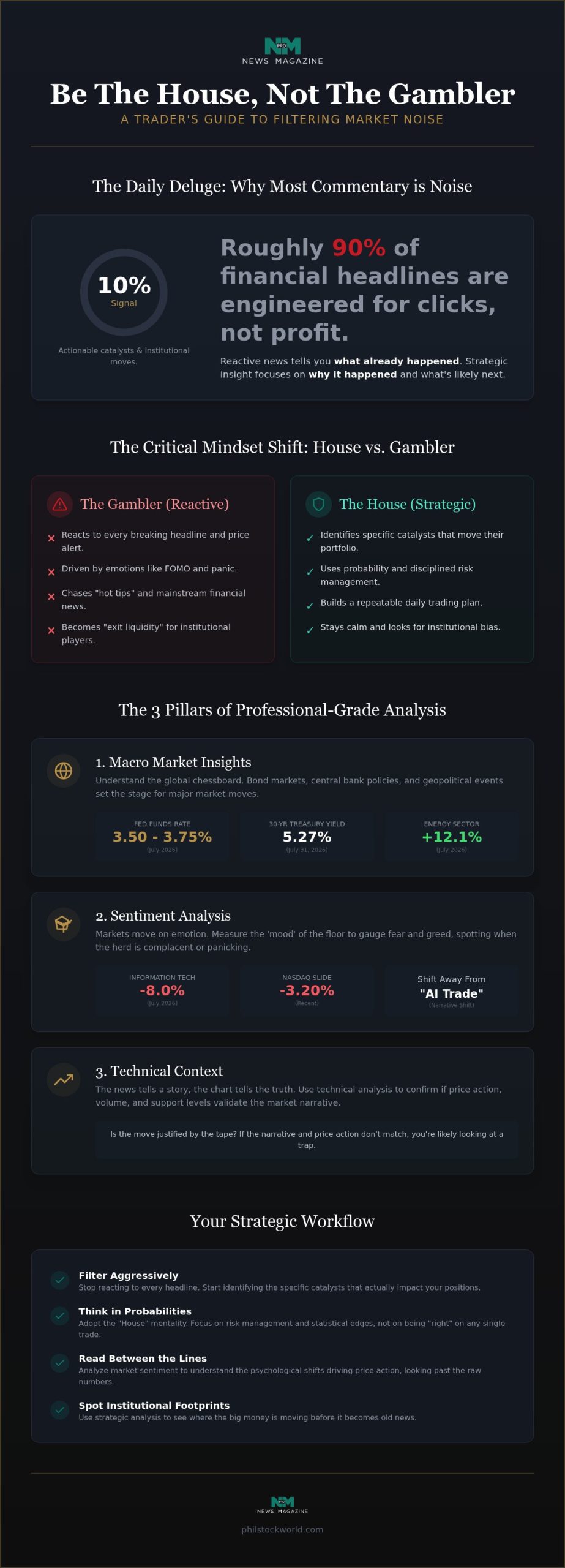
The noise problem is real. Roughly 90% of financial headlines are engineered for clicks, not for your profit and loss statement. When mainstream outlets scream about the “AI trade” slowing down or energy prices spiking due to Middle East conflict, they’re often just reacting to the herd’s movement. A street-smart mentor looks for the institutional bias hidden in these reports. They ask who benefits from you buying into the panic or the hype. Filtering this noise requires a skeptical mind that values math over metaphors and risk management over “hot tips.”
The Difference Between News and Strategic Insight
News tells you the price moved. Insight tells you if that move was justified by the tape. Retail traders often get trapped by following late-breaking headlines because they’re reacting to the final stages of a move. By the time a “breaking news” alert tells you the Information Technology sector lost 8.0% in July 2026, the smart money has already rotated into energy or financials. You need to look for the narrative behind the numbers. This involves a mix of fundamental shifts and Technical analysis to see where the actual support lies. If the narrative doesn’t match the price action, you’re likely looking at a trap.
Why the “Herd” Usually Gets it Wrong
The herd is driven by two primary emotions: FOMO and panic. Mainstream daily stock market commentary often feeds these fires, serving as institutional “exit liquidity.” When big banks put out a glowing “Daily Recap” after a massive rally, they’re often looking for someone to buy the shares they want to sell. In 2026, developing a skeptical lens is your best defense. Whether it’s the Fed’s divided stance on interest rates or the sudden implementation of new Nasdaq trading halt rules on August 10, the herd usually panics first and asks questions later. You win by staying calm, looking at the probabilities, and refusing to be the liquidity for someone else’s exit strategy.
The Three Pillars of Professional-Grade Market Analysis
Professional trading isn’t about having a crystal ball. It’s about having a better filter. To move beyond the surface-level noise, you need a unified worldview that connects disparate global events into a single, actionable narrative. This is where daily stock market commentary transforms from a simple news feed into a strategic weapon. By mastering the three pillars of macro data, market sentiment, and technical context, you stop guessing and start calculating. You’ll begin to see how a shift in energy policy or a tweak in trading halt rules filters down to your bottom line.
Macro Market Insights: The Global Chessboard
The bond market is often the smartest person in the room. While the talking heads on TV obsess over the Dow, savvy traders are watching the 30-year Treasury yield, which closed at 5.27% on July 31, 2026. Understanding How Stock Markets Work requires looking at the global chessboard. The Federal Reserve’s July 2026 meeting left the funds rate at 3.50% to 3.75%, but the real story was the three dissenting votes for a hike. This division suggests a volatile path ahead. When you see inflation concerns revived by Middle East conflicts driving energy prices up by 12.1% in a single month, you aren’t just reading news; you’re seeing the next move in a high-stakes game of policy and profit.
Sentiment Analysis: Measuring Fear and Greed
Markets don’t just move on data; they move on how people feel about that data. Sentiment analysis allows you to measure the “mood” of the floor to time your entries. “Boring” markets, where volatility is low and the herd is complacent, are often the most dangerous for retail traders because they mask institutional distribution. You can validate these psychological shifts by checking professional market charts to see if the volume supports the price action. In July 2026, the 8.0% loss in Information Technology showed a massive sentiment shift away from the “AI trade,” even as corporate earnings remained strong. Reading these cues helps you avoid being the “exit liquidity” for the big banks.
Integrating these pillars into your daily stock market commentary routine allows you to act with the calm confidence of the House. If you’re ready to stop reacting and start anticipating, our Premium Membership offers the deep-dive analysis needed to bridge the gap between headlines and high-probability trades.
Institutional vs. Independent Perspectives: Why the “House” Wins
If you think your brokerage’s morning newsletter is a disinterested guide to the markets, you’re playing a dangerous game. Most institutional daily stock market commentary is actually a marketing tool designed to generate trading fees or provide “exit liquidity” for the bank’s own positions. When a major firm issues a “Buy” rating on a tech stock that just dropped 8.0%, they aren’t necessarily looking out for your portfolio. They might be trying to prop up the price while they offload their own shares. To win, you have to stop thinking like a customer and start thinking like the House.
Operating as an independent trader gives you one massive advantage: you don’t have to answer to a board of directors or maintain a “corporate” narrative. You can afford to be skeptical. While the mainstream media obsesses over the next Fed move, you can focus on unbiased financial research that prioritizes math over headlines. The House wins because it doesn’t gamble on “hot tips” or emotional reactions; it relies on probability and risk management to ensure that the odds are always in its favor.
Breaking the Corporate Mold
Institutional “Buy” ratings are often a signal to look the other way. These firms have a vested interest in keeping you active in the market, regardless of the actual risk. You also need to watch out for “window dressing” as we approach the end of quarters in 2026. This is where fund managers dump their losers and buy the quarter’s winners just to make their reports look better to clients. By recognizing these institutional patterns in your daily stock market commentary, you can avoid the traps that snare the retail herd.
The “House” Advantage in 2026
Transitioning from a “gambler” to a “casino operator” mindset is the single most important shift you can make. In the current environment, where the Fed is divided and energy prices are volatile, you can’t afford to bet the farm on direction alone. The House uses options and strategic hedging to create a statistical edge. This means you win if the stock goes up, stays flat, or even goes down slightly. Risk management isn’t just a safety net; it’s the only “holy grail” in trading. When you trade with the House mentality, you stop chasing the “big win” and start focusing on consistent, repeatable gains built on a foundation of solid math.
How to Build Your Own Daily Trading Plan
Information without a plan is just expensive entertainment. To stop being a spectator, you need to turn your daily stock market commentary into a set of marching orders. This isn’t about predicting the future; it’s about preparing for multiple futures. By the time the opening bell rings at 9:30 AM, you should already know exactly what you’ll do if the market rallies or if it falls off a cliff. Following a structured routine ensures that you aren’t making emotional decisions when the tickers start flashing red and the herd begins to panic.
A professional-grade plan follows a logical progression from broad data to specific action:
- Review the economic calendar: Look for high-impact catalysts like the August 10, 2026, implementation of new Nasdaq trading halt rules or the NYSE Arca fee modifications scheduled for August 11.
- Analyze global sentiment: Compare overnight moves in Asian and European markets to US pre-market futures to see if the global “mood” is consistent or diverging.
- Set technical guardrails: Identify key support and resistance levels on major indices to know exactly where the institutional “floor” and “ceiling” are located.
- Audit your positions: Align the morning’s news with your existing virtual portfolio review results to see which of your holdings are most exposed to the day’s themes.
- Define “If-Then” scenarios: Decide now what you’ll buy, sell, or hedge if specific price targets are hit during the session.
Pre-Market Preparation and Rituals
Successful trading starts long before the market opens. A 30-minute morning routine can save you hours of mid-day stress and prevent costly “revenge trading.” Start by identifying the “Theme of the Day.” Is the market obsessed with the Fed’s divided stance on interest rates, or is it reacting to renewed energy price volatility? Once you’ve identified the primary driver, set realistic goals. If the volatility index is screaming, don’t expect a calm, trending day. Adjust your expectations to match the environment, and you’ll find it much easier to stay disciplined when the tape gets choppy.
The “If-Then” Framework for Action
Discipline is the byproduct of preparation. Write your plan down. There’s a psychological shift that happens when you commit your strategy to paper or a digital note. If the market gaps up on “good” news that you suspect is just institutional exit liquidity, your plan should tell you to stay on the sidelines. When the daily stock market commentary shifts mid-session due to a breaking headline, your “If-Then” framework acts as your anchor. It keeps you from chasing the herd into a trap and ensures you’re playing the role of the casino, not the gambler.
Don’t fly blind into the next session. Use our Market Charts and Analysis to map out your support and resistance levels before the first trade is even placed.
The Phil Stock World Edge: Beyond the Headlines
Static news is often just an autopsy of yesterday’s mistakes. While mainstream outlets are busy explaining why the Nasdaq dropped 3.20% last month, we’re already looking at how to profit from the next shift. The real secret to success isn’t just consuming daily stock market commentary; it’s having the tools to act on it before the opportunity evaporates. At Phil Stock World, we don’t just tell you that energy prices spiked 12.1% in July. We show you how that volatility creates a specific opening for a high-probability trade. We’re the antidote to the “noisy” mainstream finance machine that thrives on keeping you confused and reactive.
Our edge comes from a community-driven approach to real-time analysis. In our live trading rooms, we don’t just stare at tickers. We dissect the news as it breaks, filtering out the institutional bias and finding the “House” advantage in every headline. This collective intelligence acts as your best defense against the hype and panic that usually drains retail accounts. When you’re surrounded by skeptical, savvy peers, you’re much less likely to fall for the traps set by the big banks’ “Daily Recaps.”
Actionable Ideas vs. Static News
We specialize in transforming macro insights into specific “Top Trades.” It’s one thing to hear the Fed is divided on interest rates; it’s another to use that uncertainty to build advanced option trading strategies that pay off regardless of the next rate hike. By utilizing our “House” methodology, we focus on math and probability to hedge against the inherent uncertainty of the 2026 market. We also encourage regular virtual portfolio reviews to test new theories in a controlled environment before committing real capital. This disciplined approach ensures that your daily stock market commentary consumption always leads to a concrete, strategic conclusion.
Joining the Insider’s Club
Becoming a member of Phil Stock World is like gaining access to an exclusive insider’s club where the complex is made simple with wit and transparency. You aren’t just getting a newsletter; you’re getting a street-smart mentor and a community that values irreverence over pretense. We believe that trading should be intellectually stimulating and, frankly, a bit more fun than the dry, institutional lectures you’ll find elsewhere. If you’re tired of being part of the herd and ready to start trading with a statistical edge, it’s time to change your perspective. Explore our Educational Webinars today and start your journey toward becoming a truly disciplined, savvy investor.
Taking Control of the 2026 Market Pulse
Mastering the tape in 2026 isn’t about working harder; it’s about filtering smarter. You’ve seen how most daily stock market commentary is designed to serve institutional interests rather than your own bottom line. By shifting to a “House” mentality and focusing on macro catalysts like Fed policy shifts or the latest Nasdaq halt rules, you move from being a gambler to acting like a casino operator. A disciplined plan built on math and probability is the only reliable way to protect your capital during high-volatility cycles.
You don’t have to navigate these choppy waters alone. Phil Stock World, founded by veteran analyst Phil Davis, provides the unbiased research and real-time interactive trading sessions you need to stay ahead of the herd. We turn static news into actionable strategies for stocks and options that prioritize risk management above all else. It’s time to stop reacting to the headlines and start anticipating the moves that actually matter.
Join Phil Stock World and start trading like “The House” today. The market won’t wait for the crowd to catch up. Get started now and trade with the confidence of a seasoned insider.
Frequently Asked Questions
What is the best source for daily stock market commentary in 2026?
The best source for daily stock market commentary is one that prioritizes math and risk management over sensational clickbait. Mainstream media often serves as a mouthpiece for institutional agendas, leading retail traders into traps. You need a source that acts as a street-smart mentor, helping you filter the noise. Look for platforms that offer real-time analysis and community discussion to help you verify headlines before you commit your hard-earned capital to a trade.
How much time should I spend reading market news every day?
You should spend about 30 minutes on focused preparation before the opening bell. Drowning in the 24-hour news cycle leads to information overload and emotional decision-making. Use this time to identify the primary theme of the day and set your support and resistance levels. A concise routine allows you to act with the calm confidence of the House rather than reacting frantically to every tick on the screen throughout the session.
Can I really trade options based on daily market commentary?
You certainly can use daily stock market commentary to inform advanced option trading strategies. Commentary provides the macro context, such as the 12.1% jump in energy prices we saw in July 2026, while options allow you to structure trades that profit from that volatility. By understanding the “why” behind the numbers, you can use hedging to create a statistical edge that protects your portfolio even when the market moves against your initial thesis.
Why does the market sometimes go down on good news?
This phenomenon usually occurs because the market is forward-looking and has already “priced in” the positive outcome. When the actual news hits, institutional traders often use the spike in retail buying as liquidity to exit their own positions. It can also happen if the news, while good, doesn’t meet the high expectations of the whisper numbers. Always remember that the tape tells the real story, regardless of how glowing the headlines appear.
What are the most important economic indicators for a retail trader?
Retail traders should prioritize the 30-year Treasury yield, which hit 5.27% in July 2026, as it often dictates long-term market sentiment. Pay close attention to Federal Reserve meeting minutes, specifically looking for dissenting votes that signal policy uncertainty. Other critical indicators include sector-specific performance, such as the 8.0% loss in tech during the summer of 2026, and the relationship between overnight global moves and US pre-market futures before the bell rings.
How do I know if a market analyst is biased?
You can spot bias by looking at the analyst’s incentives and who signs their paycheck. If an analyst works for a large brokerage, their commentary is often designed to generate high trading volume or support the firm’s underwriting business. Unbiased research typically comes from independent platforms that operate outside the traditional corporate mold. Be skeptical of “Buy” ratings that appear after a stock has already peaked, as these often serve as institutional exit liquidity.
Is it better to follow technical analysis or fundamental commentary?
It’s best to use both in a unified strategy. Fundamental commentary tells you what a company is worth and why the macro environment matters, while technical analysis helps you time your entry and exit points. Relying on just one pillar is like trying to sit on a one-legged stool. A professional approach uses fundamentals to build a thesis and technicals to validate that the “House” is actually moving in that direction on the charts.
What happens if my daily plan doesn’t match the market’s direction?
If the market’s direction doesn’t align with your daily plan, the most successful move is usually to do nothing. Trading is a game of probabilities, and your “If-Then” framework is designed to keep you out of low-probability setups. Forcing a trade when the tape doesn’t match your logic is a fast track to capital destruction. Staying on the sidelines is a valid and often profitable position that preserves your mental and financial capital.

