


The traditional 60/40 portfolio isn’t just outdated. In 2026, it’s a dangerous trap for your hard-earned capital. You’ve likely noticed that when the S&P 500 dips, your supposedly diversified mix of tech, energy, and even bonds all seem to catch the same cold at once. It’s a frustrating reality that most retail investors face. You were told that owning different sectors would protect you, but high correlation has turned that promise into a hollow myth. If your strategy only works when the market moves up, you aren’t really an investor; you’re just a passenger.
We agree that watching a static portfolio sit idle during flat or down markets is a massive waste of time and potential. This guide will teach you how to achieve true portfolio diversification with options, showing you how to create a non-correlated plan that thrives regardless of market direction. You’ll learn to “Be the House” by selling premium and using professional-grade hedging techniques to lower your cost basis. We’re moving beyond simple stock-picking to explore how you can generate consistent income and protect your gains, even when the mainstream indices are in a freefall.
Key Takeaways
- Understand why the 60/40 rule is a dangerous myth in modern markets and how to escape the correlation trap that sinks traditional portfolios.
- Master the art of portfolio diversification with options to create non-correlated income streams that don’t depend on market direction.
- Learn the “Core and Satellite” framework to balance long-term stock ownership with short-term tactical trades for professional-grade hedging.
- Discover how to “Be the House” by selling premium; this strategy turns time decay into a mathematical advantage for your account.
- Get a clear, step-by-step process for identifying your core holdings and protecting them with smart, surgical option overlays.
Why Traditional Diversification Fails in Modern Volatile Markets
Diversification is the most misunderstood word in finance. Most people think it means owning ten different stocks from ten different sectors. They buy some Apple, some Exxon, and maybe a REIT, then they sleep soundly. That isn’t diversification; it’s just a collection. A truly diversified portfolio requires non-correlated risk streams. If every asset you own relies on the same economic tailwinds to go up, you’re just betting on the same horse with ten different saddles.
Traditional advisors still preach the gospel of Modern Portfolio Theory, which suggests that a basket of assets will eventually smooth out your returns. It’s a nice theory for a textbook. However, the “Buy and Hope” method ignores the reality of modern liquidity. We advocate for a “Be the House” strategic approach. This means we stop obsessing over which direction the market might move tomorrow and start focusing on the mathematical edge of selling premium. You don’t need the market to be right if your strategy is designed to win in multiple scenarios.
The Correlation Trap: When Everything Falls at Once
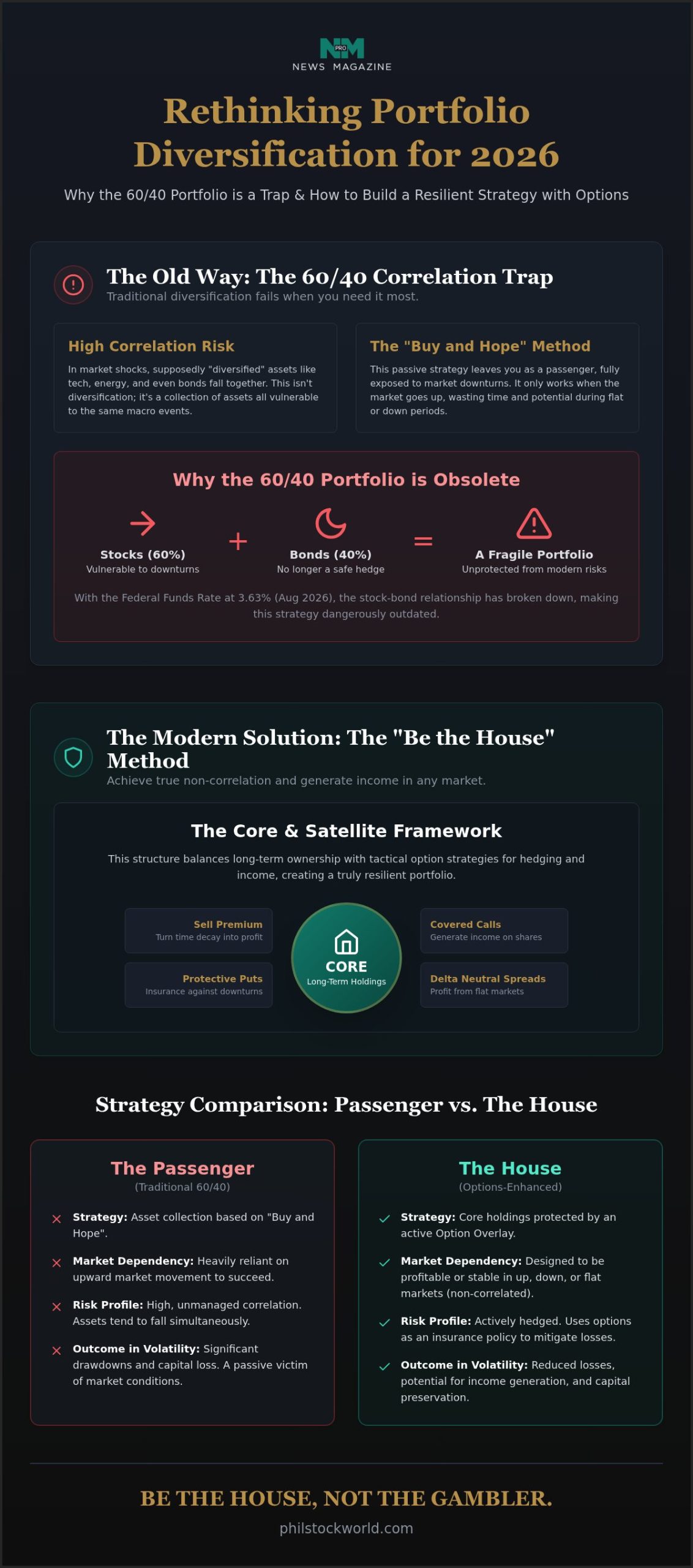
You might think your tech holdings and energy stocks are opposites. They aren’t. During macro shocks, sector lines vanish. Algorithmic trading platforms are programmed to liquidate “risk assets” the moment certain thresholds are met. This creates a feedback loop where everything from blue chips to commodities gets hammered at the same time. In the context of a 2026 market crash, correlation is the measure of how quickly your different investments behave like a single, crashing entity. You must diversify by strategy, not just by asset ticker, to survive these sudden liquidity events.
Why the 60/40 Portfolio is Obsolete
The 60/40 split is a relic of a bygone era. For years, bonds were the reliable hedge that went up when stocks went down. That relationship has disintegrated as inflation and interest rates moved in lockstep. With the Effective Federal Funds Rate at 3.63% as of August 2026, bonds are no longer the safe haven they used to be. They’ve become just another sensitive asset class that can lose value quickly in a shifting rate environment.
Fixing this broken model requires portfolio diversification with options. By implementing an Option Overlay, you can transform a static portfolio into an active, income-generating machine. This allows you to hedge against downside risk without liquidating your core positions. Instead of praying for a green day, you use portfolio diversification with options to ensure that even a flat or down market contributes to your bottom line, effectively acting as your own insurance policy.
Using Options to Achieve True Portfolio Non-Correlation
Most investors spend their lives looking for the next hot ticker, hoping that a new sector will provide the safety they crave. They’re looking in the wrong place. True non-correlation doesn’t come from what you own; it comes from how your positions react to market movement. By integrating portfolio diversification with options, you can build a “Delta Neutral” framework. This is the ultimate form of diversification where your portfolio’s value remains stable regardless of whether the market moves up, down, or stays frustratingly flat. It’s about having no dog in the fight, allowing the math of the trade to do the heavy lifting while others sweat over the daily headlines.
Before you can implement these strategies, you need to know exactly where your current vulnerabilities lie. Most people are far more exposed to a single market direction than they realize. A virtual portfolio review is the essential first step to identify these hidden risks and audit your strategy for the 2026 market. Once you understand your baseline, you can start moving away from “buy and hope” toward a more tactical, resilient structure.
Hedging as Active Diversification
Think of hedging as an insurance policy for your capital. You wouldn’t own a million dollar home without fire insurance, yet many investors carry six figure portfolios with zero protection. A small, well placed put position can offset a massive decline in your long stock holdings. The cost of this protection is a fraction of the potential loss during a catastrophic market event. For example, a “tail risk” hedge using out of the money puts on the SPX acts as a parachute. It might feel like a drag on performance during a bull run, but when the floor drops out, it’s the only thing that keeps your account balance from hitting zero. Active hedging is the key to maintaining portfolio diversification with options when correlations across all other asset classes spike to 1.0. For a deeper look at how everyday investors can implement these protective measures, our guide on portfolio hedging strategies for retail investors walks through professional-grade techniques designed to preserve your wealth during the inevitable 2026 corrections.
Selling Premium to Lower Your Basis
Our “Be the House” philosophy is built on a simple truth: it’s better to collect rent than to pay it. When you sell premium, you’re essentially selling hope to the gamblers who think they can predict the next big move. By selling covered calls or puts against positions you actually want to own, you constantly lower your cost basis. If you buy a stock at $100 and collect $5 in premium, your “real” cost is $95. Over time, this mathematical advantage makes you less dependent on price appreciation for your returns. Research from Cboe on moving Beyond 60/40 highlights how these strategy based returns provide a cushion that traditional bonds simply can’t match anymore. If you want to master these “House” tactics and trade alongside a group of savvy peers, a Premium Membership offers the real-time guidance needed to execute these plays with confidence.
Strategic Asset Allocation: Stocks, Bonds, and the Option Overlay
Think of your portfolio as a professional sports team. Your “Core” consists of your franchise players; these are the high quality, long term holdings you want to own for years. Your “Satellite” is the options overlay, acting as the special teams unit that handles specific market conditions. This “Core and Satellite” approach moves you into the “Third Way” of investing. It’s a hybrid model that combines the stability of long term ownership with the agility of short term tactical trades. By using portfolio diversification with options, you aren’t just betting on a single outcome. You’re building a system that can pivot when the macro environment shifts.
There is a massive psychological advantage to this structure. When the 24 hour news cycle starts screaming about a global meltdown, most investors freeze or panic sell. If you have a hedge in place, you’re the calmest person in the room. You know your downside is capped. This peace of mind allows you to make rational decisions while others are driven by fear. For those looking to protect their capital during economic contractions, our guide on recession proofing your portfolio with options provides a deep dive into specific downturn strategies. Institutional research supports this shift toward equity options-based strategies as a way to manage volatility without sacrificing the potential for growth.
Synthetic Positions: Capital Efficiency for Diversification
One of the most powerful tools in the savvy trader’s kit is the use of LEAPS (Long-term Equity Anticipation Securities). Instead of tying up $20,000 to buy 100 shares of a blue chip stock, you might spend $4,000 on a deep in the money LEAP. This “synthetic” long position gives you nearly identical price action for a fraction of the capital. This efficiency frees up 80% of your cash to be used for other hedges or income generating plays. Capital efficiency is the absolute key to surviving a 2026-style market where liquidity can dry up in an instant. It allows you to maintain portfolio diversification with options while keeping a massive amount of “ammo” on the sidelines.
The Role of Cash in a Diversified Portfolio
In a world of zero percent interest rates, cash was trash. In 2026, with the Federal Funds Rate at 3.63%, cash is a strategic asset. It provides the ultimate non-correlation because its value doesn’t drop when the S&P 500 does. Options allow you to stay liquid while maintaining market exposure, meaning you don’t have to be “all in” to make money. This flexibility is vital for active management. When you’re ready to fine tune your holdings, these portfolio rebalancing tips offer a concrete checklist for managing your cash reserves and ensuring your asset allocation remains optimized for the current volatility.
Step-by-Step: Diversifying Your Portfolio with Option Strategies
Forget the “set it and forget it” advice from the big box brokerages. In a high volatility environment, passive rebalancing is a recipe for mediocrity. True portfolio diversification with options requires an active, tactical approach that evolves with the tape. We don’t just buy a fund and hope for the best. We build a fortress. Follow these five steps to transition from a static observer to a strategic market player.
- Step 1: The Correlation Audit. List your core holdings and identify how they move together. If your tech stocks and “green energy” plays both crater when interest rates tick up, you aren’t diversified. You’re just doubled down on a single risk factor.
- Step 2: The Protective Put. Deploy insurance on your high-beta holdings. This ensures that a sudden 10% gap down doesn’t wreck your year.
- Step 3: The Income Overlay. Sell covered calls against your “Must-Own” stocks to generate monthly rent. This shifts your return source from uncertain price growth to certain time decay.
- Step 4: Strategic Entry. Use Bull Put Spreads to enter new sectors. This allows you to get paid while waiting for a stock to hit your preferred entry price, diversifying your entry points.
- Step 5: Audit the Greeks. Monitor your portfolio’s total Delta, Gamma, and Theta. This tells you exactly how much direction, speed, and time are affecting your net worth.
If you’re ready to stop guessing and start executing with professional precision, our Premium Membership provides the real-time alerts and community support needed to master these steps.
Protective Puts: The Portfolio Insurance Policy
Sizing is everything when it comes to hedging. If you spend too much on puts, you’ll bleed out your gains during a bull run. We generally recommend spending no more than 1% to 3% of your position value on insurance. Think of it as a business expense. The cost of insurance is always lower than the cost of a 20% correction. A solid rule of thumb is to roll your hedge when the stock price approaches the strike or when time decay begins to accelerate into the final 30 days of the contract. This keeps your protection fresh without overpaying for “volatility juice.”
Covered Calls for Diversified Income
Selling calls is how you “Be the House.” While most investors wait for a dividend that might pay 3% annually, a savvy option trader can collect that same amount in premium every few months. This diversifies your income stream. You’re no longer just an owner; you’re a landlord. To avoid having your best stocks called away too early, sell calls that are “out of the money” with a Delta of .30 or lower. This gives the stock room to run while you still bank the check. If the stock gets too close to the strike, you simply roll the position out and up, keeping your core holdings while continuing to lower your cost basis.
How to Trade Like “The House” with Phil Stock World
The biggest mistake most independent traders make is trying to go it alone. The market is a brutal environment, especially when you’re fighting against high-frequency algorithms and institutional desks with bottomless pockets. Phil Stock World operates as a high-level mastermind for traders who are tired of being the “prey.” Instead of following the herd into the latest hype cycle, our members learn to think like the casino. We don’t gamble on direction. We build structures that profit from the passage of time and the inevitable expansion and contraction of volatility. Achieving true portfolio diversification with options is much easier when you have a tribe of savvy peers looking over your shoulder.
Our approach is grounded in the “Be the House” philosophy. This isn’t about getting lucky on a single moonshot. It’s about mathematical certainty and disciplined risk control. If you’re ready to stop the “Buy and Hope” cycle, a Phil Stock World membership is your ticket into an exclusive circle where complex market data is transformed into actionable intelligence. We provide the tools and the community needed to turn a standard account into a resilient income-generating machine.
The Power of the Live Trading Room
Reading about a strategy in a book is one thing. Seeing it executed on a live chart while the market is moving is another entirely. Our interactive trading rooms offer real-time strategy execution where you can watch Phil Davis and the team dissect macro shifts as they happen. This isn’t a lecture; it’s a high-level discussion among peers. This environment is critical for preventing the emotional “retail” mistakes that lead to panic selling or FOMO buying. Having a savvy mentor to guide you through a volatile session provides a level of calm confidence that you simply won’t find at a traditional brokerage. You get to see exactly how we use portfolio diversification with options to stay profitable when the rest of the world is losing its head.
Getting Started: Your First Portfolio Audit
Most new members arrive with what we call a “leaky” portfolio. They have overlapping risks, poor position sizing, and zero protection against a sudden correction. The first step in our community is often a Virtual Portfolio Review. This isn’t a generic automated scan. It’s a deep dive into your current strategy to identify hidden correlations and structural weaknesses. We help you transition your holdings into a “House-style” fortress, focusing on system-over-luck. Once your foundation is solid, you can begin mastering advanced option trading strategies that allow you to scale your success. It’s time to stop acting like a customer and start acting like the owner of the casino.
Take Control of Your Financial Future
The 60/40 era has officially closed its doors. Relying on traditional asset classes to protect your wealth in 2026 is a gamble you don’t need to take. We’ve explored how a strategic shift toward portfolio diversification with options transforms your account from a passive target into a proactive fortress. By mastering non-correlated risk streams and learning to sell premium, you stop being a customer of the market and start becoming the owner.
It’s time to move beyond the “Buy and Hope” mentality that leaves so many retail investors stranded during macro shocks. You have the tools to lower your cost basis and hedge against tail risks with mathematical precision. Whether you’re auditing current holdings or deploying synthetic positions to maximize capital efficiency, the goal remains the same: consistent results regardless of volatility.
If you’re ready for daily market commentary from Phil Davis, real-time interactive trading sessions, and access to exclusive “Be the House” trade alerts, don’t wait. Join Phil Stock World and Start Trading Like “The House” Today! You don’t have to face these markets alone when you can join a community of savvy, like-minded traders.
Frequently Asked Questions
Can I build a diversified portfolio using only options?
You can build a portfolio entirely out of options using synthetic positions to mimic stock ownership with less capital. This approach allows for massive flexibility, but most savvy traders prefer using options as a strategic overlay for their core holdings. By utilizing spreads and LEAPS, you can gain exposure to various sectors while maintaining a cash heavy profile. This creates a truly non-correlated system that doesn’t rely on the market’s daily whims.
Is portfolio diversification with options riskier than just buying stocks?
It is actually less risky if you use them correctly as a hedging tool. While buying lotto ticket calls is pure gambling, using portfolio diversification with options allows you to cap your downside and generate income in flat markets. Standard stock ownership leaves you 100% exposed to a crash. Options provide the parachute. The risk isn’t in the tool itself; it’s in the lack of a disciplined system and proper position sizing.
How much capital do I need to start diversifying with options?
You don’t need a massive account to start. Because options provide capital efficiency, you can control large positions for a fraction of the cost of buying shares outright. A few thousand dollars is enough to begin implementing basic spreads or covered calls. The key is starting small to master the mechanics before scaling up. Leverage is a double edged sword, so focus on being the house rather than swinging for the fences.
What is the best option strategy for a beginner looking to diversify?
Selling covered calls is the perfect entry point for most beginners. It allows you to collect rent on stocks you already own, effectively diversifying your return source from price growth to time decay. Another great starter is the Bull Put Spread, which lets you get paid to wait for a better entry price on a stock you want. Both strategies focus on high probability outcomes rather than trying to predict the next volatile market swing.
How often should I rebalance a diversified options portfolio?
You should monitor your portfolio’s Greeks weekly rather than waiting for a traditional annual rebalancing. Options have a ticking clock, so you need to be aware of how time decay and volatility are affecting your positions. Rebalancing in an options context often means rolling positions to a different strike or expiration date. This active management ensures your hedges remain effective and your income streams stay consistent as the macro environment shifts around you.
What happens to my diversified portfolio during a market crash?
Your hedges should act as a financial shock absorber. While a standard 60/40 portfolio might plummet when correlations hit 1.0, a portfolio protected by puts or delta neutral spreads remains resilient. In a crash, the value of your protective puts increases, offsetting the losses on your long stock positions. This allows you to stay calm and even look for bargain entries while the rest of the retail crowd is panicking and liquidating their accounts. Understanding the full range of portfolio hedging strategies for retail investors ensures you have the right tools in place before the next wave of volatility strikes.
Do I need a special brokerage account to trade options for diversification?
You need a brokerage account approved for options trading, typically a margin account. Most major brokers have different levels of approval. To implement the strategies we discuss, you’ll generally want Level 2 or Level 3 access. This permits you to sell covered calls and trade basic spreads. The application process usually involves a quick survey about your experience and financial goals. Just ensure your broker offers low transaction fees and a high quality trading platform.
How does selling covered calls help with diversification?
Selling covered calls provides diversification by adding an income stream that doesn’t depend on the stock price going up. You’re effectively diversifying your profit sources. Instead of relying solely on capital appreciation, you’re profiting from time decay. This means your portfolio can still grow even if the underlying stock stays completely flat. It’s a fundamental part of portfolio diversification with options because it reduces your overall cost basis and provides a consistent mathematical edge.

