


Most retail investors treat a market crash like an unavoidable natural disaster, but the smartest players on the floor view volatility as a simple math problem with a profitable solution. It’s gut-wrenching to watch years of gains evaporate in a single week of red candles, especially when you know that selling your winners to hide in cash will only trigger a massive tax bill. You’ve likely felt like the herd being led to slaughter while the big banks play by a completely different set of rules. It doesn’t have to be that way.
We’re going to show you how to master portfolio hedging strategies for retail investors that preserve your wealth and keep you in the game during the inevitable 2026 corrections. You’ll learn to use professional-grade techniques to build a “sleep at night” portfolio without paying institutional fees or sacrificing your long-term upside. We’ll dive into the mechanics of the latest index options, analyze the impact of the recently abolished Pattern Day Trader rule, and show you how to maintain a calm, confident stance even when the VIX starts to move. It’s time to stop being the victim of market swings and start being the house.
Key Takeaways
- Stop relying on the 60/40 myth and learn why traditional diversification is no longer enough to preserve wealth in today’s high-volatility landscape.
- Master professional-grade portfolio hedging strategies for retail investors by using protective puts as a custom-fit insurance policy for your most valuable positions.
- Explore the mechanics of the “no-cost” collar strategy to lock in your gains without paying the high premiums that usually eat away at retail returns.
- Calculate your portfolio beta to determine exactly how much protection you need, ensuring you stay aggressively invested while defining your own “disaster level.”
- Transition from being a buyer of expensive insurance to “being the house” by selling premium and using real-time insights to outmaneuver the panicking herd.
Beyond Diversification: Why Traditional Wealth Preservation Strategies Fail in 2026
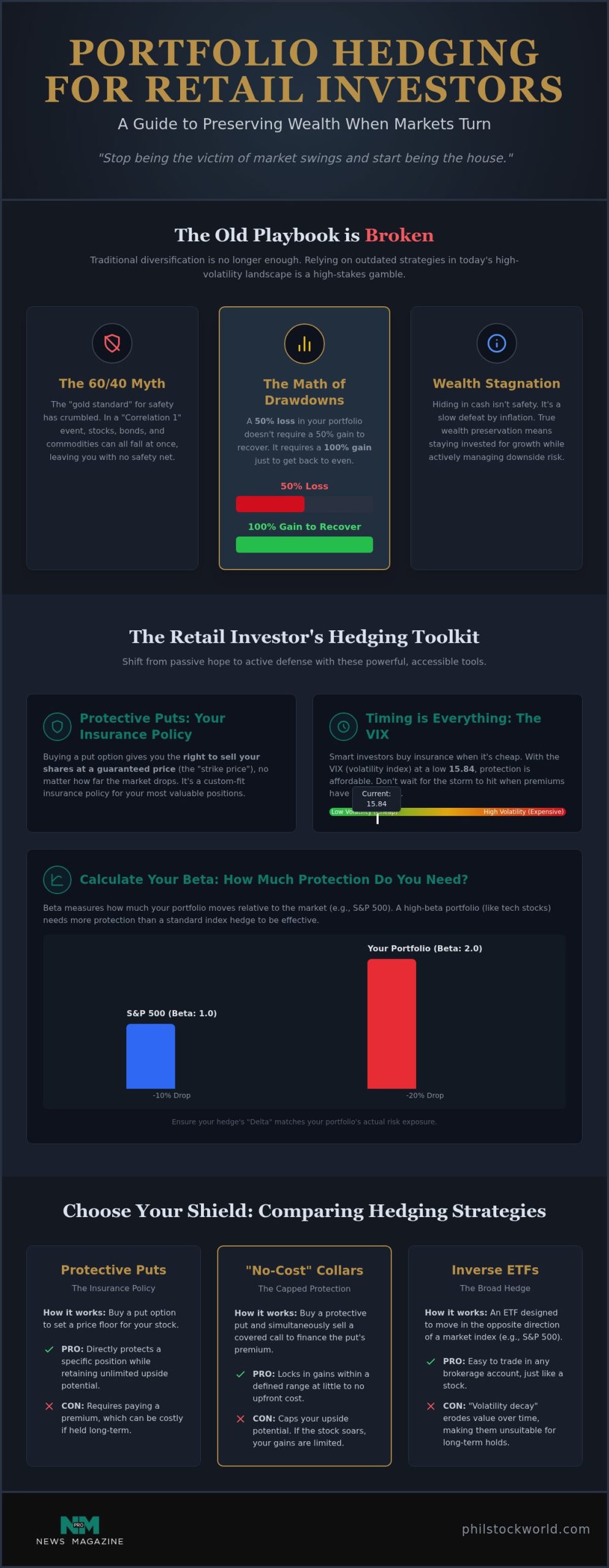
In the market of August 2026, wealth preservation isn’t about hiding. It’s about architecture. For decades, the “60/40” split was the gold standard for safety, but that 1990s logic has crumbled under the weight of new economic realities. With the 30-day SOFR rate hovering around 3.6% and the VIX hitting yearly lows near 14, the current calm is deceptive. When the tide turns, traditional bonds often fail to provide the inverse correlation investors expect. Instead of a safety net, you find yourself in a “Correlation 1” event where stocks, bonds, and commodities all crater at once. This is exactly why portfolio hedging strategies for retail investors have shifted from optional extras to mandatory equipment. Relying on simple diversification is like bringing an umbrella to a hurricane; it might keep your head dry for a minute, but it won’t save the house.
The Failure of the “Set it and Forget it” Mentality
Passive investing works until it doesn’t. If you’re within a decade of a major financial goal, a “buy and hope” strategy is a dangerous gamble. The math of drawdowns is brutal and unforgiving. If your portfolio drops 50%, you don’t just need a 50% gain to get back to even. You need a 100% return just to recover what you lost. While the market might eventually recover over twenty years, time is a luxury many independent investors can’t afford. Tactical hedging allows you to define your risk upfront rather than reacting to it after your net worth has already taken a hit. It moves you away from strategic allocation, which is often just a fancy term for standing still, and toward a proactive, resilient defense.
Wealth Preservation vs. Wealth Stagnation
Many investors mistake sitting in cash for safety. In reality, that’s just choosing a slow death by inflation over a fast one by market crash. True wealth preservation requires staying invested to capture growth while using Hedging (finance) to cap the downside. Hedging is a cost-controlled method to limit downside without capping upside. If you aren’t sure where your specific vulnerabilities lie, a virtual portfolio review is the first step to diagnosing whether you’re actually protected or just lucky. Ultimately, active risk management is the art of staying in the game when everyone else is forced to fold. It turns a volatile market from a threat into a manageable variable.
The Retail Investor’s Toolkit: Core Hedging Mechanics with Options
Think of a hedge as an insurance policy where you get to pick the deductible. In the world of portfolio hedging strategies for retail investors, the most efficient tool is the put option. When you buy a put, you’re purchasing the right to sell your shares at a specific price, known as the strike, regardless of how far the market actually falls. It’s the ultimate “get out of jail free” card. However, effective hedging isn’t just about buying protection; it’s about timing. As of August 18, 2026, the VIX is trading at 15.84, which is historically quite low. Smart investors buy their umbrellas when the sun is shining and volatility is cheap, not when the clouds have already burst and premiums have skyrocketed.
To make this work, you must understand your portfolio’s Beta. If you’re holding high-flying tech stocks that move twice as fast as the S&P 500, a standard index hedge will leave you dangerously under-protected. You need to align your “Delta”—the rate of change in your option’s price—with the actual movement of your holdings. This ensures that when your stocks drop $1,000, your hedge gains enough to offset the sting. If the Greeks sound like a foreign language, joining one of our educational webinars can help translate these complex theories into actionable profit centers.
Hedging with Put Options: The Basics
When selecting a put, you’re balancing cost against coverage. An “at-the-money” put has a strike price close to the current market price; it offers immediate protection but carries a higher premium. Conversely, “out-of-the-money” puts are cheaper but only kick in after a significant drop, acting like a high-deductible disaster policy. You also need to watch the clock. Options have expiration dates, and “Theta decay” means your protection loses value every day the market stays flat. For a deeper technical dive into choosing the right contract, check out our guide on hedging with put options.
Using Inverse ETFs for Simple Protection
If options feel too tactical, inverse ETFs like the ProShares Short S&P 500 (SH) or the ProShares Short QQQ (PSQ) offer a simpler path. These instruments are designed to move in the opposite direction of their underlying indices. They’re excellent for quick, temporary protection, especially now that the elimination of the Pattern Day Trader rule in June 2026 has made active adjustments easier for smaller accounts. However, beware of “leveraged” inverse ETFs for long-term holds. Due to daily rebalancing and volatility decay, these funds can lose value even if the market eventually goes your way. Implementing these portfolio protection strategies requires a disciplined exit plan to avoid the “decay trap.”
Comparing Hedging Strategies: Protective Puts, Collars, and Inverse ETFs
Choosing between portfolio hedging strategies for retail investors is often a balance between the level of protection you want and the price you are willing to pay. While buying a protective put is straightforward, it introduces a “cost of carry” that can eat into your annual returns if the market remains flat. If you are paying 2% or 3% of your portfolio’s value every few months for insurance that never pays out, you’re essentially creating a self-imposed bear market. To avoid this, savvy investors look toward more structured approaches that offset the cost of protection by giving up a bit of the “blue sky” potential.
The Collar Strategy: Protecting Gains Without Paying Out of Pocket
The collar is the closest thing to a free lunch in the options world. By selling a covered call against a position you already own, you generate premium income that you then use to buy a protective put. This creates a “no-cost” hedge where the only thing you’re spending is your potential for unlimited upside. If the market rallies 20%, your gains might be capped at 5% or 10%; however, if the market drops 10%, your portfolio stays anchored at your put’s strike price. In a scenario where an unhedged investor loses $50,000 in a sudden correction, the collared investor often walks away with their principal intact, ready to deploy capital when the blood is in the streets.
This strategy is particularly effective for protecting specific stock winners that have already seen massive runs. It allows you to lock in those gains without triggering a taxable liquidation event. You’re effectively trading the possibility of a home run for the certainty of a ground-rule double, which is a trade most wealth-preservation-minded investors will take every time.
Index Options vs. Individual Stock Puts
When it’s time to pull the trigger, you have to decide whether to hedge your specific stocks or the broad market. Index options, like those on the S&P 500 (SPX), are often the preferred tool for professional-grade hedging because they offer superior liquidity and favorable tax treatment under Section 1256 of the tax code. However, you must be wary of “tracking error.” If your portfolio is heavily weighted in energy stocks but you hedge with the S&P 500, a localized industry downturn could crush your holdings while the index stays flat. In that case, your hedge fails to pay out when you need it most.
A hedge is only as good as its correlation to the assets it is meant to protect. If you have a concentrated bet on a specific sector, using sector-specific ETFs like the XLE for energy or XLF for financials can provide a much tighter shield than a broad index ever could. The goal is to match the “flavor” of your risk to the “flavor” of your protection, ensuring that when your primary engine stalls, your backup generator kicks in immediately.
How to Implement a Hedge Without Killing Your Upside
Execution is where the “smart money” separates itself from the “scared money.” Implementing portfolio hedging strategies for retail investors requires a clinical, step-by-step approach that removes emotion from the equation. You aren’t trying to predict the exact day the market rolls over. Instead, you’re building a resilient architecture that functions regardless of the headline of the day. It starts with a simple five-step framework designed for the independent investor who wants protection without paralyzing their profit potential.
First, calculate your Portfolio Beta. If your holdings are packed with high-growth tech, your portfolio likely moves faster than the S&P 500. You need to know this number so you don’t bring a knife to a gunfight. Second, choose your “Disaster Level.” Decide exactly how much of a drawdown you can stomach. Can you afford a 5% dip to keep your insurance costs low, or do you need a hard floor at 10%? Third, select your duration. While short-term monthlies are cheap, they decay rapidly. For wealth preservation, LEAPS (Long-term Equity Anticipation Securities) with expirations a year or more out are often the superior tool. Fourth, scale into your position. Don’t buy all your protection on a Tuesday morning; layer it in over several weeks to average your cost. Finally, have an exit strategy. A hedge is a trade. When the market finally drops and your puts are up 200%, you must be ready to take those profits and use the cash to buy discounted stocks.
Portfolio Rebalancing and Delta Management
A hedge isn’t a “set it and forget it” tool. As the market climbs, your protective puts will lose “Delta,” meaning they provide less protection for every dollar the market falls. Conversely, if the market drops, your hedge becomes more powerful. You must actively manage this balance. This might mean “rolling” your puts to a higher strike price after a big rally or trimming them after a crash. For a granular look at how to handle these shifts, see our portfolio rebalancing tips. Taking some chips off the table during a rally is often more effective than simply buying more expensive insurance.
Common Retail Mistakes in Hedging
The most expensive mistake is over-hedging. If you spend 10% of your capital on puts, you’ve essentially guaranteed a losing year unless the market collapses. You want a shield, not a lead weight. Another trap is panic hedging. Buying puts after the market has already corrected 10% is a recipe for disaster; that’s when premiums are highest and “implied volatility” is peaked. Once the panic subsides, you’ll face a “volatility crush” where your puts lose value even if the market stays flat. To avoid these traps and see how the pros layer their protection, join our interactive trading rooms and trade alongside veteran analysts who have seen every cycle since 2006.
Trading Like ‘The House’: How Phil Stock World Simplifies Portfolio Protection
Mastering portfolio hedging strategies for retail investors requires more than just a list of techniques; it requires a fundamental shift in mindset. Most people approach the market as customers, buying “insurance” in the form of expensive puts that decay over time. At Phil Stock World, we teach you how to be the house. Instead of viewing hedging as a cost center that drains your capital, we treat it as a strategic profit center. By focusing on “selling premium” rather than just buying it, we use the market’s own volatility to fund our protection. While the herd is panicking over every headline, our members are often getting paid to wait for the right entry points.
This approach is built on the reality that the old rules have changed. The “60/40 Myth” has left millions of investors exposed to simultaneous crashes in both stocks and bonds. We believe the path to true safety lies in portfolio diversification with options. By using real-time alerts and interactive trading rooms, we help you stay ahead of volatility spikes before they happen. It’s about having a street-smart mentor in your corner who can help you navigate the noise and avoid the emotional traps that lead to “panic hedging” at the worst possible time.
The Advantage of Professional-Grade Research
Mainstream financial media thrives on chaos because it generates clicks, but chaos is a terrible foundation for an investment strategy. We filter out the noise to focus on the macro data that actually moves the needle. Whether it’s analyzing the latest SOFR rates or tracking shifts in institutional positioning, our goal is to give you the big picture before you place a single trade. In a noisy market, the most valuable asset is a clear, disciplined perspective. This clarity allows you to execute complex hedges with the calm confidence of a veteran, knowing your downside is capped while your upside remains open.
Taking the Next Step: Your Virtual Portfolio Review
Understanding the theory of hedging is one thing, but applying it to your specific holdings is where the real work begins. We encourage you to audit your current positions for the specific risks that 2026 presents. A Virtual Portfolio Review is the first step in identifying where your “set it and forget it” strategy might be leaking capital. You can see exactly how the “House” approach would have protected your gains during past cycles and how it can be tailored to your current goals. Ultimately, active management beats passive hope every time. Don’t wait for the next correction to find out if your umbrella works; build a portfolio that thrives regardless of the weather.
Secure Your Gains and Master the 2026 Market
The market of 2026 doesn’t reward those who sit on their hands and hope for the best. We’ve seen that traditional diversification is a relic of the past, and true wealth preservation requires a proactive defense. By mastering portfolio hedging strategies for retail investors, you move from being a passenger in your own portfolio to being the pilot. Whether you’re layering in protective puts or utilizing the “no-cost” collar to lock in gains, the goal is simple: stay aggressively invested while defining your own disaster level.
You don’t have to navigate these volatile waters alone. To truly “be the house,” you need the right intel and a community that doesn’t panic when the red candles appear. Our members get daily market commentary from veteran analyst Phil Davis, access to real-time trade alerts in our private community rooms, and educational webinars that transform complex theory into actionable profit. It’s time to stop watching your hard-earned gains evaporate and start building a resilient architecture that thrives in any weather.
Join the Phil Stock World Inner Circle and Start Trading Like “The House” Today. Your future self will thank you for the peace of mind that comes with a professional-grade defense.
Frequently Asked Questions
Is portfolio hedging only for wealthy investors?
Hedging is accessible to almost everyone, especially since the SEC eliminated the Pattern Day Trader rule in June 2026. This regulatory shift lowered the minimum account balance for active trading to $2,000, allowing smaller accounts to utilize portfolio hedging strategies for retail investors effectively. You don’t need a million dollar portfolio to buy a few protective puts. It’s about protecting what you have, whether that’s $10,000 or $500,000, using the same tools as the pros.
How much does it typically cost to hedge a retail portfolio?
The cash cost has plummeted as retail commissions have hit rock bottom. As of August 2026, major brokers like Schwab and Fidelity charge $0.65 per contract with no base commission. Your primary expense is the option premium, which functions like an insurance deductible. If you implement a collar strategy, you can often offset this cost entirely by selling calls. This creates a “no-cost” hedge where your only real expense is capping your potential upside.
Can I use put options in my IRA or 401(k)?
Most self-directed IRAs allow for basic hedging strategies like protective puts and covered calls. While some employer-sponsored 401(k) plans are restrictive, brokerage link options often open the door to these tools. You generally won’t be able to sell naked options or use high levels of margin in these accounts, but the conservative strategies used for wealth preservation are typically approved. Always check your specific plan’s summary description to confirm your current options trading level.
What is the best index to use for hedging a tech-heavy portfolio?
For a portfolio weighted heavily in technology, the Nasdaq-100 is your most reliable tool. Using options on the QQQ ETF provides the tightest correlation to tech giants like Apple and Nvidia. Hedging with a broad S&P 500 index might leave you under-protected if tech stocks sell off while the broader market stays flat. Matching your hedge to your portfolio’s specific “flavor” is vital to ensuring the protection actually pays out when you need it most.
How often should I rebalance or adjust my portfolio hedge?
You should adjust your hedge whenever your portfolio’s Delta or Beta shifts significantly. This doesn’t mean checking your screen every hour, but a weekly review is a healthy habit for the active investor. If the market rallies 10%, your old puts are now “out of the money” and provide less protection. You might need to “roll” those strikes higher to maintain your safety net. Real-time alerts can help you spot these moments before they become missed opportunities.
What happens to my hedge if the market stays flat for a long time?
If the market moves sideways, your hedge will lose value due to Theta, also known as time decay. Options are wasting assets; they have a definitive expiration date. This is why we often prefer “selling premium” to fund our protection. If you just buy puts and the market stays flat for six months, those puts will eventually expire worthless. It is the price of insurance. However, by using collars, you can mitigate this decay and keep your capital intact.
Can I hedge against inflation using these same options strategies?
While standard index puts protect against market crashes, you can use similar options strategies on commodity ETFs to fight inflation. Buying calls on gold (GLD) or oil (USO) can offset the rising costs of goods. Some investors also use options on Treasury Inflation-Protected Securities to keep their purchasing power intact. It is the same toolkit, just applied to different assets. Hedging is a versatile discipline that goes far beyond just surviving a stock market dip.
Do I need a special brokerage account to trade these hedging instruments?
You don’t need a special account, but you must apply for options trading privileges with your broker. Most portfolio hedging strategies for retail investors only require Level 1 or Level 2 approval. This usually involves a simple online form where you acknowledge the risks involved. Once approved, you will have access to the same professional-grade tools used by institutional desks. It is a straightforward process that unlocks a much more sophisticated way to manage your net worth.

