


The stock market isn’t a playground for gamblers; it’s a business. Right now, you’re likely playing the role of the mark instead of the house. Most investors spend their days watching high-quality tickers drift sideways, praying for a breakout while hunting for covered call trading ideas that actually deliver results. It’s an exhausting cycle of watching your capital sit idle while the smart money collects rent on your frustration. You didn’t buy those shares to watch them gather dust, yet here you are, feeling more like a spectator than a CEO.
We understand that frustration because we’ve seen it from the floor of the exchanges. This guide will show you how to leverage sophisticated strategies to transform those stagnant holdings into consistent income streams through 2026 and beyond. You’ll learn the street-smart tactics used by professional traders to generate a monthly paycheck and lower your cost basis with the confidence of a true insider. We’re going to move beyond the basic definitions and show you exactly how to structure your portfolio so you finally stop chasing the market and start letting it pay you.
Key Takeaways
- Shift your perspective from gambler to casino owner by using the “Be the House” philosophy to profit from market volatility.
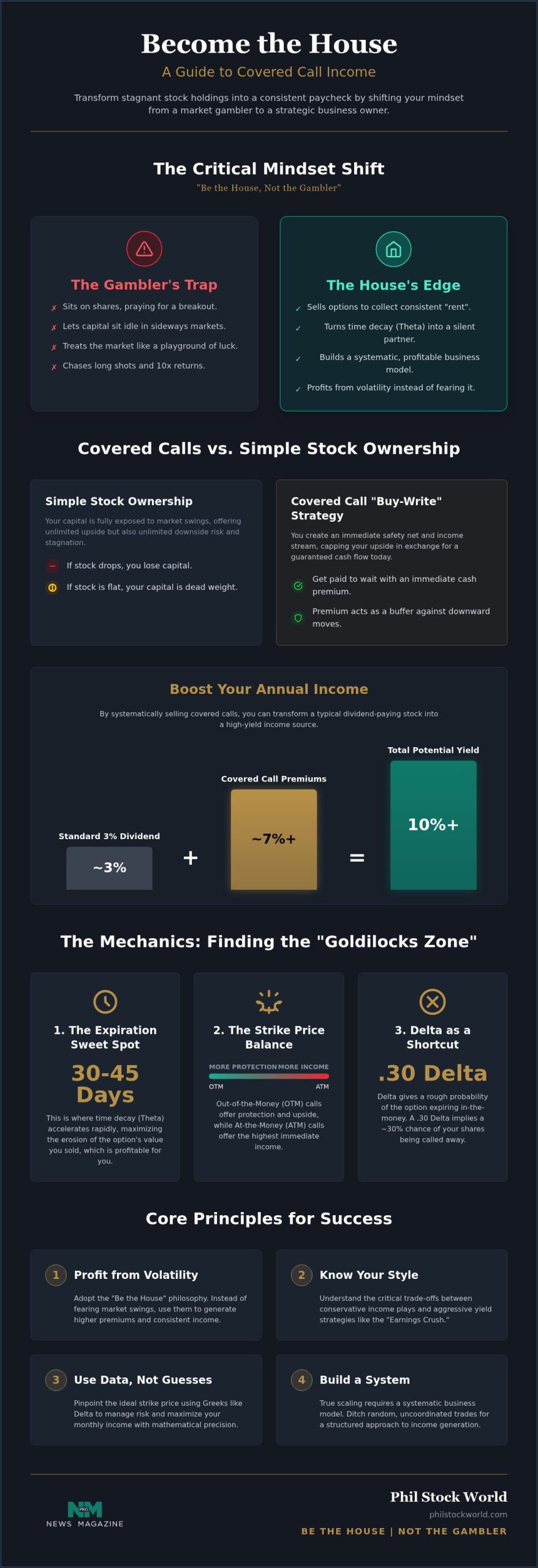
- Explore actionable covered call trading ideas that can turn a standard 3% dividend into a 10% annual income stream.
- Pinpoint the ideal strike price using Delta to maximize your monthly income while maintaining a safety net for your long-term holdings.
- Understand the critical trade-offs between conservative income styles and aggressive yield plays like the “Earnings Crush” strategy.
- Learn why scaling your income requires a systematic business model rather than a collection of random, uncoordinated trades.
Why Covered Call Trading Ideas are Your Best Defense in 2026
The market environment of 2026 isn’t interested in your “buy and hold” nostalgia. With global shifts and economic noise creating a persistent sideways grind, the traditional strategy of sitting on shares and praying for a rally is a recipe for stagnation. This is where the disciplined professional separates themselves from the recreational crowd. By utilizing the “Buy-Write” strategy, you aren’t just an investor; you’re a business owner. Finding the right covered call trading ideas allows you to extract rent from your portfolio, turning volatility into a mechanical advantage rather than a source of anxiety.
The ‘Be the House’ Philosophy
Think about how a casino operates. They don’t care about the outcome of a single hand or one spin of the roulette wheel. They rely on a mathematical edge that ensures they win over the long haul. When you sell a covered call, you’re stepping behind the dealer’s table. You are selling hope to the gamblers who are betting on a massive, immediate stock surge. While they chase the long shot, you rely on Theta, or time decay, as your silent business partner. Every day that passes without a massive price spike puts money in your pocket as the value of the option you sold slowly erodes. Most retail traders stay on the losing side of this equation because they’d rather gamble on a 10x return than build a consistent, profitable business model.
Covered Calls vs. Simple Stock Ownership
Simple stock ownership leaves you completely exposed to the whims of the market. If the stock drops, you lose. If it sits still, your capital is dead weight. Adding a covered call creates an immediate safety net by lowering your effective cost basis. That premium you collect acts as a buffer against downward moves, providing a cushion that “long-only” investors simply don’t have. It requires a psychological shift from “hoping for a rally” to “getting paid to wait.” It’s about being content with a capped upside in exchange for a guaranteed cash flow today.
Ultimately, a covered call is a contractual obligation to sell your shares at a specific profit target while you pocket an immediate cash fee for the privilege. This transformation of your portfolio into an income-generating machine is the cornerstone of covered call trading ideas used by those who value consistency over luck. By embracing this approach, you stop being a victim of market swings and start acting like the house that always gets its cut.
The Mechanics of ‘Being the House’: Selecting the Right Strikes
Selecting the right strike price is where most amateur investors stumble. They often get greedy chasing the highest premiums, only to realize they’ve sold their upside for pennies on the dollar. Success in covered call trading ideas boils down to finding that “Goldilocks” zone. This is the sweet spot where the premium is juicy enough to justify the trade, but the protection remains robust. It’s a balancing act between immediate cash flow and long-term capital preservation. If you want to be the house, you have to price your “bets” with mathematical precision.
Position sizing is the silent partner in this operation. Even the most perfect setup can turn sour if you bet the farm on a single ticker. At Phil Stock World, we emphasize risk management for options because one bad earnings miss shouldn’t wipe out months of progress. You can refine your approach by using market charts and analysis to ensure your positions are sized for survival, not just for a quick win.
Strikes and Expirations: The PSW Sweet Spot
Time is your greatest ally when you’re selling premium. We generally focus on the 30 to 45 day window for expirations. This is where Theta, or time decay, begins to accelerate rapidly. If you sell too far out, the decay is too slow to notice. If you sell too close, you don’t collect enough premium to make the risk worthwhile. Regarding strike selection, At-the-Money (ATM) calls offer the most income but the least protection. Out-of-the-Money (OTM) calls allow for some capital gains while still padding your pocket. A savvy move is to look for technical resistance levels on a chart and set your strike just above them. This uses the market’s own structure as a ceiling for your trade.
Managing the Greeks Without a PhD
You don’t need to be a mathematician to use the Greeks effectively. Delta is your shortcut for understanding assignment risk. A .30 Delta call roughly implies a 30% chance the stock finishes above that strike by expiration. It’s a quick way to gauge how likely you are to lose your shares. Meanwhile, Vega tells you how much the option price will swing based on volatility. Selling calls right before a major volatility spike, like an earnings report, can be dangerous if you aren’t prepared for the price swing. Your goal is to let Theta do the heavy lifting. Watch the clock; every day that the stock doesn’t move against you, your profit grows. This mechanical approach is what turns covered call trading ideas into a reliable business model.
Income vs. Protection: Comparing Diverse Covered Call Approaches
Trading isn’t a one-size-fits-all endeavor. Some investors prefer the “Conservative Grind,” focusing on high-quality blue chips where the goal is to eke out an extra few percent while protecting a massive nest egg. Others hunt for “Aggressive Yield,” targeting high-beta stocks where the premiums are fat but the price swings are violent. Your choice depends on your specific goals for 2026. Are you looking to pay your mortgage with monthly premiums, or are you trying to hedge a long-term position against a choppy macro environment? Integrating income generating option strategies into your broader portfolio requires a clear understanding of these trade-offs. You can’t have maximum protection and maximum profit at the same time. It’s about choosing your battleground.
The Standard Buy-Write vs. The Synthetic Long
Capital efficiency is the hallmark of a street-smart trader. In the standard Buy-Write, you tie up 100% of the cash required to own the underlying stock. In a high-interest-rate environment, that’s a lot of “lazy” capital. This is where the Poor Man’s Covered Call (PMCC) shines. By using a long-term LEAPS (Long-term Equity Anticipation Securities) option as a substitute for the stock, you can control the same 100 shares for a fraction of the cost. This synthetic long position allows you to sell short-term calls against it just like a regular covered call. It frees up your cash for other covered call trading ideas, effectively boosting your return on capital. However, you must be careful. While the PMCC is capital efficient, it lacks the dividend rights and the “forever” timeframe of actual stock ownership.
Rolling for Credits: The Art of the ‘Never-Ending’ Trade
What happens when the stock rallies past your strike price? Most amateurs panic and let the stock get called away, missing out on the extended gains. The professional move is to “roll” the position. This involves buying back your current short call and simultaneously selling a new one further out in time and potentially at a higher strike price. This is known as rolling “up and out.” The goal is always to roll for a net credit. You want the market to pay you for the extra time you’re giving it. Rolling for a debit is a cardinal sin in the PSW world. It means you’re paying the market to stay in a trade that has already moved against you. By mastering these advanced option trading strategies, you can defend your positions indefinitely, turning a potential “loss” of shares into a continuous cycle of cash flow.
5 Actionable Covered Call Trading Ideas for Modern Markets
Moving from theory to execution requires a tactical roadmap. You can’t just throw darts at a board and expect to “be the house.” Success requires matching the right strategy to the right market condition. Here are five covered call trading ideas that professional traders use to maintain their edge in the 2026 landscape:
- The Dividend Aristocrat Booster: Selling OTM calls on low-volatility blue chips to turn a 3% dividend into a double-digit annual yield.
- The ‘Earnings Crush’ Play: Selling calls when Implied Volatility is peaked just before an announcement, then buying them back cheap once the uncertainty vanishes.
- The ‘Rescue’ Call: Aggressively selling calls on “dog” stocks that have dropped in value to systematically lower your break-even point.
- The Sector Rotation Grind: Selling calls on sectors losing momentum while keeping your winners “naked” to capture full upside.
- The Wheel Strategy: A continuous loop of selling cash-secured puts until assignment, then selling covered calls until the shares are called away.
If you’re unsure which of these covered call trading ideas fits your current holdings, a Virtual Portfolio Review can help you identify the best strikes for your specific risk profile.
Scenario: The Dividend Capture Synergy
Timing is everything when you’re hunting for yield. Many investors forget that the market prices in the dividend. If you sell a call too close to the ex-dividend date with a strike that is too near the current price, you risk early assignment. The buyer wants that dividend just as much as you do. To avoid this trap, we look for “House” assets. These are blue-chip stocks with predictable cycles. You want to time your call sale so the premium is rich, but the strike is high enough to ensure you keep the dividend and the fee. It’s about stacking high-probability wins rather than swinging for the fences.
Scenario: Repairing a Broken Position
We’ve all been there. You buy a stock at $100, and suddenly it’s trading at $80. You’re a “bag-holder.” Instead of waiting for a miracle, you can use the ‘Rescue’ call to go on the offensive. While hedging with put options provides the ultimate insurance against further drops, selling calls is your primary tool for active recovery. For advanced traders, the “Ratio Write” involves selling two calls for every 100 shares owned. It’s a bold move that can halve your recovery time, but it carries the risk of having to buy more shares if the stock rockets. Done correctly, you transform a stagnant loser into a cash-generating machine that pays you to wait for the eventual rebound.
Scaling Your Income Strategy: Beyond the Basics
Scaling isn’t about simply doing more of the same; it’s about doing it with more precision. Many traders collect a few covered call trading ideas and treat them like a collection of lottery tickets. That’s a hobby, not a business. To truly scale, you need to transition into a systematic portfolio approach where every position serves a specific purpose. This isn’t about finding the “perfect” stock. It’s about building a machinery of income that functions regardless of whether the market is up, down, or sideways. You want a portfolio that behaves like a well-oiled engine, not a series of uncoordinated bets. A professional-grade options risk management checklist ensures that as you add more positions, your exposure stays controlled and your capital remains protected.
Building a Virtual Portfolio
Joining the PSW Inner Circle
The market is a noisy, chaotic place. If you’re a lone wolf relying on a generic algorithm, you’re at a distinct disadvantage. When the screens turn red and volatility spikes, the “recreational” traders panic. That’s when having a community of peers and a street-smart mentor becomes your greatest asset. The Phil Stock World membership gives you access to our Live Trading Room, where we make real-time adjustments as events unfold. It’s about cutting through the mainstream media fluff and focusing on actionable data. You get to see how we defend positions and roll for credits when the pressure is on, turning a chaotic market into a controlled environment.
Trading is a marathon. It’s not about the one big win that makes you feel like a genius for a day. It’s about the hundreds of small, calculated wins that build wealth over years. Act like the house. Stay disciplined. Let the gamblers fund your retirement while you sit back and collect the rent. When you stop chasing the market and start letting it pay you, the entire game changes.
Take Control of Your Portfolio’s Future
The 2026 market doesn’t reward passive hope. It rewards the strategic application of covered call trading ideas that treat volatility as a source of revenue rather than a cause for panic. By mastering the mechanics of strike selection and understanding the nuanced art of rolling positions, you’ve already moved ahead of the vast majority of retail investors. You’re no longer just holding stocks; you’re operating a business where time decay works in your favor every single day. It’s about consistency, not luck.
Transitioning from a casual trader to a disciplined professional is far more effective when you aren’t operating in a vacuum. You need real-time insights and a community that lives the “Be the House” philosophy. Ready to stop gambling and start ‘Being the House’? Join Phil Stock World today! Membership offers you direct access to our live trading rooms, daily market commentary from Phil Davis, and advanced virtual portfolio tracking tools to refine your edge. The market is going to move regardless of what you do. You might as well make sure it’s paying you for the ride. We’ll see you on the inside.
Frequently Asked Questions
Can I lose money selling covered calls?
You can absolutely lose money if the underlying stock price craters. While the premium you collect acts as a buffer, it won’t save you from a massive wipeout in the share price. You are still a shareholder, which means you carry the downside risk of the equity. The goal is to select stable assets where the income outweighs the moderate price fluctuations you might encounter.
What happens if my stock price goes above the strike price?
If the stock price exceeds your strike, you’ll likely be assigned, meaning you must sell your shares at that agreed-upon price. You keep the premium and any gains up to the strike, but you miss out on any “moonshot” rally beyond that point. This is why picking the right strike is critical; you want to be happy selling at that level. Professional traders often roll the position to avoid this.
Is it better to sell weekly or monthly covered calls?
Monthly calls, specifically those in the 30 to 45 day range, are generally superior for capturing rapid Theta decay with less stress. Weekly options offer higher theoretical returns but require constant monitoring and higher commission costs. Most successful covered call trading ideas focus on the monthly “sweet spot” to balance high premiums with manageable portfolio maintenance. It’s about working smarter, not harder.
Do I still get the dividend if I sell a covered call?
You remain the owner of the shares and are entitled to the dividend as long as you hold the stock through the ex-dividend date. However, be wary of “dividend risk.” If the dividend is large, the option holder might exercise early to capture that payment themselves. We always check the calendar to ensure our income strategy doesn’t get derailed by an early assignment before the payout.
How much money do I need to start a covered call strategy?
You need enough capital to purchase at least 100 shares of your chosen stock, as one option contract represents 100 shares. If you’re looking at a $50 stock, that’s a $5,000 minimum entry. For those with smaller accounts, synthetic strategies like the Poor Man’s Covered Call can lower the barrier to entry significantly. Always ensure you have enough to diversify across a few different sectors to manage risk.
What is the ‘Poor Man’s Covered Call’ and is it safe?
The Poor Man’s Covered Call is a “synthetic” version where you buy a long-term LEAPS option instead of the actual stock. It’s safe in the sense that your maximum risk is limited to the premium paid, but it involves leverage that can magnify losses if the stock drops. It’s a brilliant way to test covered call trading ideas with less capital, provided you understand how Delta and expiration affect your position.
When should I ‘buy to close’ my covered call early?
You should consider buying to close when you’ve captured 50% to 80% of the maximum possible profit well before expiration. There’s no sense in waiting weeks to squeeze out the last few nickels of premium while keeping the full risk of the trade open. Closing early frees up your capital to move on to the next opportunity. It’s a mechanical way to lock in wins and keep your capital moving.
How are covered call premiums taxed in 2026?
Premiums are typically taxed as short-term capital gains, which means they are taxed at your ordinary income rate. Selling calls can also “suspend” the holding period of your underlying stock, potentially preventing you from hitting the one-year mark for long-term capital gains treatment. Always consult a tax professional regarding current 2026 regulations for your specific bracket. It’s the cost of doing business as the house and should be factored into your net yield.

