

Most of the financial news you consume isn’t designed to make you money; it’s often designed to provide liquidity for the institutions already exiting their positions. You’ve likely felt that sting before, watching a “strong buy” recommendation turn into a portfolio-draining slide while the big banks quietly move on to the next play. It’s frustrating to feel like the game is rigged, but mastering stock market research for self-directed investors is the first step to reclaiming your edge. You deserve to trade with the same clarity as the professionals who usually profit at your expense.
We’re going to flip the script by teaching you how to ignore the talking heads and focus on the raw data that actually moves the needle. I’ll show you how to strip away the institutional bias that clutters your feed and replace it with a reliable framework for independent decision-making. By the end of this guide, you’ll have a clear path to accessing “house” level data and the confidence to ignore the “hot tips” that usually lead to retail sell-offs. It’s time to stop being the liquidity and start being the house.
Key Takeaways
- Understand why “free” financial news often makes you the product rather than the beneficiary of actual market insights.
- Learn to identify and filter out institutional bias in stock market research for self-directed investors to find raw, actionable data.
- Spot the five critical red flags of compromised research to protect your portfolio from hidden brokerage agendas and corporate gatekeeping.
- Adopt a “house” perspective by aligning with independent communities that focus on education and risk management instead of trade churn.
- Build a reliable framework for independent decision-making that lets you trade with the confidence and clarity of a market insider.
The Crisis of Credibility: Why Unbiased Stock Market Research is Rare
Truth is a rare commodity in the markets. Unbiased research isn’t just a buzzword; it’s analysis that exists without the shadow of investment banking fees or brokerage commissions. When you’re conducting stock market research for self-directed investors, you have to realize that most “free” information is actually a marketing expense for someone else. If you aren’t paying for the data, you aren’t the customer. You’re the product being packaged and sold to institutional whales looking for a way out of a bad position.
By 2026, the noise has only gotten louder. AI-generated “pump” algorithms now churn out thousands of articles every second, all designed to trigger high-frequency trading bots or lure retail traders into over-extended trends. You’ve likely felt like “exit liquidity” before. That’s the industry term for the retail herd that buys at the top while the smart money is ringing the register. It’s a rigged game if you’re playing by their rules, but you don’t have to be their target.
The Illusion of Objectivity in Mainstream Media
Mainstream networks need eyeballs to sell ad space. Eyeballs love a rally. This creates a permanent bullish bias because “everything is fine” keeps people tuned in, while “the sky is falling” makes them change the channel. There’s also the “Breaking News” lag. By the time a headline hits your screen, the big players have already traded the data. They’ve squeezed the juice out of the move before you even open your app. Real stock market research for self-directed investors requires moving beyond simple market reporting and into strategic analysis that anticipates the news rather than reacting to it.
Investment Banking vs. Pure Research
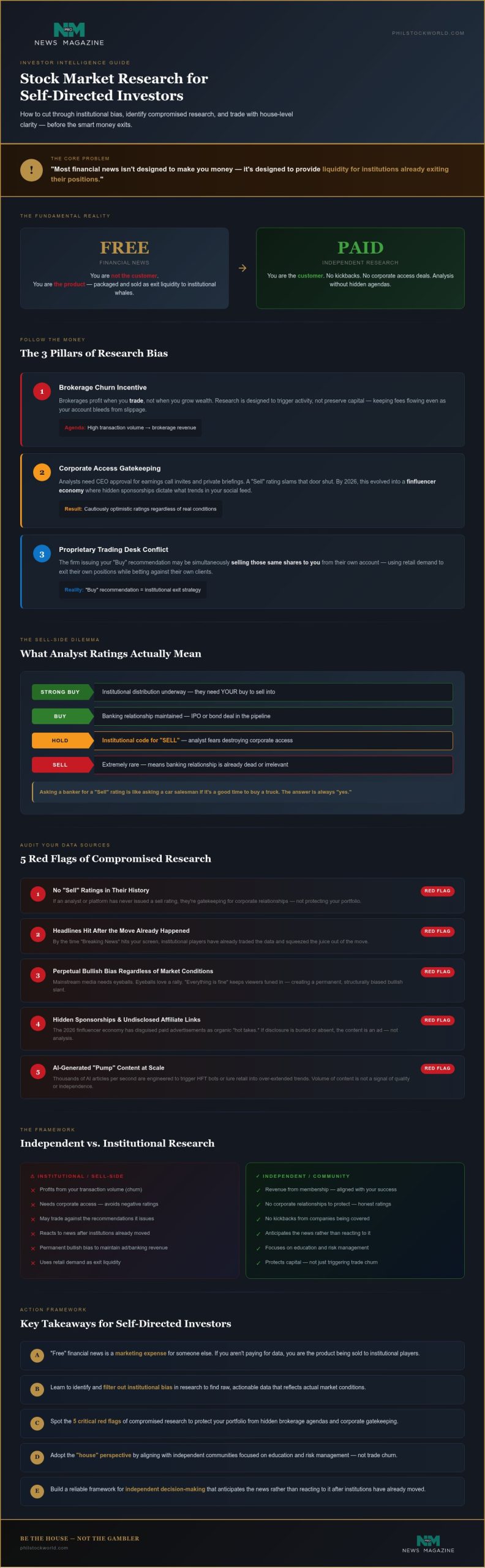
The conflict is baked into the business model. A major bank isn’t going to release a scathing “Sell” report on a company they hope to lead an IPO for next quarter. Sell-side bias is research produced by firms that make money by selling securities or services to the companies they cover, which often results in inflated price targets that lure retail buyers into overvalued positions. While “Chinese Walls” are supposed to separate research from banking, these barriers are often more porous than they appear. Analysts know that keeping the CEO happy leads to better corporate access and more lucrative deals. For the independent trader, relying on these price targets is like asking a car salesman if it’s a good time to buy a truck. The answer is always “yes.”
Investors in the biopharma sector can bypass this bias by examining the underlying infrastructure of drug development, where innovations in clinical trial navigation services often provide a clearer picture of a company’s progress than a sanctioned press release.
Follow the Money: The Three Pillars of Research Bias
If you want to understand why your portfolio isn’t performing like the headlines suggest it should, you have to follow the cash. Most stock market research for self-directed investors is produced by firms with a fundamental conflict of interest. Brokerages don’t necessarily profit when your portfolio grows; they profit when you trade. This drive for “churn” means their research is often designed to trigger activity rather than preserve capital. High transaction volume keeps their lights on, even if those trades slowly bleed your account dry through fees and slippage.
Then there’s the issue of corporate access. Analysts at major firms need to stay on the CEO’s good side to ensure they get invited to the next earnings call or private briefing. If an analyst drops a scathing “Sell” rating, that corporate door slams shut. This gatekeeping ensures that most institutional research remains cautiously optimistic, regardless of the actual market conditions. By 2026, this has evolved into a sophisticated “finfluencer” economy where hidden sponsorships and affiliate links dictate what stocks trend on your social feed. You’re often looking at a paid advertisement disguised as an organic “hot take.”
Proprietary trading desks add the final layer of bias. It’s common for the firm providing your “Buy” recommendation to be the one selling those shares to you from their own account. They use retail demand to exit their own positions, effectively betting against the very people they claim to advise. Cutting through this requires a Premium Membership in a community that doesn’t take kickbacks from the companies it covers.
The Sell-Side Dilemma
In the world of high-stakes reporting, “Hold” is often just institutional code for “Sell.” Analysts fear being the lone wolf with a negative rating because it puts their firm’s underwriting contracts at risk. If a bank wants to lead a multi-billion dollar bond offering for a tech giant, they can’t have their research department calling that same company overvalued. This herding effect leads to a sea of identical “Buy” ratings that ignore mounting risks until it’s far too late for the average investor to get out safely.
The Danger of ‘Free’ Alerts
The rise of “free” newsletters has created a new trap. These services often profit through payment for order flow or by front-running retail interest. They alert you to a “breakout” only after they’ve built their own position, using your buying pressure to drive the price up so they can dump their shares. Most professional trade alerts in the “free” space lack a transparent, long-term track record because their goal isn’t consistent returns. It’s about creating enough hype to move the needle for a few minutes. Reliable stock market research for self-directed investors must be audited and independent, or it’s just another form of marketing.
Independent vs. Institutional: A Framework for Self-Directed Investors
Choosing a source for stock market research for self-directed investors is ultimately an exercise in auditing incentives. You have to ask a simple question: Who wins when you win? In the institutional world, the answer is rarely the analyst. They are typically salaried employees or bonus-driven bankers who profit from your activity rather than your actual success. Independent research flips this model. When you move away from the “Institutional Suit” and toward a “Savvy Mentor” approach, the researcher’s business longevity depends on the quality of their insights. If their analysis is consistently wrong, their community disappears. This creates a natural alignment of interests that big bank research departments simply cannot replicate.
Transparency of methodology is the next pillar of a reliable framework. A flashy conclusion on a glossy PDF is useless if you can’t see the math behind it. Professional research should walk you through the macro thesis, the technical setup, and the specific risk parameters. It’s the difference between being told what to think and being taught how to think. When you understand the logic, you gain the confidence to hold through minor volatility instead of panic-selling the moment a ticker turns red. You want to see the work, not just the “Buy” button.
Then there’s the “Skin in the Game” factor. There is a massive psychological gulf between a professional analyst and a professional trader. One worries about their career path and corporate standing; the other worries about their account balance. You should always look for researchers who are actually putting their own capital behind their words. Finally, never underestimate the power of community validation. An independent community acts as a real-time “BS-filter.” When a suspicious institutional claim hits the wire, a room full of savvy traders can dissect it in minutes, spotting the flaws and identifying the hidden agendas we’ve already uncovered.
Why Independent Newsletters Are Gaining Ground
The “Institutional Suit” is losing relevance because investors are tired of sanitized, corporate-approved opinions. They want raw, unfiltered commentary that doesn’t have to pass through a PR department. A specialized options trading newsletter focuses on long-term strategy rather than the daily hype cycle. It provides the depth needed for complex hedging and risk management, which are often ignored by surface-level brokerage reports that only want to push the next big trade.
The Power of Real-Time Interaction
Markets move with a speed that makes static reports obsolete. A PDF published on Tuesday is often useless by Wednesday morning if the Fed makes a surprise announcement. Your research must be dynamic to be effective. Utilizing a live trading room for options allows for immediate clarification when the macro environment shifts. This community peer-review process significantly improves individual trade discipline by holding you accountable to your own stated strategy and preventing emotional mistakes.
How to Audit Your Data: 5 Red Flags of Compromised Research
You can’t afford to be naive when vetting stock market research for self-directed investors. In a world where data is weaponized, your first job isn’t to find the right trade; it’s to find the right filter. If you don’t have a system to audit the information hitting your screen, you’re just guessing. Most retail traders get wiped out because they treat every headline as gospel without looking at the plumbing behind the news. It’s time to start looking for the cracks in the narrative.
- The Disclosure Deep Dive: Scroll past the flashy charts and look for the tiny text at the bottom. If the firm owns the stock or gets paid to promote it, the research is a sales pitch, not a strategy.
- The Certainty Trap: Real pros talk in probabilities and risk management. If a report promises a “guaranteed” moonshot with zero mention of downside, you’re looking at hype.
- Chasing the Tail: Analyze the timing of the alert. If a “tip” arrives after the stock has already surged 20%, you aren’t the early bird. You’re the exit liquidity for the people who bought weeks ago.
- The Revenue Audit: Ask how the researcher pays their bills. If the content is free, they’re likely selling your order flow or taking kickbacks from corporate sponsorships.
- Memory Lane: Check their historical archives. Do they own their losers and explain what went wrong, or do they quietly delete the posts that didn’t age well?
Spotting the ‘Pump and Dump’ in 2026
AI has completely changed the manipulation landscape. Algorithms now create thousands of bot profiles to generate a fake “consensus” on social media platforms. They make a stock look like a crowd favorite when it’s actually a coordinated move. Watch out for the “technical analysis” trap, too. Charts are easy to manipulate; a savvy manipulator can find a “bull flag” in a dumpster fire if they draw the lines just right. And remember, if an “exclusive” tip is shared with a million followers, it’s about as exclusive as a public park. Real stock market research for self-directed investors doesn’t happen in a vacuum of social media likes.
Developing Your Inner Skeptic
Apply the “Cui Bono” test to every headline you read. Who benefits if you buy this stock right now? When research ignores hedging or downside protection, it isn’t a strategy; it’s a gamble. A professional approach always accounts for what happens if the trade goes wrong. You need a framework that treats trading like a business, not a hobby. You can start building that house mindset here with a Phil Stock World membership. Stop being the prey and start acting like the house. Join our trading community today to see the difference between hype and high-level analysis.
The ‘House’ Perspective: Why Independent Communities are the Final Solution
The final piece of the puzzle isn’t a better algorithm or a faster news feed. It’s moving from being a passive consumer of data to being an active collaborator in a high-level trading environment. When you stop acting like a retail target and start behaving like a market insider, your entire approach to stock market research for self-directed investors shifts fundamentally. You no longer wait for a glossy report to tell you what to do; you participate in a living research engine that stress-tests every idea before a single dollar is committed. This collaborative vetting process is the only way to stay ahead of the institutional machines.
We don’t just hand out tickers. That’s what the hype machines do to keep you coming back for more “tips.” Instead, the focus is on teaching you to fish. Much like how a serious angler uses FishingStat to log every detail of their catch to find patterns for success, we teach you to analyze the underlying mechanics of market volatility and institutional flow. By understanding these drivers, you develop a skill set that survives any market cycle. A Virtual Portfolio Review then serves as the ultimate reality check, identifying blind spots in your research before the market exposes them at a higher cost.
The Phil Stock World Advantage
Having direct access to veteran traders like Phil Davis changes the game. You’re in a room where market nonsense is called out in real-time, often hours before mainstream media even realizes there’s a problem. We focus on macro-level truths that networks ignore because those truths aren’t always “camera-ready” or bullish enough for their advertisers. Our “Be the House” philosophy is simple; we use research to sell premium and manage risk, rather than just buying into the latest overblown hype. It’s about taking the other side of the trades that the retail herd blindly follows.
Your Next Move in the Market
Independent research is the only path to long-term survival in the 2026 market. The retail herd will always be there to provide liquidity for the big banks, but you don’t have to be among them. Step out of the noise and join a community that prioritizes transparency and strategy over commissions. It’s time to stop guessing and start trading with the confidence of an insider. You can explore our Premium Membership options or sign up for our upcoming Educational Webinars to start refining your edge today. The house always has the advantage. It’s time you did too.
Secure Your Seat at the Insider’s Table
You’ve seen how the institutional machine is built to profit from your activity. By auditing the incentives behind every headline and developing a healthy skepticism for “free” alerts, you’ve already moved miles ahead of the retail herd. High-quality stock market research for self-directed investors isn’t about finding a magic ticker; it’s about aligning yourself with a community that prioritizes risk management and macro-level truth over brokerage churn.
Under the guidance of veteran market analyst Phil Davis, you can transition from a passive consumer to a savvy market collaborator. Whether you’re utilizing our real-time interactive trading rooms to vet a move or undergoing comprehensive virtual portfolio reviews to stress-test your strategy, you’re no longer trading in a vacuum. You’re building a “house” mindset that turns market volatility into opportunity. Ready to trade like ‘The House’? Join Phil Stock World for unbiased research and real-time alerts today.
The markets won’t slow down, but you can finally stop chasing them. It’s time to trade with the clarity and confidence you deserve.
Frequently Asked Questions
What exactly is ‘unbiased’ financial research?
Unbiased financial research is analysis produced by entities that don’t profit from your specific trading activity or from the companies they cover. It’s free from the “sell-side” pressure of investment banking deals or the “churn” incentives of retail brokerages. Instead of pushing a narrative to secure a future underwriting contract, this type of research focuses on objective data and risk management. It prioritizes the investor’s portfolio health over institutional revenue goals.
Why do investment banks provide free research reports to retail clients?
Banks offer free reports because they use retail demand to provide liquidity for their institutional clients. When a major bank issues a “Buy” rating, it often creates the buying pressure needed for a whale to exit a large position without crashing the price. These reports also serve as marketing tools to maintain relationships with corporate leaders. If you aren’t paying for the analysis, you’re likely the exit strategy for someone else’s trade.
How can I tell if a trading newsletter is biased?
Check the fine print for disclosures regarding stock ownership or paid sponsorships. A biased newsletter often uses hyperbolic language and ignores the potential downside of a trade. If the author is getting a kickback from a brokerage or a corporate PR firm, their “hot tip” is just a paid advertisement. Reliable stock market research for self-directed investors should always show you the math and the risks, not just a flashy price target.
Is paid financial research worth the cost for self-directed investors?
Paid research is worth the investment if it aligns the researcher’s success with your own. When you pay for a subscription, you become the customer rather than the product being sold to advertisers or banks. This small overhead can save you thousands by helping you avoid the “bull traps” set by mainstream media. It provides a structured framework for independent decision-making that “free” news simply cannot afford to offer.
What are the most common conflicts of interest in market commentary?
The biggest conflicts involve analysts who work for firms that also handle underwriting for the companies they cover. They can’t be bearish without risking multi-million dollar banking fees. Additionally, many media outlets rely on ad revenue from the very companies they report on, leading to a perpetual bullish bias. Some firms even have proprietary trading desks that bet against the very recommendations they send to their retail clients.
How does a trading community help identify market bias?
A community acts as a collective “BS filter” by crowdsourcing the auditing process. When an institutional report hits the wire, a room full of veteran traders can dissect the flaws and hidden agendas in minutes. This peer-review system prevents individual members from falling for emotional traps or manipulated data. It turns the solitary act of trading into a collaborative effort where the group’s shared experience protects each member’s capital.
Can AI help in finding unbiased financial data in 2026?
AI is a double-edged sword in 2026. While it can quickly aggregate raw data and identify patterns, it’s also used by institutions to create fake social media “consensus” and pump specific stocks. You can use AI to scan filings and technical setups, but you still need a human “street-smart” filter to interpret the intent. AI doesn’t understand the psychological games played by big banks; it only sees the numbers they want it to see.
What should I look for in a professional trade alert service?
Look for a service that prioritizes risk management over “get rich quick” promises. A professional alert should include a clear entry point, a specific exit strategy, and the macro reasoning behind the trade. It should also have a transparent, long-term track record that includes losers as well as winners. The best stock market research for self-directed investors focuses on teaching you the strategy so you can eventually make these calls on your own.

