


Are you actually managing a strategy, or are you just holding a collection of tickets for a lottery that ended three years ago? It’s a question most investors avoid because the answer usually reveals a messy reality of hidden risk concentrations and emotional decision-making. If you’re tired of watching your gains vanish every time the headlines turn sour, it’s time to stop guessing. A comprehensive virtual portfolio review acts as a high-level audit, stripping away the market noise to see if your current holdings can actually withstand the pressures of the 2026 market.
You’ve likely felt that nagging suspicion that your diversification is just an illusion. It’s frustrating to see stagnant returns in sectors that should be moving, especially when you lack a clear plan for effective hedging. This article will show you how to transform that random collection of stocks into a disciplined, income-generating machine. We’ll dive into actionable hedging strategies, the nuances of position sizing, and the exact steps needed to transition from a nervous gambler to someone who finally understands how to play the house.
Key Takeaways
- Learn how a professional virtual portfolio review goes beyond basic stock picks to stress-test your strategy against future market volatility.
- Identify the critical difference between true diversification and hidden sector correlations that leave your capital exposed to unnecessary risk.
- Discover why human mentorship outpaces robo-advisors when it comes to navigating “Black Swan” events and complex options hedging.
- Master the art of position sizing to ensure your portfolio behaves like “the house” rather than a gambler at the table.
- Translate expert audit feedback into actionable trade adjustments that turn stagnant holdings into a disciplined, income-generating machine.
What is a Financial Virtual Portfolio Review?
Let’s clear the air immediately. If you search for a “virtual portfolio review” online, you might find a dozen art schools offering to critique your charcoal sketches or graphic design layouts. That’s not what we’re doing here. This is a cold, hard financial audit. It’s a remote, expert-led deep dive into your capital allocation, designed to strip away the ego and look at the raw mechanics of your wealth. We aren’t interested in the aesthetics of your charts; we’re interested in the plumbing of your profits.
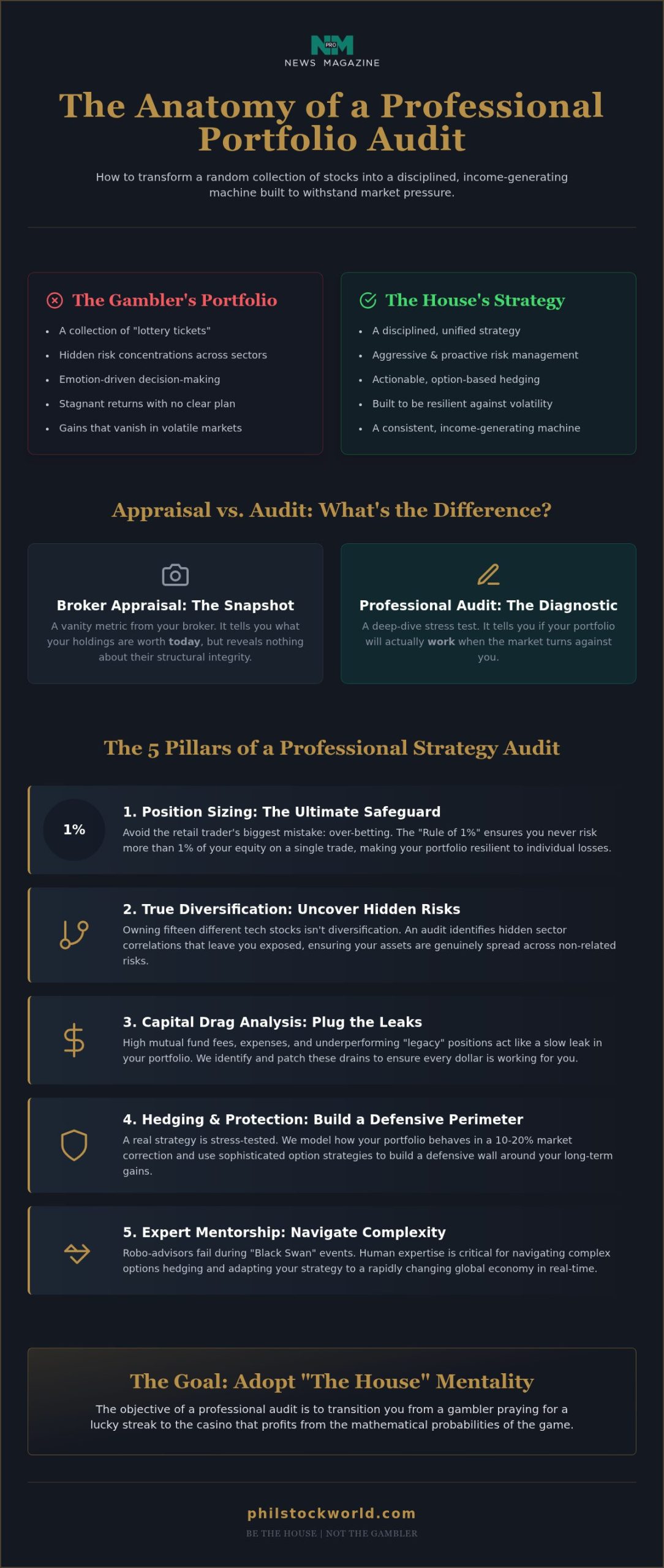
In the high-velocity 2026 market, a static strategy is a dead strategy. The global economy moves too fast for the old “set it and forget it” mentality to survive. A professional review focuses on three core pillars: aggressive risk management, intelligent sector allocation, and sophisticated, option-based hedging. It’s about ensuring your money isn’t just sitting there, but is actively defended against the next inevitable spike in volatility.
The Difference Between a Review and an Appraisal
An appraisal is what your broker sends you every month. It tells you what your holdings are worth today based on the last tick. It’s a snapshot, and frankly, it’s often a vanity metric. A review, however, tells you how your portfolio actually works. It’s the difference between knowing the price of a car and knowing if the brakes will hold when you’re doing 80 mph in a rainstorm.
While Modern Portfolio Theory provides the academic foundation for how we think about risk and return, a virtual portfolio review takes those abstract concepts and applies them to the messy reality of today’s tape. We look past your “net worth” to find your “net delta.” We want to know exactly how much your account moves for every one-point shift in the S&P 500. The goal is to adopt “The House” mentality. We want you to stop being the gambler praying for a lucky streak and start being the casino that profits from the math of the game.
Who Needs a Professional Audit?
This isn’t for the casual saver with a single index fund. This is for the self-directed trader who has hit a performance ceiling and can’t figure out why their gains have stalled. It’s for the investor holding “legacy” positions, those stocks that were world-beaters in 2021 but have become dead weight in a post-inflationary macro environment.
Most importantly, it’s for anyone utilizing advanced option trading strategies without a cohesive master plan. If you’re selling premium or buying puts without understanding how those Greeks interact with your long-term equity, you aren’t hedging; you’re just adding more variables to a problem you haven’t solved yet. A professional audit provides the clarity needed to turn those disparate trades into a unified, income-generating machine.
The 5 Pillars of a Professional Strategy Audit
A professional strategy audit isn’t a social call. It’s a rigorous stress test of your financial health. When you undergo a virtual portfolio review, we aren’t just looking at what you own. We’re looking at how those pieces fit together. Most investors treat their portfolios like a sticker book, collecting names they like without considering the structural integrity of the whole collection. A real audit identifies the cracks before the market finds them for you.
Position Sizing: The Retail Trader’s Achilles Heel
The biggest mistake we see is “over-betting.” It’s easy to get swept up in a single-stock narrative and allocate 20% of your account to one idea. That’s a recipe for disaster. In a professional context, we often advocate for the “Rule of 1%,” where you never risk more than 1% of your total equity on any single trade. Position sizing is the ultimate safeguard against ruin. If you can’t survive a single bad trade, you aren’t playing the house; you’re just another guest at the table.
Diversification is another area where traders get tripped up. You might think you’re safe because you hold fifteen different companies, but if they all belong to the tech sector, you’re highly correlated. A review identifies these hidden traps. We also scrutinize the drag on your capital. For instance, high Mutual Fund Fees and Expenses can act like a slow leak in your tires, draining your performance over time. Our goal is to patch those leaks and ensure every dollar is working for you, not against you. Applying disciplined portfolio rebalancing tips after your audit is one of the most effective ways to eliminate those hidden drags and realign your capital with your actual risk tolerance.
Hedging and Protection
A true audit requires a “stress test.” We need to know exactly how your account behaves during a 10% or 20% market correction. Most people find out the hard way. We prefer to use put options to build a defensive perimeter around your long-term gains. By integrating Phil Stock World membership insights, you can learn to identify the optimal hedge ratios for your specific holdings. This isn’t about guessing the next crash; it’s about being prepared for it. Understanding the full scope of recession-proofing your portfolio with options is essential to building that defensive perimeter before volatility strikes.
Beyond protection, we look for income. Stagnant stocks are missed opportunities. By selling covered calls, you can turn those quiet positions into “dividend” machines that generate cash flow regardless of price movement. Finally, we establish exit discipline. You need hard rules for taking profits and cutting losses before the trade even starts. If you’re looking to refine these pillars, joining a community with a proven membership can provide the real-time guidance needed to stay on track.
Human Expertise vs. Robo-Advisors: Why Algorithms Miss the Big Picture
Algorithms are fantastic at math but historically illiterate. A robo-advisor builds your future based on a backward-looking spreadsheet, assuming the next decade will mimic the last. That’s a dangerous bet when global debt and shifting policy are rewriting the rules in real time. A virtual portfolio review provides the human intuition that a line of code simply cannot replicate. Computers can calculate a standard deviation in milliseconds, but they have no concept of how a geopolitical shift might ripple through your specific energy holdings.
When markets break, they don’t follow a tidy bell curve. This is the “Black Swan” problem. Algorithms often freeze or sell at the absolute bottom because their rigid risk parameters are exceeded. You need a street-smart mentor who has traded through the dot-com bubble and the 2008 crash to tell you when to hold firm and when to pivot. Unbiased research is the only way to get a straight answer. If your advisor is making a commission on the product they recommend, or if they’re incentivized to keep you in a specific fund, the advice is compromised before the discussion even begins. Many traders who rely on paid stock picking services discover too late that a firehose of “buy” alerts without exit strategies is no substitute for real-time, expert-led analysis.
The Limits of Automated Modern Portfolio Theory
Automated platforms love to talk about diversification, but they rarely understand the nuance of the “Greeks.” They ignore Gamma, Theta, and Vega, leaving you exposed to time decay or volatility spikes you didn’t see coming. Blind rebalancing is another trap. A computer might sell a winner just to hit a target percentage, potentially triggering unnecessary tax liabilities that eat your real-world returns. Raw data is noise without contextual market commentary to give it meaning. You don’t just need to know what happened; you need to know why it matters for your specific strategy. Developing the ability to read market charts and decode the footprints of the herd is precisely the kind of contextual skill that separates a disciplined trader from one who is perpetually reacting to noise.
The Phil Stock World Advantage
We operate differently because we have zero interest in managing your assets. Phil Stock World isn’t a broker; we’re an educational powerhouse. This means our feedback is entirely focused on your success, not our management fees. We don’t want your AUM; we want you to understand the tape. We teach you how to stop chasing the “stock of the day” and start “playing the house.” By using our virtual portfolio review tool, you gain access to institutional-level analysis without the institutional conflict of interest. It’s about empowering you to make the decisions, backed by the confidence of a veteran team that has seen it all.
How to Prepare for Your Virtual Audit
Preparation isn’t just about printing out a brokerage statement; it’s about a mental shift. Before your virtual portfolio review, you need to consolidate every single holding into one unified view. Use our Virtual Portfolio tool to see everything in one place. Stop flipping between different tabs and apps. It’s time to identify your “Problem Children.” These are the trades you’re afraid to look at because the red numbers sting. Be honest about why you’re still holding them. Is it a real strategy, or just hope? Hope is a terrible hedge.
Define your 2026 objectives clearly. Are you chasing aggressive growth, or is wealth preservation your priority? Your questions need to evolve too. Instead of asking “what should I buy next?”, start asking “how should I structure my current exposure to survive a sector rotation?”. You want to build a fortress, not a house of cards. This level of preparation ensures that our session moves past surface-level talk and into the deep mechanics of your wealth.
Gathering Your Data
Start by listing every position you currently hold. You need the entry price, the current price, and, most importantly, your original thesis. Why did you buy it in the first place? If that reason no longer exists, the stock probably shouldn’t either. Don’t forget your open option contracts. We need to see the expiration dates and strike prices to understand your total risk profile. A review is only as good as the data you provide. If you hide the skeletons in your closet, we can’t help you clean them out.
Setting Realistic Expectations
Think of this audit as a diagnostic tool, not a magic wand. We’re here to find the leaks in your strategy, not to give you a “get rich quick” scheme. The focus is on the “Why” behind every trade. If you can’t justify a position with logic, it’s just gambling. This isn’t a one-time event, either. A virtual portfolio review should be a recurring part of your process. The market changes, and your strategy must change with it. If you’re ready to get serious about your structure, subscribe to Phil’s Stock World’s premium tier and we’ll review your portfolio and strategies in chat.
Executing the Plan: From Review to Real-Time Results
A virtual portfolio review is only as valuable as the trades that follow it. If you spend an hour dissecting your strategy and then go back to your old habits, you’ve just wasted everyone’s time. Execution is where the savvy trader separates themselves from the academic theorist. You need to translate those audit notes into immediate, decisive action. This isn’t about minor tinkering; it’s about realigning your capital to reflect a disciplined, hedged worldview that can survive whatever 2026 throws at it.
Once you’ve made your adjustments, the work doesn’t stop. The Live Trading Room becomes your tactical headquarters. It’s where you monitor your newly audited strategy in the context of real-time market shifts. You’re no longer a passive observer waiting for the market to tell you if you’re right. Instead, you’re an active hedger, constantly adjusting your deltas and protecting your gains as the tape evolves. The best traders in the world don’t operate in a vacuum. They seek constant peer and expert review because they know that ego is the fastest way to a margin call.
The Post-Audit Checklist
Your first move after a virtual portfolio review should be a thorough pruning. Trim the bloated positions that have outlived their thesis and reallocate that capital into efficient hedges. This isn’t just about selling; it’s about restructuring for resilience. Set automated alerts for your new price targets immediately so you don’t have to glue your eyes to the screen all day. Finally, engage with the community. Staying disciplined is much easier when you’re surrounded by other professionals who are also focused on playing the house rather than gambling on headlines.
- Trim positions that exceed your risk parameters or sector limits.
- Deploy put options to lock in unrealized gains on core holdings.
- Set multi-layer alerts for both profit-taking and stop-loss levels.
- Review your “net delta” weekly to ensure your hedge ratio remains effective.
Join the “House” Community
A review gets you on the right path, but the market is a moving target. This is where Phil Stock World membership becomes indispensable. It provides the ongoing support and daily market commentary needed to maintain the edge you gained during your audit. There’s a powerful synergy between a deep-dive review and the granular, day-to-day analysis we provide. You don’t just get a map; you get a navigator. Don’t just trade the next cycle hoping for the best. Trade with a strategy that has been stress-tested by experts who have seen it all. It’s time to stop guessing and start playing the house; don’t just trade, trade with an edge.
Master the Math of the 2026 Market
The 2026 market won’t wait for you to find your footing. We’ve explored how stripping away the noise and focusing on position sizing can turn a fragile account into a fortress. It’s about moving past the “hope and pray” method and finally adopting a “play the house” mentality. By focusing on your net delta and implementing option-based protection, you stop reacting to the headlines and start profiting from the volatility.
Real wealth isn’t built on a lucky stock pick; it’s built on a disciplined, repeatable process. With over 20 years of market experience and a track record featured on major financial news networks, we’ve helped a community of more than 5,000 active traders find their edge. A virtual portfolio review is the first step toward that professional-grade clarity. Don’t let another market shift catch you off guard.
Learn how to evaluate your option strategies and do a Virtual Portfolio Review at Phil’s Stock World. You’ve got the tools and the roadmap. Now, it’s time to execute with confidence.
Frequently Asked Questions
What is the difference between a virtual portfolio review and a financial plan?
A virtual portfolio review is a tactical audit of your current holdings and risk management, whereas a financial plan is a broad roadmap for life goals. We don’t focus on your retirement dates or insurance needs. Instead, we look at your net delta, position sizing, and how your current trades survive a market crash. It’s about the “now” and the structural integrity of your capital rather than a generic life-stage projection.
How long does a typical virtual portfolio review take?
A standard session typically lasts approximately one hour, though the preparation you do beforehand is just as vital. During this hour, we move at a brisk pace to cover your “Problem Children” and identify immediate hedging opportunities. It’s a high-intensity discussion designed to provide actionable feedback rather than a long, drawn-out lecture. We value efficiency because the market doesn’t wait for slow deliberations or endless meetings.
Do I need to give you my brokerage login for a review?
You never need to share your sensitive login credentials or account numbers with us. We aren’t a brokerage and we don’t manage your assets directly. You simply provide a list of your positions, entry prices, and current strikes using our Virtual Portfolio tool. This keeps your data secure while giving us the transparency needed to stress-test your strategy. Your privacy is a priority, and we only need the numbers to help you succeed.
Can a virtual review help with tax-loss harvesting?
While we can identify stagnant positions that might be prime candidates for tax-loss harvesting, we aren’t tax advisors. Our focus is on the strategic benefit of exiting a losing trade to reallocate capital into a “House” methodology. If a position is dead weight, cutting it loose can improve your portfolio’s health. You should always consult a tax professional to discuss the specific legal and financial implications for your annual filing.
Is a virtual portfolio review suitable for beginner traders?
It’s actually one of the best ways for beginners to avoid the expensive mistakes that usually haunt retail traders for years. Learning about position sizing and hedging early on prevents you from blowing up your account on a single bad bet. We strip away the complex jargon and focus on the core mechanics of trading like the house. It’s a mentor-led audit that builds a foundation of discipline before bad habits take root.
What metrics are prioritized in a Phil Stock World review?
We prioritize net delta and sector correlation above all else during a virtual portfolio review. Most traders think they’re diversified until a specific sector takes a hit and they realize their entire portfolio moves in lockstep. We also look closely at your hedge ratios to ensure you have enough protection in place for a 10% or 20% correction. These metrics tell us the truth about your risk, regardless of what your P&L says today.
How often should I have my portfolio reviewed by an expert?
Market conditions change rapidly, so having a professional audit at least once a quarter is a smart move. You should also consider a virtual portfolio review whenever the macro environment shifts significantly, such as a major policy change or a sudden spike in volatility. Constant monitoring keeps your strategy from becoming stale. It’s about maintaining a dynamic defense rather than letting your holdings drift into unmanaged risk over several months.
What happens if the review contradicts my current strategy?
Contradiction is often where the most value lies for a trader. If our audit reveals that your current strategy is exposing you to ruinous risk, we’ll tell you straight. We have no conflict of interest because we don’t manage your money; our only goal is your education. You’re paying for an unbiased, expert perspective to find the blind spots you’ve missed. Embracing that feedback is how you transition from a gambler to a professional.

