


Why does your virtual portfolio look like a winning lottery ticket while your real brokerage account feels like a slow leak? It’s the classic paper trading trap. You’ve likely spent hours mastering various virtual portfolio analysis techniques, watching those digital profits climb, yet the moment you put real skin in the game, the market finds a way to humble you. It’s frustrating to have a screen full of green and a bank account that stays stagnant because virtual success rarely accounts for the psychological friction of real risk or the hidden traps in complex options strategies.
We’re going to fix that. This guide teaches you how to stop playing games and start stress-testing your strategies using the professional-grade “House Approach.” You’ll learn how to protect your capital against 2026 macro shocks and find a winning edge that actually translates to your bottom line. We’re diving into a reliable framework to audit your trading ideas, moving from overwhelming quantitative data to actionable insights that give you the confidence to scale. It’s time to stop guessing and start engineering your wins with the same discipline used by the pros who treat the market like a business, not a casino.
Key Takeaways
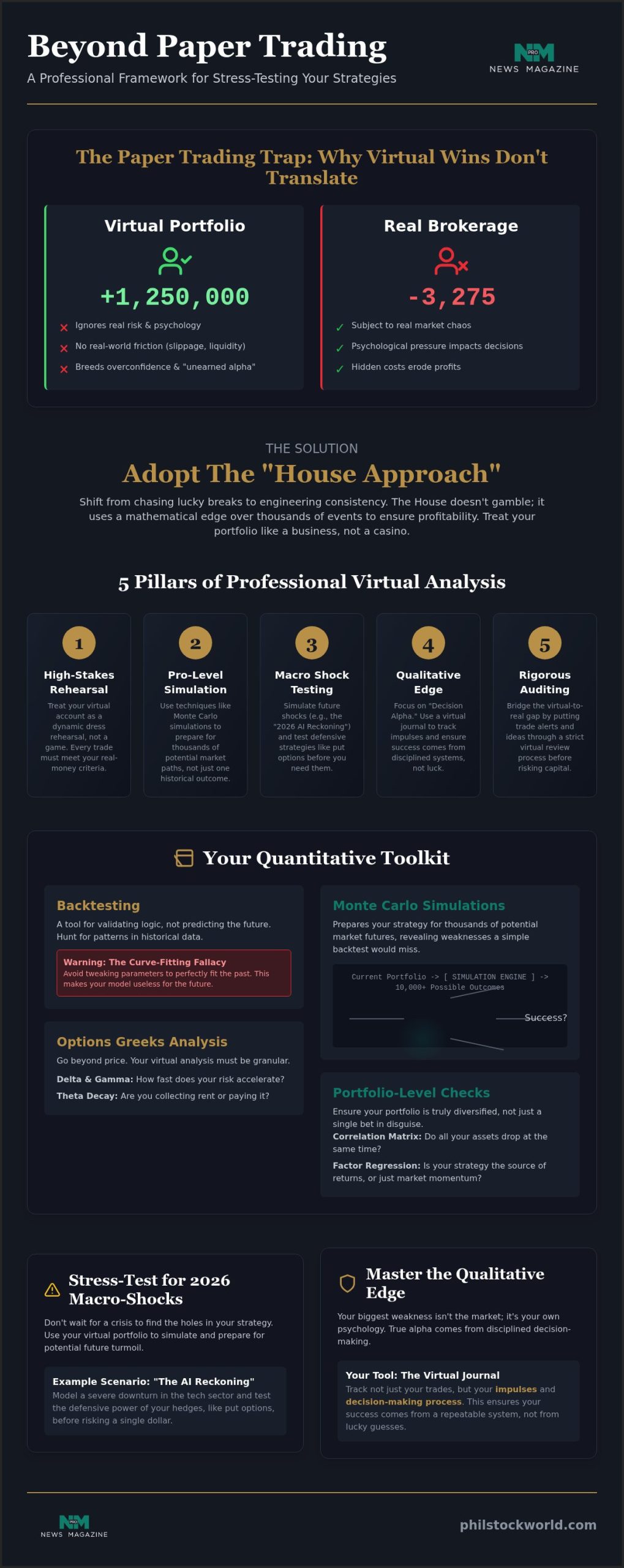
- Move beyond static paper trading by treating your virtual account as a dynamic, high-stakes dress rehearsal for the real market.
- Master professional virtual portfolio analysis techniques like Monte Carlo simulations to prepare for thousands of potential market paths instead of just one historical outcome.
- Protect your capital by simulating 2026 macro-shocks, such as the “AI reckoning,” and testing the defensive power of put options before you risk a single dollar.
- Focus on “Decision Alpha” by tracking your impulses in a virtual journal, ensuring your success comes from disciplined systems rather than lucky guesses.
- Bridge the gap between virtual wins and real-money trades by auditing professional alerts through a rigorous virtual review process.
The Philosophy of Virtual Portfolio Analysis: Why Paper Trading Isn’t Enough
Most retail traders treat paper trading like a video game. They rack up imaginary millions while ignoring the cold reality of the tape. If you want to survive the volatility of 2026, you need to treat your virtual environment as a high-stakes simulation rather than a consequence-free sandbox. Traditional frameworks like Modern Portfolio Theory provide a solid mathematical baseline for balancing risk and return, but they often fail to capture the chaotic, psychological nature of real-money execution. Effective virtual portfolio analysis techniques bridge this gap by forcing you to manage trades in real-time, accounting for the messy variables that static spreadsheets ignore.
Static backtesting tells you what would have happened in a perfect world. Dynamic virtual management tells you what you’ll actually do when the market turns against you. The “House” mindset is about shifting from chasing lucky breaks to engineering consistency. Casinos don’t care about a single big winner; they care about the math that ensures they win over thousands of hands. That’s the level of discipline we’re aiming for. It’s the difference between being a gambler and being the one who owns the table.
Defining the Scope of Modern Virtual Analysis
In 2026, simply tracking price movement is an amateur move. You need to dive into advanced option trading strategies that require a deep understanding of the Greeks. Your virtual analysis must be granular. It shouldn’t just show profit; it should show why that profit exists. Focus on these parameters:
- Delta and Gamma Sensitivity: How fast does your risk accelerate as the underlying asset moves?
- Theta Decay: Are you the one paying the rent, or are you the landlord collecting it?
- Realistic Friction: You must account for slippage and liquidity. In a virtual environment, it’s easy to assume you’ll get filled at the mid-price. In reality, the spread can eat your lunch.
The Paper Trading Trap and How to Avoid It
Quantitative Techniques: Backtesting and Monte Carlo Simulations
Quantitative data is the engine room of the House Approach. While we’ve established the philosophy of treating virtual trades with respect, we now need the math to back up our gut feelings. Professional virtual portfolio analysis techniques rely on more than just a quick glance at your P&L. You need to understand factor regression to see if your returns are actually coming from your strategy or if you’re just accidentally riding a specific market wave. For those looking to master these advanced quantitative methods, financialmodellinguniversity.com offers specialized courses for investment professionals. A correlation matrix is equally vital. It’s the only way to ensure your “diversified” portfolio isn’t just one giant bet on the tech sector dressed up in five different tickers. If everything in your portfolio drops at the same time, you aren’t diversified; you’re just exposed.
The Art and Science of Backtesting
Backtesting is a tool for validating logic, not predicting futures. It allows you to hunt for the footprints of the herd in historical data, but it comes with a massive warning label: the curve-fitting fallacy. This happens when you tweak your strategy parameters so precisely to fit past events that the model becomes useless for the future. You aren’t finding a pattern; you’re just painting a target around where the arrow already landed. By mastering how to read market charts, you can spot when a market regime has shifted, allowing you to discard historical data that no longer applies to the current 2026 environment. If the math starts to feel like a hall of mirrors, getting a Virtual Portfolio Review can help provide an objective look at your logic before you commit capital.
Monte Carlo: Finding Your Probability of Ruin
Monte Carlo simulations are your defense against the “what if” scenarios that keep traders awake at night. Instead of looking at one single historical path, you simulate 10,000 potential ways the market could move. Using sophisticated quantitative portfolio evaluation techniques helps you interpret the resulting bell curve of outcomes. This isn’t just academic theory. It’s about identifying your “probability of ruin.” If 3% of your simulations result in a total account wipeout during a period of high volatility, your position sizing is objectively too large. You don’t wait for a Black Swan event to happen in real life to realize you’re overleveraged. You find that out in the safety of a simulation and adjust your size until the worst-case scenario is a bruise, not a fatal blow.
Stress Testing for 2026: Hedging and Macro-Shocks
Most retail traders think stress testing is something only the big banks do during their annual Federal Reserve reviews. That’s a mistake. In 2026, the market doesn’t care about your status; it only cares about your preparation. By using advanced virtual portfolio analysis techniques, you can simulate the “AI Reckoning” or a sudden spike in interest rates before they hit your real capital. It’s about finding the breaking point of your strategy in a controlled environment. If a 10% sector drop wipes out 40% of your gains, you don’t have a strategy; you have a ticking time bomb.
Liquidity is the silent killer. When the exit door gets small, price action becomes irrelevant because you can’t get out at any price. Your virtual model should account for this by simulating wide spreads and low volume scenarios. It’s better to realize your position is too large for the current market environment while the money is still imaginary. This is where you move beyond simple price tracking and start engineering a portfolio that can take a punch without folding.
Scenario Analysis: Beyond the Headlines
Don’t just rely on headline news. Create custom “What If” scenarios that target your specific niche. If you’re heavy on tech, what happens if a major cloud provider goes dark for 48 hours? If you’re in energy, how do geopolitical shifts ripple through your holdings? This is where hedging with put options becomes your best friend. Virtual stress tests allow you to see exactly how many contracts you need to stay delta-neutral when the carnage starts. You can test different strike prices and expirations to find the sweet spot where protection is affordable but effective.
The Resilience Audit
A resilience audit measures more than just your peak-to-trough decline. It looks at recovery time. The 2026 Federal Reserve stress tests projected an aggregate decline of 1.6 percentage points in capital ratios for major banks. You should hold your own virtual portfolio to a similar standard. If your model takes eighteen months to break even after a 15% dip, you need to rethink your allocation. During these audits, look for “hidden” correlations. Assets that usually move independently often start falling in lockstep when panic sets in. By comparing different virtual portfolio analysis techniques, you can identify which hedging strategy yields the highest “Peace of Mind” ratio. It isn’t about being right; it’s about being the one who is still standing when the dust settles.
The Qualitative Edge: Behavioral Analysis and Journaling
Numbers tell you where you are. They rarely tell you how you got there. If your virtual account is up 20%, is it because your strategy is sound or because you got lucky during a bull run? Mastering virtual portfolio analysis techniques requires a shift from quantitative obsession to qualitative auditing. Your virtual journal is actually more important than your spreadsheet. While the spreadsheet tracks the “what,” the journal tracks the “you.” It’s where you record the psychological friction of a trade, the hesitation before an entry, and the impulse to close a winner too early. Without this data, you’re just a passenger in your own portfolio.
Analyzing the timing of your entries and exits against market sentiment is the only way to prove you aren’t just a “herd” follower. Did you buy because the chart told you to, or because a headline made you feel FOMO? By conducting a rigorous “Post-Mortem” for every virtual losing trade, you can identify if the failure was in the logic or the execution. This process turns a digital loss into a real-world lesson, ensuring that when you finally put real capital on the line, your hands won’t shake when the volatility spikes.
Auditing Your Decision-Making Process
Decision Alpha is the measurable value of sticking to your system. It’s the only metric that truly predicts long-term survival in the 2026 market. You need to distinguish between a good trade that lost and a bad trade that won. A bad trade that wins is a toxic event; it reinforces reckless behavior that will eventually blow up a real account. If you find yourself struggling to be objective about your own mistakes, using a virtual portfolio review can help you spot recurring psychological errors that you might be blind to. It’s about finding the gap between what you planned to do and what you actually clicked.
Sentiment Integration
2026 is a year of constant noise. Cross-referencing your virtual trades with daily market commentary helps you see if you’re falling for the herd mentality. Are you entering trades because the logic is there, or because every social feed is shouting about the same ticker? Virtual analysis lets you practice “Contrarian” entries without the financial sting of being wrong. It’s a low-risk way to train your brain to move against the crowd when sentiment reaches an extreme. By the time you move to real money, you’ll have the muscle memory to stay calm while others are panicking.
Don’t let hidden biases sabotage your real-money future. Take the next step in your trading journey by booking a Virtual Portfolio Review to audit your decision-making process today.
Implementing Your Review: The Phil Stock World Methodology
Knowledge without execution is just noise. You’ve explored the math, the stress tests, and the psychological hurdles. Now, you need to tie it all together into a disciplined trading approach that yields consistent results. At Phil Stock World, we believe the transition from virtual to real capital should be a graduated process, not a leap of faith. Even professional trade alerts should be “paper traded” first. This isn’t because we doubt the logic. It’s because you need to see how that logic interacts with your specific risk tolerance and execution speed before you bet the farm.
Trading is often portrayed as a lonely endeavor, but that’s a recipe for stagnation. Lonely analysis leads to echo chambers where your own biases go unchecked. By joining a community-driven trading room, you can validate your virtual models in real-time against the collective wisdom of peers and mentors. This collaborative environment acts as a secondary stress test. It forces you to defend your thesis before the market has a chance to dismantle it. When you use virtual portfolio analysis techniques within a community, you aren’t just looking at data; you’re participating in a live, tactical discussion that keeps you sharp and objective.
The Weekly Portfolio Audit
Consistency is built in the off-market hours. You need a 15-minute weekly checklist to review your virtual positions and ensure your system is still firing on all cylinders. Ask yourself if the original thesis for each trade still holds up. If a virtual strategy isn’t performing according to your backtested expectations, “kill” it. Don’t wait for it to turn around. Use this time to dive into Seeking Alpha alternatives that provide deeper, institutional-grade research rather than generic retail sentiment. This audit is your defensive line; it keeps the bad habits out of your real-money brokerage account.
Scaling with Confidence
The goal of mastering virtual portfolio analysis techniques is to eventually scale into real-world profits. We recommend the “10% Rule.” Once a virtual strategy has proven its resilience over a full market cycle, move just 10% of the intended capital into a live account. This allows you to feel the psychological weight of real money without the risk of a catastrophic loss. If your execution remains disciplined, scale up slowly. Maintaining the “House” mindset when real money is on the line is the final boss of trading. It requires a level of emotional detachment that only comes from knowing your numbers are sound. Ready to stop guessing? Get a professional Virtual Portfolio Review today and start engineering your edge with the confidence of an insider.
Engineered for Consistency: Your Next Move in the 2026 Market
You don’t have to navigate these volatile waters alone. It’s time to leverage daily expert market commentary, real-time live trading room access, and exclusive virtual portfolio reviews to validate your models and sharpen your edge. Master the Market with a Phil Stock World Membership and start trading with the calm confidence of the House. You’ve got the framework; now it’s time to turn that virtual edge into real-world success.
Frequently Asked Questions
What is the most effective virtual portfolio analysis technique for beginners?
Start with simple price-action tracking combined with a basic hedge. Beginners often get lost in a sea of quantitative data, so the focus should be on “Decision Alpha”—measuring whether you actually followed your pre-set plan. This helps build the habit of discipline before moving to complex Greeks. It’s the foundation of all professional virtual portfolio analysis techniques. By keeping it simple at first, you avoid the cognitive overwhelm that causes most novices to quit.
Can virtual portfolio analysis accurately predict real-market returns?
No technique can predict the future with 100% certainty, but virtual analysis provides a vital probabilistic roadmap. It tells you what’s likely to happen based on historical patterns and current macro stressors. The goal isn’t a crystal ball; it’s about understanding your “probability of ruin.” If your virtual model shows a high failure rate during a simulated 2026 AI reckoning, your real-world returns will likely suffer the same fate without adjustments.
How often should I conduct a virtual portfolio review?
You should perform a high-level audit weekly and a deep-dive review quarterly. Markets move fast in 2026, and a weekly check ensures your virtual positions still align with your core thesis. A more formal Virtual Portfolio Review helps you step back and see the bigger picture, identifying if you’re drifting away from the “House Approach.” Regularity prevents small psychological errors from compounding into catastrophic real-money mistakes later down the road.
What are the best tools for virtual portfolio stress testing in 2026?
Use tools that offer Monte Carlo simulations and robust options modeling. Platforms like Portfolio Visualizer remain popular for backtesting, while institutional-grade tools provide the granularity needed for 2026 macro-shocks. However, the best tool is often your own trading journal. Software handles the numbers, but your journal captures the “human element” that quantitative tools miss. Combining both ensures your stress test covers both the cold data and your own behavioral discipline.
Is backtesting enough to validate a new options strategy?
Backtesting is a great starting point, but it’s never enough to validate an options strategy on its own. Backtesting only tells you how a strategy performed in the past, often ignoring the “slippage” of real-world fills. You need forward-testing in a live virtual environment to see how your strategy handles current volatility and liquidity. This dynamic approach is a core part of effective virtual portfolio analysis techniques used by professional traders to protect their capital.
How do I account for slippage and commissions in a virtual portfolio?
Manually adjust your virtual fill prices to be slightly worse than the mid-price and deduct standard commission fees. Most paper trading platforms assume perfect fills at the best price, which is a total fantasy. If the spread is wide, assume you’re getting filled at the “ask” when buying. By injecting this artificial friction into your virtual model, you ensure your strategy remains profitable even when the market isn’t doing you any favors.
What is the difference between quantitative and qualitative portfolio analysis?
Quantitative analysis deals with the hard numbers, like Delta, Gamma, and Monte Carlo outcomes, while qualitative analysis focuses on the “why” behind your decisions. Quantitative tells you that you lost money; qualitative tells you that you lost money because you were chasing a headline. A balanced approach uses the math to find your edge and behavioral journaling to ensure you actually have the discipline to execute that edge when the pressure is on.
Why do many traders perform better in virtual portfolios than in real accounts?
Traders perform better in virtual accounts because the “pain of loss” is absent, allowing them to stick to their plans without emotional interference. When real money is on the line, fear and greed take over, leading to impulsive exits and revenge trading. This is why we emphasize the “Decision Alpha” metric. If you can’t match your virtual performance in a real account, your problem isn’t the strategy; it’s your psychological discipline.

